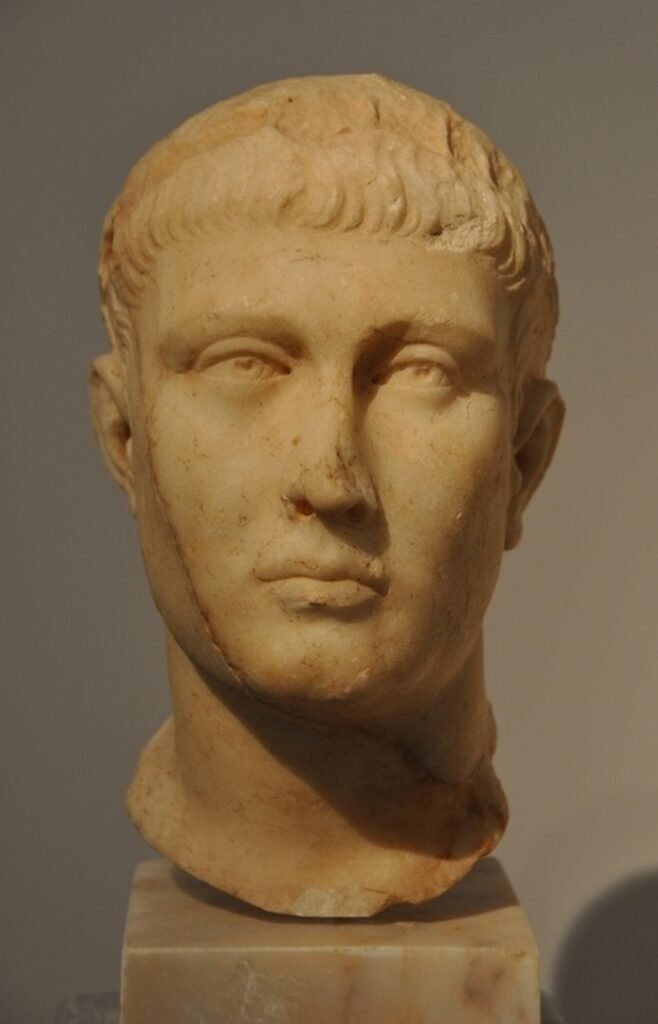
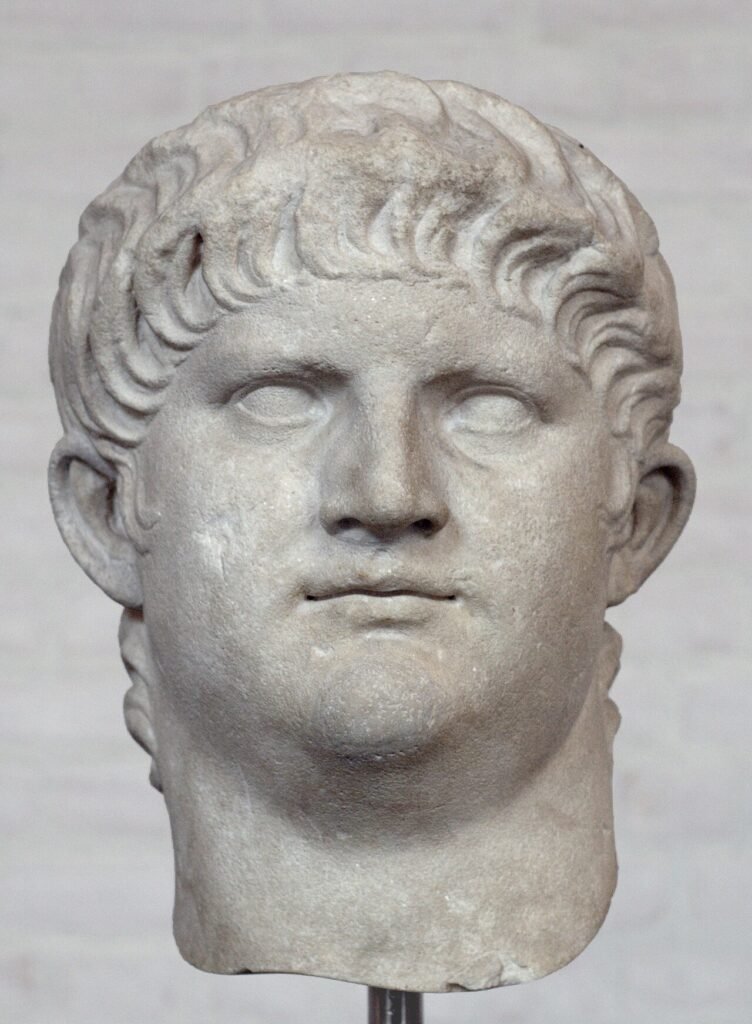
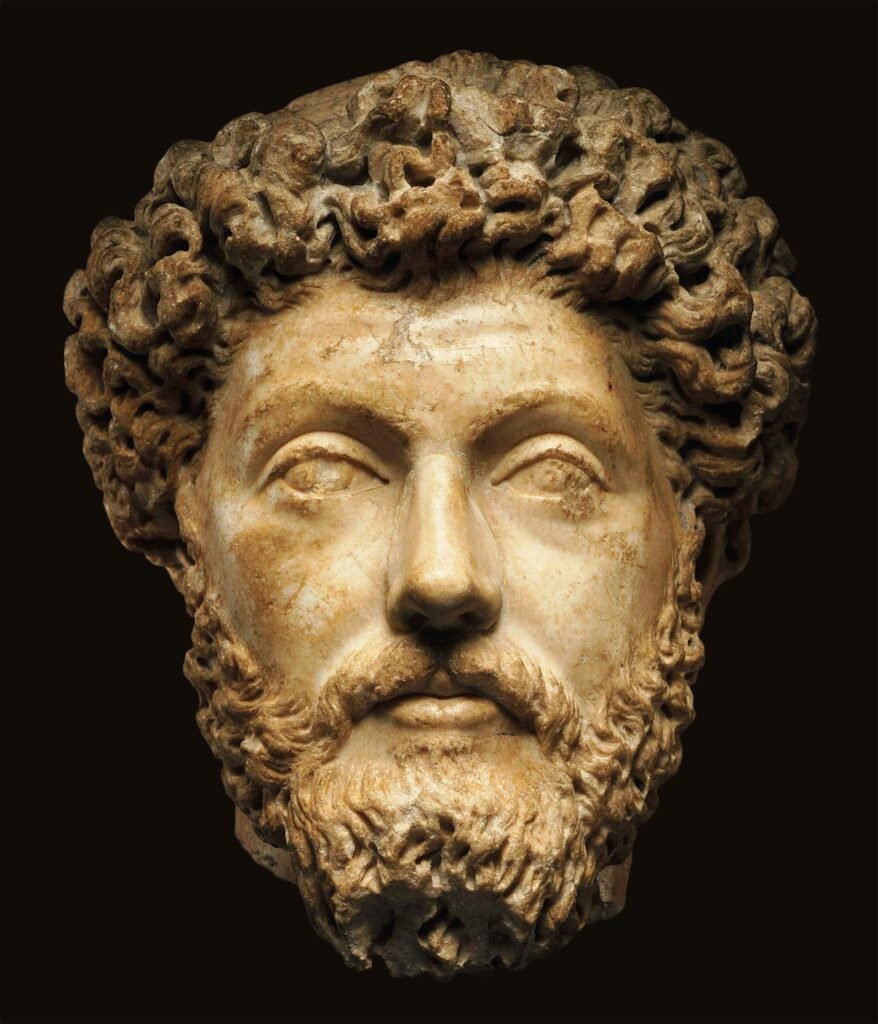
Hadrian (born January 24, 76 CE, in Italica, in the Roman province of Hispania Baetica, near modern-day Seville, Spain—died July 10, 138 CE, in Baiae, near modern-day Naples, Italy) was a Roman emperor who ruled from 117 to 138 CE. His full name was Publius Aelius Hadrianus. He is best known for strengthening the Roman Empire’s borders, traveling extensively throughout its provinces, promoting architecture and public construction, and ordering the building of Hadrian’s Wall in Britain. His reign marked a shift away from the territorial expansion pursued by his predecessor, Trajan, toward a stronger focus on securing and managing the empire’s existing territories.
Early Life and Family Background
Hadrian was born into a Roman family with roots in Italica, a settlement in Hispania established by Roman settlers. His family belonged to the provincial elite and had connections to Roman political and military life. His father, Publius Aelius Hadrianus Afer, was a senator who held important public positions. Hadrian was also related to Trajan, who later became emperor.
Hadrian lost his father when he was about ten years old. Following his father’s death, Trajan and the Roman official Publius Acilius Attianus became responsible for his upbringing. These connections gave Hadrian access to influential people and helped prepare him for a career in public service.
As a young man, Hadrian received an education that included Latin literature, Greek language, and other subjects expected of someone from a wealthy Roman family. He developed a strong interest in Greek culture, literature, philosophy, and art. His enthusiasm for Greek traditions later influenced his public activities and personal interests.
Hadrian traveled to Rome as a young man and began building connections within the political establishment. He also developed a reputation for his interest in Greek learning, which earned him the nickname Graeculus, meaning little Greek.
Early Political and Military Career
Hadrian began his public career during the reign of Emperor Domitian. He served as a military tribune, a position that involved assisting senior officers and gaining practical experience in the Roman army.
He later served in several military assignments along the Danube frontier. These experiences helped him understand the organization of the legions and the challenges involved in defending the empire’s borders.
When Nerva became emperor in 96 CE, Hadrian continued his military service. After Trajan succeeded Nerva in 98 CE, Hadrian’s career benefited from his family connection to the new emperor.
Hadrian served as a quaestor, a government official responsible for financial and administrative duties. He later held other important positions, including tribune of the plebs and praetor. These offices allowed him to gain experience in Roman law, politics, and administration.
He also served as a military commander during Trajan’s campaigns, including the Dacian Wars. His military service brought him closer to the emperor and strengthened his position within the imperial administration.
Hadrian accompanied Trajan during the eastern campaigns against the Parthian Empire. He received important responsibilities and eventually became governor of Syria, one of the empire’s most significant eastern provinces.
His growing military and political influence made him a leading candidate to succeed Trajan.
Adoption and Rise to the Throne
Trajan died in August 117 CE while returning from his eastern military campaigns. At the time of his death, he had not publicly established a successor.
Hadrian was proclaimed emperor by the Roman army in Syria shortly afterward. His adoption by Trajan was announced as the basis of his succession, although the exact circumstances surrounding the adoption have been debated by historians.
Trajan’s widow, Plotina, supported Hadrian’s claim. Publius Acilius Attianus, who had helped raise Hadrian, also played an important role in the events surrounding the transition of power.
The Roman Senate eventually recognized Hadrian as emperor. He was approximately 41 years old when he took the throne.
Hadrian faced immediate challenges because Trajan had recently expanded Roman territory through his eastern campaigns. Maintaining control over these new regions required large military resources and created difficulties for the imperial government.
Hadrian decided that the empire should not continue expanding at any cost. He withdrew Roman forces from some of Trajan’s eastern conquests and focused instead on establishing defensible borders.
This decision marked an important change in Roman military policy and shaped much of Hadrian’s reign.
Marriage and Personal Relationships
Hadrian was married to Vibia Sabina, a relative of Trajan through his family connections. Their marriage helped strengthen Hadrian’s political position before he became emperor.
Sabina became empress when Hadrian took the throne. However, surviving accounts suggest that their marriage was not particularly close. They had no children, and the relationship appears to have been largely formal.
Hadrian also maintained a close personal relationship with Antinous, a young Greek man from Bithynia in Asia Minor. Antinous accompanied the emperor during his travels and became an important figure in his private life.
In 130 CE, Antinous drowned in the Nile River while traveling with Hadrian in Egypt. The circumstances of his death remain uncertain. Hadrian was deeply affected by the loss and later arranged for Antinous to be honored as a god.
Hadrian also had a strong interest in intellectual and artistic circles. He enjoyed conversations with philosophers, writers, architects, and scholars. His personal interests frequently influenced the people and projects he supported during his reign.
Early Years as Emperor
After becoming emperor, Hadrian concentrated on stabilizing the empire and reorganizing its military position.
He recognized that maintaining the territories conquered by Trajan in the East would require a costly and difficult military commitment. Roman forces therefore withdrew from several areas, including much of Mesopotamia, while Armenia returned to a position of reduced independence under Roman influence.
These decisions were not universally popular. Some Roman senators and military leaders believed that abandoning conquered territories weakened the empire’s position.
Hadrian also faced political opposition in Rome. Several prominent senators were accused of plotting against him shortly after Trajan’s death and were executed. The circumstances surrounding these deaths damaged Hadrian’s relationship with parts of the Senate.
Despite these early difficulties, Hadrian gradually established his authority. He strengthened the administration, maintained military discipline, and encouraged a more practical approach to governing the empire.
He also worked to improve relations with provincial communities and ensure that local governments operated effectively.
Extensive Travels Throughout the Roman Empire
One of the most distinctive features of Hadrian’s reign was the amount of time he spent traveling outside Rome.
Unlike many earlier emperors, Hadrian personally visited numerous provinces to inspect military installations, meet local officials, review public projects, and understand regional conditions.
His journeys took him to the western provinces, including Gaul, Germany, Britain, and Spain. He also traveled through North Africa, Greece, Asia Minor, and the eastern territories.
These visits allowed him to examine the condition of the Roman army and the effectiveness of provincial administration. He inspected military camps, reviewed troops, and paid attention to the construction and maintenance of roads and fortifications.
Hadrian also showed particular interest in local cultures. He spent considerable time in Greece, where he supported religious institutions, educational activities, and architectural projects.
His travels were not simply ceremonial visits. They were part of his approach to governing an empire that covered a vast area and included people with different languages, customs, and traditions.
Hadrian’s Wall in Britain
One of Hadrian’s most famous building projects was the defensive wall constructed across northern Britain.
Hadrian visited Britain around 122 CE and inspected the Roman frontier. The Roman army controlled much of what is now England, but the northern regions remained difficult to secure.
Rather than attempting to conquer all of northern Britain, Hadrian ordered the construction of a fortified frontier system across the island.
Known as Hadrian’s Wall, the structure stretched approximately 73 miles from the River Tyne in the east to the Solway Firth in the west. It included stone and turf sections, forts, watchtowers, gates, and military roads.
Roman soldiers were stationed along the wall to monitor movement, control crossings, and respond to attacks. The system also helped regulate trade and travel between Roman territory and communities farther north.
Construction began around 122 CE and continued for several years. The wall was not simply a barrier designed to stop every possible invasion. It formed part of a wider military system intended to manage the northern frontier.
Hadrian’s Wall became one of the most recognizable Roman frontier structures and remains an important archaeological site in Britain.
Military Reforms and Border Security
Hadrian believed that the Roman Empire needed a strong and well-organized army to protect its existing territories.
He paid close attention to military training, equipment, discipline, and the condition of frontier defenses. During his provincial travels, he inspected troops and expected soldiers to maintain high standards.
He also supported the construction of defensive installations in other regions. Along the Rhine and Danube frontiers, Roman authorities strengthened existing military positions and developed systems of forts, roads, and barriers.
In North Africa, the Roman military maintained defensive lines and monitored movement across the frontier regions. Similar arrangements existed in the eastern provinces.
Hadrian’s approach emphasized controlling important routes and maintaining permanent military positions rather than pursuing continuous conquest.
He also encouraged the recruitment and organization of auxiliary troops. These soldiers, who were not originally Roman citizens, served alongside the legions and provided specialized military skills.
By strengthening the army’s organization and frontier defenses, Hadrian sought to reduce the risks associated with an empire that had become difficult to manage through expansion alone.
Architecture and Building Projects
Hadrian had a strong interest in architecture and engineering. He supported major construction projects throughout the empire and was personally involved in discussions about design and planning.
In Rome, he ordered the construction of the Pantheon in its present form. The building is famous for its large concrete dome and central circular opening, called an oculus, which allows natural light to enter.
Although the Pantheon carries an inscription honoring Marcus Agrippa, its present structure was built during Hadrian’s reign.
Hadrian also constructed a large imperial residence at Tivoli, outside Rome. Known as Hadrian’s Villa, the complex included palaces, gardens, pools, theaters, and other buildings inspired by architectural styles from different parts of the empire.
The villa reflected Hadrian’s interest in Greek and Egyptian art and architecture. It also provided a private setting where the emperor could work, relax, and receive visitors.
Another major project was the Temple of Venus and Roma, one of the largest temples in ancient Rome. Its design reflected Hadrian’s interest in monumental architecture and traditional Roman religion.
He also supported improvements to roads, bridges, aqueducts, and public buildings across the provinces. These projects helped strengthen local communities and improve communication throughout the empire.
Interest in Greek Culture and Philosophy
Hadrian had a deep appreciation for Greek civilization. He admired Greek literature, philosophy, art, and architecture and spent considerable time in Greek cities.
Athens held a particularly important place in his interests. He supported construction projects there, including the completion of the Temple of Olympian Zeus, a monumental building whose construction had begun centuries earlier.
He also contributed to the development of public spaces and cultural institutions in the city. His support helped strengthen Athens as an important center of Greek religious and intellectual life under Roman rule.
Hadrian became closely associated with the cultural movement sometimes called the Second Sophistic, in which Greek-speaking intellectuals and public speakers promoted classical Greek traditions.
His enthusiasm for Greek culture influenced his personal appearance, public activities, and relationships with educated people.
Hadrian’s interest in Greek traditions did not mean that he rejected Roman identity. Instead, he encouraged the cultural traditions of different parts of the empire while maintaining Roman political authority.
Administrative and Legal Reforms
Hadrian devoted significant attention to the organization of the imperial government.
He strengthened the role of professional administrators and improved the management of legal and financial affairs. His government increasingly relied on trained officials who could handle the complex responsibilities of running a large empire.
One important development involved Roman law. Hadrian commissioned the jurist Salvius Julianus to organize and standardize the praetorian edict, a collection of legal rules that Roman magistrates used when administering justice.
This work helped bring greater consistency to Roman legal practice.
Hadrian also sought to improve the administration of imperial finances and provincial government. He paid attention to public spending and expected officials to manage resources responsibly.
His government maintained the existing system of taxation while working to improve the efficiency of imperial administration.
Hadrian’s policies reflected his interest in making the Roman state more organized and predictable rather than relying primarily on military expansion.
The Bar Kokhba Revolt
One of the most serious challenges during Hadrian’s reign was the Jewish revolt in Judea, which began in 132 CE.
The uprising was led by Simon bar Kokhba, a Jewish leader who established an independent political and military movement against Roman rule.
The revolt developed in a period of growing tension between Jewish communities and the Roman authorities. Hadrian’s plans for Jerusalem, including the establishment of a Roman colony and the development of a religious site associated with Jupiter, contributed to the conflict. The precise relationship between these policies and the outbreak of the revolt remains debated.
Jewish forces initially achieved significant successes and established control over parts of Judea. The Roman government responded by sending additional troops to suppress the uprising.
Hadrian appointed Sextus Julius Severus, an experienced military commander, to lead the Roman campaign. Roman forces gradually regained control through a series of difficult military operations.
The conflict lasted several years and ended around 135 CE with the fall of the remaining rebel strongholds, including Bethar.
The revolt resulted in widespread destruction and severe losses among the Jewish population. Jerusalem was reorganized as a Roman colony called Aelia Capitolina, and restrictions were placed on Jewish access to the city.
The suppression of the revolt was one of the most difficult episodes of Hadrian’s rule.
Later Years and Declining Health
During the final years of his reign, Hadrian spent more time in Italy as his health declined.
He continued overseeing government affairs and remained involved in decisions about the empire’s future. However, his physical condition increasingly limited his activities.
Hadrian had no biological children, so choosing a successor became an important political concern.
In 136 CE, he adopted Lucius Ceionius Commodus, who became known as Lucius Aelius Caesar. Hadrian intended him to succeed to the throne, but Aelius died in January 138 CE before becoming emperor.
Hadrian then adopted Antoninus Pius, a respected senator and administrator. The adoption included the condition that Antoninus would, in turn, adopt the young Marcus Aurelius and Lucius Verus.
This arrangement established a succession plan that would eventually bring both Marcus Aurelius and Lucius Verus to power.
Hadrian’s relationship with the Senate had become strained during the later part of his reign. Some senators disapproved of his political decisions and the executions carried out during his rule.
Antoninus Pius helped secure the Senate’s acceptance of Hadrian’s succession arrangements and later ensured that Hadrian received the traditional honors granted to a Roman emperor.
Death
Hadrian died on July 10, 138 CE, at Baiae, a coastal resort near modern Naples, Italy. He was 62 years old.
His final years had been marked by illness and growing political difficulties. After his death, Antoninus Pius succeeded him as emperor.
Hadrian was initially buried at Puteoli, but his remains were later transferred to Rome. His monumental mausoleum, now known as Castel Sant’Angelo, became his final resting place.
His wife, Vibia Sabina, had died before him, in 136 CE. With his death, a reign that had lasted more than 20 years came to an end.