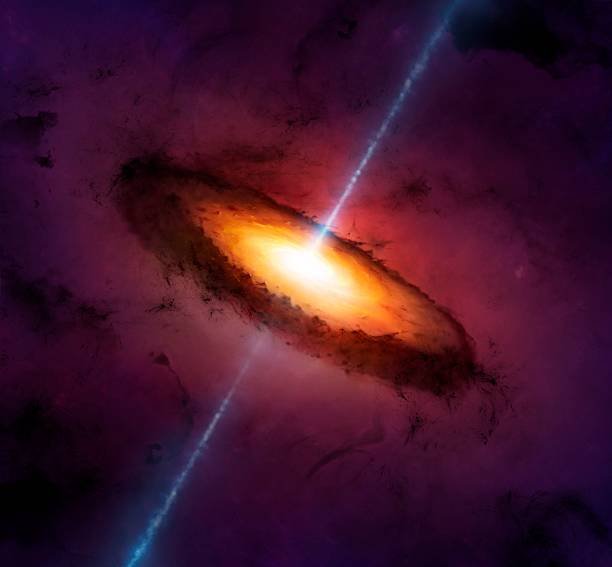
Among the countless wonders of the cosmos, black holes reign as both monarchs and mysteries. They are regions of space where gravity becomes so intense that nothing—no particle, no light, no signal—can escape their grasp. They are the silent sentinels of destruction, swallowing stars whole and warping the fabric of spacetime itself. For centuries, scientists imagined that black holes were eternal, that once matter crossed the event horizon—the point of no return—it was lost forever.
But in 1974, a young theoretical physicist named Stephen Hawking turned this idea inside out. He proposed that black holes are not completely black. Instead, they glow faintly with a ghostly light—a radiation so subtle that it could take billions of years to notice. This emission, now known as Hawking radiation, revealed something astonishing: black holes can evaporate, shrink, and eventually die.
This revelation was not just another discovery—it was a revolution. Hawking’s insight bridged the worlds of quantum mechanics and general relativity, two pillars of modern physics that had long stood apart. And in doing so, he showed that even the darkest objects in the universe are governed by the same delicate balance of energy and information that shapes everything else.
The story of Hawking radiation is more than a tale of physics—it is a meditation on mortality, on how even the most powerful things in existence are not eternal. It is the story of how the universe, in its infinite elegance, ensures that nothing lasts forever.
The Nature of a Black Hole
To understand Hawking’s discovery, we must first understand what a black hole truly is. The idea dates back to the eighteenth century, when scientists like John Michell and Pierre-Simon Laplace speculated about “dark stars”—objects so massive that light could not escape their gravitational pull. But it wasn’t until Albert Einstein’s general theory of relativity, published in 1915, that the mathematics describing such phenomena became possible.
Einstein’s equations showed that gravity is not a force in the classical sense—it is the curvature of spacetime caused by mass and energy. When a massive star runs out of fuel, it can no longer resist the inward pull of gravity. The core collapses, and if the mass is large enough—usually more than about three times that of our Sun—no known force can halt the collapse. The star implodes into a singularity, a point of infinite density, where the known laws of physics break down.
Surrounding the singularity lies the event horizon, a boundary marking the limits of escape. Anything that crosses it is forever cut off from the rest of the universe. Time and space themselves trade roles here—inside the horizon, moving forward in time means moving inward toward the singularity. The black hole becomes a one-way passage to oblivion.
To an external observer, the black hole appears as a sphere of darkness surrounded by a distorted glow. It does not emit light; it swallows it. The only clues to its presence are the motions of stars and gas swirling nearby, the gravitational waves it sends through spacetime, and the shadows it casts upon the luminous backdrop of the cosmos.
For decades, physicists believed that this darkness was absolute—that black holes were eternal prisons from which nothing, not even information, could return. But quantum mechanics, the theory governing the microscopic world, refused to stay silent.
The Quantum Whisper
In the strange landscape of quantum physics, emptiness is never truly empty. Even the vacuum of space is alive with invisible energy—a restless sea of quantum fluctuations. According to Heisenberg’s uncertainty principle, energy and time cannot both be precisely defined. This means that for incredibly short intervals, tiny amounts of energy can appear out of nothing, creating pairs of particles and antiparticles that flicker into existence and annihilate one another almost instantly.
This quantum foam of creation and destruction happens everywhere, all the time. Space itself hums with virtual particles, constantly being born and dying in pairs, their lifespans shorter than a heartbeat of a photon. Normally, these pairs cancel each other out, leaving no trace. But near the edge of a black hole, something extraordinary happens.
The intense gravity near the event horizon can separate the pair before they annihilate. One particle may fall into the black hole, while the other escapes into space. To a distant observer, it appears as if the black hole is emitting radiation. The escaping particle becomes real, stealing a tiny bit of the black hole’s energy in the process.
This is Hawking radiation—a quantum glow emitted by darkness itself.
The black hole loses a small amount of mass each time this occurs. Over vast stretches of time, it slowly evaporates, shrinking and fading until it eventually vanishes in a final burst of energy.
The Genius of Hawking’s Insight
Stephen Hawking’s path to this discovery was not simple. In the early 1970s, physicists were struggling to reconcile general relativity with quantum mechanics. The equations that described the universe on the grandest scales refused to mesh with those that governed the subatomic world. Black holes, where gravity and quantum effects both dominate, seemed the perfect testing ground.
Hawking built upon the work of Jacob Bekenstein, who had proposed that black holes possess entropy—a measure of disorder or information. Entropy, in thermodynamics, is related to temperature and the flow of energy. Bekenstein’s idea implied that black holes should have a temperature as well. But how could something that absorbs everything have a temperature? Hawking initially disagreed, believing that black holes were truly dark.
Then, through a remarkable series of calculations, he found that Bekenstein was right. Quantum effects at the event horizon did cause black holes to emit thermal radiation. The temperature was inversely proportional to the black hole’s mass: smaller black holes would radiate more strongly, while massive ones would glow faintly.
The formula Hawking derived linked gravity, quantum theory, and thermodynamics into one elegant expression. It connected the surface area of a black hole to its entropy and its energy to its temperature. This synthesis hinted at a deep unity underlying all of physics—a glimpse into the long-sought “theory of everything.”
In one stroke, Hawking had shown that black holes were not immortal voids, but dynamic, evolving entities. They could radiate, lose energy, and die.
The Slow Death of a Cosmic Giant
The evaporation of a black hole is a slow, patient process. For a black hole as massive as the Sun, the radiation is almost undetectable. Its temperature would be around a mere 60 nanokelvins—far colder than the cosmic microwave background that fills space. Instead of losing mass, such a black hole would actually absorb more energy from its surroundings than it emits.
But as the universe grows older and cooler, the balance shifts. When the background radiation becomes weaker than the black hole’s own emission, the evaporation begins in earnest. The black hole slowly loses mass, and as it shrinks, its temperature rises. The smaller it becomes, the faster it evaporates, in a runaway process that ends in a final cataclysmic flash of energy.
A black hole of a few billion tons—the mass of a mountain—would evaporate within the current age of the universe, releasing a tremendous burst of gamma rays in its final moments. Primordial black holes, thought to have formed shortly after the Big Bang, might already be undergoing such deaths, their last sighs detectable as high-energy flashes scattered across the sky.
The larger black holes—the ones at the centers of galaxies—will take incomprehensibly longer to vanish. A supermassive black hole weighing millions or billions of solar masses would require around 10⁶⁷ to 10¹⁰⁰ years to evaporate completely. To put that in perspective, the universe is only about 1.38 × 10¹⁰ years old. The death of such black holes lies in a future so remote that even the stars will have burned out, and galaxies will have dissolved into darkness.
In that distant epoch, when the cosmos is silent and cold, black holes will be the last luminous objects, evaporating one by one, their final radiation marking the end of all structure in the universe.
The Mystery of Information
Hawking’s discovery solved one mystery but birthed another—the infamous information paradox.
In quantum mechanics, information about a physical system is never truly lost. Even when a particle changes state or interacts with others, the total information is preserved. But black holes seemed to violate this rule. When matter falls into a black hole, all details about it—its structure, its history, even its quantum state—disappear behind the event horizon. If the black hole then evaporates, where does that information go?
If Hawking radiation is purely thermal, it carries no information about the matter that formed the black hole. That would mean information is destroyed, contradicting one of the most fundamental principles of physics. This paradox struck at the heart of both quantum mechanics and general relativity, suggesting that one—or both—needed revision.
For decades, physicists have debated possible solutions. Some proposed that information is encoded in subtle correlations within the radiation itself, though too faint to detect. Others suggested that the event horizon might be an illusion, or that information is stored in a “holographic” way on its surface—a concept later developed into the holographic principle by Gerard ’t Hooft and Leonard Susskind.
More recent work in string theory and quantum gravity hints that the paradox may indeed resolve through holography: the idea that the three-dimensional interior of a black hole is actually described by information on its two-dimensional surface. In this view, Hawking radiation does not erase information but slowly releases it back into the universe.
Though the debate continues, one thing is certain—Hawking’s insight forced physicists to confront some of the deepest questions about the nature of reality, time, and information itself.
The Thermodynamics of Space and Time
Perhaps one of the most profound legacies of Hawking radiation lies in its unification of physics’ great themes. It revealed that black holes behave like thermodynamic systems. They have entropy, temperature, and energy. They can exchange heat with their surroundings and evolve toward equilibrium.
The entropy of a black hole, as Bekenstein and Hawking discovered, is proportional not to its volume but to the area of its event horizon. This simple but startling fact suggests that the information contained within any region of space may be encoded on its boundary—a concept that reshaped modern theoretical physics and led to the birth of holographic theories of spacetime.
In this way, black holes became laboratories for exploring the connections between gravity, quantum theory, and thermodynamics. They may hold the key to a unified framework that describes all physical phenomena—a dream that Einstein chased and that physicists continue to pursue today.
Hawking’s equations did more than describe the end of black holes. They whispered that the universe itself might be governed by deep, holographic principles, where space, time, and reality are emergent properties arising from quantum information.
The Final Fireworks
What happens when a black hole reaches the end of its life?
As it radiates away its mass, the process accelerates dramatically. The black hole grows hotter, brighter, and more violent in its final moments. In the last fraction of a second, it releases an enormous burst of energy—equivalent to the explosion of millions of hydrogen bombs.
The final flash of evaporation might produce a shower of high-energy particles, including gamma rays, neutrinos, and cosmic rays. Detecting such events could provide direct evidence for Hawking radiation. Astronomers have searched for these signatures, especially from small, primordial black holes that might still exist, but so far, none have been conclusively observed.
Yet, the absence of evidence does not disprove Hawking’s theory—it only reminds us of how faint and rare such events would be. The cosmos is vast, and the slow death of a black hole unfolds across timescales that make human history seem like a blink.
Still, the thought that black holes can die—that even the darkest hearts of galaxies have finite lives—changes how we see the universe. Eternity, it seems, belongs to nothing.
The Loneliest Epoch
To grasp the true consequence of Hawking radiation, we must journey into the unimaginable future. After trillions upon trillions of years, all stars will have burned their fuel. White dwarfs and neutron stars will cool into black embers. The galaxies themselves will dissolve as gravity weakens with expansion.
Only black holes will remain, scattered across the dark void. Slowly, imperceptibly, they will begin to evaporate. First the smallest, then the larger ones, until only the supermassive giants remain—vast, silent, waiting.
As they fade, their dying light will be the last source of energy in the universe. When the final black hole evaporates, no structure will remain. Space will be filled only with weak radiation, thin and cold, stretching endlessly.
This era is called the Black Hole Era, a time when the universe itself begins to forget. Hawking radiation will be its last whisper, its final heartbeat before silence.
Yet, in that fading glow lies a kind of beauty—a cosmic symmetry. The universe that began in a brilliant explosion ends in a soft exhalation of light. The circle of creation closes, not with fire, but with a sigh.
The Human Mirror
Hawking’s discovery is not only a triumph of intellect but also a meditation on existence. It reminds us that even the mightiest structures in the universe are impermanent. Entropy touches everything, from stars to galaxies to black holes themselves.
There is something profoundly human in that realization. We too are bound by time, our lives brief flashes against the cosmic backdrop. Yet within that brevity lies understanding, creation, and awareness—the same forces that drive the universe to know itself through us.
Hawking radiation teaches that nothing truly lasts forever—but also that nothing is truly lost. Energy transforms, matter evolves, and information, perhaps, is never destroyed. The cycle of being and becoming continues, endlessly reshaping itself.
Hawking himself, confined to a wheelchair and battling disease, found a kind of kinship with the black holes he studied—silent, unyielding, yet filled with hidden light. Through his equations, he gave the universe a voice, proving that even in the deepest darkness, there is still a whisper of creation.
The Legacy of a Brilliant Mind
Stephen Hawking’s work changed physics forever. It bridged the gap between quantum theory and general relativity, inspired new fields of research, and redefined our understanding of space and time. His insights continue to guide the search for a unified theory—a single framework that explains gravity, matter, and information.
Beyond equations, his legacy is one of perseverance and wonder. He showed that the greatest frontiers of science are not just found in telescopes or particle accelerators, but in the human mind’s ability to imagine what lies beyond the horizon.
Hawking radiation stands as a testament to curiosity itself. It reminds us that no mystery is too vast, no paradox too daunting, for the mind that dares to seek.
The Universe Remembered
When the last black hole fades, and the final echo of Hawking radiation dissolves into the cold emptiness, what will remain? Perhaps nothing in the physical sense. But the universe will have told its story—from the fiery birth of stars to the quiet death of black holes.
In that story, Hawking’s discovery marks one of the most profound chapters—a recognition that even destruction gives way to transformation. The cosmos is not eternal stasis but eternal change, a vast cycle of creation, decay, and rebirth written in the language of physics.
And so, even as the universe cools toward silence, its legacy endures—in the equations we write, in the light we study, in the understanding we carry.
For as long as there are minds to wonder and hearts to question, the faint radiation from the edge of a black hole will continue to echo in our imagination.
The light that emerges from darkness will forever remind us of a simple, astonishing truth—that even the universe’s darkest secrets can glow.