Every time a human being looks up at the night sky, a question as old as consciousness itself awakens: How vast is the universe? Among the countless stars scattered across the dark fabric of space, how many galaxies are truly out there? Are there billions—or trillions—of island universes, each holding its own stars, planets, and perhaps even life?
This question isn’t merely scientific—it’s existential. It speaks to our yearning to understand our place in the grand tapestry of creation. For millennia, we’ve tried to grasp the size and scale of everything, yet the more we learn, the smaller we seem to become—and the more magnificent the universe grows in our eyes.
To ask how many galaxies exist is to ask how far our curiosity can stretch. It is to look at the night sky not as a ceiling, but as a window into infinity. And it’s a story that begins not with modern telescopes, but with the awakening of the human imagination.
The First Glimpses of the Infinite
Long before the first telescope was built, ancient astronomers believed that all the stars in the heavens were part of a single cosmic sphere that rotated around Earth. To them, the Milky Way—a faint, milky band stretching across the sky—was a mystery, often described as a river of light or the trail of gods.
It wasn’t until the early 17th century that Galileo Galilei turned his telescope toward that glowing band and made a breathtaking discovery: the Milky Way was not a cloud of mist, but a dense collection of countless stars. For the first time in human history, we began to understand that our sky was made of suns.
Still, for centuries, astronomers thought our galaxy was the entire universe. The stars, the nebulae, and every glowing patch in the sky were thought to belong to a single galactic system. But then came the great shift—the moment when humanity realized the universe was far grander than we had ever imagined.
The Discovery of Other Galaxies
In the early 20th century, telescopes grew more powerful, and with them came clearer views of mysterious “spiral nebulae.” Some astronomers believed these spirals were clouds of gas inside our Milky Way. Others, like the brilliant yet controversial astronomer Heber Curtis, proposed something radical: these spirals might be entire galaxies—island universes beyond our own.
In 1924, Edwin Hubble, using the newly built 100-inch Hooker Telescope at Mount Wilson Observatory, measured the distance to one of these spirals—Andromeda. His results shattered the cosmic boundaries of the time. Andromeda, he found, lay far beyond the edge of the Milky Way, millions of light-years away. It was not a nebula—it was another galaxy.
That single revelation transformed our understanding forever. The universe was not one grand galaxy—it was a vast ocean of galaxies, each containing billions of stars. Humanity’s sense of scale expanded by unimaginable magnitudes.
The Milky Way: Our Home Among Billions
Before exploring how many galaxies exist, we must first appreciate our own. The Milky Way, our galactic home, is a barred spiral galaxy about 100,000 light-years across. It contains roughly 200 to 400 billion stars and an even greater number of planets, dust clouds, and mysterious dark matter that binds it all together.
Our solar system sits about two-thirds of the way from the galactic center, orbiting around it once every 225 million years. When you look up at the night sky, every star you see with the naked eye belongs to the Milky Way. But beyond that faint horizon, invisible to our eyes, lie countless other galaxies—each a world unto itself.
From our vantage point, we are merely one small whirlpool in a cosmic sea that stretches into eternity.
Counting the Uncountable
When astronomers first began cataloguing galaxies in the 20th century, estimates were modest. Using ground-based telescopes, scientists believed there were perhaps a few thousand galaxies in the observable universe. But with the advent of space telescopes—unhindered by Earth’s atmosphere—everything changed.
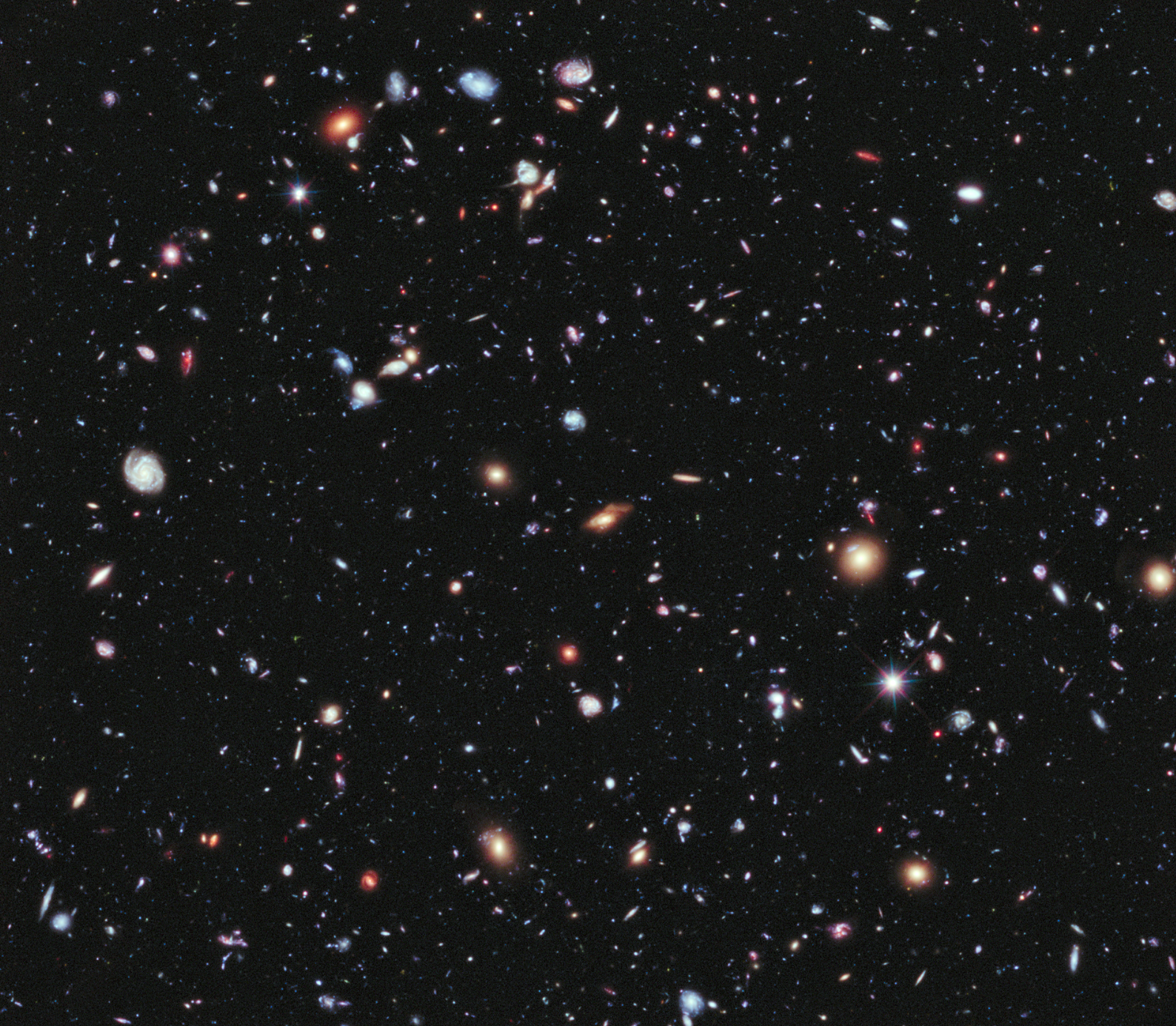
In 1995, the Hubble Space Telescope was pointed at a tiny, seemingly empty patch of sky no larger than a grain of sand held at arm’s length. What it revealed stunned the world. That tiny patch, known as the Hubble Deep Field, contained over 3,000 galaxies—each a unique collection of billions of stars—within an area that looked black and empty to the naked eye.
Subsequent deep-field images—like the Hubble Ultra Deep Field and the eXtreme Deep Field—went even deeper, showing over 10,000 galaxies in a single image. By extrapolating this density across the entire sky, astronomers estimated that the observable universe contains at least 100 to 200 billion galaxies.
But that was only the beginning of the revelation.
The New Frontier: A Trillion Galaxies?
In 2016, using data from the Hubble telescope combined with mathematical models and computer simulations, scientists made a revolutionary update. They realized that many galaxies in the early universe were too faint, too small, or too distant to be seen by our current telescopes.
After accounting for these unseen galaxies, researchers estimated that the total number of galaxies in the observable universe might be around two trillion—a number so vast that it defies comprehension.
Two trillion galaxies. Each with hundreds of billions of stars. Each star potentially hosting worlds. If even a fraction of those stars have planets, and a fraction of those planets harbor life, the possibilities become staggering.
And yet, that number refers only to the observable universe—the part we can see, limited by the speed of light and the age of the cosmos. The universe itself may be infinitely larger.
The Observable Universe: Our Visible Horizon
Light travels at a finite speed—about 300,000 kilometers per second. That means when we look into space, we are looking back in time. The most distant light we can see today comes from galaxies whose light has traveled for about 13.8 billion years, nearly the age of the universe itself.
However, because the universe has been expanding all this time, those galaxies are now far farther away—about 46 billion light-years from us in every direction. This gives the observable universe a diameter of roughly 93 billion light-years.
Beyond that horizon lies the unobservable universe, regions so distant that their light has not yet had time to reach us. What lies there remains unknown. If space is infinite—and current models suggest it might be—then there could be infinitely many galaxies beyond our reach.
The observable universe is not the boundary of reality; it is merely the boundary of our perception.
The Cosmic Web: Structure in the Vastness
When we imagine two trillion galaxies, it’s easy to think of them scattered randomly through space. But the universe has structure—grand, intricate, and awe-inspiring.
Galaxies are not isolated; they are bound together by gravity into groups and clusters, which themselves form even larger superclusters. These massive cosmic structures are interconnected by filaments of dark matter and gas, creating a vast, web-like pattern called the cosmic web.
Between these filaments lie enormous voids—regions so empty they contain almost no galaxies at all. If we could step back and see the universe as a whole, it would look like a glowing, three-dimensional spiderweb of light stretching into darkness.
Our Milky Way belongs to a small group called the Local Group, which includes Andromeda, the Triangulum Galaxy, and about fifty smaller galaxies. This Local Group is part of the Laniakea Supercluster, a vast region spanning 520 million light-years, containing over 100,000 galaxies. And beyond Laniakea lie countless more superclusters, connected like threads in a cosmic masterpiece.
The Hidden Universe: Dark Matter and the Invisible
Even with our most powerful telescopes, what we see is only a tiny fraction of what exists. Observations of galaxy rotations, gravitational lensing, and cosmic background radiation all point to a stunning truth: most of the universe is invisible.
Only about 5% of the universe is made of ordinary matter—the kind that forms stars, planets, and people. The rest is composed of dark matter (about 27%) and dark energy (about 68%).
Dark matter is a mysterious, unseen substance that doesn’t emit or absorb light, yet exerts a powerful gravitational pull, shaping the formation of galaxies and clusters. Without it, galaxies could not have formed as they did—the universe’s structure would be entirely different.
Dark energy, even more enigmatic, is the force driving the accelerated expansion of the universe. It is as though space itself is stretching faster and faster with time.
If we could somehow see dark matter and dark energy, the universe might appear far richer and more complex than we ever imagined. There may be entire structures made not of stars, but of invisible forces that silently sculpt the cosmos.
Galaxies Through Time: The Evolving Universe
Galaxies are not static islands; they are living entities in cosmic time. They are born, evolve, collide, and sometimes die.
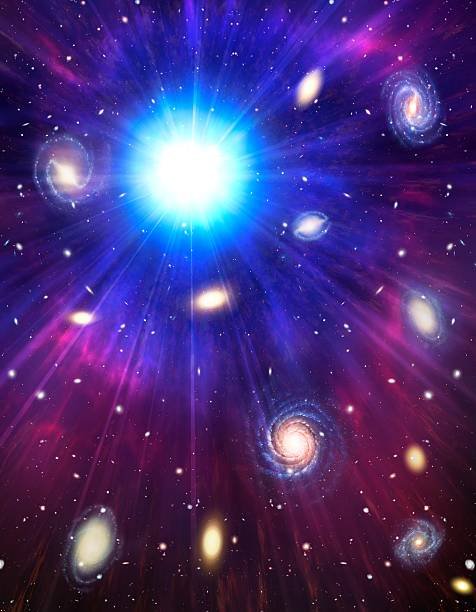
In the early universe, just a few hundred million years after the Big Bang, the first galaxies began to form from collapsing clouds of gas and dark matter. These early galaxies were small, irregular, and chaotic—mere building blocks compared to the majestic spirals and ellipticals we see today.
Over billions of years, galaxies merged and grew, creating the grand spirals, massive ellipticals, and intricate shapes that populate the modern cosmos. Our own Milky Way has likely swallowed dozens of smaller galaxies in its history—and in about 4 billion years, it will collide with the Andromeda Galaxy, merging into a single giant elliptical galaxy astronomers have nicknamed Milkomeda.
This cosmic evolution continues. Galaxies recycle material, give birth to new stars, and shape the universe’s appearance like an artist eternally refining their masterpiece.
The James Webb Revolution
In 2022, a new eye opened to the universe—the James Webb Space Telescope (JWST). Its mission is not just to look farther, but to look deeper in time, to the era when the first galaxies were born.
Already, JWST has shattered expectations. It has spotted galaxies that appear to have formed surprisingly early—just a few hundred million years after the Big Bang. Some are brighter and larger than models predicted, forcing astronomers to rethink how quickly structure emerged in the young cosmos.
These discoveries suggest that the universe might be teeming with more galaxies than even the most optimistic Hubble estimates. Some galaxies may be hidden behind dust, others may shine in wavelengths invisible to Hubble but visible to Webb’s infrared eyes.
As JWST continues its mission, it may reveal that the number of galaxies in the universe is not static—it’s a moving target, shaped by time, evolution, and our ever-improving instruments of exploration.
Beyond Numbers: The Philosophy of Scale
When we speak of trillions of galaxies, it’s easy to get lost in the mathematics and forget the meaning. Numbers this vast transcend imagination. What does it feel like to live in a universe so immense that our entire Milky Way is but one grain of sand among endless shores?
It is humbling—and yet profoundly beautiful. Physics and cosmology do not diminish our significance; they magnify the wonder of our existence. Against such immensity, the fact that consciousness arose—that matter became aware of itself—is nothing short of miraculous.
Every time we discover a new galaxy, we are expanding not just the boundaries of knowledge, but of meaning. We are reaffirming that curiosity itself is a cosmic force—that in seeking to understand, we participate in the grand unfolding of the universe.
Perhaps the universe needs observers like us to know itself. Perhaps that is why it gave rise to minds that can look up at the stars and ask how many?
The Infinite Beyond the Observable
If the observable universe holds two trillion galaxies, how many lie beyond? The answer may well be infinite.
If space extends forever, galaxies would continue endlessly, scattered across boundless distances. Every direction would hold an infinite expanse of light and matter. The laws of physics suggest that beyond our visible horizon, the cosmos continues much the same—filled with galaxies, stars, and worlds uncounted.
There may be regions so far away that their light will never reach us, not even given infinite time. These galaxies exist forever outside our cosmic horizon—real, but forever unseen. The universe, it seems, hides an eternal mystery: the majority of itself.
The Multiverse Hypothesis
As if trillions of galaxies were not enough, some theories suggest there could be many universes—each with its own galaxies, stars, and laws of physics. This concept, known as the multiverse, arises naturally from certain interpretations of quantum mechanics and cosmological inflation.
If true, our observable universe may be only one bubble in an infinite cosmic foam—one universe among countless others. Each bubble might contain its own galaxies and stars, or even entirely different forms of matter and energy.
It is a bold idea, unproven but deeply intriguing. And it stretches the meaning of “how many galaxies” beyond comprehension. If the multiverse exists, the true number of galaxies is not merely vast—it is limitless.
The Fragility of Perspective
Amid the grandeur of cosmic numbers, there is something deeply human to remember. Every galaxy, every star, every planet reminds us of the fragility of our own existence. We live on a small world orbiting an ordinary star in an unremarkable corner of one galaxy among trillions.
And yet, here we are—thinking, dreaming, questioning. Within our tiny window of perception, we hold the ability to understand the infinite. Our curiosity bridges the distance between atoms and galaxies, between the known and the unknowable.
Carl Sagan once wrote, “Somewhere, something incredible is waiting to be known.” Each new telescope, each new discovery, brings us closer to that something. And every time we peer deeper into space, we are also looking deeper into ourselves.
The Eternal Sky
So, how many galaxies exist in the universe? The answer, in the truest sense, is not a number—it is a feeling. It is the feeling of awe that comes when we realize the universe is far larger, richer, and more mysterious than we can ever measure.
Estimates will change as our instruments improve. Two trillion today may become ten trillion tomorrow. Beyond the observable universe, infinity may await. But the essence remains the same: we live in a cosmos overflowing with galaxies, each a cosmic poem written in starlight.
When you stand beneath the night sky and gaze upward, remember this: every faint shimmer, every point of light, is part of a vast symphony. The light you see has traveled for billions of years to reach your eyes. It carries stories from the birth of the universe, whispered across time and space.
In those distant galaxies—some alive with new stars, others long dead—the universe tells us its story. And we, for a brief moment in cosmic history, have the privilege of listening.
The Universe That Knows Itself
Ultimately, the question of how many galaxies exist is not just about counting—it’s about connection. It’s about realizing that we are part of something far greater than ourselves.
Every atom in your body was forged in the heart of a star. Every breath you take is filled with the dust of galaxies that existed long before Earth was born. You are not separate from the universe—you are the universe, made conscious, gazing back upon itself with wonder.
So when you look up at the night sky, know this: you are part of that cosmic story. You are made of the same light that shines in distant galaxies. And as long as you keep asking questions—as long as you keep searching—the universe will keep answering, one galaxy at a time.