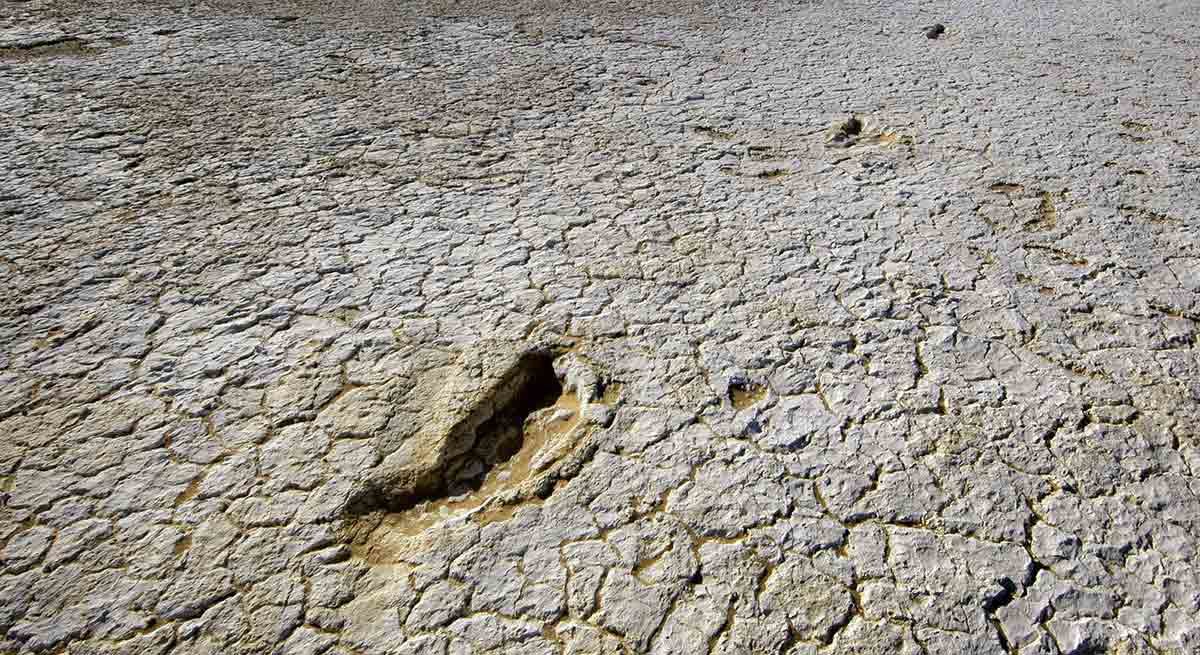
Long before cities rose, before languages formed, before even the idea of humanity existed, the Earth was already alive with struggle, creativity, and transformation. Prehistoric life did not merely occupy the planet for a brief prologue to human history. It shaped the land beneath our feet, the air we breathe, the oceans that regulate climate, and the very biology that makes our existence possible. The modern world is not a fresh creation built on a blank slate. It is the latest chapter in a story written over billions of years by organisms that lived, adapted, competed, and vanished long before we arrived.
Prehistoric life was not primitive in the sense of being simple or insignificant. It was inventive, resilient, and profoundly influential. Every forest, every animal, every ecosystem today carries echoes of ancient worlds. To understand how prehistoric life shaped the world we live in is to recognize that the present is inseparable from the deep past, and that humanity is not the author of Earth’s story, but a recent character shaped by everything that came before.
The Birth of Life and the First Global Transformation
Life on Earth began more than three and a half billion years ago, in a world that would be unrecognizable to us. The early planet was harsh, dominated by volcanic activity, meteor impacts, and a toxic atmosphere lacking oxygen. Yet within this chaos, simple single-celled organisms emerged, likely in ancient oceans or hydrothermal vents. These early life forms were small, invisible to the naked eye, but their impact on the planet would eventually be colossal.
The earliest organisms did not breathe oxygen. Instead, they relied on chemical reactions that drew energy from minerals and sunlight. Among them were cyanobacteria, microscopic architects of planetary change. Through photosynthesis, they released oxygen as a byproduct, slowly altering Earth’s atmosphere. This process, known as the Great Oxygenation Event, transformed the planet forever. Oxygen accumulated in the air and oceans, triggering mass extinctions of organisms that could not tolerate it, while opening the door for more complex life.
The oxygen-rich atmosphere created by prehistoric microbes made possible everything from animal respiration to protective ozone layers that shielded life from harmful radiation. The air filling your lungs today is a direct legacy of these ancient organisms. Without them, complex life, including humans, would never have existed.
Oceans as the Cradle of Complexity
For much of Earth’s history, life remained confined to the oceans. Yet these ancient seas were not static environments. They were dynamic laboratories where evolution experimented with form and function. Over hundreds of millions of years, simple cells gave rise to complex multicellular organisms. Bodies developed tissues, organs, and eventually nervous systems. Life learned how to move, hunt, defend, and cooperate.
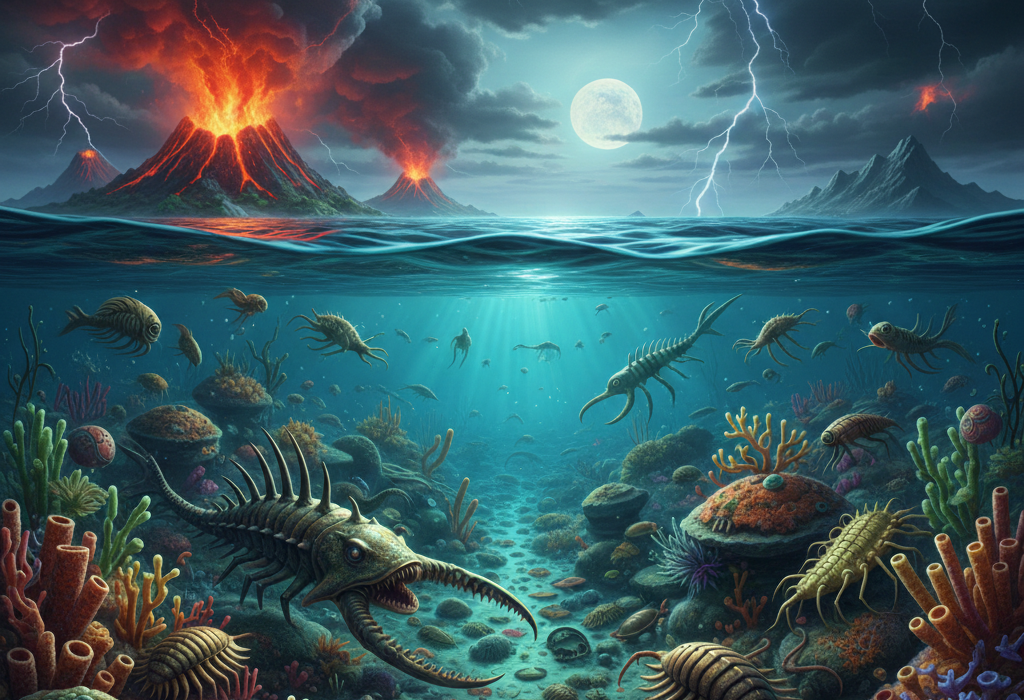
The Cambrian explosion, which occurred around 540 million years ago, marked a dramatic turning point. In a relatively short geological period, an astonishing diversity of animal life appeared. Creatures evolved hard shells, jointed limbs, eyes, and specialized feeding structures. These innovations reshaped ecosystems and established many of the basic body plans that still define animals today.
Predation became a powerful evolutionary force. The ability to see, move quickly, and protect oneself became matters of survival. This ancient arms race drove complexity and innovation, setting patterns that continue in modern ecosystems. The behaviors of today’s animals, from camouflage to group living, trace their roots to these early marine environments.
Life Conquers the Land
One of the most profound transformations in Earth’s history occurred when life moved from water onto land. This transition was not a single event, but a long, difficult process involving plants, fungi, and animals adapting to an entirely new set of challenges. Gravity, desiccation, temperature extremes, and lack of buoyant support demanded radical solutions.
Early land plants evolved structures to prevent water loss and tissues to transport nutrients internally. As plants spread across continents, they began to alter the planet in dramatic ways. Roots stabilized soil, reducing erosion. Vegetation influenced weather patterns and helped regulate atmospheric carbon dioxide. Vast prehistoric forests, especially during the Carboniferous period, captured enormous amounts of carbon, much of which became buried and transformed into coal deposits.
These ancient forests played a key role in shaping Earth’s climate. By drawing carbon dioxide out of the atmosphere, they contributed to global cooling and helped establish climate systems that persist today. The fossil fuels that power modern civilization are, in essence, stored sunlight from prehistoric plants, compressed over millions of years.
Animals followed plants onto land, evolving limbs, lungs, and new sensory systems. Amphibians bridged the gap between aquatic and terrestrial life, while reptiles developed eggs that could survive on land, freeing them from the need to return to water to reproduce. These innovations opened vast new ecological opportunities and set the stage for the rise of dominant land animals.
The Age of Giants and the Architecture of Ecosystems
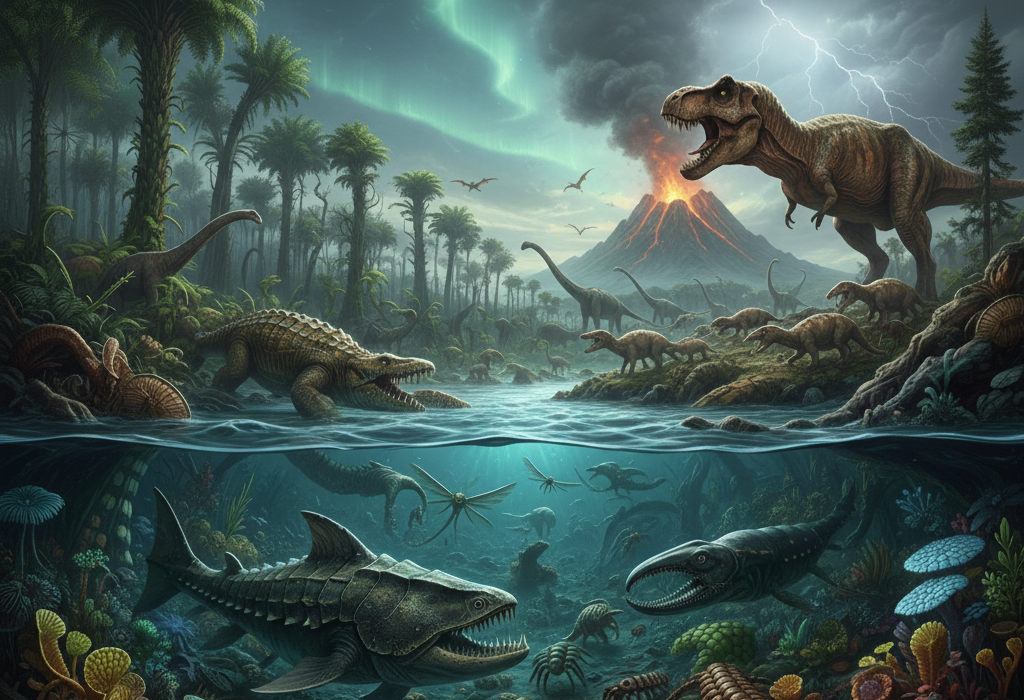
The Mesozoic Era, often called the Age of Dinosaurs, is one of the most iconic chapters of prehistoric life. For over 160 million years, dinosaurs dominated terrestrial ecosystems, evolving into an astonishing variety of forms. Some were massive herbivores shaping landscapes through their feeding, while others were agile predators influencing prey behavior and population dynamics.
Dinosaurs were not merely large animals; they were ecosystem engineers. Herds of plant-eating dinosaurs likely influenced vegetation patterns, dispersing seeds and altering plant communities. Predators maintained balance by controlling herbivore populations. These interactions created complex food webs similar in structure to modern ecosystems.
At the same time, smaller prehistoric creatures were laying the foundations for the future. Early mammals evolved during the dinosaur era, developing traits such as warm-bloodedness, fur, and complex teeth. Though they lived in the shadows of larger reptiles, these adaptations would later allow mammals to thrive in a changing world.
Birds also emerged from small, feathered dinosaurs, carrying prehistoric legacy into the skies. Feathers, originally evolved for insulation or display, became tools for flight. Every bird alive today is a living dinosaur, a reminder that extinction does not always mean disappearance, but sometimes transformation.
Mass Extinctions as Creative Forces
Prehistoric life was repeatedly reshaped by mass extinctions, catastrophic events that wiped out large portions of Earth’s species. While these events were devastating, they also played a crucial role in shaping the world we live in. By clearing ecological space, extinctions allowed surviving organisms to diversify and evolve in new directions.
The most famous mass extinction, which occurred around 66 million years ago, ended the reign of non-avian dinosaurs. Triggered by an asteroid impact and associated environmental upheaval, it caused dramatic changes in climate and ecosystems. Yet this disaster opened opportunities for mammals, which rapidly diversified and expanded into niches previously dominated by reptiles.
Without this extinction, mammals might never have become dominant, and humans might never have evolved. In this sense, prehistoric catastrophes were not just endings, but beginnings. They redirected the course of life, shaping the evolutionary pathways that led to modern ecosystems.
The Rise of Mammals and the Shaping of Modern Fauna
After the age of dinosaurs, mammals underwent a remarkable evolutionary expansion. Freed from competition with giant reptiles, they evolved into forms adapted to nearly every environment on Earth. From whales returning to the oceans to bats mastering flight, mammals demonstrated extraordinary adaptability.
Prehistoric mammals shaped ecosystems through their behaviors and interactions. Large herbivores influenced vegetation patterns through grazing and migration. Predators drove prey evolution, sharpening senses and social behaviors. These dynamics created the ecological frameworks still seen today.
Primates emerged in prehistoric forests, developing grasping hands, forward-facing eyes, and complex social structures. These traits, shaped by life in trees, would later become central to human evolution. The prehistoric past did not merely prepare the environment for humanity; it shaped our bodies, minds, and instincts.
Prehistoric Life and the Making of the Landscape
The physical landscapes we inhabit are deeply influenced by prehistoric life. Coral reefs, formed by tiny marine organisms over millions of years, protect coastlines and support vast biodiversity. Limestone cliffs and caves are built from the accumulated shells of ancient sea creatures. Even soil itself is a product of prehistoric life breaking down rock and organic matter over immense timescales.
Plants transformed continents by creating soils capable of supporting complex ecosystems. Their interaction with fungi formed underground networks that still sustain forests today. The composition of Earth’s atmosphere, the chemistry of its oceans, and the fertility of its land are all outcomes of ancient biological processes.
Rivers, shaped by vegetation stabilizing their banks, follow paths influenced by prehistoric plant life. Deserts, forests, and grasslands reflect evolutionary histories millions of years in the making. When we look at a landscape, we are seeing the visible imprint of life’s long interaction with geology and climate.
Climate, Life, and a Delicate Balance
Prehistoric life and climate have always been intertwined. Changes in life altered climate, and changes in climate drove evolution. This feedback loop shaped the planet’s long-term stability and variability. The emergence of photosynthesis cooled the planet. The spread of forests altered rainfall patterns. Marine organisms influenced ocean chemistry and heat distribution.
Ice ages, driven by complex interactions between Earth’s orbit, atmosphere, and biosphere, shaped the evolution of animals and plants. Species adapted, migrated, or went extinct in response to shifting climates. These ancient climate changes provide crucial context for understanding modern climate challenges. They show both the resilience and vulnerability of life in the face of environmental change.
Human Evolution as a Prehistoric Story
Humans are not separate from prehistoric life; we are its continuation. Our species is the result of millions of years of evolutionary experimentation. Traits such as bipedalism, large brains, and social cooperation emerged in response to ancient environments and challenges.
Early human ancestors evolved in landscapes shaped by prehistoric climate shifts and ecosystems. Savannas, forests, and changing food resources influenced our development. Even our emotional responses, fears, and social instincts reflect survival strategies honed in prehistoric worlds.
The tools we use, the curiosity that drives science, and the stories we tell are extensions of ancient adaptive behaviors. When we study prehistoric life, we are studying ourselves, not as isolated beings, but as products of a vast evolutionary tapestry.
The Emotional Legacy of Deep Time
Understanding how prehistoric life shaped the world we live in evokes powerful emotions. There is awe in realizing that our planet has been alive for billions of years, enduring catastrophes and transformations beyond human imagination. There is humility in recognizing how small our moment is within this immense timeline.
There is also a sense of connection. The calcium in our bones once belonged to ancient seas. The oxygen we breathe was produced by organisms long extinct. The fuels powering our cities come from prehistoric forests. We are not separate from the past; we are made of it.
This perspective can change how we view the present. It reminds us that the world is not static, that change is constant, and that life’s resilience is matched by its fragility. It challenges us to consider our role not as conquerors of nature, but as participants in an ongoing story.
Lessons from Prehistoric Life for the Modern World
Prehistoric life teaches us that survival depends on adaptability, balance, and respect for environmental limits. Ecosystems thrive when diversity is maintained and collapse when critical thresholds are crossed. Mass extinctions show how quickly dominant systems can unravel.
Today, humanity is influencing the planet at a scale comparable to ancient global events. By studying prehistoric life, scientists gain insight into how ecosystems respond to rapid change. These lessons are not abstract; they are essential for guiding decisions about conservation, climate action, and sustainable living.
The prehistoric past does not offer simple solutions, but it provides context. It shows what is possible, what is fragile, and what is at stake.
A World Still Shaped by the Ancient Past
The world we live in is not merely influenced by prehistoric life; it is constructed by it. Every breath, every bite of food, every landscape and climate pattern carries the imprint of ancient organisms. The past is not gone. It is present in the air, the soil, the oceans, and within our own bodies.
To understand how prehistoric life shaped the world we live in is to see Earth as a living system with a deep memory. It is to recognize that our future is inseparable from this history. We inherit not only the benefits of billions of years of evolution, but also the responsibility to ensure that the story continues.
Prehistoric life shaped the world through persistence, adaptation, and transformation. The question now is how humanity will shape the next chapter, and whether we will do so with the wisdom that comes from understanding just how long and extraordinary the journey has been.