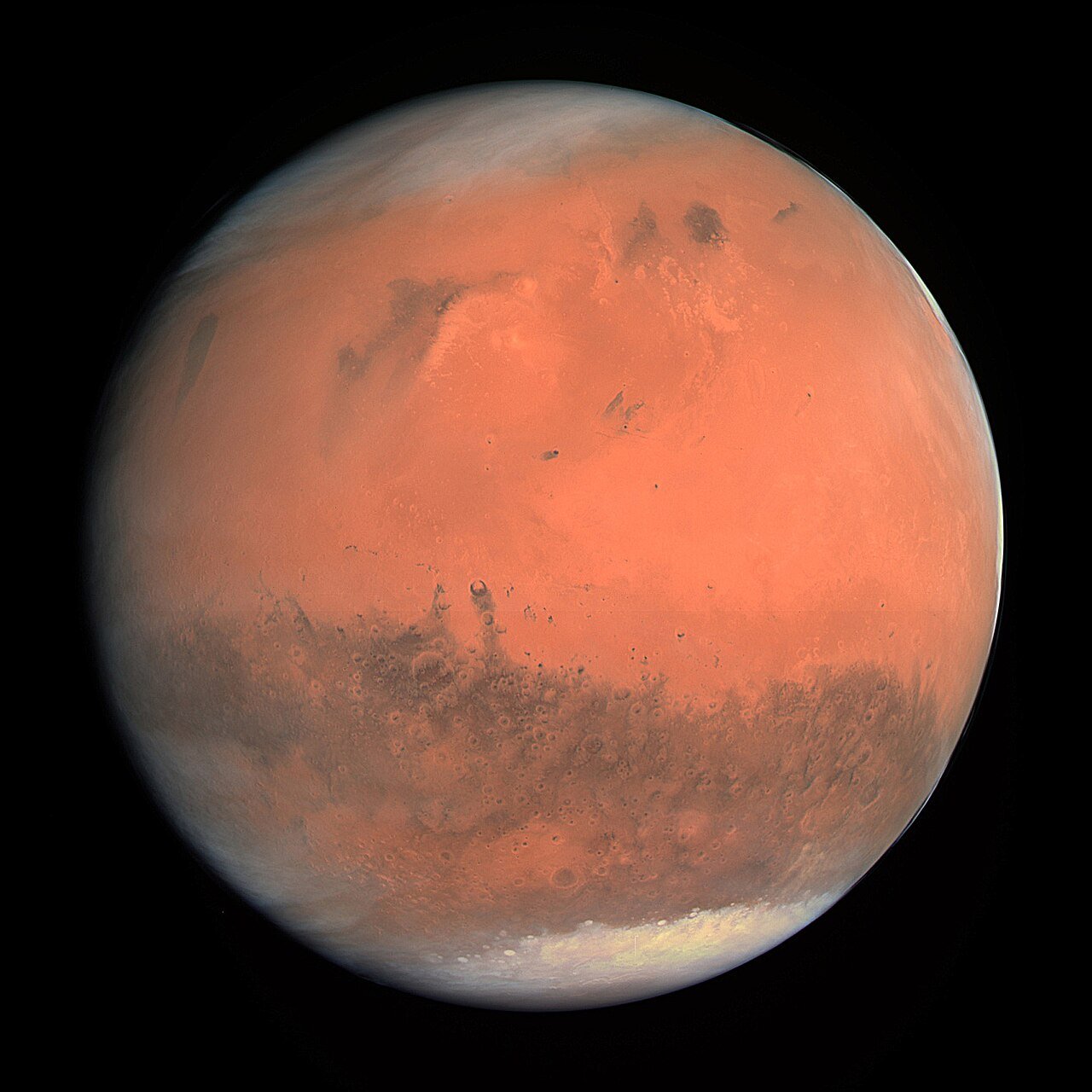
Mars has always haunted the human imagination. It glows like a ruby in the night sky, its blood-red hue inspiring myths, stories, and dreams for millennia. To the ancients, Mars was the god of war—fiery, unpredictable, and powerful. To scientists and dreamers of the modern age, it became something far more profound: a possible second cradle of life.
From the first telescopic glimpses centuries ago to the sophisticated robotic explorers now roaming its dusty plains, Mars has remained a mirror for humanity’s eternal question: Are we alone?
This question, though simple, is one of the most profound ever asked. If life exists—or once existed—on Mars, it would mean that life is not a miraculous accident confined to Earth but a natural phenomenon of the cosmos. It would suggest that the universe is teeming with living worlds, each following its own story of creation and survival.
Mars is the closest and most likely place to find that answer. It is our neighbor in space, our near twin in size and structure, and a planet that once shared many of Earth’s life-giving qualities. To study Mars is to look into an ancient reflection of our own planet—and perhaps our own beginnings.
The Allure of a Living Mars
The dream of life on Mars began long before space exploration. In the late 19th century, Italian astronomer Giovanni Schiaparelli claimed to have seen “canali”—channels—on Mars’s surface. The word was mistranslated into English as “canals,” suggesting artificial construction. Soon, popular imagination filled the planet with visions of civilizations, deserts crisscrossed by waterways, and intelligent beings struggling to survive on a dying world.
Writers like H. G. Wells, with The War of the Worlds, and Edgar Rice Burroughs, with his tales of John Carter of Mars, brought these ideas to life, blending science with fantasy. Mars became the stage on which humanity projected both its hopes and fears—the possibility of cosmic companionship, or of invasion from beyond.
But as telescopes improved, the illusions faded. The “canals” were optical tricks, and no cities or forests appeared. When spacecraft finally arrived in the 1960s, they found a barren, frozen desert. Yet, even in that lifeless landscape, the search for life did not end—it evolved. Scientists began to ask a new question: if Mars is dead today, was it ever alive?
A Planet Once Like Earth
Billions of years ago, Mars may have looked far different from the dry, dusty world we see today. Evidence from orbiters and rovers suggests that ancient Mars was warm and wet, with lakes, rivers, and perhaps even an ocean.
The Mars of the past likely had a thicker atmosphere, capable of holding heat and allowing liquid water to flow across its surface. Vast networks of dried river valleys and deltas show unmistakable signs of erosion by water. Minerals that form only in the presence of water—such as clays and sulfates—have been detected across the planet.
NASA’s rovers Curiosity and Perseverance have found layered rocks, sediments, and even ancient lakebeds that reveal a history of long-standing water systems. In Gale Crater, Curiosity discovered evidence of a freshwater lake that may have existed for millions of years—ample time for microbial life to arise.
If life ever emerged on Mars, it would have done so during this ancient epoch, when conditions were mild enough to nurture chemistry similar to early Earth’s. And even as the planet cooled and dried, microbial life—if it ever appeared—might have found refuge underground, where liquid water could still persist.
The Vanishing Atmosphere
The transformation of Mars from a warm, watery world into a frozen desert is one of the greatest mysteries in planetary science. Today, the Martian atmosphere is incredibly thin—less than 1% of Earth’s surface pressure—and composed mostly of carbon dioxide. It provides little protection from solar radiation and cannot sustain liquid water on the surface.
What happened to the Martian air?
The most widely accepted explanation is that Mars lost its magnetic field early in its history. Unlike Earth, whose molten iron core generates a powerful magnetic shield, Mars’s core cooled and solidified, leaving the planet vulnerable to the solar wind—a stream of charged particles from the Sun. Over millions of years, this relentless wind stripped away the atmosphere, atom by atom.
As the atmosphere thinned, Mars lost its ability to retain heat. The surface temperature plunged, and the once-flowing rivers and seas froze or evaporated into space. The planet’s climate collapsed, and any surface life would have faced extinction.
Yet deep beneath the surface, the story may not have ended. Even now, Mars might shelter microbial life in hidden pockets of warmth and water, beyond the reach of the cold, deadly surface.
The First Explorers
The quest to uncover Mars’s secrets began in earnest with the space age. In 1965, NASA’s Mariner 4 flew past the planet and sent back the first close-up images. The world it revealed was shocking—a cratered, desolate landscape, utterly unlike the living Mars of science fiction.
Many scientists and the public felt deflated. The dream of canals and civilizations evaporated overnight. But others saw something more profound: a challenge. If Mars was lifeless on the surface, perhaps its secrets lay hidden beneath.
In the 1970s, NASA’s Viking 1 and Viking 2 landers became the first missions to touch down on the Martian surface and search directly for life. Each carried a suite of experiments designed to detect metabolic activity in the soil. One of these experiments, the Labeled Release test, gave tantalizing results—a possible sign of microbial respiration. However, other instruments failed to confirm it.
The findings divided scientists. Some argued that the signals were chemical, not biological, reactions caused by the harsh Martian environment. Others believed Viking may have stumbled upon life—but the evidence was too ambiguous to prove it.
Decades later, those Viking experiments remain one of the most fascinating enigmas in astrobiology—a mystery that continues to spark debate and reanalysis.
The Meteorite That Whispered “Life”
In 1996, Mars returned to the headlines when scientists announced a stunning discovery: a meteorite found in Antarctica, known as ALH84001, appeared to contain microscopic structures resembling fossilized bacteria. The meteorite had originated from Mars, blasted into space by an ancient impact and eventually falling to Earth millions of years later.
Under the microscope, scientists found tiny worm-like formations, magnetite crystals, and organic molecules that seemed to suggest biological origin. President Bill Clinton even addressed the nation, calling it a potential breakthrough that “speaks of the possibility of life beyond Earth.”
But as with the Viking results, skepticism soon followed. Other researchers pointed out that the features in the meteorite could be formed through non-biological chemical processes. The excitement faded, but the idea that Mars might once have harbored life gained renewed credibility.
Even if the meteorite didn’t contain fossils, it proved something equally important: material can travel between Mars and Earth naturally, carried by impacts. If life ever existed on one planet, it could theoretically spread to the other—a process known as panspermia.
The idea that Earth and Mars might share a biological lineage transformed the question of Martian life from fantasy to plausible science.
Signs in the Soil
In recent years, robotic missions have provided new and compelling evidence that Mars was once habitable. The Curiosity rover discovered organic molecules—complex carbon-based compounds—in Martian rocks billions of years old. These molecules are the building blocks of life, though not proof of life itself.
Even more intriguing was the detection of fluctuating levels of methane in the Martian atmosphere. On Earth, most methane is produced by biological processes, though it can also form through geological activity. Mars’s methane appears to rise and fall seasonally, hinting at some ongoing process beneath the surface.
NASA’s Perseverance rover, currently exploring Jezero Crater, is searching for signs of ancient microbial life in an environment that once held a large lake. It carries instruments capable of analyzing rock composition in exquisite detail, and it’s collecting samples that future missions will return to Earth—the first ever from another planet.
If even a trace of fossilized microbial life is found in those rocks, it will be one of the most important discoveries in human history—a confirmation that life is not unique to Earth.
Life Beneath the Red Dust
Surface conditions on Mars today are brutal. The planet is bombarded by ultraviolet radiation, bathed in oxidizing chemicals, and exposed to deep cold. But life, if it exists, may not need sunlight or warmth—it may thrive underground.
Beneath Mars’s surface lies a world of relative stability. The soil provides protection from radiation, and there may still be liquid water in subsurface aquifers or salty brines. Some radar data from the European Space Agency’s Mars Express orbiter even suggest there could be reservoirs of liquid water beneath the planet’s south polar ice cap, though this remains debated.
If microbial life endures on Mars, it would likely resemble extremophiles on Earth—organisms that live in boiling hot springs, acidic lakes, or beneath Antarctic ice. On our planet, microbes survive in environments once thought utterly sterile, proving that life is far more adaptable than once imagined.
Mars, then, could be hiding its life not on the surface, but below it—waiting to be discovered by the next generation of explorers.
The Power of Perseverance
The most advanced robotic mission ever sent to Mars, NASA’s Perseverance rover, embodies decades of scientific progress and human ambition. Launched in 2020, it landed in Jezero Crater—a site chosen because it once hosted an ancient river delta, where sediments could have trapped and preserved biosignatures.
Equipped with cameras, lasers, and a helicopter companion named Ingenuity, Perseverance is doing more than any mission before it to search for signs of past life. It drills into rocks, studies their chemical makeup, and stores samples in sealed tubes that will one day be brought back to Earth.
Each sample may contain tiny fossils or chemical fingerprints of organisms that lived billions of years ago. To hold such a fragment would be to touch the story of life beyond Earth—a relic from another biological world.
Perseverance also carries instruments to test technologies for future human exploration, including a device that extracts oxygen from the Martian atmosphere. This not only helps prepare for crewed missions but symbolizes humanity’s determination to turn imagination into reality—to reach across the gulf of space in search of connection.
Mars Through Human Eyes
Humanity’s dream of setting foot on Mars is older than the space age itself. Visionaries like Wernher von Braun imagined massive ships ferrying explorers to the Red Planet, while science fiction continued to fill minds with vivid possibilities.
Today, that dream is closer than ever. NASA’s Artemis program, SpaceX’s Starship ambitions, and international collaborations all envision human missions to Mars within the coming decades.
When humans finally walk on Mars, they will not just be explorers—they will be the first emissaries of life from Earth to another world. Every footprint they leave will mark a new chapter in the story of life in the universe. But before we can go, we must understand what already exists there.
If living microbes still cling to the Martian soil, our arrival could change their world forever. For that reason, scientists approach Mars exploration with caution, following strict planetary protection protocols to prevent contamination in both directions.
The search for life is not just a quest of discovery—it is a test of responsibility.
Mars and the Mystery of Methane
One of the most intriguing clues to potential life on Mars is methane. In 2003, the European Space Agency’s Mars Express detected faint traces of methane in the atmosphere. Later, NASA’s Curiosity rover confirmed that methane levels vary with the seasons, peaking during warmer months.
On Earth, about 90% of atmospheric methane is produced by living organisms, primarily microbes. Could the same be true for Mars? Or does the methane come from purely geological sources, such as reactions between water and certain minerals underground?
The mystery deepens because methane breaks down quickly under sunlight. If it is present in the Martian atmosphere, something must be replenishing it. Whether that source is biological or chemical remains one of the most compelling questions in planetary science.
Future missions equipped with more precise instruments may finally reveal the answer. A single molecule’s origin could determine whether Mars is a dead planet—or one that still breathes.
Echoes of a Lost Ocean
Long ago, Mars may have had a northern ocean covering much of its lowlands. Satellite images reveal what appear to be ancient shorelines, deltas, and channels flowing into vast basins. If true, Mars once held enough water to cover its surface to a depth of tens of meters.
Over time, that water vanished—but where did it go?
Some escaped into space as the atmosphere thinned. Some froze into the polar caps. And some may still lie hidden underground. Recent studies suggest that up to a third of Mars’s ancient water could remain trapped within minerals in the crust.
These findings are crucial for understanding not just the planet’s climate history but its potential for life. Where there was water, there was chemistry. And where there was chemistry, life might have taken root.
The Legacy of Robotic Explorers
Each rover that has touched Mars—Sojourner, Spirit, Opportunity, Curiosity, and Perseverance—has expanded our understanding of this enigmatic world.
Spirit and Opportunity found evidence of minerals that form in water, showing that Mars once had environments suitable for life. Curiosity proved that these environments were not just transient but long-lasting, stable, and potentially habitable. Perseverance now carries that search into the next phase—hunting for direct biosignatures.
These machines, though lifeless themselves, are extensions of human curiosity. They traverse valleys and hills no human has ever seen, turning over stones that may hold answers to questions older than civilization.
Each discovery, no matter how small, is a whisper from Mars—a reminder that exploration is both a scientific and a spiritual endeavor.
Lessons from a Neighbor World
Mars holds up a mirror to Earth. It shows us what happens when a planet loses its atmosphere, its warmth, and its water. It reveals the fragility of habitability and the delicate balance that sustains life.
Yet it also offers hope. If Mars once supported life—and perhaps still does—it proves that life is not a rare miracle but a natural outcome of planetary evolution. The Red Planet may be barren today, but it carries the memory of a wetter, warmer age. In its ancient rocks lie the stories of chemistry, geology, and possibly biology intertwined.
By studying Mars, we learn about Earth’s past, its present, and perhaps even its future.
The Future of the Search
The coming decades promise to be a golden age of Martian exploration. NASA’s sample return mission, planned for the 2030s, aims to bring back the cores collected by Perseverance. The European Space Agency’s ExoMars rover, named Rosalind Franklin, will drill deep into the soil, where signs of life are most likely to persist.
These missions are designed not just to search for life, but to understand the processes that make—or unmake—a habitable world. Each one brings us closer to answering a question that has echoed for centuries: Is life unique to Earth?
If we find even the faintest fossil of a microbe, it will transform our view of existence. The discovery would mean that life is not an isolated miracle but a cosmic inevitability. And if Mars is still alive today, even at the microbial level, it would prove that biology is far more resilient than we ever imagined.
A Message in the Dust
Every grain of Martian dust tells a story. It is the residue of ancient rivers, the ashes of vanished volcanoes, the relics of a world that once breathed. Somewhere in that dust may lie the chemical fingerprints of life—waiting patiently through eons for someone to notice.
The search for life on Mars is not just a scientific endeavor. It is a continuation of humanity’s oldest longing: to understand our place in the cosmos. It is the pursuit of meaning written across the stars.
Perhaps one day, when we sift through those samples returned to Earth, we will find the unmistakable signs of biology—patterns too intricate, molecules too purposeful to be random. When that day comes, it will not only change science; it will change us.
The Red Planet’s Silent Promise
For now, Mars remains silent. The winds still carve its dunes, dust storms sweep across its plains, and the cold night falls over empty valleys. But silence is not absence. It is potential.
Every rover’s tire track, every orbiting probe, every dream of human footsteps yet to come, is part of a great unfolding story—the story of a species reaching outward to seek itself in the reflection of another world.
Perhaps, beneath the frozen soil or hidden in ancient rocks, tiny Martian organisms still sleep, awaiting warmth, light, and discovery. Or perhaps life there died billions of years ago, leaving only fossils and clues. Either way, Mars has given us a gift: the drive to keep asking, to keep searching, to keep wondering.
Because in the end, the search for life on Mars is not only about Mars—it is about us. It is about the human heart that refuses to stop hoping, the mind that refuses to stop questioning, and the spirit that refuses to stop exploring.
Mars, the red planet, once a symbol of war, has become a symbol of connection—a bridge between worlds, between science and imagination, between the known and the infinite unknown.
And perhaps, someday, when we finally uncover the answer—whether yes or no—we will realize that the journey itself was the real discovery.
For in reaching toward Mars, humanity is not just seeking life among the stars.
It is seeking to understand the life within itself.