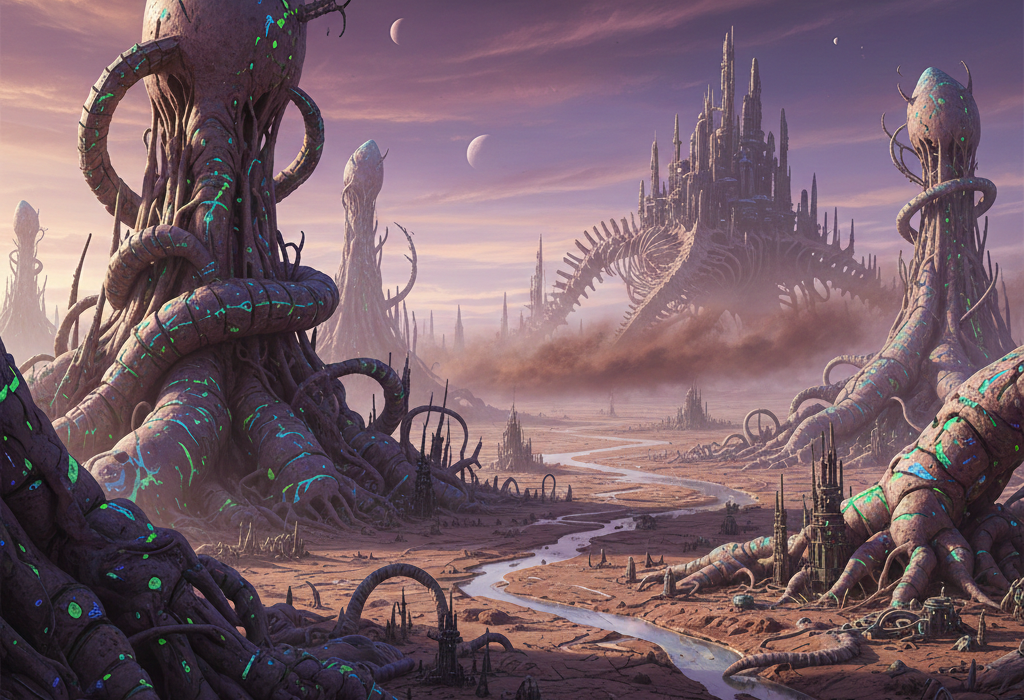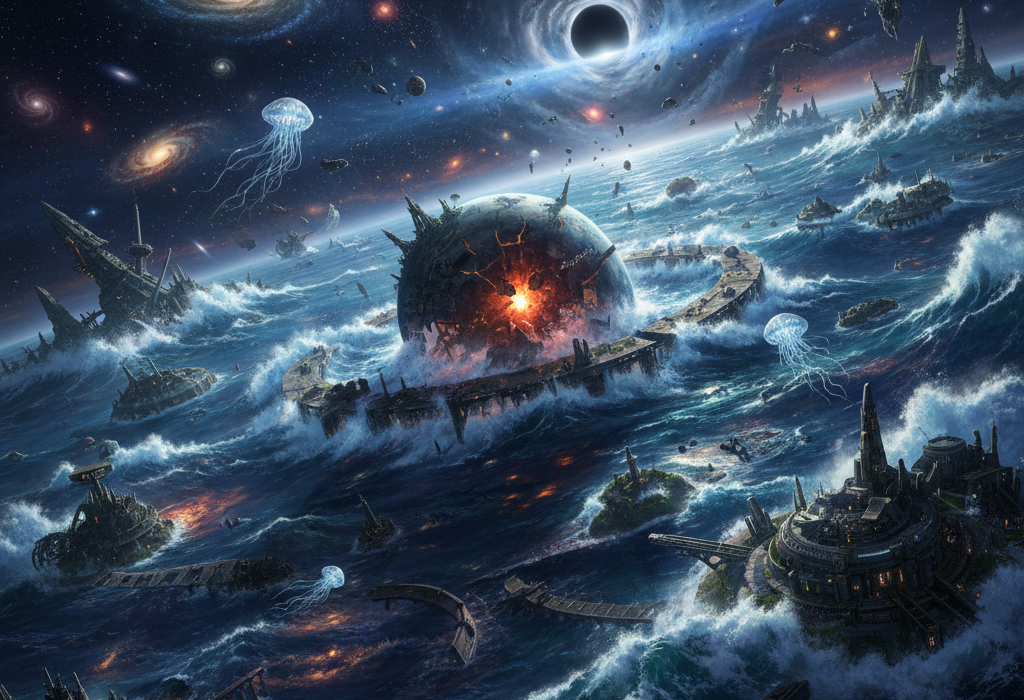
Earth remembers everything, yet tells its story without words. Long before humans carved symbols into stone or pressed ink onto paper, the planet lived through vast ages of change that left no written memory behind. These lost ages are not empty gaps in history; they are deep chapters written in rock layers, chemical traces, and fossilized whispers. They are eras when continents were born and destroyed, when the atmosphere transformed from poison to life-giving breath, when strange worlds of living forms rose and vanished without witnesses capable of recording their existence.
To imagine these ages is to confront time on a scale that humbles the human mind. A thousand years feels ancient to us. Ten thousand years stretches the imagination. But Earth’s unwritten past spans billions of years, a duration so immense that human history occupies only a thin, nearly invisible line at the very end. Yet these lost ages shaped everything we know. Without them, there would be no oceans, no oxygen-rich sky, no animals, no humans, and no memory at all.
Earth Before Earth Had a Face
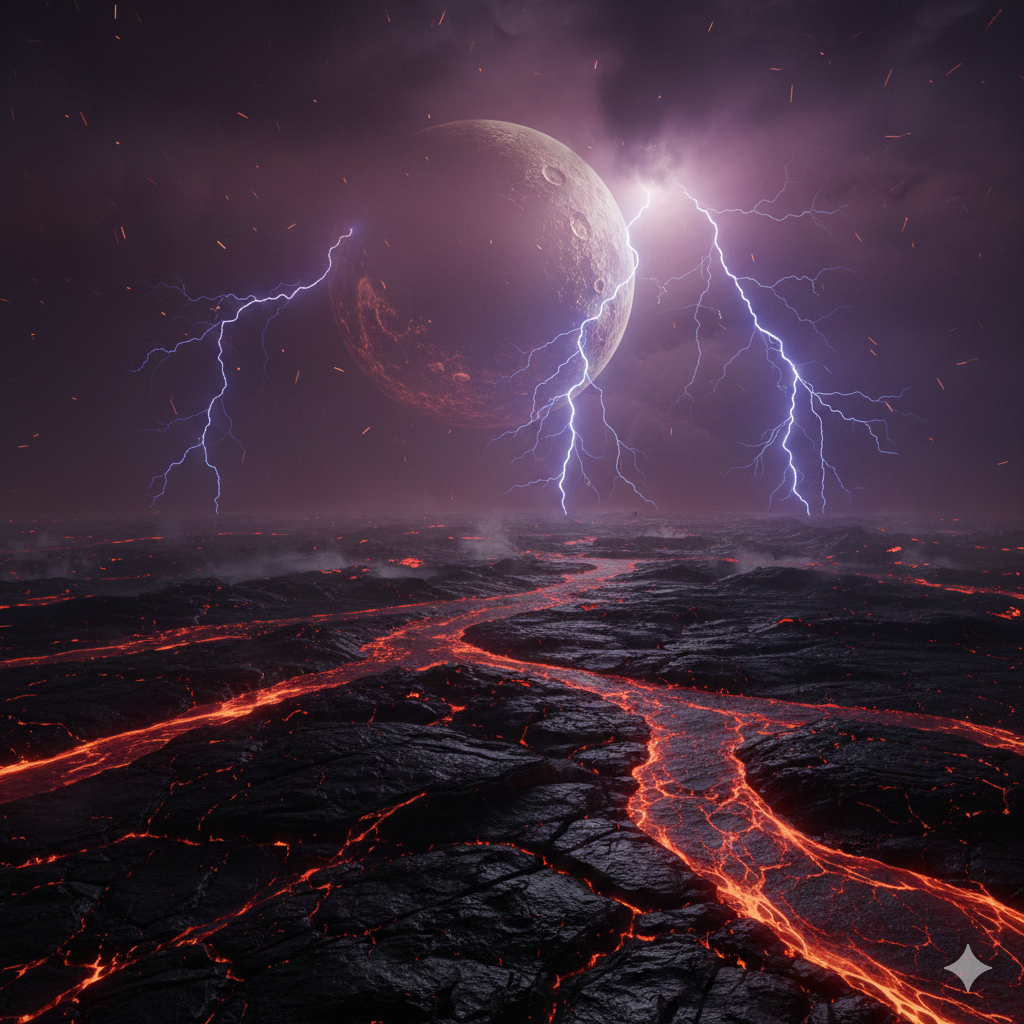
In its earliest age, Earth did not resemble the world we know. It was a violent place, a young planet still assembling itself from cosmic debris. The surface was molten or semi-molten, repeatedly scarred by massive impacts as the inner solar system settled into stability. There were no oceans, no continents, and no sky fit for breathing. Instead, clouds of toxic gases wrapped the planet, released from volcanic eruptions and chemical reactions deep within the forming crust.
This era left no fossils, no landscapes preserved in familiar form. The rocks from this time have been recycled by plate tectonics, melted and reshaped beyond recognition. What we know comes from indirect clues, from meteorites, from the Moon’s battered surface, and from the physics of planetary formation. Earth’s earliest age is almost entirely erased, yet it was essential. In this chaos, the planet differentiated into core, mantle, and crust. Gravity pulled heavy elements inward, forming an iron-rich core that would later generate a magnetic field, shielding future life from harmful radiation.
This was the first lost age, a time when Earth was becoming itself, even though nothing alive yet existed to witness it.
The Birth of Oceans and the First Stable Surface
As Earth cooled, something remarkable happened. Water, delivered by volcanic outgassing and possibly by icy bodies from space, began to collect on the surface. Rain fell for thousands, perhaps millions of years, filling low basins and creating the first oceans. The sky changed as well, gradually thinning and shifting in composition.
This age, still far beyond any written memory, marked the transition from a hostile world to one with the potential for life. Continents in the modern sense did not yet exist, but early crustal fragments floated atop the mantle, colliding and merging. These ancient pieces of crust, some of which survive today as tiny remnants within older continental cores, are among the oldest rocks on Earth.
The oceans of this era were not blue and life-filled. They were likely dark, mineral-rich, and acidic. Yet within them, chemistry was quietly at work. Complex molecules formed, interacted, and organized in ways that would eventually cross a threshold from nonliving matter to life. No one knows exactly how this happened, and Earth left no written explanation. But the evidence suggests that life emerged surprisingly early, almost as soon as conditions allowed.
The Age of Invisible Life
For most of Earth’s history, life existed without eyes, bones, or voices. Microorganisms ruled the planet for billions of years, shaping the environment in ways that would later make complex life possible. This vast microbial age is one of the most important lost ages, because its inhabitants left behind subtle but profound changes rather than dramatic fossils.
Early life forms were simple, but not primitive in the sense of being ineffective. They were chemical masters, capable of extracting energy from their surroundings in diverse ways. Some fed on chemical gradients near volcanic vents. Others used sunlight, inventing photosynthesis long before plants existed. These tiny organisms altered the chemistry of oceans and atmosphere molecule by molecule, generation after generation.
Because they were small and soft, most left no direct fossil record. Instead, their presence is inferred from chemical signatures in ancient rocks. Certain ratios of isotopes hint at biological activity. Layered rock structures known as stromatolites, built by microbial communities trapping sediments, offer rare physical evidence of this age. They stand today as some of the oldest visible signs of life, silent monuments to a world without memory.
The Great Oxygen Transformation
One of the most dramatic unwritten chapters in Earth’s history is the rise of oxygen in the atmosphere. For a long time, oxygen was a deadly poison to most living things. Early microbes thrived in oxygen-free environments, and the planet’s air reflected this reality.
Then photosynthetic organisms began releasing oxygen as a waste product. At first, this oxygen reacted with iron and other elements, never accumulating in the air. But eventually, Earth’s chemical sinks became saturated. Oxygen began to build up in the atmosphere, triggering a planetary transformation known as the Great Oxygenation Event.
This change reshaped the planet in profound ways. Many anaerobic organisms died off or retreated to oxygen-free niches, marking one of the earliest mass extinctions. At the same time, oxygen enabled new metabolic pathways, allowing life to extract far more energy from food. The sky changed color. The oceans changed chemistry. Even the rocks changed, as iron oxidized and settled into new forms.
No written memory records the terror or opportunity of this transition. Yet every breath we take is a direct consequence of it. The oxygen-rich world we inhabit was forged through microbial labor carried out in complete silence over immense spans of time.
The Frozen Worlds of Deep Time
Earth has not always been warm and welcoming. Several times in its history, the planet plunged into extreme cold, with ice reaching far closer to the equator than today. Some evidence suggests that during certain periods, Earth may have been almost entirely frozen, a global icehouse often referred to as Snowball Earth.
These frozen ages left dramatic geological traces, but no stories. Glaciers scoured the land, grinding rock into fine sediment. Ice reflected sunlight back into space, reinforcing the cold. Life survived, but only in refuges, perhaps beneath ice-covered oceans or near geothermal heat sources.
These frozen worlds tested the resilience of life. When the ice finally retreated, possibly due to volcanic carbon dioxide building up in the atmosphere, the planet emerged transformed. Nutrients released by melting glaciers flooded the oceans, and life responded with innovation and expansion.
The silence of these ages hides a powerful lesson. Earth’s climate can shift radically, and life can endure even the harshest conditions, though not without loss and upheaval.
The Explosion That Left Few Words
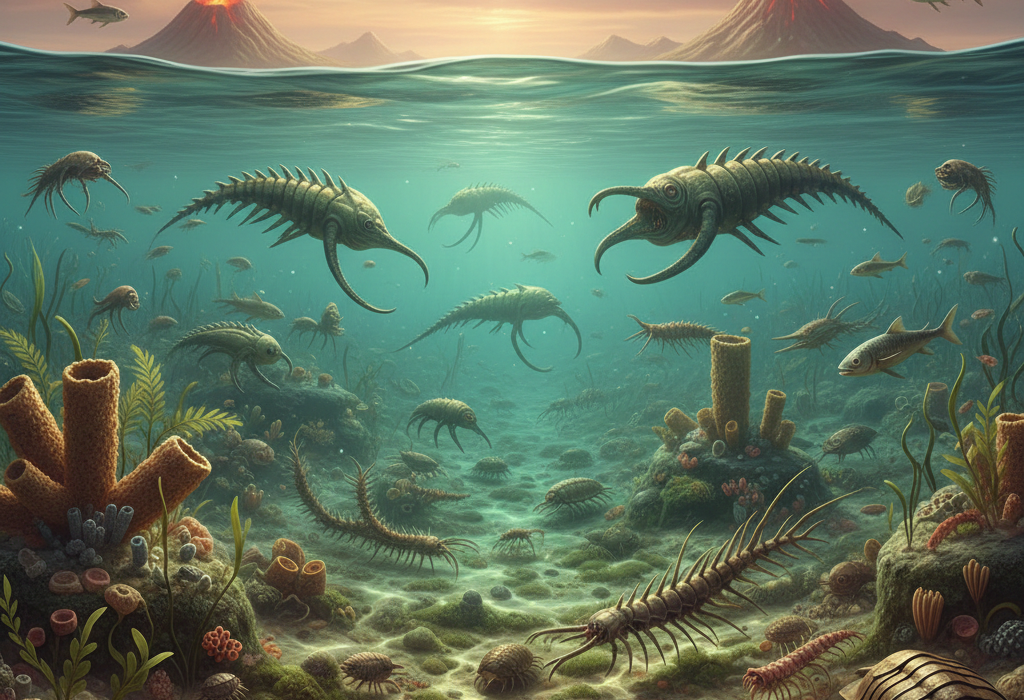
One of the most astonishing transitions in Earth’s history occurred when complex life suddenly became visible in the fossil record. This period, known as the Cambrian explosion, saw a rapid diversification of animal forms with shells, skeletons, and complex body plans.
Before this, life was mostly soft-bodied and rarely preserved. Then, in a relatively short geological time, a parade of strange and beautiful creatures appeared. Many bore no resemblance to modern animals. Some left descendants; others vanished entirely.
This was not the beginning of life, but the beginning of life leaving clear physical memories. Even so, much of this age remains lost. Fossils capture shapes, not behaviors, colors, or sounds. We can reconstruct bodies, but not experiences. We do not know how these creatures interacted, how they perceived their world, or what evolutionary pressures shaped their lives.
The Cambrian world was alive with motion and conflict, yet it passed without witnesses capable of writing it down.
Forgotten Kingdoms of the Seas
For hundreds of millions of years, life flourished primarily in the oceans. Entire ecosystems rose and fell, dominated by creatures now extinct and often unknown outside specialist study. Reef systems built by organisms unlike modern corals stretched across shallow seas. Armored fish patrolled ancient waters. Giant predators ruled marine food chains long before the first dinosaurs walked on land.
These marine worlds were dynamic and complex. Sea levels rose and fell as continents shifted and climates changed. Shallow seas flooded continents, then retreated. Each change rewrote the map of life.
Despite the richness of these ages, they left no written chronicles. What we know comes from shells turned to stone, from teeth embedded in sediment, from subtle changes in rock layers that hint at mass extinctions and recoveries. These lost ages remind us that the oceans, not the land, were Earth’s primary stage for most of its history.
The Rise and Fall Before Dinosaurs
Long before dinosaurs, Earth experienced other ages of dominance and collapse. Strange reptile-like creatures, massive amphibians, and early ancestors of mammals filled the land. Forests of towering plants unlike any alive today covered vast regions, altering the atmosphere and climate.
Then came one of the greatest catastrophes in Earth’s history, a mass extinction so severe that it wiped out most species on the planet. Entire lineages vanished. Ecosystems collapsed. The causes likely involved massive volcanic eruptions, climate shifts, and ocean chemistry changes.
This devastation cleared ecological space, setting the stage for new forms of life to rise. The dinosaurs would later become the most famous beneficiaries of this reset. But the world before them, rich and strange in its own right, is largely forgotten by popular imagination, another lost age erased by time.
The Dinosaur World Without Witnesses
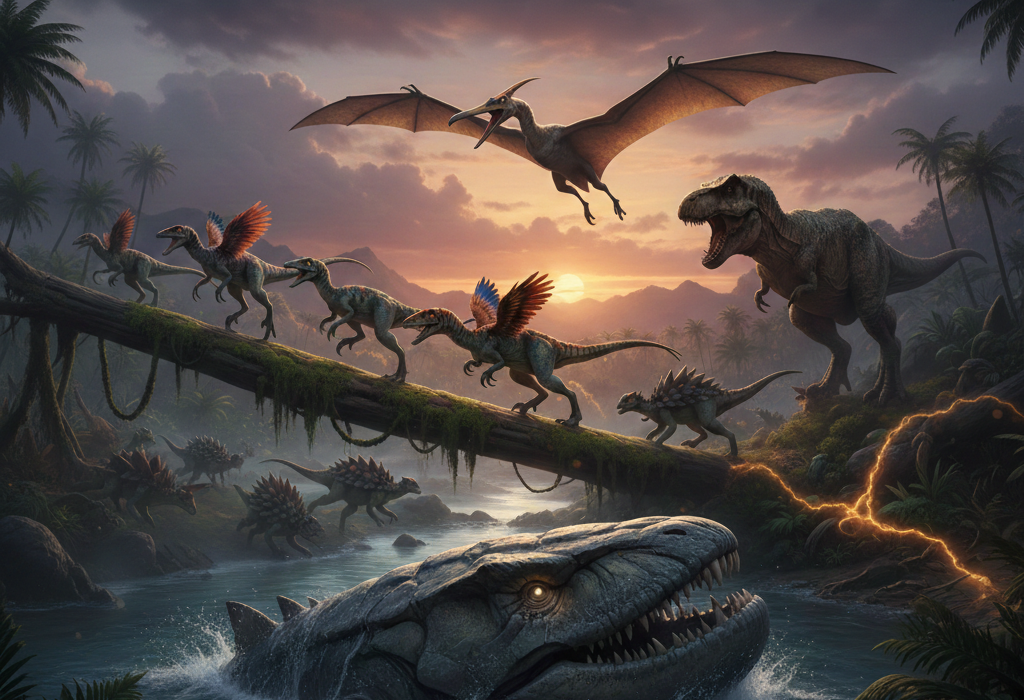
Dinosaurs ruled Earth for an unimaginably long time, far longer than humans have existed. They evolved into countless forms, from tiny feathered creatures to colossal giants. They inhabited forests, deserts, polar regions, and coastal plains. The world they lived in was warmer, with different sea levels and continental arrangements.
Despite their fame, even the dinosaur age is largely a world without memory. Fossils tell us about bones and sometimes feathers, but not about social structures, calls, or daily lives. We infer behavior from tracks and anatomy, building stories from fragments.
The end of the dinosaur age was sudden and violent, marked by an impact from space that reshaped the planet. Firestorms, darkness, and ecological collapse followed. Another lost age ended, clearing the way for mammals to diversify.
The Long Shadow Before Humans
After the dinosaurs, mammals gradually expanded into new roles. Forests changed. Grasslands appeared. Climate oscillated between warm and cold. Ice ages came and went, sculpting landscapes and influencing evolution.
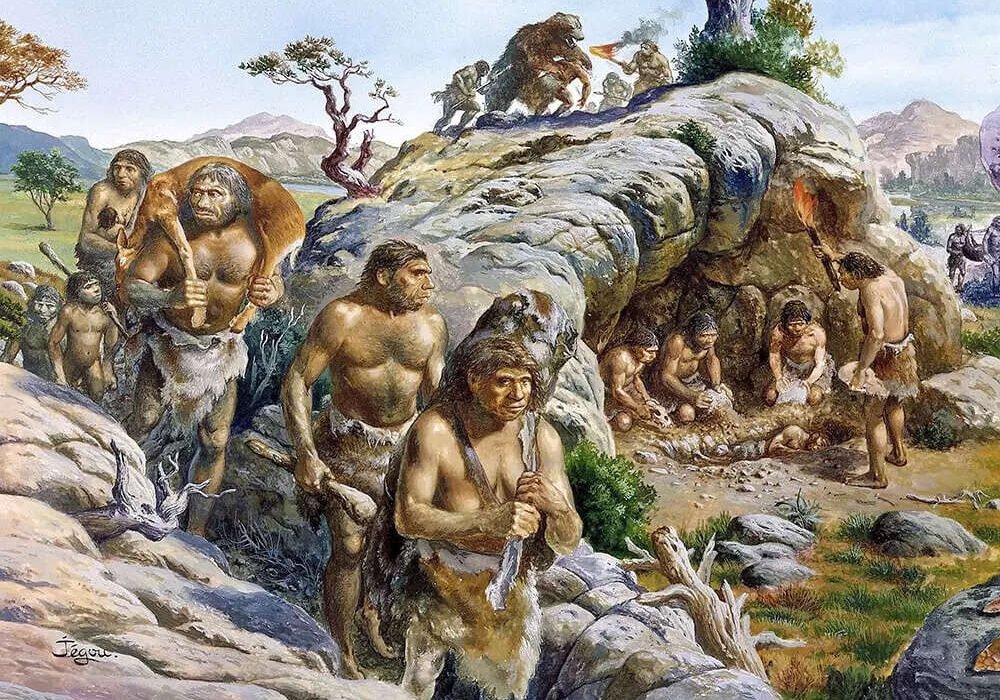
Early human ancestors emerged during this time, but for most of their existence, they left little behind beyond stone tools and bones. Even when humans learned to use fire and cooperate in complex ways, their stories were oral and fragile, easily erased by time.
The vast majority of human prehistory is itself a lost age, existing beyond written memory. Only in the last few thousand years did writing appear, capturing a tiny sliver of the human experience and an even tinier fraction of Earth’s story.
How Science Reads a Wordless Past
To uncover these lost ages, scientists act as translators of stone and time. Geology reveals sequences of events through layered rocks. Chemistry uncovers ancient environments through isotopes. Paleontology reconstructs life from fragments of bone and shell. Physics helps determine ages through radioactive decay.
This process is slow and incomplete. Earth does not give up its secrets easily. Each discovery answers some questions while raising others. Yet the overall picture grows clearer with each generation of research.
Science does not replace written memory; it creates a different kind of memory, one that belongs not to individuals or cultures, but to humanity as a whole.
The Emotional Weight of Forgotten Time
There is something deeply moving about Earth’s lost ages. They remind us that existence does not depend on being remembered. Entire worlds lived, changed, and disappeared without leaving stories, songs, or names. Their reality was no less real for that absence.
At the same time, these ages give context to our own moment. Human history feels vast from within, yet it is fleeting on a planetary scale. This perspective can feel unsettling, but also liberating. It places our struggles and achievements within a larger, ongoing story.
To study Earth’s unwritten past is to practice humility and wonder at the same time.
Why the Lost Ages Matter Today
Understanding these lost ages is not merely an academic exercise. They show how Earth responds to change, how life adapts or collapses under stress, and how interconnected systems truly are. Climate shifts, mass extinctions, and recoveries are not abstract concepts; they are recurring themes in Earth’s history.
By learning how the planet behaved long before humans existed, we gain insight into the consequences of change today. The past does not offer simple lessons, but it provides context, warning, and perspective.
A Planet That Remembers Without Words
Earth’s lost ages are not truly lost. They live on in the air we breathe, the ground beneath our feet, and the bodies we inhabit. Every atom in us has traveled through these ages, participating in cycles far older than memory.
Written history gave humans a voice across time, but long before that, Earth was already telling its story in a deeper language. Physics, chemistry, and geology allow us to listen, to reconstruct a narrative that no one recorded yet everyone inherits.
In the end, the lost ages of Earth remind us that memory is not the same as meaning. A world does not need to be written down to matter. It only needs to exist, to change, and to leave behind traces for those curious enough to seek them.