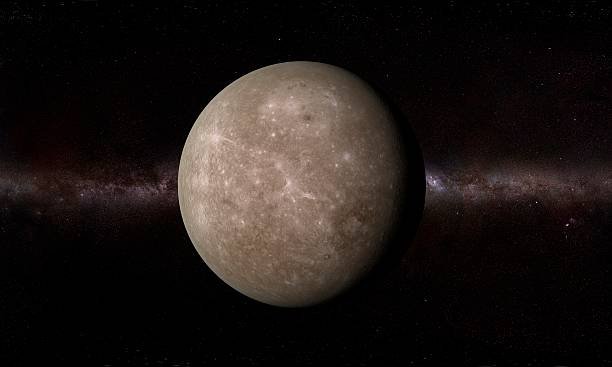
In the innermost region of the Solar System, where sunlight blazes with unforgiving intensity and the void is filled with the whisper of the solar wind, circles a small, scarred, and enigmatic planet: Mercury. To the unaided eye, it appears as a wandering point of light close to the Sun—a fleeting glimmer that vanishes in the glare of dawn or dusk. Yet beneath its cratered surface lies one of the most surprising and perplexing features in planetary science: a living magnetic field.
Mercury, barely larger than Earth’s Moon, is a world of extremes—searing days, freezing nights, and a landscape battered by eons of meteoritic bombardment. For centuries, it was regarded as a geologically dead relic, its mysteries hidden beneath a veil of solar brightness. But when spacecraft first visited this scorched planet, they revealed something wholly unexpected: despite its diminutive size and apparent stillness, Mercury possesses a global magnetic field.
This discovery defied all expectations. How could a planet so small, so old, and so close to the Sun retain a magnetic field when much larger worlds, like Mars and Venus, have long lost theirs? What secret lies in its metallic heart that keeps it alive? The mystery of Mercury’s magnetic field challenges our understanding of how planets evolve, how dynamos function, and what it truly means for a world to be alive in a magnetic sense.
A History of Discovery
For most of human history, Mercury was little more than an elusive wanderer across the heavens. The ancient Babylonians and Greeks tracked its movements, naming it after swift gods—Nabu, Hermes, and later Mercury—because it raced across the sky faster than any other planet. Yet until the age of space exploration, Mercury’s true nature remained cloaked in mystery.
Even powerful telescopes revealed little. Its proximity to the Sun made observation difficult, and for centuries astronomers speculated wildly about its composition, its rotation, and its surface. Some believed it was tidally locked to the Sun, showing one face eternally scorched and the other frozen in darkness. That assumption persisted until 1965, when radar observations from Earth revealed that Mercury actually rotates three times for every two orbits—a 3:2 spin-orbit resonance, a gravitational dance that keeps the same side facing the Sun every other orbit.
Then came Mariner 10, the first spacecraft to visit Mercury. Launched by NASA in 1973, it made three flybys of the planet between 1974 and 1975. During those brief encounters, Mariner 10 transformed Mercury from a point of light into a real world. It revealed a heavily cratered surface, a tenuous atmosphere, and—most astonishingly—a magnetic field. Instruments detected magnetic lines of force wrapping around the planet, resembling a miniature version of Earth’s magnetosphere. The finding stunned scientists.
Mercury’s small size, just 4,880 kilometers in diameter, suggested that its interior should have cooled long ago, solidifying its iron core and halting any internal dynamo—the process by which moving molten metal generates magnetic fields. Yet the data from Mariner 10 were undeniable: Mercury’s magnetic field was real, global, and intrinsic. The question was why.
The Dynamo Mystery
A planetary magnetic field arises from a simple yet powerful mechanism known as the geodynamo. Deep within a planet, electrically conductive fluids—usually molten iron—circulate through convection. As these fluids move within a rotating planet, they generate electric currents, which in turn create magnetic fields. This self-sustaining process requires both rotation and an internal heat source to keep the core fluid and in motion.
On Earth, the geodynamo thrives because our planet is massive enough to retain heat, and the slow crystallization of its inner core releases energy that drives convection. But for Mercury, the same logic seemed impossible. Being small, Mercury should have lost its internal heat long ago, its metallic heart frozen solid billions of years in the past. Without a molten core, there could be no convection—and without convection, no magnetic field.
Yet Mercury defied that logic. Mariner 10’s data indicated a magnetic field roughly 1% the strength of Earth’s, weak but undeniably present. It was as though a flicker of magnetic life still burned deep within this small, ancient world. Scientists were faced with a puzzle that would endure for decades: how could Mercury’s dynamo still be running?
Messenger and the Revival of Curiosity
For nearly thirty years after Mariner 10, Mercury remained largely unexplored. No other spacecraft visited it, and its mysteries endured. Then, in 2011, NASA’s MESSENGER mission—short for MErcury Surface, Space ENvironment, GEochemistry, and Ranging—entered orbit around the planet, providing the first long-term study of Mercury’s surface and magnetic environment.
MESSENGER’s discoveries revolutionized our understanding. The spacecraft confirmed that Mercury’s magnetic field is indeed generated by an internal dynamo, not by remnant magnetization in the crust. But the field was far from symmetric. It was oddly offset—about 480 kilometers north of the planet’s equator. This asymmetry suggested that Mercury’s core and magnetic dynamo were more complex than previously imagined.
MESSENGER also revealed that Mercury’s core is enormous, making up about 85% of the planet’s radius—a proportion unmatched by any other terrestrial planet. Even more intriguing, part of that core remains molten. Radar studies and spacecraft measurements showed that Mercury’s inner core is solid, but the outer portion is liquid, a layer of molten metal that could still flow and sustain a weak dynamo.
These findings offered critical clues, yet they deepened the mystery. How could such a small planet preserve enough heat to maintain a liquid outer core for billions of years?
The Heart of Iron and Fire
Mercury’s density is astonishingly high—second only to Earth’s in the Solar System. This implies a massive iron core, perhaps enriched by its proximity to the Sun, where lighter elements were scarce during formation. But the core’s survival as a partially molten sphere challenges conventional thermal models.
One possible explanation lies in chemistry. The presence of light elements such as sulfur or carbon within the core could lower its melting point, allowing it to remain liquid at cooler temperatures. This chemical “antifreeze” effect means that even after billions of years of cooling, Mercury’s heart might still churn with slow, metallic motion.
Another factor may be tidal heating. Although Mercury’s orbit is nearly stable today, its past could have been more chaotic. Early in its history, gravitational interactions with the Sun may have caused significant flexing of its interior—friction that generated heat and delayed solidification. The result is a planet that, despite its small size, still possesses a faint heartbeat of molten motion beneath its frozen crust.
This dynamic core is the likely source of Mercury’s magnetic field—a remnant dynamo kept alive by chemistry, history, and perhaps even the faint tug of the Sun itself.
The Shape of the Field
Mercury’s magnetic field is not only weak but strangely lopsided. Unlike Earth’s roughly symmetric dipole, centered near the planet’s core, Mercury’s field is stronger in the northern hemisphere and weaker in the south. This asymmetry puzzled scientists but also provided vital clues about how its dynamo operates.
The offset could arise from variations in core composition or from differences in heat flow across the core-mantle boundary. If more heat escapes through one hemisphere than the other, convection patterns within the core could become uneven, producing a displaced magnetic field.
MESSENGER’s data also revealed that the field interacts constantly with the solar wind—the stream of charged particles emanating from the Sun. Mercury, being so close to the Sun, is bombarded by intense solar radiation and plasma. This interaction compresses the dayside of the magnetosphere to just 1.5 planetary radii from the surface, while stretching the nightside into a long magnetic tail extending millions of kilometers into space.
In this fierce environment, Mercury’s magnetosphere is in perpetual flux. Magnetic reconnection—where magnetic field lines break and reconnect—occurs frequently, releasing bursts of energy and particles. These dynamic processes make Mercury’s magnetosphere one of the most active and variable in the Solar System, despite its small scale.
Lessons from a Small Planet
Mercury’s magnetic field offers a unique window into planetary evolution. Most small worlds—like Mars, the Moon, and many asteroids—long ago lost their magnetic dynamos. Their cores solidified, leaving behind only fossilized traces of magnetism in ancient rocks. That Mercury’s dynamo still flickers implies that planetary magnetic lifetimes are not solely determined by size.
It also challenges models of planetary cooling. The persistence of a molten core inside Mercury suggests that the relationship between internal heat, chemistry, and convection is more subtle than previously thought. If even a small planet can sustain a weak dynamo for billions of years, then the conditions for magnetic activity elsewhere in the universe may be far more diverse than scientists imagined.
Moreover, Mercury’s magnetosphere serves as a natural laboratory for studying how magnetic fields interact with solar wind under extreme conditions. Understanding this interaction helps scientists interpret observations of exoplanets orbiting close to their stars—worlds that may experience similar magnetic and atmospheric dynamics.
The Role of the Sun
The Sun’s influence on Mercury is profound. The planet’s elliptical orbit carries it as close as 46 million kilometers from the solar surface—less than half Earth’s distance. At that range, solar radiation and magnetic storms batter Mercury with relentless intensity.
The solar wind not only shapes the planet’s magnetosphere but may also feed energy back into the dynamo itself. Some researchers propose that variations in the solar magnetic field could induce electric currents within Mercury’s core, subtly influencing its internal motion. Others suggest that the Sun’s gravitational pull may maintain a small degree of tidal heating, keeping parts of the core molten.
Mercury thus exists in a delicate equilibrium—a world balanced between the heat of the Sun and the cold of space, between external forces and internal persistence. Its magnetic field is a record of that balance, an echo of both internal fire and solar fury.
Mercury’s Surface and Magnetic Legacy
The magnetic field not only shapes Mercury’s space environment but may also leave imprints on its surface. MESSENGER detected signs of magnetic anomalies—regions where crustal rocks retain traces of ancient magnetization. These relic fields suggest that Mercury’s dynamo has been active for billions of years, waxing and waning as the planet cooled.
By studying these magnetic imprints, scientists can reconstruct the timeline of Mercury’s interior evolution. Some areas show evidence of an early, stronger field, hinting that the dynamo may have been more vigorous in the distant past before gradually weakening. This long-lived magnetic history distinguishes Mercury from other small worlds and provides a key to understanding how planetary dynamos evolve and die.
The Search for the Source
Despite decades of research, the precise workings of Mercury’s dynamo remain elusive. Several competing theories attempt to explain it.
One hypothesis emphasizes compositional convection—where lighter elements, such as sulfur, separate from the iron core as it cools, driving circulation. Another suggests that the slow crystallization of the inner core releases latent heat and buoyant material, sustaining weak convection in the outer core. A third possibility involves thermoelectric or magnetohydrodynamic effects unique to Mercury’s high iron content and strong solar exposure.
Whatever the cause, the evidence points to a planet finely tuned between activity and stasis. Its field is neither strong enough to shield it from all solar radiation nor weak enough to have vanished completely. In this delicate balance lies the enduring puzzle of Mercury—a world that should be silent, yet continues to hum faintly with magnetic life.
The BepiColombo Mission: A New Chapter
As one mystery fades, another begins. In 2018, the European Space Agency and the Japan Aerospace Exploration Agency launched BepiColombo, a dual-spacecraft mission designed to study Mercury’s surface, atmosphere, and magnetosphere in unprecedented detail. Named after the Italian mathematician Giuseppe “Bepi” Colombo, who helped design Mariner 10’s trajectory, the mission carries two orbiters: the Mercury Planetary Orbiter (MPO) and the Mercury Magnetospheric Orbiter (MMO, now called Mio).
When BepiColombo arrives in Mercury’s orbit, it will probe the magnetic field’s origin, structure, and variability with far greater precision than ever before. By measuring how the field changes over time and across locations, scientists hope to pinpoint the depth and dynamics of the core’s liquid layers. The mission will also examine how Mercury’s magnetosphere responds to the solar wind, capturing the interplay between internal and external forces.
If BepiColombo succeeds, it may finally reveal whether Mercury’s magnetic field is a relic struggling to survive or a resilient engine still burning strong at the edge of the Sun’s dominion.
Magnetic Fields and the Habitability of Worlds
Mercury’s magnetism is more than an isolated curiosity—it carries implications for life across the cosmos. On Earth, the magnetic field serves as a shield, deflecting charged particles from the Sun and protecting the atmosphere from erosion. Without it, our planet would have been stripped of much of its air and water, much like Mars.
Mercury, though magnetized, lacks such protection because its field is too weak and its atmosphere too thin. Yet the very existence of its magnetic field reminds us that magnetism may play a crucial role in determining which planets remain habitable. It shapes how atmospheres evolve, how radiation interacts with surfaces, and even how planets retain volatile compounds essential to life.
By studying Mercury’s field, scientists learn not only about its inner workings but also about the broader laws governing planetary survival in harsh stellar environments. In a sense, Mercury is both a survivor and a warning—a planet that endured the Sun’s fury but at the cost of its atmosphere and habitability.
The Magnetic Soul of a Planet
At its heart, Mercury’s magnetic field is a story of persistence. Against all odds, a small world of iron and rock clings to a remnant of dynamism—a faint magnetic heartbeat echoing from its core. It should have been silenced by time, yet it endures, whispering secrets of planetary creation and endurance.
To study Mercury’s magnetism is to glimpse the boundary between life and death in planetary terms. A magnetic field is, in many ways, a sign of geological vitality—a pulse from within. Its continuation on Mercury speaks of resilience, a defiance of the expected.
In the shimmering light of the Sun, Mercury seems lifeless. Yet in the invisible realm of magnetism, it is alive with subtle motion, its iron heart still turning, still glowing faintly with the memory of its fiery birth.
A Window into the Early Solar System
Mercury’s magnetic field is also a time machine. Because the planet formed so close to the Sun and retained its ancient composition, it offers a glimpse into the early Solar System’s conditions. Its survival tells us how the first terrestrial planets formed, differentiated, and cooled.
If Mercury’s dynamo still operates, it may resemble the early stages of Earth’s own magnetic evolution—when our planet’s core first began to stir. By comparing the two, scientists can trace the universal principles that govern magnetic generation across worlds. Mercury thus stands as both a relic of the past and a model for understanding planets everywhere.
The Legacy of Mercury’s Magnetism
In the final measure, the mystery of Mercury’s magnetic field transcends the technical details of molten cores and convection. It represents the enduring capacity of nature to surprise—to reveal vitality where logic predicts silence. Every measurement of Mercury’s field, every magnetic line detected, speaks to a universe richer and more intricate than our preconceptions allow.
As BepiColombo continues its journey and future missions delve deeper into Mercury’s heart, we stand on the threshold of new understanding. What began as a puzzling anomaly in the data of Mariner 10 has become a profound inquiry into the forces that shape planets and protect life.
Mercury’s magnetism reminds us that even the smallest worlds can hold immense secrets—that even a scorched, airless sphere can possess a living core, defying the stillness of time.
The Enduring Mystery
Mercury’s magnetic field is not merely a scientific curiosity—it is a story of endurance, complexity, and connection. It links the innermost planet to the cosmic processes that forged the Solar System. It binds the visible world of sunlight and craters to the invisible one of iron and electricity.
In its faint magnetic glow, Mercury holds a mirror to Earth and to all worlds that strive against entropy. It is a reminder that even in the most hostile of places, hidden within the silence of rock and metal, the universe still hums with unseen energy.
The smallest planet guards one of the greatest mysteries—a magnetic soul that has outlasted billions of years of cosmic struggle. And as we continue to listen to its faint electromagnetic song, we are reminded that even the quietest worlds can whisper the loudest truths about how the cosmos lives, breathes, and endures.