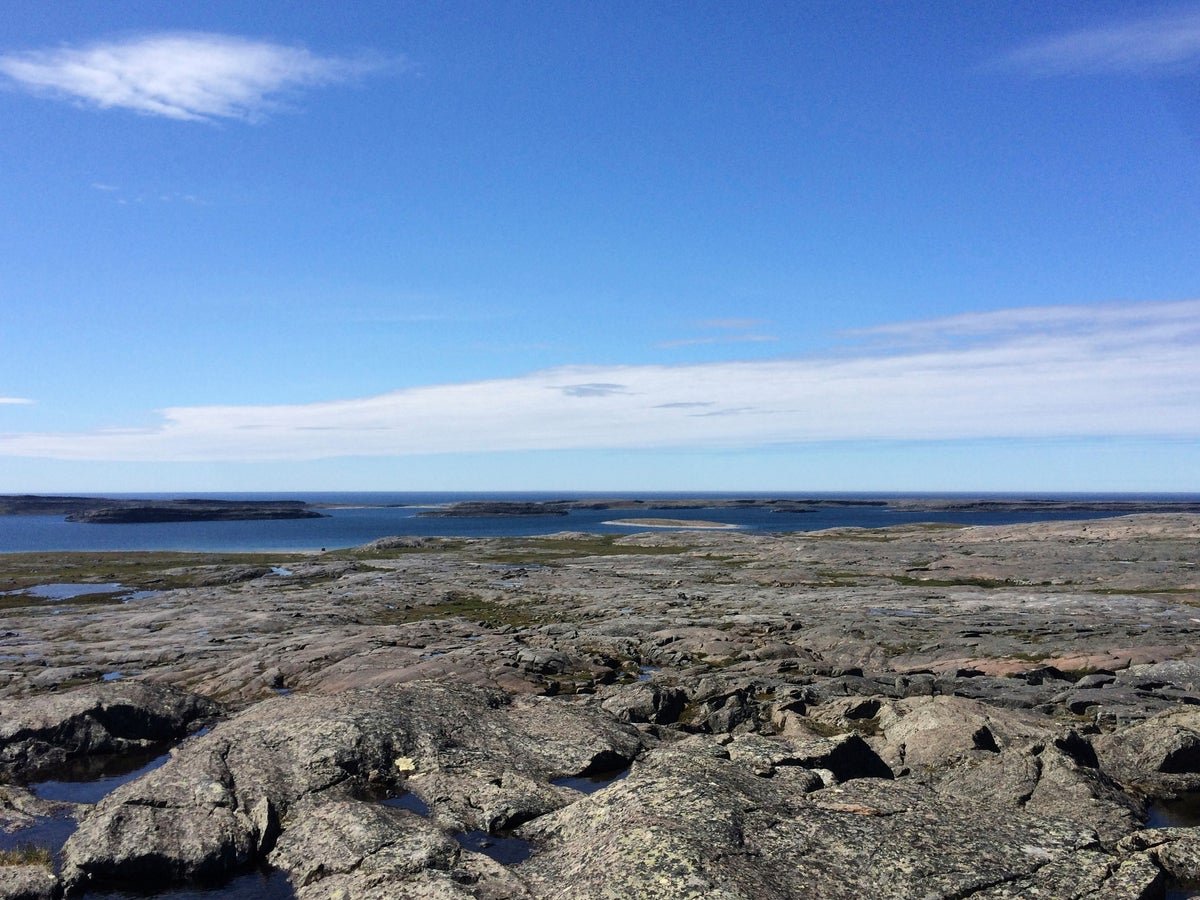
Beneath our feet lies a memory far older than humanity, older than animals, older than plants, older even than oceans as we know them. The Earth’s oldest rocks are not merely stone. They are survivors from a violent, alien past, silent witnesses to a time when our planet was still finding its identity. These ancient rocks carry within them clues to questions that continue to haunt science: How did Earth form? When did life begin? Why did this planet become a cradle for biology while so many others remained barren?
To hold one of these rocks is to touch deep time. It is to place your hand on a fragment of the early Earth, preserved against unimaginable odds. Their mysteries are not written in words, but in minerals, isotopes, crystal structures, and scars left by heat and pressure beyond modern experience. Decoding them is one of the greatest scientific challenges of our age, and one of the most emotionally powerful journeys geology can offer.
The Meaning of Deep Time
Human history spans thousands of years. Recorded civilization stretches back only a few millennia. Yet Earth is approximately 4.54 billion years old. This immense span of time, often called deep time, defies everyday intuition. The oldest rocks on Earth formed more than four billion years ago, during an era when the planet was still cooling from its fiery birth.
Deep time reshapes how we understand reality. Mountains rise and vanish. Oceans open and close. Continents collide, split, and drift apart like slow-moving ships. The oldest rocks come from a time when none of this was settled. The Earth’s surface was unstable, repeatedly melted, crushed, and reshaped. Almost everything from that era has been destroyed. What remains is rare, fragile, and profoundly precious.
Earth’s Violent Birth and the First Crust
The Earth formed from a swirling disk of gas and dust surrounding the young Sun. Through countless collisions, small particles grew into larger bodies until a planet emerged. This process was chaotic and violent. Impacts were frequent and catastrophic, releasing enormous amounts of heat.
During this early period, Earth was likely a molten world. Heavy elements sank to form the core, while lighter materials rose toward the surface. As the planet cooled, a solid crust began to form. But this first crust was unstable. It was repeatedly destroyed by massive impacts, including the colossal collision thought to have formed the Moon.
The oldest surviving rocks are not remnants of Earth’s first crust, but of later generations that managed to endure. Their survival is extraordinary. Each one represents a narrow escape from total obliteration.
The Scarcity of Earth’s Oldest Rocks
Unlike the Moon, which preserves ancient surfaces in pristine condition, Earth is geologically active. Plate tectonics, erosion, volcanism, and metamorphism continuously recycle the crust. Old rocks are subducted into the mantle or transformed beyond recognition.
As a result, rocks older than four billion years are exceptionally rare. Most of Earth’s surface is younger than 200 million years. The oldest known intact rock formations are found in a few isolated regions, including the Acasta Gneiss Complex in Canada, parts of Greenland, and small fragments in Australia and Africa.
Their rarity is itself a mystery. How did these rocks survive when so much else was erased? Their existence suggests that parts of Earth’s crust stabilized earlier than once thought, offering a glimpse into the planet’s early evolution.
The Acasta Gneiss and a Window into the Past
Among the most famous ancient rocks on Earth is the Acasta Gneiss, located in northwestern Canada. Dated to about 4.03 billion years old, it represents some of the oldest known intact crustal material.
The Acasta Gneiss is not a simple rock. It has been altered multiple times by heat and pressure, its original features blurred by billions of years of geological processing. Yet within its minerals, scientists can still read its age and history.
These rocks reveal that continental crust began forming surprisingly early in Earth’s history. This challenges earlier models that suggested a long delay before stable continents could exist. The implication is profound: Earth may have become geologically diverse much sooner than expected.
Zircons: Time Capsules Smaller Than Sand
Some of the most important clues about Earth’s earliest history come not from large rock formations, but from microscopic crystals called zircons. These tiny minerals can survive conditions that destroy almost everything else. They are nature’s time capsules.
Zircons incorporate uranium atoms into their crystal structure when they form, but they exclude lead. Over time, uranium decays into lead at a known rate. By measuring the ratio of uranium to lead, scientists can determine the zircon’s age with remarkable precision.
Some zircons found in Western Australia are over 4.4 billion years old, older than any known intact rock. They suggest that solid crust and even liquid water may have existed on Earth far earlier than previously believed.
Evidence of Early Oceans
One of the most astonishing discoveries locked inside ancient zircons is evidence for early oceans. Certain isotopic signatures within these crystals suggest that they formed in the presence of liquid water.
This implies that Earth may have cooled enough to support oceans within a few hundred million years of its formation. Such a finding reshapes our understanding of Earth’s early environment. Rather than a perpetually molten hellscape, the young planet may have experienced periods of relative calm, with water cycling between surface and interior.
Water is essential for life as we know it. The possibility that oceans existed so early raises profound questions about when life might have begun.
Traces of Earth’s Earliest Atmosphere
Ancient rocks also preserve clues about Earth’s earliest atmosphere. Chemical signatures within minerals reveal the presence or absence of oxygen and other gases at different times.
The early atmosphere was vastly different from today’s. It likely contained little to no oxygen and was dominated by volcanic gases such as carbon dioxide, methane, and nitrogen. This environment would have been hostile to most modern life but may have been ideal for the chemical reactions that led to the origin of biology.
Understanding the evolution of Earth’s atmosphere is crucial not only for reconstructing our own history, but for assessing the habitability of other planets.
The Question of the First Continents
One of the enduring mysteries locked inside Earth’s oldest rocks concerns the origin of continents. Modern continents are made of buoyant crust that floats atop denser mantle material. How and when did this unique structure arise?
Ancient rocks suggest that some form of continental crust existed very early in Earth’s history. But whether these early landmasses resembled modern continents or were transient features remains unclear.
The formation of continents is closely linked to plate tectonics, a process that may not have operated in the same way on the early Earth. Some scientists argue that plate tectonics began much later, while others see evidence for early tectonic activity hidden in ancient rocks.
Heat, Pressure, and Transformation
Earth’s oldest rocks have not remained unchanged. They have been subjected to extreme heat and pressure, transforming them through a process known as metamorphism. Original textures and minerals are often altered or erased, complicating efforts to interpret their history.
Yet metamorphism also preserves information. The minerals that form under specific conditions act as thermometers and barometers, recording the temperatures and pressures they experienced. By studying these minerals, scientists can reconstruct the environments deep within the early Earth.
These reconstructions reveal a planet that was hotter and more dynamic than today, yet capable of producing stable crustal regions.
Magnetic Clues from Ancient Stone
Some ancient rocks preserve records of Earth’s magnetic field. Tiny magnetic minerals align themselves with the planet’s magnetic field as they cool. Once locked in place, they retain this orientation for billions of years.
These magnetic signatures suggest that Earth had a functioning magnetic field very early in its history. This is a crucial discovery, because Earth’s magnetic field protects the atmosphere from being stripped away by solar wind.
A strong early magnetic field may have been essential for preserving Earth’s atmosphere and surface water, setting the stage for life.
The Hunt for Earth’s Oldest Life
Perhaps the most emotionally charged mystery locked inside ancient rocks is the question of life’s origin. Did life arise quickly once conditions allowed, or did it take billions of years?
Some of the oldest sedimentary rocks contain structures and chemical signatures that some scientists interpret as evidence of early life. Carbon isotopes, for example, can indicate biological activity because living organisms preferentially use lighter carbon atoms.
These findings are controversial. The rocks have been heavily altered, and non-biological processes can sometimes produce similar signatures. Yet the possibility that life existed more than 3.8 billion years ago is both thrilling and humbling.
Stromatolites and the First Ecosystems
Slightly younger rocks preserve clearer evidence of early life in the form of stromatolites. These layered structures are formed by microbial communities that trap and bind sediments.
Ancient stromatolites show that life had become widespread and ecologically significant by around 3.5 billion years ago. They represent some of Earth’s earliest ecosystems, long before animals or plants.
The existence of these structures suggests that once life began, it spread rapidly and adapted to a wide range of environments.
The Oxygen Revolution Hidden in Stone
For much of Earth’s history, oxygen was absent from the atmosphere. The rise of oxygen, known as the Great Oxidation Event, dramatically altered the planet.
Ancient rocks record this transformation. Changes in mineral composition and isotopic ratios reveal when oxygen began to accumulate. This shift was driven by photosynthetic microorganisms that released oxygen as a byproduct.
The oxygen revolution paved the way for complex life, but it was also a global catastrophe for organisms adapted to oxygen-free conditions. Earth’s oldest rocks preserve the scars of this planetary transition.
Why These Rocks Matter Today
The mysteries locked inside Earth’s oldest rocks are not mere academic curiosities. They inform our understanding of planetary evolution, climate stability, and the conditions necessary for life.
By studying these rocks, scientists refine models of how planets form and evolve. These insights are essential for interpreting observations of distant exoplanets and assessing their potential habitability.
Ancient rocks also provide context for modern environmental change. They reveal how Earth responded to past shifts in climate and chemistry, offering lessons for the future.
The Emotional Weight of Ancient Stone
There is something profoundly moving about studying Earth’s oldest rocks. They remind us that humanity occupies only a fleeting moment in a vast timeline. Civilizations rise and fall, but these rocks endure.
They connect us to a time before memory, before biology reshaped the planet. They speak of survival against impossible odds, of order emerging from chaos.
For scientists who study them, these rocks are not just objects of analysis. They are messengers from a lost world, carrying stories that can never be fully told, only partially understood.
The Limits of What We Can Know
Despite decades of research, many mysteries remain locked inside Earth’s oldest rocks. Their histories are fragmented, their signals blurred by time. Some information may be forever lost.
This uncertainty is not a failure of science, but a reflection of reality. The early Earth was a dynamic, destructive place. Survival was rare. Preservation was accidental.
What we can recover is extraordinary precisely because it is incomplete. Each discovery reshapes our understanding and raises new questions.
Earth’s Oldest Rocks and Our Place in the Universe
Ultimately, the study of Earth’s oldest rocks is about more than geology. It is about understanding how a lifeless planet became alive, how chaos gave rise to stability, and how time sculpted a world capable of reflection.
These rocks remind us that Earth is not static. It is a living system with a deep and turbulent past. They show that habitability is fragile, hard-won, and rare.
In their silence, Earth’s oldest rocks speak volumes. They tell a story of fire and water, destruction and renewal, chance and persistence. They tell the story of a planet that survived its own birth and, against all odds, became home.