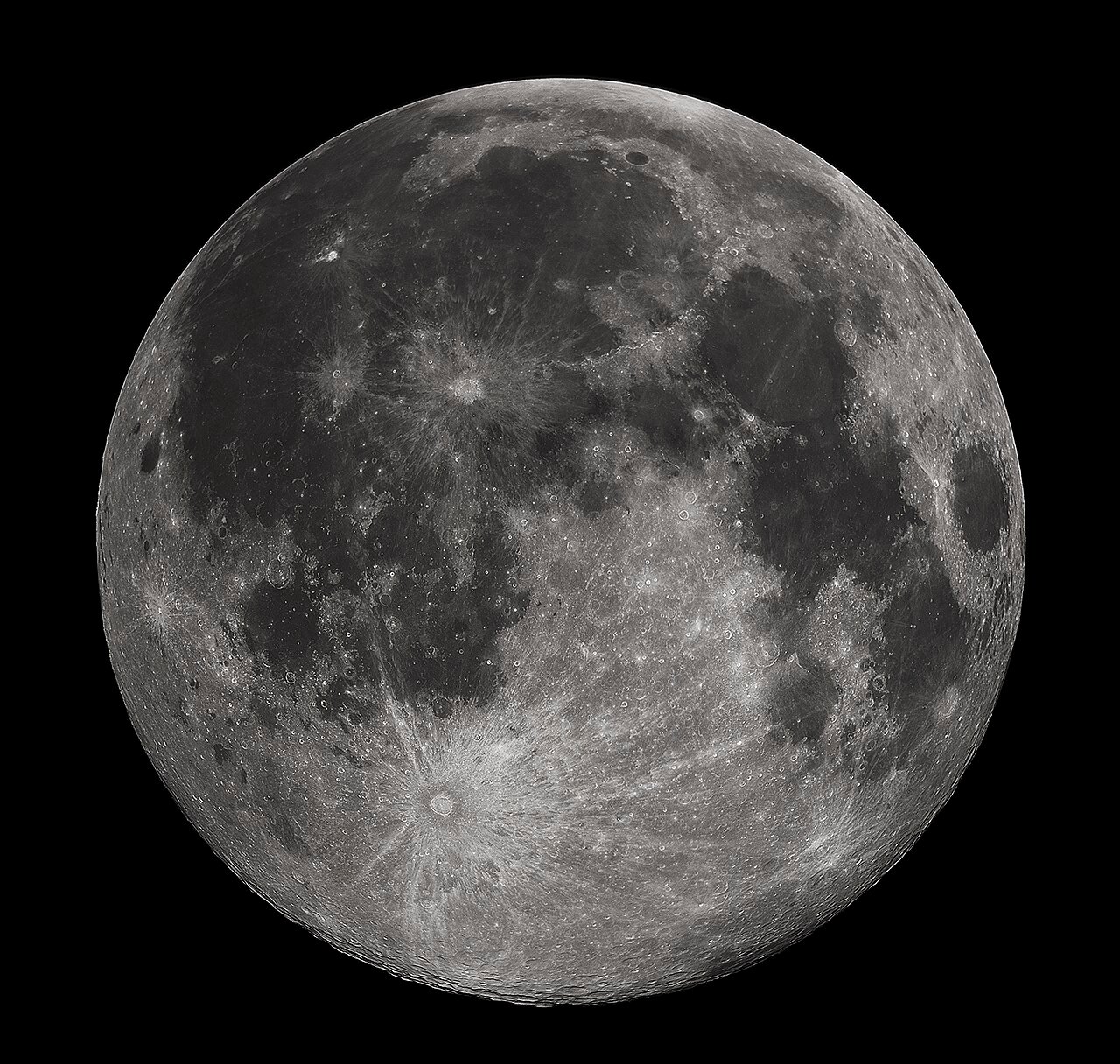
Far from the luminous face of our own Moon, circling the rust-red planet Mars, drift two small, enigmatic worlds—Phobos and Deimos. They are not majestic orbs like Earth’s Moon, but dark, irregular fragments that resemble battered asteroids. Yet their story is no less profound. These two tiny moons, each no larger than a modest mountain, have become symbols of the strange, violent beauty that defines the Solar System.
For centuries, Mars—the god of war—was imagined as a place of conflict, passion, and restless energy. When Phobos and Deimos were discovered in 1877 by American astronomer Asaph Hall, their very names reflected this mythic heritage. Phobos means “fear,” and Deimos means “terror,” the two sons who accompanied Ares, the Greek god of war, into battle. Appropriately, they now circle the blood-colored planet that bears their father’s Roman name, bound by gravity in an eternal dance of dread and devotion.
But behind the mythology lies a story written not in legend, but in dust, rock, and time. Phobos and Deimos are relics of Mars’ violent past—tiny survivors of cataclysmic collisions and cosmic theft. They are witnesses to an ancient epoch, and their fates are as dramatic as their origins. One is doomed to fall and shatter, the other destined to drift away into the void. Together they form a study in contrasts: fragile, faint, and fleeting reminders that even the smallest worlds can reveal the grandest truths about our Solar System’s history.
The Discovery of Mars’ Moons
In the summer of 1877, Asaph Hall was working at the U.S. Naval Observatory in Washington, D.C. Mars was at opposition—meaning it was closest to Earth and at its brightest. This rare alignment offered astronomers a chance to study the planet in exceptional detail. Hall, peering through the 26-inch refractor telescope (then the largest of its kind), noticed a faint point of light close to the planet’s glare. At first, he doubted his eyes, suspecting a background star or optical illusion. But repeated observations confirmed the truth: Mars had a moon.
Within a week, Hall spotted a second, even smaller object farther out. He had discovered not one, but two satellites of Mars—Phobos and Deimos. Their existence had been anticipated for centuries; the satirist Jonathan Swift had even imagined them in his 1726 novel Gulliver’s Travels, describing two Martian moons with uncanny accuracy more than 150 years before they were found.
These discoveries stirred the scientific world. Until then, only Earth and the outer giant planets were known to have moons. That Mars, a terrestrial planet, possessed two of them raised new questions about how satellites formed and evolved. Yet the faintness and proximity of Phobos and Deimos made them difficult to study from Earth. For nearly a century, their true nature remained shrouded in mystery, awaiting the arrival of spacecraft to unveil their secrets.
Portraits of Two Tiny Worlds
Phobos and Deimos could hardly be more different from Earth’s Moon. Phobos, the larger of the two, measures roughly 27 kilometers across at its widest point—about the size of a small city. Deimos is smaller still, just 15 kilometers in diameter. Both are irregularly shaped, more like lumpy potatoes than spheres, and covered with impact craters, grooves, and dust. Their surfaces are dark, reflecting only about six percent of the sunlight that strikes them, making them among the darkest objects in the Solar System.
Phobos orbits Mars at a mere 6,000 kilometers above its surface—closer than any other known moon to its parent planet. It completes a full orbit in just 7 hours and 39 minutes, traveling faster than Mars itself rotates. As a result, Phobos rises in the west and sets in the east, racing across the sky several times a day. From the Martian surface, it would appear as a fast-moving, irregular disk, casting fleeting shadows that streak over the desert plains.
Deimos, by contrast, orbits at a much greater distance of about 23,500 kilometers and takes 30 hours to complete one revolution. It moves more slowly across the Martian sky, rising in the east and setting in the west like a normal moon. To an observer on Mars, Deimos would appear as a faint, star-like point, barely large enough to resolve to the naked eye.
Despite their modest size, these moons exert a profound fascination. They are ancient relics—timeless, airless worlds that hold clues to Mars’ origin, its environment, and the forces that shaped the early Solar System.
Origins Shrouded in Mystery
The question of how Phobos and Deimos came to orbit Mars remains one of planetary science’s enduring puzzles. Two main hypotheses compete to explain their origin: capture and co-formation.
The capture theory suggests that the moons were once asteroids wandering through the inner Solar System. Their irregular shapes, small sizes, and dark carbon-rich composition resemble those of D-type asteroids commonly found in the outer asteroid belt. According to this idea, Mars’ gravity snared these passing bodies billions of years ago, locking them into orbit.
However, capturing two such objects into nearly circular, equatorial orbits poses a problem. Simple gravitational capture would typically produce highly elliptical or inclined orbits. To circularize them, some form of energy dissipation—perhaps through atmospheric drag or a collision—would have been necessary. But Mars’ atmosphere, even in its denser youth, may not have been thick enough to slow the asteroids effectively.
The co-formation theory, on the other hand, posits that Phobos and Deimos formed from debris produced by a giant impact early in Mars’ history—similar to how Earth’s Moon formed. A massive collision could have ejected material into orbit around Mars, which then coalesced into the two small moons. Simulations suggest this is plausible, especially if much of the debris eventually fell back to the planet or was lost to space.
Recent evidence from spacecraft supports a hybrid scenario. The moons’ densities are unusually low—less than twice that of water—implying they are porous, “rubble-pile” objects made of loose material held together by gravity. Their surfaces also contain fine dust rich in carbon compounds, consistent with asteroid-like origins. It is possible, then, that Phobos and Deimos are the remnants of a larger moon system born from an impact, later eroded and reassembled into their current forms.
Phobos: The Doomed Moon
Of the two Martian moons, Phobos is the more dramatic—and the more doomed. Orbiting so close to Mars, it lies below the planet’s synchronous orbit radius, where a satellite’s orbital period matches the planet’s rotation. As a result, tidal forces between Mars and Phobos are not balanced. Mars’ gravity raises tidal bulges on Phobos, and because the moon orbits faster than Mars rotates, those bulges lag behind, exerting a braking force that gradually pulls Phobos inward.
Every century, Phobos spirals about 1.8 meters closer to Mars. In roughly 30 to 50 million years—a blink of an eye in cosmic time—it will either crash into the planet or be torn apart by gravitational stresses, forming a temporary ring system around Mars. This slow-motion death spiral has already left its mark. The moon’s surface is etched with mysterious grooves, thought to be stress fractures caused by tidal forces stretching it toward destruction.
Phobos’ largest feature, the crater Stickney, dominates its western hemisphere. Named after Asaph Hall’s wife, who encouraged him to continue his search, Stickney spans nearly 9 kilometers—about one-third of Phobos’ diameter. The impact that created it nearly shattered the moon, sending shock fractures rippling across its surface. Combined with the tidal stresses, these scars reveal a body teetering on the edge of structural failure.
If Phobos ultimately disintegrates, its debris could form a faint ring around Mars, similar to the dusty rings of Jupiter. Over time, the particles would spiral inward and fall to the planet, leaving behind only traces of the moon that once was. Thus, Phobos’ fate is sealed—it is a celestial martyr, drawn inexorably toward the world that birthed and now devours it.
Deimos: The Gentle Drifter
Deimos, smaller and farther away, faces a gentler destiny. Instead of spiraling inward, it is slowly drifting outward, like Earth’s Moon but at a much slower rate. Its weak gravitational bond with Mars ensures its survival for eons to come. Where Phobos races, Deimos glides; where Phobos falls, Deimos ascends.
Its surface is smoother than that of Phobos, with fewer large craters and more subdued features. This is partly due to the accumulation of fine dust that has filled its depressions over billions of years. The largest crater, Swift (named for Jonathan Swift), is only about 1 kilometer wide. From orbit, Deimos appears calm and inert, a gentle counterpoint to its tormented sibling.
Though Deimos will likely never collide with Mars, it too will not remain forever. As Mars’ rotation slows over billions of years, tidal interactions will eventually alter Deimos’ orbit. But that future lies so far ahead that the Sun itself may have evolved into a red giant by then, engulfing the inner planets. Deimos, for now, remains a patient observer—a quiet sentinel drifting above the red plains below.
The Martian Sky from the Moons
Imagine standing on Phobos’ surface. Mars looms overhead, filling nearly half the sky—a massive, blood-red disk ten times larger than our Moon appears from Earth. The horizon curves sharply, for Phobos is so small that its surface drops away rapidly. There is no air, no sound, only the blackness of space and the glow of sunlight reflecting off Martian dust storms far below.
On Deimos, the view is subtler but equally haunting. Mars appears smaller, yet still immense—a glowing orb suspended in the void. The Sun’s light casts stark shadows across the rocky ground, and stars shine unblinking against the eternal night. Every 30 hours, a sunrise sweeps across the landscape, painting the distant planet in shades of crimson and gold.
Both moons experience extreme temperature swings, from 25°C in sunlight to -120°C in shadow. Dust and regolith shift slightly with each heating and cooling cycle, slowly reshaping their surfaces over geological time. Yet, in their silence, these moons offer perspectives no Earth-bound observer could imagine—a world seen from the outside, a planet rising over an alien horizon.
The Exploration of Phobos and Deimos
Our knowledge of Mars’ moons has grown immensely thanks to a succession of spacecraft. The first close-up images came from NASA’s Mariner 9 in 1971, which revealed Phobos and Deimos as irregular, cratered bodies. Later missions such as Viking, Phobos 2, Mars Global Surveyor, and Mars Express provided higher-resolution views, uncovering details of their geology, composition, and orbits.
The Soviet Phobos missions of the late 1980s were the first attempts to land on one of the moons, though both failed before contact. In 2011, Russia’s Phobos-Grunt mission also ended prematurely, never leaving Earth’s orbit. However, these efforts paved the way for renewed interest.
In recent years, Japan’s space agency JAXA has taken the lead with the Martian Moons eXploration (MMX) mission, set to launch later this decade. MMX aims to orbit Mars, study both moons, and collect samples from Phobos’ surface for return to Earth. These samples could finally answer the long-standing question of their origin—whether they are captured asteroids, remnants of a giant impact, or something in between.
Future missions may even consider using Phobos and Deimos as waystations for human exploration. Their low gravity makes landing and takeoff easier than on Mars itself, and their proximity offers ideal vantage points for communication relays, fuel depots, and observation platforms. Humanity’s first foothold on the Martian system may not be the planet’s surface, but these tiny moons circling above it.
The Science Hidden in Shadows
Though small, Phobos and Deimos hold immense scientific value. Their compositions, surfaces, and orbits preserve information about the early Solar System. Because they have no atmospheres or tectonic activity, they retain records of bombardments and solar radiation stretching back billions of years.
Their dark surfaces, rich in carbonaceous material, may resemble the primordial building blocks from which planets formed. Studying their isotopic signatures could reveal how material was distributed in the solar nebula and whether water and organics were delivered to Mars (and perhaps Earth) by similar objects.
Moreover, the moons’ orbital evolution provides insights into tidal dynamics and planetary interiors. By measuring how their orbits change over time, scientists can infer properties of Mars’ crust and mantle—how it flexes, dissipates energy, and evolves. In this sense, Phobos and Deimos act as seismographs in the sky, silently recording the internal life of the planet below.
The Fates of Fear and Terror
Every celestial body tells a story of creation and destruction, and the story of Phobos and Deimos is one of cosmic inevitability. Phobos’ inward spiral will end in disintegration, likely forming a transient ring around Mars before its fragments rain down in fiery streaks. Deimos, moving outward, will drift ever farther until it becomes a faint speck lost in the void.
In a sense, their destinies mirror the duality of Mars itself—a planet once alive with water and volcanic fire, now cold and barren. Phobos embodies collapse and return; Deimos embodies escape and solitude. Together they remind us that even in the vast, silent reaches of space, time is the ultimate sculptor.
When Phobos finally breaks apart, Mars may briefly wear a crown of dust—a spectral halo shimmering in sunlight. For a few million years, that ring will encircle the planet like a memorial to its lost moon. Then, as the particles fall and fade, only Deimos will remain, carrying on the vigil alone.
Reflections from the Red Planet
From Earth, Phobos and Deimos appear as faint points of light near Mars, barely visible through telescopes. Yet their existence reshapes how we think about planetary systems. They are not grand or glamorous, but they reveal that even small bodies play vital roles in the cosmic story.
They remind us that moons need not be large to be meaningful. Each is a survivor—a remnant of chaos, shaped by gravity and time into something fragile yet enduring. They are the cosmic echoes of ancient collisions, the scars of creation still orbiting their wounded parent.
For future explorers, Phobos and Deimos may serve not only as scientific targets but as stepping stones to the stars. From their low-gravity surfaces, humans could look out at Mars and see both home and frontier—a world once imagined as hostile, now within reach.
The Legacy of Mars’ Doomed Moons
In the end, the story of Phobos and Deimos is a reminder of impermanence. They are worlds caught between survival and decay, between the pull of gravity and the silence of eternity. Yet within their tiny forms lies the vast narrative of the Solar System itself—the ceaseless cycle of formation, destruction, and rebirth.
As Phobos edges closer to its demise, it embodies a truth that echoes across the cosmos: nothing endures unchanged. Even moons fall, planets age, and stars fade. But in their falling, they leave traces of wonder for those who look up and seek to understand.
Phobos and Deimos, the Fear and Terror of Mars, are not merely names from mythology. They are chapters in a cosmic saga still unfolding—chapters written in dust, orbit, and time. And though one will vanish and the other drift away, both will continue to shape our understanding of how worlds are born, how they die, and how, in their fragile dance, they reveal the enduring beauty of the universe.