Long before humans learned to fear the dark, before stories of monsters and myths were whispered around fires, the Earth belonged to predators whose very existence shaped the rules of survival. These were not creatures of imagination but living, breathing animals forged by millions of years of evolution. They hunted in oceans with no shores, on continents that no longer exist, and under skies filled with unfamiliar stars. To survive in those ancient worlds was not merely to live another day; it was to adapt, to innovate, and to dominate or disappear.
Prehistoric predators were more than killers. They were evolutionary experiments, pushing biology to its limits. Their bodies, senses, strategies, and behaviors redefined what it meant to hunt and be hunted. Through them, nature tested ideas that would echo across deep time, influencing ecosystems, shaping prey species, and laying foundations for the predators of today.
To understand these creatures is to understand survival itself, written not in words but in bone, tooth, and instinct.
The Meaning of Predation in Prehistoric Worlds
Predation is one of the most powerful forces in evolution. A predator does not simply remove prey from an ecosystem; it shapes behavior, anatomy, and even intelligence. In prehistoric times, when environments were often harsher and more volatile than today, predators became architects of life’s direction.
Unlike modern ecosystems, many prehistoric worlds were dominated by entirely different physical conditions. Oxygen levels fluctuated, climates shifted dramatically, and continents drifted apart or collided. In these unstable settings, predators had to evolve quickly or perish. Speed, size, armor-piercing jaws, venom, stealth, cooperation, and intelligence were all tools tested by evolution.
Survival was not about being the strongest in an absolute sense, but about being strong in the right way, at the right time, in the right place.
The Rise of the First Great Predators
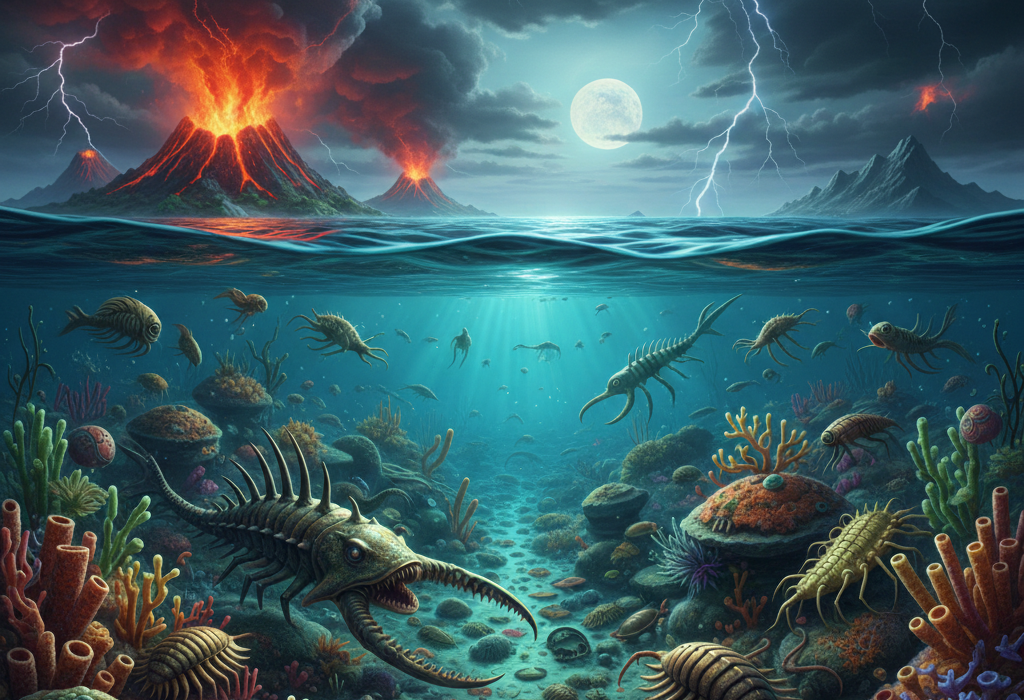
The story of prehistoric predators begins not on land, but in the sea. Hundreds of millions of years before dinosaurs walked the Earth, life thrived in ancient oceans where early predators emerged.
During the Cambrian Period, around 540 million years ago, life underwent an extraordinary burst of diversification. Simple organisms gave way to complex animals with eyes, limbs, and nervous systems. With complexity came predation. Creatures like Anomalocaris prowled the seas, armed with grasping appendages and powerful mouths capable of crushing early shelled animals.
These early predators redefined survival by forcing prey to adapt. Shells hardened, burrowing behaviors evolved, and sensory systems improved. The predator-prey arms race had begun, and it would never stop.
Predation transformed life from passive existence into an active struggle, accelerating evolution at an unprecedented pace.
Apex Predators of Ancient Oceans
As life diversified, the oceans became arenas of evolutionary extremes. Some of the most fearsome predators in Earth’s history ruled beneath the waves.
In the Devonian Period, often called the Age of Fishes, massive armored predators like Dunkleosteus appeared. With jaws formed of sharp bony plates rather than teeth, Dunkleosteus could slice through prey with astonishing force. Its bite ranks among the most powerful ever known, even by modern standards.
Later, marine reptiles would dominate prehistoric seas. Ichthyosaurs, shaped like dolphins but often much larger, were fast, intelligent hunters. Plesiosaurs used long necks and needle-like teeth to ambush fish and squid, while short-necked pliosaurs became the true terror of the oceans, combining size, speed, and crushing jaws.
Perhaps the most famous marine predator of all was Megalodon, a colossal shark that lived millions of years after the dinosaurs. It preyed on whales, reshaping marine ecosystems wherever it swam. Its extinction reminds us that even the most powerful predators are not immune to environmental change.
These ocean giants redefined survival by pushing size and strength to extremes, proving that in some ecosystems, sheer power could be an effective evolutionary strategy.
The Conquest of Land and New Hunting Grounds
When vertebrates moved from water to land, predation entered an entirely new phase. Land offered new opportunities but also new challenges. Gravity, air breathing, and temperature regulation demanded radical anatomical changes.
Early land predators were amphibian-like creatures that lurked near water, ambushing prey that ventured too close. Over time, reptiles evolved tougher skin, better lungs, and more efficient movement, allowing predators to roam farther from water sources.
The Permian Period saw the rise of predators like Dimetrodon, often mistaken for a dinosaur but actually more closely related to mammals. With its iconic sail and powerful jaws, Dimetrodon was an apex predator long before dinosaurs appeared. Its success demonstrated that dominance did not require massive size alone but efficient thermoregulation and strong feeding mechanics.
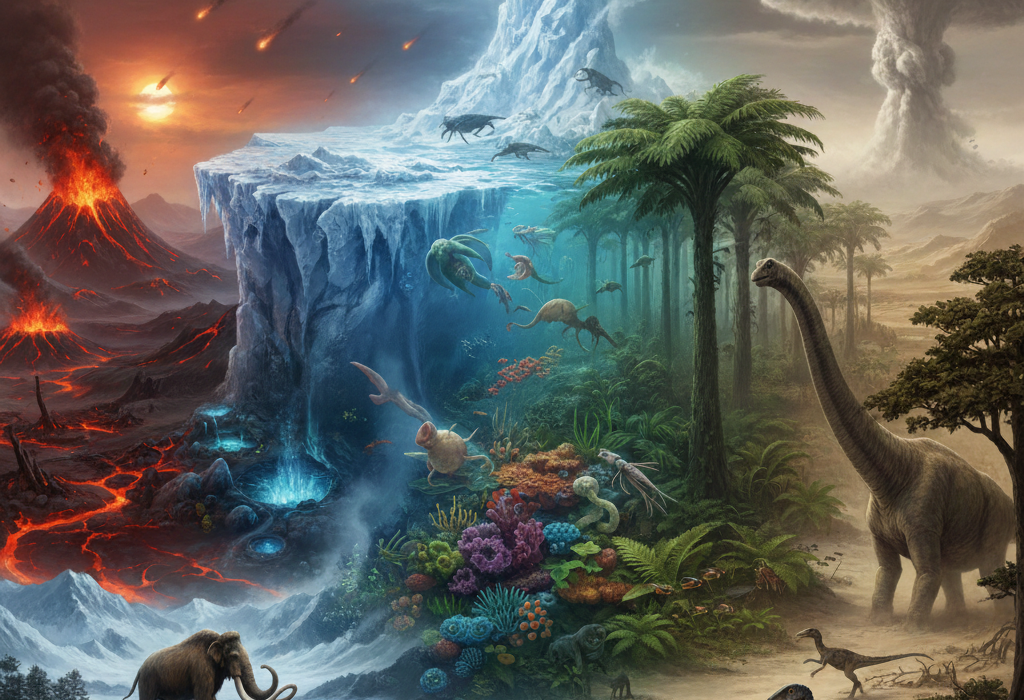
The end-Permian mass extinction, the most severe in Earth’s history, wiped out most life. Those predators that survived or evolved afterward did so in a world fundamentally reshaped, setting the stage for the age of dinosaurs.
Dinosaurs and the Evolution of Ultimate Hunters
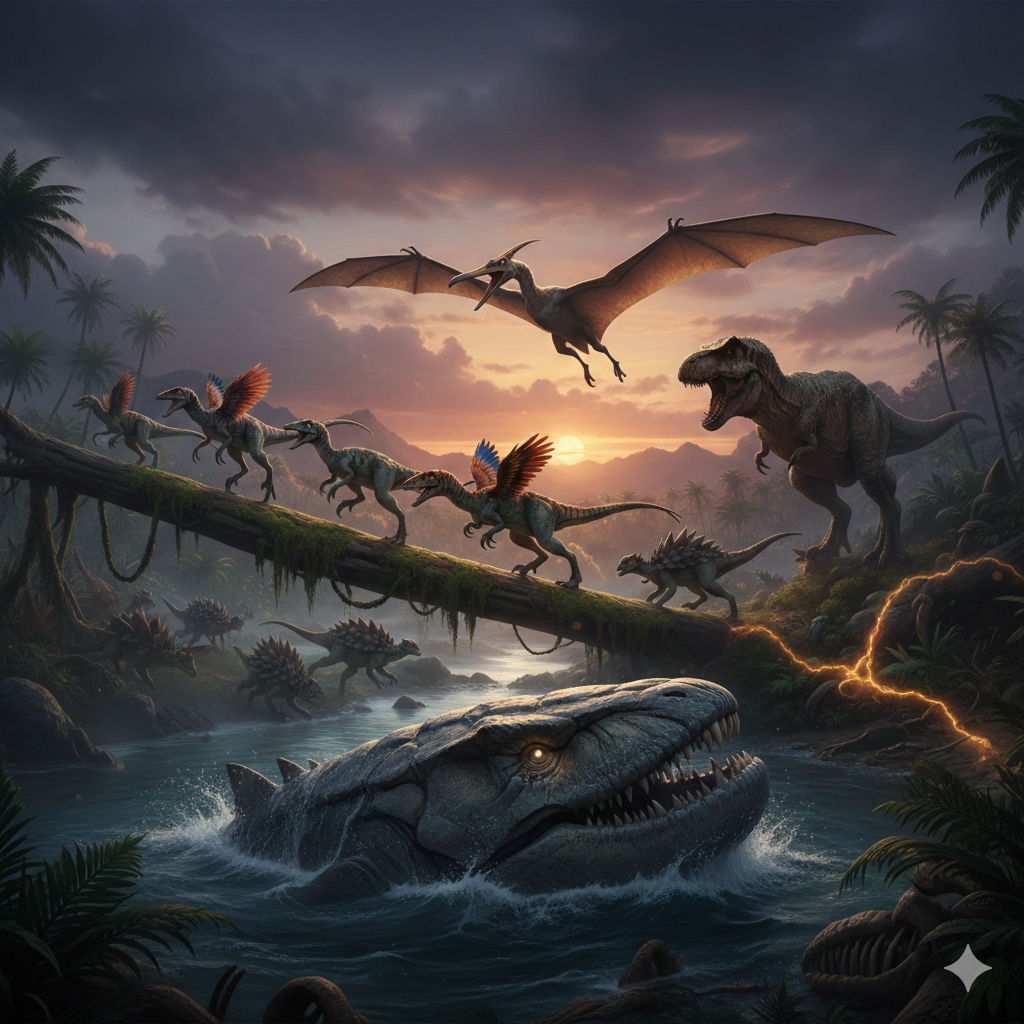
Dinosaurs reigned for over 160 million years, and during that time, predation reached extraordinary levels of specialization. Contrary to popular imagination, dinosaurs were not all slow, lumbering giants. Many were agile, intelligent, and highly adapted hunters.
Theropod dinosaurs, the group that includes all major carnivorous dinosaurs, evolved a wide range of hunting strategies. Early theropods were relatively small, but over time, some lineages grew to immense sizes, while others became faster and more precise.
Allosaurus dominated the Jurassic landscapes with serrated teeth designed to slice flesh rather than crush bone. Its hunting style may have involved slashing attacks, causing prey to bleed out. This was a different approach to predation, relying on injury rather than immediate kill.
Later, tyrannosaurs would redefine apex predation. Tyrannosaurus rex combined enormous size with unmatched bite force, capable of crushing bone. Far from being a slow scavenger, evidence suggests it was an active hunter with keen senses, including excellent vision and a powerful sense of smell.
These dinosaurs shaped entire ecosystems. Herbivorous dinosaurs evolved size, armor, horns, and herding behaviors in response. The balance between predator and prey drove evolutionary innovation on a grand scale.
Small Predators and the Power of Precision
While massive predators capture imagination, many prehistoric hunters were small, fast, and exceptionally intelligent. These predators redefined survival not through brute force but through precision and adaptability.
Dromaeosaurs, often called “raptors,” were agile theropods with sharp claws and keen senses. Their famous sickle-shaped toe claw was a weapon of control rather than simple killing, allowing them to latch onto prey. Evidence suggests some species may have hunted in groups, increasing their effectiveness.
These predators demonstrated that intelligence and coordination could rival size as evolutionary advantages. Their legacy lives on in modern birds, which are the direct descendants of small theropod dinosaurs.
In this way, prehistoric predators blurred the line between reptile and bird, between brute and brain, reshaping how survival could be achieved.
Predators of the Sky
Flight opened a new dimension for predation. Pterosaurs, the first vertebrates to achieve powered flight, dominated prehistoric skies long before birds evolved.
Some pterosaurs were small insect hunters, while others grew to astonishing sizes. Giant azhdarchid pterosaurs had wingspans rivaling small airplanes. Far from being clumsy, evidence suggests they were capable of walking efficiently on land and hunting like aerial stalkers, striking prey with long beaks.
Aerial predation added new pressures to ecosystems. Prey animals had to watch not only the ground but the sky. This vertical expansion of predation forced new adaptations, including camouflage, burrowing, and rapid escape behaviors.
Predators of the air redefined survival by making no place entirely safe.
Mammalian Predators After the Dinosaurs
The extinction of non-avian dinosaurs opened ecological niches that mammals quickly filled. Over millions of years, mammalian predators evolved into forms as terrifying and diverse as their reptilian predecessors.
Sabertooth cats, such as Smilodon, wielded elongated canine teeth designed for delivering precise, fatal bites. Their powerful forelimbs suggest they ambushed and restrained large prey before striking.
Other predators, like the dire wolf, relied on endurance and cooperation. Hunting in packs allowed them to take down prey much larger than themselves. This social strategy would later become central to human survival as well.
Even more unusual were predators like Andrewsarchus, a massive carnivorous mammal with a skull built for crushing. These animals show that mammals were not merely replacing dinosaurs but reinventing predation in their own image.
The Role of Intelligence and Behavior
As brains grew larger and behavior more complex, predation became as much about strategy as anatomy. Intelligence allowed predators to adapt quickly, learn from experience, and exploit new opportunities.
Some prehistoric predators may have used tools or environmental features to their advantage. Evidence of coordinated attacks, ambush tactics, and learned behavior suggests that survival increasingly depended on mental flexibility.
This trend culminated in humans, whose predatory success relies less on physical strength and more on intelligence, cooperation, and technology. In this sense, human evolution is part of the same story written by prehistoric predators.
Extinction and the Fragility of Dominance
One of the most sobering lessons from prehistoric predators is that dominance is temporary. No matter how powerful or well-adapted a predator may be, environmental change can undo millions of years of success.
Climate shifts, habitat loss, and mass extinctions repeatedly reset the evolutionary board. Predators that specialized too narrowly often vanished, while more adaptable species survived.
This pattern reveals a central truth about survival: flexibility often matters more than strength. The most fearsome predators were not always the most resilient.
What Prehistoric Predators Teach Us About Survival
Prehistoric predators redefined survival by showing that there is no single path to dominance. Some relied on size, others on speed, others on intelligence or cooperation. Each strategy worked only within a specific environmental context.
Their stories remind us that evolution is not a ladder but a branching tree, full of experiments, dead ends, and unexpected successes. Survival is not about perfection but about fit.
By studying these ancient hunters, we gain insight into the forces that shaped life on Earth, including our own species. We see that fear, competition, and adaptation are not flaws in nature but engines of creativity.
The Enduring Legacy of Ancient Hunters
Though prehistoric predators are long extinct, their influence remains. Modern ecosystems still bear the marks of ancient arms races. The instincts of prey animals, the behaviors of modern predators, and even human psychology reflect a world shaped by fear and pursuit.
In museums, fossils stand silent, but they tell stories of motion, struggle, and survival. They remind us that life is resilient, inventive, and deeply interconnected.
Prehistoric predators were not monsters in a moral sense. They were products of their time, fulfilling roles that kept ecosystems dynamic and balanced. Through them, survival was tested, refined, and redefined again and again.
In understanding these ancient predators, we come closer to understanding life itself, not as a gentle progression, but as a dramatic, ongoing negotiation between existence and extinction, written across the vast canvas of deep time.