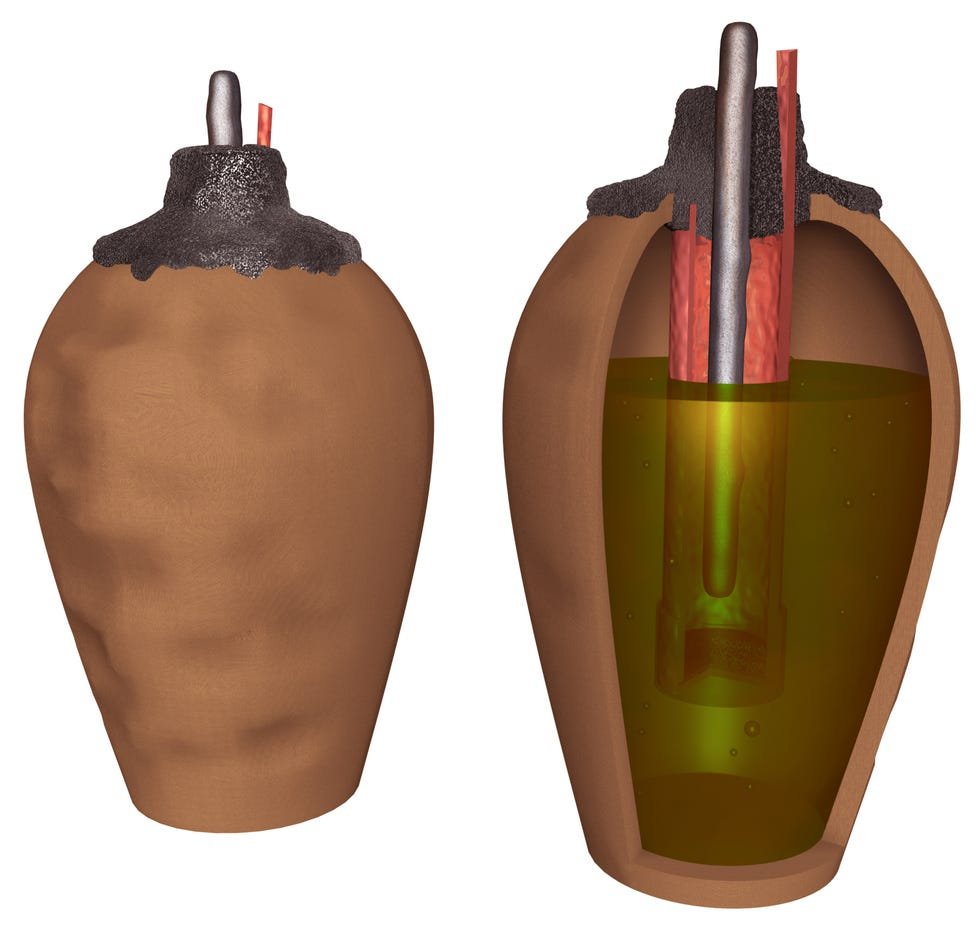
Imagine archaeologists brushing away centuries of dust from an unremarkable clay jar buried beneath the soil of ancient Mesopotamia. At first glance, it appears to be just another artifact from a civilization that flourished nearly two thousand years ago. But inside the jar lies an unusual combination of materials—a copper cylinder surrounding an iron rod, all sealed with bitumen.
To many, it was simply another relic.
To others, it was something astonishing.
Could this humble object be the world’s first battery?
The idea is irresistible. If true, it would suggest that people living nearly two millennia before the invention of the modern electric battery had already discovered a way to generate electricity. It would rewrite technological history, challenge long-held assumptions about ancient science, and raise an extraordinary question:
Did the ancient world understand electricity long before Benjamin Franklin flew his famous kite or Alessandro Volta invented the electric battery?
For decades, this mysterious artifact—popularly known as the “Baghdad Battery”—has inspired documentaries, books, museum exhibits, and endless debate. It has been cited as evidence of forgotten technologies, advanced ancient civilizations, and even lost scientific knowledge.
Yet archaeology is rarely so simple.
The truth is both more fascinating and more complicated than the legend.
The Baghdad Battery remains one of history’s most intriguing archaeological mysteries—not because we know what it was, but because we still do not.
The Discovery That Sparked a Global Mystery
The story begins in modern-day Iraq, a region often called the cradle of civilization.
This land, situated between the Tigris and Euphrates Rivers, witnessed the rise of some of humanity’s earliest cities, writing systems, laws, and scientific traditions. For thousands of years, Mesopotamia served as a crossroads where cultures exchanged ideas, technologies, and knowledge.
During archaeological excavations near the ancient village of Khujut Rabu, southeast of Baghdad, researchers uncovered an unusual ceramic vessel.
The artifact eventually attracted the attention of Austrian archaeologist Wilhelm König, who worked at the Iraq Museum in Baghdad during the 1930s.
König carefully examined the object.
Unlike ordinary storage jars, this vessel contained three distinctive components.
A small clay pot formed the outer container.
Inside rested a rolled copper sheet shaped into a cylinder.
Running through the center of this cylinder was an iron rod.
Bitumen, a naturally occurring form of asphalt, sealed the top while insulating the metal components from one another.
The arrangement immediately appeared unusual.
To modern eyes, it looked strangely familiar.
It resembled the basic structure of a simple electrochemical cell.
What Does the Artifact Actually Look Like?
The so-called Baghdad Battery is surprisingly small.
The clay jar stands roughly 13 to 15 centimeters (about 5 to 6 inches) tall.
The copper cylinder fits neatly inside the vessel without touching the iron rod suspended through its center.
This separation is important.
In modern batteries, two different metals remain electrically isolated while connected through a chemical solution known as an electrolyte.
The Baghdad artifact possesses the same basic physical arrangement.
However, one crucial component is missing.
No liquid electrolyte survived inside the vessel.
If the jar originally functioned as an electrical device, any acidic liquid would almost certainly have evaporated or decomposed over the centuries.
Possible candidates include vinegar, grape juice, lemon juice, or fermented wine, all of which contain weak acids capable of supporting electrochemical reactions.
How a Battery Produces Electricity
To understand why the artifact attracted so much attention, it helps to understand how batteries work.
Electricity does not simply appear from nowhere.
It arises from the movement of electrons.
A battery converts chemical energy into electrical energy through reactions between different materials.
When two dissimilar metals are placed in an acidic solution, one metal tends to lose electrons more readily than the other.
This difference creates an electric potential.
If the metals are connected by a conductor, electrons begin flowing.
That flow is electric current.
The principle is elegantly simple.
Modern batteries employ far more sophisticated materials, but the underlying chemistry remains fundamentally similar.
Iron and copper, the metals found in the Baghdad artifact, can indeed produce a small voltage when immersed in certain acidic liquids.
The Experiments That Fueled the Legend
The battery hypothesis became far more compelling when researchers attempted to recreate the device.
Several experimental archaeologists constructed replicas using clay jars, copper cylinders, iron rods, and acidic solutions.
The results surprised many observers.
The replicas generated electricity.
Typically, each produced between about 0.5 and 1 volt, depending on the materials and electrolyte used.
This is a relatively small voltage.
It is nowhere near enough to power modern electronics.
However, connecting multiple cells together could theoretically increase the total voltage.
These experiments demonstrated something important.
The design could function as a battery.
But demonstrating possibility is not the same as proving historical purpose.
A spoon can serve as a screwdriver in an emergency.
That does not mean it was designed to tighten screws.
This distinction lies at the center of the Baghdad Battery debate.
Could Ancient People Have Used Electricity?
Suppose the artifact truly generated electricity.
What would it have been used for?
This question immediately becomes more difficult.
No ancient texts describe electrical experiments.
No wires have been discovered alongside the jars.
No electrical devices from the same period have been identified.
No lamps, motors, switches, or conductors accompany the artifacts.
Without such supporting evidence, proposed uses remain speculative.
Nevertheless, several fascinating possibilities have been suggested.
The Electroplating Hypothesis
One of the most widely discussed ideas involves electroplating.
Electroplating uses electricity to deposit a thin layer of one metal onto another.
Today, it protects jewelry, improves corrosion resistance, and creates decorative finishes.
If ancient craftsmen possessed simple batteries, perhaps they used them to coat inexpensive objects with precious metals like gold or silver.
This idea gained popularity because electroplating requires relatively low electrical currents.
Experimental demonstrations have shown that replica Baghdad Batteries can deposit thin metallic coatings under laboratory conditions.
At first glance, this seems persuasive.
However, archaeology tells a more complicated story.
Ancient gold-plated artifacts from Mesopotamia generally show characteristics consistent with traditional mechanical techniques rather than electroplating.
Methods such as hammering thin gold foil onto surfaces or using mercury gilding explain these objects without requiring electricity.
To date, no archaeological evidence definitively demonstrates ancient electroplating powered by batteries.
Medicine and Healing
Another proposal suggests medical applications.
Electrical stimulation can affect muscles and nerves.
Ancient physicians occasionally used naturally electric fish, such as electric rays, to relieve pain or treat certain conditions.
Historical records from Greek and Roman medicine describe such practices.
Could artificial batteries have served a similar purpose?
Some proponents imagine mild electrical currents being applied therapeutically.
However, no surviving medical texts from ancient Mesopotamia mention electrical devices.
Nor has any equipment associated with such treatments been discovered.
The medical hypothesis remains intriguing but unsupported.
Religious Rituals
Some writers have proposed ceremonial or religious uses.
Imagine priests secretly producing tiny electrical shocks during sacred rituals.
To observers unfamiliar with electricity, such effects might appear miraculous.
Although this idea captures the imagination, it relies almost entirely on speculation.
There is no archaeological evidence connecting the jars with temples, religious ceremonies, or ritual practices involving electricity.
It belongs more to historical fiction than established archaeology.
A Simple Storage Container?
Many archaeologists favor a far less dramatic explanation.
The object may simply have been an ordinary storage vessel.
Copper cylinders could have protected valuable scrolls, sacred writings, or other delicate materials.
Iron rods may have reinforced internal structures or served unrelated purposes.
Bitumen was widely used in ancient Mesopotamia as a waterproof sealant.
The combination of these materials does not necessarily indicate electrical technology.
Archaeological interpretation often depends upon context.
Unfortunately, the excavation records from the original discovery remain incomplete by modern standards, making definitive conclusions difficult.
What Was the Historical Context?
Dating the Baghdad Battery has also proven challenging.
Most researchers associate the artifacts with the Parthian or early Sasanian periods, roughly between the last centuries BCE and the early centuries CE.
These civilizations possessed remarkable engineering skills.
They built sophisticated irrigation systems.
They developed advanced metalworking techniques.
They maintained long-distance trade routes stretching from the Mediterranean to China.
Their scientific achievements were considerable.
Yet no surviving historical documents describe the deliberate production of electricity.
This silence is significant.
Civilizations that developed writing generally recorded important technological innovations.
If batteries had played a meaningful practical role, historians might expect at least some textual evidence.
None has been found.
The Missing Evidence
One reason many archaeologists remain skeptical is the absence of supporting artifacts.
Technological systems rarely exist in isolation.
For example, ancient metallurgy leaves furnaces, slag, tools, molds, and workshops.
Writing leaves inscriptions, tablets, and styluses.
Glassmaking leaves kilns and broken vessels.
Electrical technology should likewise leave traces.
Researchers might expect wires, conductive connectors, specialized containers, electrodes, or objects clearly modified through electrochemical processes.
Such evidence has not emerged.
Instead, the Baghdad Battery stands largely alone.
This isolation makes extraordinary interpretations difficult to support.
Why the Artifact Looks So Convincing
Despite the uncertainties, the artifact continues to fascinate because it genuinely resembles a battery.
Human brains excel at recognizing familiar patterns.
When modern observers see two dissimilar metals separated inside a container, they naturally think of electrochemical cells.
But resemblance alone cannot establish function.
Archaeology has repeatedly shown that objects can resemble modern technologies while serving entirely different purposes.
History often surprises us.
Ancient tools may imitate modern instruments by coincidence rather than design.
Scientific interpretation therefore requires evidence beyond appearance.
Modern Scientific Evaluations
Over the decades, researchers from many disciplines have examined the Baghdad Battery.
Chemists confirm that the arrangement could generate electricity.
Materials scientists agree that the metals are compatible with simple electrochemical reactions.
Experimental archaeologists have successfully built functioning replicas.
Yet historians and archaeologists emphasize another crucial point.
No direct evidence demonstrates that the original jars were ever used in this way.
The distinction between “could have” and “did” is fundamental.
Science seeks evidence rather than possibility.
Many objects are capable of unintended functions never imagined by their creators.
Without contextual evidence, assigning purpose becomes highly uncertain.
Popular Culture and Extraordinary Claims
The Baghdad Battery achieved worldwide fame through television documentaries, popular books, and speculative history programs.
Some writers have claimed it proves that ancient civilizations possessed advanced electrical technologies.
Others have suggested lost scientific knowledge destroyed by time.
More extraordinary theories invoke vanished civilizations or even extraterrestrial influence.
These ideas attract public attention because they challenge conventional history.
However, extraordinary claims require extraordinary evidence.
To date, such evidence has not appeared.
Professional archaeologists generally reject sensational conclusions unsupported by physical findings.
The mystery remains genuine, but its existence does not justify unlimited speculation.
Why Ancient Technology Often Seems More Advanced Than We Expect
The Baghdad Battery also reflects a broader misunderstanding about ancient civilizations.
People sometimes assume ancient societies were technologically primitive.
In reality, they achieved remarkable engineering feats.
They constructed pyramids with astonishing precision.
They developed complex calendars.
They mapped the stars.
They built aqueducts, monumental architecture, sophisticated irrigation systems, and intricate mechanical devices such as the Antikythera Mechanism.
Recognizing these genuine achievements does not require attributing technologies they may never have possessed.
Ancient ingenuity deserves admiration based on evidence, not exaggeration.
The Importance of Experimental Archaeology
One valuable outcome of the Baghdad Battery debate has been the growth of experimental archaeology.
Instead of merely discussing artifacts, researchers attempt to recreate ancient technologies using historically accurate materials and techniques.
Building replica batteries has taught scientists much about ancient metallurgy, chemistry, and craftsmanship.
These experiments demonstrate that ancient artisans possessed the technical skills necessary to create surprisingly sophisticated objects.
Whether or not they intended to produce electricity, the artifact reveals considerable expertise in working with metals, ceramics, and sealants.
Could the Mystery Ever Be Solved?
Future discoveries may eventually clarify the artifact’s purpose.
Additional excavations could uncover similar objects in better-preserved archaeological contexts.
Chemical analysis might detect microscopic traces of ancient electrolytes inside surviving vessels.
Previously overlooked historical texts may one day describe unfamiliar technologies.
Scientific techniques continue to improve.
High-resolution imaging, residue analysis, and advanced spectroscopy offer new ways of examining ancient artifacts without damaging them.
Each technological advance increases the possibility that hidden clues may emerge.
Until then, uncertainty remains an essential part of the story.
What the Baghdad Battery Really Teaches Us
Perhaps the greatest lesson of the Baghdad Battery has little to do with electricity itself.
It teaches us how science approaches mystery.
When the artifact first came to public attention, excitement quickly outpaced evidence. The possibility of ancient electricity captured imaginations around the world because it seemed to promise a forgotten chapter of human history.
But science is not built upon exciting possibilities.
It is built upon careful investigation.
Researchers asked whether the object could function as a battery.
Experiments showed that it could.
They then asked whether evidence demonstrated that it actually did.
So far, the answer remains uncertain.
That distinction is the foundation of scientific thinking.
Evidence must lead conclusions—not the other way around.
Conclusion
The Baghdad Battery occupies a unique place in archaeology because it exists at the boundary between possibility and proof.
Its design undeniably resembles a simple electrochemical cell. Laboratory replicas can generate small amounts of electricity using materials similar to those available in antiquity. This makes it one of the most intriguing artifacts ever discovered.
Yet resemblance is not confirmation.
No surviving texts describe its electrical use. No associated technological system has been found. No archaeological evidence conclusively demonstrates that ancient Mesopotamians generated electricity with these vessels.
Today, most specialists view the battery hypothesis as an interesting possibility rather than an established historical fact. Other explanations—including that the jars served entirely different purposes—remain equally plausible.
In many ways, the Baghdad Battery is more valuable because it has not been definitively explained. It reminds us that archaeology is not merely about uncovering objects from the past but about interpreting them with patience, skepticism, and evidence. Every artifact tells a story, but sometimes the most fascinating stories are those with missing pages.
Whether the Baghdad Battery was humanity’s earliest electrical device or simply an ordinary object whose true purpose has been forgotten, it continues to challenge our assumptions about ancient civilizations and the limits of historical knowledge.
Some mysteries fade as evidence accumulates.
Others continue to inspire questions across generations.
The Baghdad Battery remains one of the latter—a silent clay jar that has generated more debate than electricity, and in doing so has become one of the most captivating puzzles in the history of archaeology.