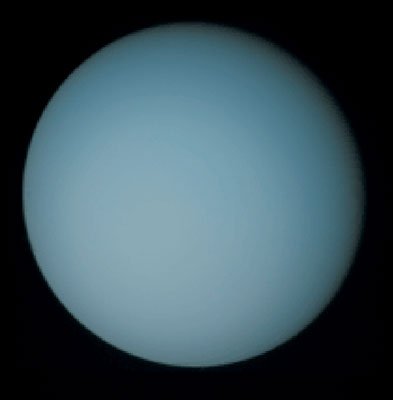
Far beyond the warmth of the Sun, past the glowing orbits of Jupiter and Saturn, drifts a lonely blue world—enigmatic, frozen, and tilted on its side. Uranus, the seventh planet from the Sun, is one of the most mysterious members of our cosmic family. It does not blaze with the fury of storms like Jupiter, nor shine with the majestic rings of Saturn. Instead, it glows softly in a tranquil blue-green light, serene and distant, almost indifferent to the drama of the inner planets.
Yet beneath that calm exterior lies a world stranger than imagination. Uranus is the coldest planet in the solar system, a frozen giant with a tilted axis so extreme that it literally rolls around the Sun on its side. Its seasons are unlike anything on Earth—each lasting more than 20 years, bringing half a planet into endless sunlight while the other half lies in perpetual night.
This tilted ice giant defies expectations and refuses to fit neatly into the patterns that govern other worlds. It is a planet of paradoxes—a place where winds rage at hundreds of kilometers per hour across a world colder than dry ice, and where time, light, and weather obey rules unlike anywhere else in the solar system.
To understand Uranus is to explore the strange and the beautiful—the quiet depths of a world that stands apart, both scientifically and poetically.
A Discovery That Changed the Map of the Heavens
For most of human history, the solar system ended with Saturn. Ancient astronomers saw only six planets, all visible to the naked eye. The stars beyond seemed fixed and eternal, a glittering backdrop to the dance of the known worlds.
Then, in 1781, everything changed. William Herschel, a musician turned astronomer, was scanning the night sky with his homemade telescope when he spotted a faint, blue-green disk. At first, he thought it was a comet. But as he tracked its slow, steady motion, he realized he had discovered something far greater: a new planet.
This was Uranus—the first planet found with the aid of a telescope, and the first to expand humanity’s boundaries of the known solar system. Its discovery doubled the size of our cosmic neighborhood and opened the door to a universe much larger than anyone had imagined.
The discovery of Uranus marked a turning point in science and imagination alike. It was proof that the cosmos held more secrets than the human eye could see, and that curiosity, coupled with technology, could uncover them. It was a new frontier—a reminder that the map of heaven was not yet complete.
The Pale Blue World
Seen through a telescope, Uranus appears as a tranquil orb of pale cyan light, its color born from methane in its atmosphere. Methane absorbs red wavelengths of sunlight and reflects blue and green, painting the planet in hues of serenity.
This calm appearance is deceptive. Beneath the blue haze lies a deep, frigid atmosphere composed mainly of hydrogen and helium, with about 2% methane and traces of water and ammonia. The air grows denser with depth, merging into a vast, icy mantle of water, methane, and ammonia ices—materials that are neither fully liquid nor fully solid, but exist in a strange, slushy state of matter.
At its heart, Uranus may have a rocky core the size of Earth, but it’s buried beneath thousands of kilometers of exotic ices and compressed gases. The pressure and temperature deep inside the planet are immense—millions of atmospheres and thousands of degrees—yet still less than the fiery interiors of Jupiter or Saturn.
This composition makes Uranus an “ice giant,” a distinct class of planet that differs from the gas giants. Its ethereal blue glow conceals not fire, but frozen chemistry—a symphony of elements held together in a delicate, alien balance.
The Coldest Planet in the Solar System
Despite orbiting closer to the Sun than Neptune, Uranus holds the record for being the coldest planet in the solar system. Its minimum atmospheric temperature plunges to an astonishing -224°C, colder than any other known world.
Why is Uranus so cold? The answer remains one of planetary science’s enduring mysteries. Most giant planets radiate more heat than they receive from the Sun, thanks to leftover energy from their formation and slow gravitational contraction. Jupiter and Saturn, for example, still glow faintly with internal heat.
But Uranus seems almost lifeless in comparison. It emits barely any internal heat at all—its energy output is nearly equal to the sunlight it absorbs. Something, at some point, may have extinguished its inner warmth.
One leading theory is that Uranus suffered a catastrophic collision early in its history. A massive impact—perhaps with a protoplanet the size of Earth—could have knocked it on its side and disrupted its internal structure, releasing much of its primordial heat into space. This ancient trauma may have left Uranus frozen from the inside out, a wounded world still carrying the scars of cosmic violence.
Whatever the cause, Uranus remains the solar system’s great cold enigma—a silent planet that radiates almost nothing, as though its very heart has gone still.
A Planet Turned Sideways
Perhaps the strangest thing about Uranus is its tilt. Every planet in the solar system spins roughly upright relative to its orbit, with slight variations. But Uranus is different—it is tipped over so far that it lies almost on its side, with an axial tilt of about 98 degrees.
This means that as it orbits the Sun, each pole experiences decades of continuous daylight followed by decades of darkness. Imagine standing at Uranus’s north pole: for 42 Earth years, the Sun would circle low on the horizon without setting. Then, for the next 42 years, the Sun would vanish, leaving endless twilight.
This extreme orientation gives Uranus the strangest seasons in the solar system. Each season lasts about 21 Earth years, and the planet’s weather patterns shift dramatically as sunlight slowly migrates from pole to pole.
During its equinoxes—when the Sun lies directly above its equator—the atmosphere becomes chaotic. Giant storms appear and vanish, clouds form and disperse, and the planet’s once-still surface comes alive. These rare moments reveal that beneath its calm exterior, Uranus hides a restless heart that wakes only when the light returns.
The Winds of a Frozen Giant
Uranus may be cold, but it is not still. High-speed winds race across its cloud tops, reaching speeds of up to 900 kilometers per hour—nearly the speed of sound on Earth. These winds blow in the direction of the planet’s rotation, sculpting long, faint cloud bands across the atmosphere.
Because Uranus’s clouds are made of methane and ammonia ices, they form in layers. The uppermost haze, visible from space, lies above thicker cloud decks hidden below. From Earth, these layers blur together into the planet’s characteristic smooth, featureless appearance.
Yet modern telescopes and spacecraft have revealed surprising variability. In 2014, the Keck Observatory recorded bright, transient storms erupting on Uranus—massive cloud systems brighter than anything seen before. These storms, triggered during equinox, hint that deep within the icy atmosphere, powerful energy still stirs, waiting for sunlight to ignite it.
Even the planet’s magnetic field behaves strangely. Unlike Earth’s, which aligns roughly with its rotation axis, Uranus’s magnetic field is wildly tilted—about 59 degrees from the axis—and offset far from the planet’s center. The result is a magnetic field that twists and flickers unpredictably, creating auroras that dance chaotically across its poles.
Uranus is a world where wind, magnetism, and light seem to follow no familiar rule—a place where chaos wears the mask of calm.
The Long Journey of Voyager 2
In January 1986, after a nine-year journey through the outer solar system, NASA’s Voyager 2 spacecraft made its historic flyby of Uranus. It remains the only mission ever to visit the planet up close.
Voyager 2 passed within 81,500 kilometers of Uranus’s cloud tops, capturing the first—and still only—close-up images of the planet, its moons, and its delicate rings. The data it sent back transformed our understanding of this icy world.
The spacecraft revealed a nearly featureless sphere of blue-green gas, confirming the dominance of methane in its atmosphere. It discovered 10 new moons, a dark ring system, and complex magnetic interactions that no one had predicted.
Perhaps most hauntingly, Voyager 2’s images captured the eerie simplicity of Uranus—a world that seemed tranquil and inscrutable, as though frozen in cosmic silence. After that brief encounter, the spacecraft sped onward toward Neptune, leaving Uranus behind in the eternal twilight of the outer solar system.
To this day, those fleeting images remain our most intimate glimpse of Uranus—a single chapter in an unfinished story waiting for humanity to return.
The Hidden Rings
For decades, astronomers believed only Saturn had rings. Then, in 1977, something unexpected happened. As Uranus passed in front of a distant star, the star’s light flickered several times before and after the planet’s transit—evidence of thin, dark rings encircling the planet.
Voyager 2 later confirmed and photographed these rings. Unlike Saturn’s wide, bright bands of ice, Uranus’s rings are narrow, faint, and composed mostly of dark particles, possibly made of radiation-darkened ice or carbon-rich material.
There are 13 known rings in total, each named after characters from Shakespeare and Alexander Pope, continuing the poetic tradition of naming Uranus’s features after literary figures.
These rings are confined and shaped by small “shepherd moons” whose gravity prevents them from dispersing. The entire system is tilted, like the planet itself, spinning sideways through the darkness.
Though subtle and shadowy, the rings of Uranus add to its haunting allure—a hidden crown of dust circling a world that seems to prefer mystery over display.
The Family of Moons
Orbiting Uranus is a collection of at least 27 known moons, each a world unto itself. They are named for characters from Shakespearean plays and English poetry—Titania, Oberon, Ariel, Umbriel, Miranda, and many others. Their names evoke magic, love, and tragedy, and their surfaces reflect those same contrasts.
Miranda, perhaps the most fascinating, is a shattered moon stitched back together. Voyager 2 revealed towering cliffs, vast canyons, and regions of patchwork terrain unlike anything seen elsewhere. Some cliffs on Miranda rise over 20 kilometers high—the tallest known in the solar system. It looks as though the moon was once broken apart by massive impacts and later reassembled by gravity, creating a Frankenstein landscape of frozen chaos.
Titania and Oberon, the largest moons, show evidence of ancient geological activity—ridges, valleys, and possible cryovolcanic flows where icy material once erupted from beneath their crusts. Ariel, another moon, displays deep canyons and resurfaced plains, suggesting that its interior may once have been warm enough to move and reshape itself.
Each moon tells a different chapter of Uranus’s history, their icy scars recording billions of years of collisions, freezing, and silent transformation. They are reminders that even in the darkest corners of the solar system, geological beauty endures.
Seasons of Eternal Twilight
Because of its sideways tilt, Uranus’s seasons are among the strangest in the solar system. As it orbits the Sun every 84 Earth years, its poles alternately bathe in sunlight or sink into darkness for decades at a time.
During solstice, one pole points almost directly at the Sun, basking in continuous daylight, while the other is plunged into unbroken night. Near the equinox, sunlight spreads evenly across the planet, sparking atmospheric upheavals and sudden storms.
The human mind struggles to imagine such a rhythm. On Earth, seasons are measured in months; on Uranus, a single spring can last a quarter of a century. Imagine growing up beneath a Sun that never sets, then living to see the first sunset of your life decades later.
These extreme seasonal shifts profoundly affect the planet’s atmosphere. The slow, uneven heating of the poles likely drives the planet’s winds and storms, creating patterns that change only on the scale of human lifetimes.
In a way, Uranus teaches us patience—it reminds us that in the grand theater of the cosmos, even seasons can last generations, and change comes slowly to the cold edges of the Sun’s domain.
The Mystery of the Missing Heat
Among Uranus’s greatest puzzles is its lack of internal heat. All other giant planets radiate significantly more energy than they receive from the Sun, but Uranus emits almost none. Its internal temperature appears inexplicably low, and its energy balance is nearly perfect.
Why? Scientists are not certain. The leading explanation, as mentioned before, is that a colossal impact early in its history knocked Uranus over and disrupted its interior. This might have caused layers of its core and mantle to mix inefficiently, trapping heat deep within and preventing it from escaping.
Another theory suggests that Uranus’s interior could be stratified—composed of distinct layers that inhibit convection, the process that transfers heat outward. If the heat cannot move freely, the planet’s surface would remain cold while its core stays hot, locked in silence beneath the ice.
Whatever the cause, this frozen stillness sets Uranus apart. It is a planet that seems to have lost its inner fire, drifting through space like a dream half-forgotten—a world that once burned and now only remembers the warmth it lost.
A Tilted Magnet and Dancing Lights
Uranus’s magnetic field adds yet another layer of strangeness to its already peculiar character. Unlike Earth’s symmetrical field, Uranus’s is wildly irregular—tilted nearly 60 degrees from its rotation axis and offset far from its center.
This creates an ever-changing magnetic environment, one that twists and warps as the planet rotates. The result is that Uranus’s magnetosphere—a bubble of magnetic influence extending into space—is constantly flipping and reorienting, exposing different regions to solar wind at different times.
Despite this chaos, Uranus does produce auroras—ghostly glows that flicker near its poles. But unlike the steady curtains of light on Earth or Jupiter, Uranus’s auroras are faint and fleeting, often appearing at unexpected latitudes.
The magnetism of Uranus is another clue to its inner structure, hinting at complex layers of ionized water and ammonia deep within the planet. It is a reminder that beneath its serene exterior, Uranus is a world of invisible storms and restless energy.
The Future of Exploration
It has been nearly four decades since Voyager 2’s brief encounter with Uranus. In that time, technology and curiosity have advanced enormously, yet no spacecraft has returned. Uranus remains a largely uncharted frontier—an ice giant waiting for its second visitor.
In recent years, interest in revisiting Uranus has grown. NASA and other space agencies have proposed missions to study it up close, including orbiters that could map its magnetic field, analyze its moons, and probe its atmosphere with descent probes.
A Uranus Orbiter and Probe mission, for example, could revolutionize our understanding of ice giants—not only revealing Uranus’s secrets but also helping us interpret the countless exoplanets discovered across the galaxy that resemble it. Ice giants are common in the universe; by understanding Uranus, we understand the architecture of distant star systems as well.
The call to return to Uranus is not just scientific—it is poetic. After all, it remains one of the last great unknowns of our own solar system. To stand at the edge of what we know and look back at that silent blue orb is to feel the pull of exploration itself.
Uranus and the Cosmic Imagination
Uranus captures something unique in the human imagination. It is not dramatic like Jupiter, nor radiant like Saturn—it is subtle, distant, almost meditative. It invites contemplation rather than awe, reflection rather than spectacle.
Its sideways spin and endless seasons challenge our ideas of normality. Its cold silence evokes both melancholy and wonder. It is a planet that seems to whisper instead of roar, reminding us that the universe contains beauty in restraint as well as grandeur.
In mythology, Uranus (or Ouranos) was the primordial sky, the father of the Titans—a being of infinite vastness. The planet that bears his name lives up to that mythic heritage. It is the sky made manifest: pale, distant, eternal.
Perhaps that is why Uranus continues to fascinate scientists and dreamers alike. It is a symbol of the unknown, of mysteries waiting patiently in the darkness, untouched and unspoiled.
Lessons from a Frozen World
In studying Uranus, we learn not just about a distant planet, but about the forces that shape worlds everywhere. We learn about tilt and balance, about the fragility of heat and the resilience of ice. We learn that even in the farthest reaches of the Sun’s light, motion and energy persist in unexpected ways.
Uranus reminds us that the universe is not uniform. It thrives on variation and surprise. Every planet tells a different story, and every story adds a new verse to the cosmic song.
If Earth is a symphony of warmth and life, Uranus is the haunting echo of silence—a melody in minor key that speaks of endurance, patience, and mystery. It shows us that even the coldest, quietest corners of space are full of wonder waiting to be heard.
The Eternal Tilt
As Uranus continues its slow, sideways journey around the Sun, it remains one of the solar system’s most enigmatic figures—a world of paradoxes and poetry. It spins in defiance of the ordinary, frozen yet dynamic, faint yet endlessly captivating.
One day, humanity will return to Uranus. Our machines will glide once more through its turquoise skies, our instruments will listen for whispers of warmth beneath the ice, and our eyes will gaze anew upon its moons and rings. When that happens, we will not only uncover its secrets but also rediscover a truth about ourselves: that curiosity is infinite, and the desire to understand the universe knows no cold strong enough to extinguish it.
Uranus, the coldest planet with the strangest seasons, drifts quietly in the darkness—its poles bathed alternately in light and shadow, its heart still wounded from ancient impact, its story waiting to be finished.
And though the Sun’s warmth barely reaches it, Uranus continues to glow—a faint, steady beacon in the cosmic night. It reminds us that even in the farthest, coldest places, there is still light, still motion, still mystery.
The sideways planet spins on, patient and timeless, whispering through the void. And we, its distant observers, can only marvel—knowing that somewhere out there, beneath the pale blue calm, the universe still dreams.