Far beyond the warmth of the Sun, where sunlight is little more than a faint whisper, lies a world wrapped in sapphire blue — cold, distant, and majestic. Neptune, the eighth and most remote planet in the solar system, orbits in darkness more than 4.5 billion kilometers from the Sun. It is the final giant, the edge of our planetary family, the sentinel of the deep.
For centuries, Neptune was hidden from human eyes, too distant and dim to be seen without a telescope. Yet even from afar, its discovery marked one of science’s greatest triumphs — a planet found not by sight, but by mathematics. When Uranus’s orbit wobbled in a way that Newton’s laws couldn’t explain, astronomers realized another unseen world must be tugging on it. Guided by calculations alone, Johann Galle turned his telescope skyward in 1846 — and there it was: a tiny blue disk shining faintly against the blackness of eternity.
Since that moment, Neptune has been a world of fascination and mystery — a planet that defies expectations. It is cold, yes, but also wildly dynamic. It is distant, but restless. It has storms so fierce that winds rage faster than anywhere else in the solar system. It glows with a strange blue light, its clouds streaking across its face like frozen oceans in motion. Beneath those clouds lies a world no probe has ever touched, a place of crushing pressure, exotic ice, and hidden heat — a world that may still hold secrets we have yet to imagine.
A World Beyond the Edge
Neptune’s domain is a realm of silence and shadow. It is so far from the Sun that daylight there is 900 times dimmer than on Earth. From Neptune’s surface — if one could stand upon its invisible depths — the Sun would appear not as a blazing disk, but as a bright star barely piercing the twilight haze.
And yet, Neptune shines. Its color — that deep, vivid azure — is one of the most striking in the cosmos. Unlike the pale blue of Uranus, Neptune’s hue is darker, more intense, like the ocean at twilight. This mesmerizing color comes from the gases in its atmosphere. Methane absorbs red light from the Sun, allowing only blue and green wavelengths to scatter back into space. But the exact reason for Neptune’s rich shade remains a puzzle; scientists suspect that an unknown component in its atmosphere — perhaps a haze particle or subtle chemical — deepens the color beyond what methane alone could produce.
Neptune is immense, the fourth-largest planet by diameter and the third-most massive. It is about 49,000 kilometers across — nearly four times wider than Earth. But unlike the gas giants Jupiter and Saturn, Neptune is an ice giant, a planet with a different internal makeup. It is composed not mostly of hydrogen and helium, but of heavier elements — water, ammonia, and methane ices compressed under enormous pressure. These substances exist in exotic forms, behaving more like dense, hot fluids than solid ice.
The Breath of a Frozen Giant
Despite receiving so little sunlight, Neptune’s atmosphere is astonishingly active. The planet seems alive with storms, winds, and weather patterns that defy its frigid environment. Voyager 2 — the only spacecraft ever to visit Neptune, in 1989 — revealed a world unlike any other.
As the spacecraft approached, it captured the first images of the “Great Dark Spot,” a colossal storm nearly the size of Earth swirling through the southern hemisphere. This vortex was like Jupiter’s Great Red Spot — but faster, darker, and more transient. Voyager also discovered smaller storms, high-speed winds, and bright white clouds racing across the planet like frozen ghosts.
These clouds are made of methane ice crystals, reflecting sunlight in dazzling streaks against the dark blue atmosphere. Scientists nicknamed one of them “Scooter” for the way it zipped around the planet at incredible speed.
The most astonishing revelation, however, was Neptune’s wind. Despite its distance from the Sun, Neptune has the fastest winds in the solar system — reaching speeds of 2,100 kilometers per hour, faster than the speed of sound on Earth. How could such ferocity exist on a world bathed in near darkness?
The answer remains uncertain. Some scientists believe Neptune’s core radiates more heat than it receives from the Sun, powering its wild weather. Others think its unique composition and internal convection create deep atmospheric flows that drive these violent storms. Whatever the cause, Neptune’s atmosphere is a paradox — a frozen world with the heart of a tempest.
The Mystery of the Great Dark Spot
When Voyager 2 flew past Neptune, the Great Dark Spot became an instant icon. It was a vast oval storm, spinning counterclockwise in the southern hemisphere, flanked by bright, cirrus-like methane clouds. It seemed eternal — but when the Hubble Space Telescope observed Neptune just a few years later, the storm had vanished.
In its place, the atmosphere appeared calm — until another dark spot emerged, this time in the northern hemisphere. Unlike Jupiter’s centuries-old Red Spot, Neptune’s storms seem temporary, forming and fading within years.
These dark spots are thought to be massive vortices — regions of low pressure where the atmosphere sinks, clearing away the higher, brighter methane clouds and revealing darker layers below. They are immense, thousands of kilometers wide, yet ephemeral. The discovery of these transient storms has transformed our understanding of weather on ice giants. Neptune’s atmosphere, it seems, is in constant flux — a living, shifting world of wind and shadow.
The Hidden Heat Within
One of Neptune’s greatest mysteries lies not above its clouds but beneath them. Despite its immense distance from the Sun, Neptune emits more than twice the energy it receives. Something inside is generating heat — but what?
Unlike Uranus, which radiates almost no excess heat, Neptune glows with internal warmth. Scientists believe this heat may come from the planet’s slow contraction under gravity, releasing leftover energy from its formation 4.5 billion years ago. Another theory suggests that Neptune’s interior layers — compressed water, ammonia, and methane — may be undergoing complex chemical reactions that release energy.
Deep below the atmosphere, pressures rise to millions of times Earth’s, and temperatures climb to thousands of degrees. Here, the familiar compounds of water and methane exist in exotic forms. Some researchers propose that within these depths, carbon atoms may break free and form diamond rain — literal jewels falling through the mantle of the planet, sinking toward the core in glittering storms of carbon.
If true, Neptune’s interior would be a place of unimaginable beauty and violence — a realm where physics bends and elements transform under pressure no laboratory on Earth can replicate.
A World of Ice and Shadows
Beneath the storm-tossed atmosphere lies Neptune’s mantle — a vast layer of superheated ices that flow like liquid metal. This region is neither gas nor solid but something in between — a hot, dense ocean of “slush” made of water, ammonia, and methane.
Here, molecules are stripped and reassembled in extreme conditions. Hydrogen and oxygen may separate and recombine, forming exotic substances unknown on Earth. This mantle likely extends halfway down to the core, surrounding a dense rocky center perhaps the size of Earth itself.
At the heart of Neptune, where pressures exceed 7 million atmospheres and temperatures soar to 7,000°C, lies the planet’s secret furnace. Though small compared to the whole planet, this core may still contain as much mass as the entire Earth — an ancient relic from the solar system’s formation, still glowing faintly with primordial heat.
It is this heat, rising slowly through the icy mantle, that may fuel Neptune’s storms and winds. Even in the outer darkness, the planet has a hidden fire — a ghostly echo of the Sun’s warmth, trapped deep within.
The Planet of Winds and Whispers
Neptune’s atmosphere is layered in subtle complexity. The uppermost region is dominated by methane, hydrogen, and helium, forming hazy blue clouds that move in shifting bands. Beneath these layers, temperatures rise rapidly, and clouds of hydrogen sulfide and ammonia may form.
Voyager 2 detected bright, high-altitude cirrus clouds composed of frozen methane, drifting above the deeper haze. These clouds cast shadows on the layers below, giving the planet a textured, dynamic appearance.
Even more mysterious are the planet’s winds. They blow westward near the equator and eastward near the poles, creating turbulent zones where jet streams collide. These patterns are unlike anything seen on Jupiter or Saturn. The winds’ energy source remains one of Neptune’s enduring enigmas — perhaps driven by internal heat or by complex dynamics between atmospheric layers.
Beneath all of this, lightning may flash in the depths — invisible to our eyes, but hinted at by faint radio emissions detected by spacecraft. Neptune, for all its coldness, is a planet of movement and sound — an ocean of air, alive with invisible storms.
The Magnetic Maze
Neptune’s magnetic field adds another layer of strangeness. Like Uranus, it is tilted dramatically — about 47 degrees from its axis of rotation — and offset from the planet’s center. This means that as Neptune spins, its magnetic field wobbles and twists in complex patterns, unlike the orderly alignment of Earth’s or Jupiter’s fields.
Scientists believe the magnetic field is generated not in a metallic core, as on Earth, but within a shell of electrically conductive fluid — possibly a mixture of water, ammonia, and methane under high pressure. This creates a magnetic field that is dynamic and unstable, shifting constantly over time.
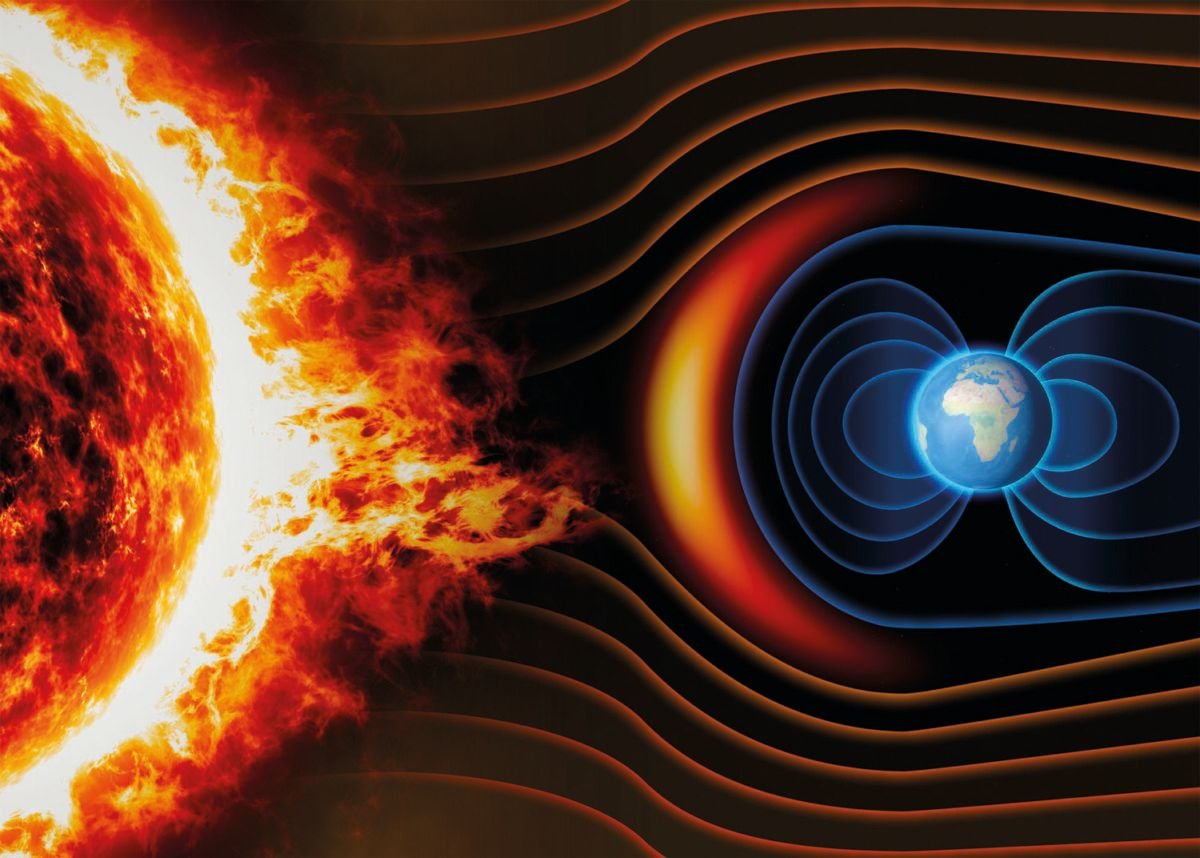
The result is a magnetosphere filled with trapped particles and radiation belts, shaped by the solar wind. Despite its distance, Neptune’s magnetic field interacts with the solar wind in bursts and pulses, generating auroras near its poles. But unlike the vivid lights on Earth, Neptune’s auroras are faint, ghostly glows flickering in the planet’s eternal night.
The Enigmatic Moon Triton
Orbiting Neptune is one of the most remarkable moons in the solar system — Triton. Discovered just 17 days after Neptune itself, Triton is unlike any other large moon. It orbits the planet in the opposite direction of Neptune’s rotation — a retrograde orbit — suggesting it was once a wandering body, perhaps a captured dwarf planet from the Kuiper Belt.
Triton is a world of frozen wonder. When Voyager 2 passed by, it revealed geysers of nitrogen erupting from the surface, shooting dark plumes eight kilometers high. Beneath its icy crust, scientists suspect an ocean of liquid water or ammonia may still exist — kept warm by tidal forces as Triton’s orbit slowly decays.
The surface of Triton is etched with strange patterns, pinkish plains, and smooth frozen lakes of nitrogen. It is one of the coldest places ever measured in the solar system, with temperatures near –235°C. Yet even here, there is motion and change — the slow breathing of a world on the edge of extinction.
In about 3.6 billion years, Triton will spiral inward and be torn apart by Neptune’s gravity, forming a brilliant ring system around the planet. Until then, it remains a haunting companion — a moon stolen from the outer reaches, forever bound to the deep blue giant.
Rings of Dust and Ice
Though faint and fragile, Neptune possesses rings — ghostly bands of dust encircling the planet. They are composed mostly of dark material, possibly organic compounds altered by radiation. Unlike Saturn’s shining rings, Neptune’s are incomplete, forming clumps and arcs that appear to defy gravity.
Voyager 2’s cameras revealed several distinct rings, each named for astronomers who played a role in Neptune’s discovery: Adams, Le Verrier, Lassell, Arago, and Galle. The Adams ring, the outermost, contains bright arcs named Liberty, Equality, and Fraternity — poetic echoes of the French Revolution, honoring Le Verrier’s homeland.
These arcs remain one of the most puzzling phenomena in planetary science. According to physics, they should quickly spread out into smooth rings, yet they persist in concentrated clusters. Scientists suspect the gravitational influence of small nearby moons, like Galatea, helps stabilize them. But even today, their structure shifts and evolves — a fragile dance of dust and ice at the edge of the solar system.
Neptune’s Eternal Night
A day on Neptune lasts about 16 hours, yet its year is immense — nearly 165 Earth years. Since its discovery, Neptune has completed only one orbit around the Sun. Seasons change slowly there, each lasting about 40 years.
Despite the darkness, Neptune is not a silent, frozen world. Infrared observations show that its atmosphere pulses with subtle changes. Clouds appear and disappear, storms form and fade, and the planet’s brightness fluctuates over time. Even without sunlight, Neptune’s internal energy drives a slow, graceful rhythm of weather and renewal.
If one could stand on Neptune’s invisible surface — impossible though it is — the view would be haunting. The sky would glow deep indigo, filled with slow-moving clouds and lightning flashes. Far above, Triton would hang like a pale orb, faintly reflecting what little sunlight filters this far. The Sun would appear as a brilliant star — a distant beacon, a reminder of warmth long lost.
The Voyager’s Farewell
In August 1989, NASA’s Voyager 2 made humanity’s only visit to Neptune. After a 12-year journey past Jupiter, Saturn, and Uranus, the spacecraft swept just 4,950 kilometers above Neptune’s cloud tops — the closest approach of any mission to the planet.
It revealed a living world: storms swirling at supersonic speeds, bright clouds racing around the equator, and a mysterious, dynamic atmosphere. It sent back breathtaking images of Triton’s geysers, Neptune’s rings, and the Great Dark Spot — glimpses that still stand as some of the most iconic in planetary exploration.
After its encounter, Voyager 2 continued onward, sailing into interstellar space. It left Neptune behind — but its legacy endures. To this day, the data it gathered remain our primary window into the blue giant. Decades later, scientists are still uncovering new insights hidden within those transmissions from the edge of the solar system.
The Dreams of Future Explorers
Since Voyager’s flyby, no spacecraft has returned to Neptune. Yet the longing to revisit it has never faded. Missions have been proposed — orbiters, atmospheric probes, and even landers designed to descend into the planet’s upper layers.
A future mission, perhaps using nuclear propulsion, could reach Neptune within 12 to 15 years. Such a spacecraft could map its atmosphere in detail, study its magnetic field, and investigate the composition of its interior. It could also explore Triton up close — perhaps even landing on its icy surface to sample the material ejected by its geysers.
Scientists dream of sending a floating probe into Neptune’s clouds, drifting on the high winds and tasting the chemistry of its atmosphere. It would be the ultimate journey into the deep — to descend through the layers of methane haze, past the roaring jet streams, into the unknown heart of the planet.
Each new observation, whether from telescopes on Earth or from the James Webb Space Telescope, reveals something new: shifting storms, transient clouds, mysterious brightness changes. Neptune is not static. It breathes, it changes — a distant world, alive with unseen energy.
The Planet That Defies the Cold
Neptune is a paradox — a planet that should be still, yet isn’t. In the near-absolute zero of the outer solar system, it burns with invisible heat. It glows softly in infrared light, radiating power into the void. Its atmosphere churns with impossible winds; its magnetic field twists and shudders; its moon erupts with geysers beneath a frozen sky.
It is as though Neptune refuses to yield to the cold. It spins, it storms, it endures — a symbol of persistence and mystery at the universe’s edge. In its deep blue heart, one can almost feel the echo of creation itself — the raw energy that forged the planets and still pulses, faint but fierce, through their cores.
The Deep Blue Unknown
To gaze upon Neptune through a telescope is to look into infinity. It is a tiny blue dot, motionless and serene, but behind that stillness lies a world of power and motion. Every swirl of cloud, every whisper of wind, every flicker of light tells a story older than Earth’s civilizations.
Neptune reminds us that even in the coldest, darkest corners of space, there is wonder. It is a world both alien and strangely familiar — an ocean planet without a surface, a giant born of ice and mystery. Its beauty is deceptive, its silence profound.
When we look at Neptune, we are not just seeing a planet; we are seeing the edge of possibility. We are witnessing the limits of human reach, and yet, we dream of going further — of diving into those deep blue clouds and uncovering the truths hidden beneath.
The Eternal Sentinel of the Solar System
Neptune stands at the boundary between the known and the unknown. Beyond it lies the Kuiper Belt — a realm of frozen worlds, comets, and cosmic debris. In many ways, Neptune is the gatekeeper to interstellar space, its gravity shaping the paths of distant objects and protecting the inner planets from icy intruders.
It is a reminder of how small our world truly is, and how vast the universe beyond remains. Even now, as spacecraft drift beyond the heliosphere, Neptune watches over the last outpost of the Sun’s light — a silent guardian of the deep.
In its storms, we see the power of nature. In its cold, we see the endurance of time. In its deep blue glow, we glimpse the poetry of the cosmos — the beauty that survives even in darkness.
A Planet of Dreams and Destiny
Neptune is not merely a world; it is an idea — the embodiment of humanity’s eternal curiosity. It calls to us from the edge of the solar system, whispering of secrets and inviting exploration. It is the final frontier within our Sun’s reach, a symbol of what remains to be discovered.
Beneath its clouds may lie answers to questions about planetary formation, atmospheric chemistry, and the nature of matter under pressure. In its winds and storms may be clues to the behavior of distant exoplanets — the countless Neptune-like worlds orbiting stars across the galaxy.
As we study Neptune, we are not just learning about a distant planet. We are learning about ourselves — about our origins, our limits, and our unyielding drive to explore.
The Blue Flame in the Darkness
In the vast cold beyond the Sun, Neptune burns with invisible fire. It is the last planet, the farthest frontier, the shimmering flame of mystery at the edge of the light.
Beneath its clouds, where diamond rain may fall and methane winds howl across endless horizons, Neptune keeps its secrets — for now. But we will return. Humanity always does.
When that day comes, we will descend into the deep blue, past the clouds and lightning, into the hidden heart of a world that has waited in silence for billions of years. And as our instruments touch the unseen, as we listen to the hum of its storms and the pulse of its heat, we will finally hear what Neptune has been whispering all along — a song of the cosmos, ancient, cold, and endlessly beautiful.
The deep blue mysteries will not stay hidden forever. They are calling to us — from beneath Neptune’s clouds, from the edge of the Sun’s domain, from the very heart of the universe itself.