There is a place in the universe where light itself surrenders. A boundary so absolute that even the laws of physics, as we know them, seem to unravel. It is not a wall or a surface—it is a point of no return. This is the event horizon, the invisible boundary surrounding a black hole, where the known universe ends and the unknowable begins.
To speak of the event horizon is to speak of the ultimate mystery. It is the silence beyond sound, the darkness beyond light. It is where time slows to a crawl, where the fabric of spacetime folds inward, and where everything we understand about nature meets its most extreme test.
The event horizon is not just an astrophysical phenomenon—it is the frontier of human understanding. To gaze upon it, even in theory, is to stare into the heart of the universe’s deepest question: what happens when reality itself breaks?
The Birth of a Concept
The story of the event horizon begins not with modern telescopes or cosmic images, but with mathematics—and imagination. In 1915, Albert Einstein published his General Theory of Relativity, a revolutionary description of gravity not as a force but as the curvature of spacetime caused by mass and energy.
In Einstein’s universe, objects like stars and planets warp the space around them, and other bodies move along those curves. It was an elegant, geometric way to understand gravity. But a year later, a German physicist named Karl Schwarzschild applied Einstein’s equations to an extreme case: a single, perfectly spherical mass compressed into an infinitely small point.
The result was both elegant and terrifying. Schwarzschild found that if an object’s mass were compressed into a certain critical radius, gravity would become so intense that nothing—not even light—could escape its pull. The boundary at that radius would be what we now call the event horizon.
Schwarzschild’s solution was purely mathematical. No one at the time believed such a thing could exist in reality. The idea of an object so dense that it swallowed light seemed absurd—a curiosity of equations, not of the cosmos. Einstein himself doubted the existence of such singularities. But the universe, it turns out, had other plans.
The Collapse of Stars and the Birth of Black Holes
Stars are born from clouds of gas and dust that collapse under their own gravity. For millions or billions of years, they burn through nuclear fuel, fusing hydrogen into helium, radiating light, and holding themselves in a delicate balance between inward gravitational pull and outward pressure from fusion.
But when the fuel runs out, the star’s internal pressure fades, and gravity takes over. For small stars, this collapse leads to white dwarfs or neutron stars—dense but stable remnants. For massive stars, however, the collapse becomes unstoppable. The core implodes, and all the matter falls inward toward a single point.
At that moment, gravity becomes infinite, spacetime curves infinitely, and a singularity forms—an infinitely dense point where the laws of physics as we know them cease to apply. Surrounding that singularity lies the event horizon—the threshold between the universe we can observe and the one hidden forever beyond.
What began as a theoretical curiosity in Einstein’s equations had now become a physical reality. The universe does, in fact, make black holes.
What Is the Event Horizon?
The event horizon is often misunderstood as a surface or a wall, but in truth, it is an imaginary boundary defined by the geometry of spacetime. It marks the limit beyond which the escape velocity equals or exceeds the speed of light.
If you were to approach a black hole, the event horizon would look like a spherical shell surrounding a region of infinite darkness. For an observer far away, any object falling toward it would appear to slow down, its light stretched into redder and redder wavelengths until it faded from view. From the distant perspective, the object never seems to cross the horizon—it simply vanishes in slow motion, fading into eternity.
But for the object itself, the story is very different. From its own perspective, it would cross the event horizon in finite time, without noticing anything peculiar—at least not immediately. Once beyond that boundary, however, escape becomes impossible. Space and time themselves conspire against it. Every possible path forward leads only deeper inward, toward the singularity.
It’s not that the object is being pulled in by a “force” in the conventional sense. Rather, inside the event horizon, all directions—including what we think of as “outward”—point toward the singularity. It is as if the very geometry of reality has been twisted into a funnel of no return.
Time at the Edge of Eternity
Perhaps the most haunting aspect of the event horizon is its relationship with time. Einstein’s relativity teaches us that gravity slows down time. The stronger the gravitational field, the slower the clock ticks. Near a black hole, where gravity becomes extreme, time itself nearly stops.
Imagine hovering just above the event horizon in a spaceship capable of resisting the pull. To you, inside your ship, time would seem to flow normally. But if you looked out into the universe, you’d see everything racing by—stars burning through ages in moments, galaxies swirling in fast-forward. From the perspective of someone watching you from far away, however, your time would appear to nearly freeze as you approached the horizon.
This time distortion isn’t just theoretical—it’s been measured near massive objects like neutron stars and verified by experiments involving atomic clocks on Earth. But near the event horizon, the effect becomes absolute. For an outside observer, you never quite reach the horizon; for you, time continues forward.
It’s as if the event horizon represents the ultimate separation not just of space, but of time itself—a boundary across which past and future lose their meaning.
The Singularity: The Heart of Darkness
Beyond the event horizon lies the singularity—the point where density becomes infinite and spacetime curvature becomes undefined. Here, the known laws of physics collapse. General relativity predicts this infinite density, but quantum mechanics—the theory governing the smallest scales—cannot make sense of it.
This is where the two great pillars of modern physics clash. Relativity describes gravity and spacetime; quantum theory describes particles and forces. At the singularity, they both fail. It is a riddle at the heart of existence, the place where our understanding of reality breaks down completely.
Some physicists believe the singularity is not truly a “point” but rather a region where our current theories no longer apply, waiting for a deeper quantum theory of gravity to reveal its secrets. Others suggest that spacetime may “end” there entirely, that the singularity represents a literal boundary of the universe—a place beyond which even the concept of “place” loses meaning.
Whatever the truth, the singularity remains hidden behind the veil of the event horizon, beyond all observation, protected by what physicist Roger Penrose called cosmic censorship—the universe’s way of hiding its most chaotic secrets from view.
Hawking’s Revelation: Black Holes Are Not Entirely Black
For decades, black holes were thought to be eternal—regions of pure darkness from which nothing could ever escape. But in the 1970s, Stephen Hawking made a startling discovery. By applying quantum mechanics to the curved spacetime around a black hole, he found that black holes are not completely black.
Quantum fluctuations in the vacuum near the event horizon can cause pairs of particles to pop into existence—one falling in, the other escaping. To an outside observer, this escaping particle looks like radiation coming from the black hole itself. This phenomenon is now known as Hawking radiation.
Over immense spans of time, as black holes emit this faint radiation, they slowly lose mass and energy. Eventually, they could evaporate entirely, vanishing in a final burst of radiation. The event horizon, once seen as eternal, becomes a temporary boundary in an evolving universe.
Hawking’s insight transformed the event horizon from a one-way trap into a dynamic participant in cosmic evolution. It connected the worlds of gravity, quantum physics, and thermodynamics—suggesting that black holes have entropy and even temperature.
Yet Hawking’s theory also raised troubling paradoxes. If information falls into a black hole and the black hole later evaporates, is that information lost forever? Such a loss would violate one of quantum mechanics’ fundamental principles—that information can never be destroyed. The black hole information paradox remains one of physics’ most profound mysteries, and the event horizon is its battleground.
The Geometry of the Abyss
The event horizon is more than a boundary—it’s a dynamic shape sculpted by gravity. For a non-rotating, uncharged black hole, it forms a perfect sphere. But most black holes spin, and rotation changes everything.
A rotating black hole, described by the Kerr solution to Einstein’s equations, drags spacetime itself around with it in a phenomenon known as frame-dragging. Near such a black hole, space and time are literally twisted. The event horizon becomes flattened at the poles and bulges at the equator, and just outside it lies the ergosphere—a region where nothing can remain still relative to the distant stars.
Within the ergosphere, it’s theoretically possible to extract energy from the black hole’s rotation—a process called the Penrose mechanism. Nature may perform this trick on cosmic scales, powering the jets of radiation we see streaming from quasars and active galactic nuclei.
To visualize the event horizon, imagine a sphere of darkness where light orbits in perfect circles before being swallowed. This “photon sphere” marks the outer limit of where light can barely escape, spiraling around the black hole multiple times before fleeing into the universe. Beyond that, the event horizon waits silently.
Seeing the Unseeable
For most of history, black holes were invisible ideas—mathematical phantoms we could describe but never observe. Then, in 2019, humanity caught its first glimpse of the unseeable.
The Event Horizon Telescope (EHT), a network of radio telescopes scattered across the globe, captured the first direct image of a black hole’s shadow—the supermassive black hole at the center of the galaxy M87, 55 million light-years away.
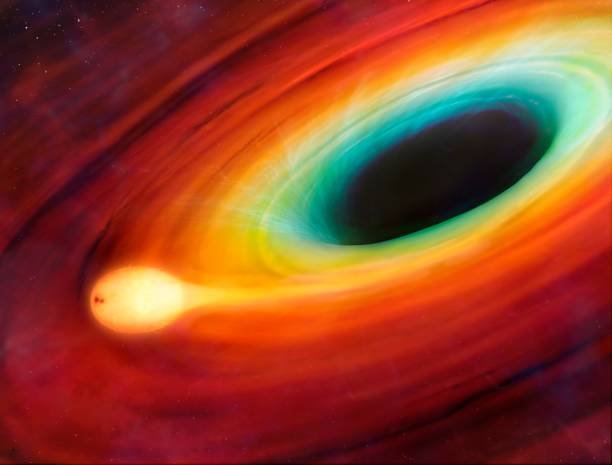
What the EHT saw was not the black hole itself, but the shadow cast by its event horizon against the glowing ring of superheated gas swirling around it. The image, a halo of fire surrounding a dark core, was the most dramatic proof ever that the event horizon is real.
When the image was revealed, it was more than science—it was poetry made visible. The blurry circle was a human triumph, a portrait of gravity at its most extreme. For the first time, we saw the boundary between light and nothingness.
In 2022, the EHT released another breathtaking image—this time of Sagittarius A*, the supermassive black hole at the center of our own Milky Way. Though far smaller than M87’s monster, its proximity gave us a closer, more intimate view of the abyss that anchors our galaxy.
Each of these images is a window into the heart of cosmic mystery, proof that the event horizon is not just theory but an observable feature of reality itself.
Falling Toward the Horizon
What would it feel like to fall into a black hole? The answer depends on its size. For a small black hole—say, one with the mass of our Sun—you would be torn apart long before reaching the event horizon. The difference in gravitational pull between your feet and your head would stretch you into a stream of atoms in a process scientists grimly call spaghettification.
But for a supermassive black hole, like the ones at galactic centers, the tidal forces at the horizon are gentler. You might pass through without feeling much at all—at least initially. The stars would distort, the universe behind you would appear to freeze in time, and light would twist around you in impossible ways.
Inside, the concept of direction would lose meaning. All paths lead inward. Time and space would swap roles—moving forward in time would mean moving deeper into the black hole. Eventually, you would reach the singularity, though no signal of your journey could ever escape to tell the tale.
To cross the event horizon is to be erased from the visible universe, to pass beyond the reach of cause and effect. It is not death in the biological sense—it is the annihilation of identity itself.
The Event Horizon as a Mirror of the Human Mind
The event horizon does more than bend spacetime—it bends imagination. It forces us to confront the limits of knowledge, the boundaries of perception, and the nature of reality.
In many ways, it is a mirror of our own consciousness. Just as the event horizon marks the limit of what can be seen or known from the outside, the human mind has its own horizon of awareness—a boundary beyond which thought and understanding cannot yet penetrate.
To study black holes is to explore that frontier within ourselves. We look into the darkness not just to understand the cosmos, but to understand our place within it. The event horizon becomes a metaphor for curiosity itself—the point where we stand on the edge of the unknown, peering into mystery with both fear and wonder.
It reminds us that the universe is not fully tamed, that there are places where even our greatest theories falter, and that knowledge itself has an event horizon—a boundary we are always striving to cross.
The Holographic Universe and the Edge of Reality
In recent decades, physicists have begun to suspect that the event horizon might hold the key to understanding the universe itself. According to the holographic principle, all the information about what falls into a black hole might not be lost but instead encoded on its event horizon—like a cosmic hard drive storing data in two dimensions that describe a three-dimensional interior.
This idea, proposed by physicists Gerard ’t Hooft and Leonard Susskind, suggests that the universe as a whole might be a vast hologram—our three-dimensional reality emerging from information encoded on a distant two-dimensional boundary.
If true, the event horizon is not just the edge of a black hole—it is the blueprint for understanding space, time, and matter as we know them. It might be the bridge between quantum mechanics and gravity, the key to the long-sought theory of everything.
In this view, every bit of information that falls into a black hole remains preserved on its horizon, perhaps to be released again in Hawking radiation. The black hole is not a cosmic eraser but a cosmic memory—its event horizon the ultimate record of all that has touched it.
Beyond the Horizon: Wormholes and White Holes
Einstein’s equations allow for other strange possibilities beyond the event horizon. Some solutions predict that black holes might be connected to white holes, hypothetical regions where matter and energy are expelled instead of absorbed. In such a scenario, a black hole could serve as one end of a wormhole, a tunnel through spacetime linking distant parts of the universe—or perhaps even different universes altogether.
While these ideas remain speculative, they reveal how the event horizon may not just be an end, but a gateway. It may be the threshold not of destruction, but of transformation—a doorway into regions of the cosmos we can only imagine.
The Event Horizon and the Future of Physics
As we continue to probe the mysteries of the event horizon, new technologies and theories are emerging to push our understanding further. Quantum gravity, string theory, loop quantum cosmology—all strive to reconcile the physics of the very large with that of the very small.
Perhaps one day, through a unified theory, we will finally understand what truly happens beyond the horizon—whether singularities exist, whether information survives, and whether the universe itself is built from the same logic that governs these cosmic abysses.
The Event Horizon Telescope continues its work, mapping more black holes, refining our view, turning the invisible into the visible. In doing so, it brings us closer to the moment when mathematics, observation, and imagination will converge into one coherent vision of reality.
The Human Horizon
In the vast scale of the cosmos, our planet is a whisper. Yet from this whisper, we have imagined and discovered the most profound truths. The event horizon stands as both a symbol and a challenge—an emblem of the limits we face and the courage we show in confronting them.
Every generation of humanity pushes its own event horizon forward—beyond superstition, beyond ignorance, beyond fear. In the cold mathematics of spacetime, we find not emptiness, but meaning. We find ourselves.
To gaze into a black hole is to see the universe stripped to its bare essence—a pure confrontation between being and nothingness. And perhaps that is why it moves us so deeply.
Because in that darkness, we glimpse not just the end of light, but the beginning of understanding.
The event horizon is not the universe’s wall—it is its invitation.
It asks us the oldest question of all: How far are you willing to go in search of truth?