Long before the first word was spoken, long before symbols were carved into stone or inked onto clay, the world already had a deep and complex history. This immense stretch of time, extending millions and billions of years into the past, is what we call prehistory. It is the forgotten world before history began, not because nothing happened, but because no one was yet there to record it in writing. Yet this world was anything but empty. It was alive with change, struggle, creativity, extinction, and emergence. It shaped everything that would come after, including us.
Prehistory is not a vague shadowland. It is a real, scientifically reconstructed past, uncovered through fossils, stones, bones, sediments, and the patient work of researchers who read the Earth itself as a kind of archive. This era contains the origins of life, the rise and fall of entire species, the slow sculpting of continents, and the fragile beginnings of humanity. To explore it is to confront time on a scale that dwarfs human imagination and to realize that civilization is only the thinnest layer atop an ancient, restless planet.
When Earth Was Young and Unrecognizable
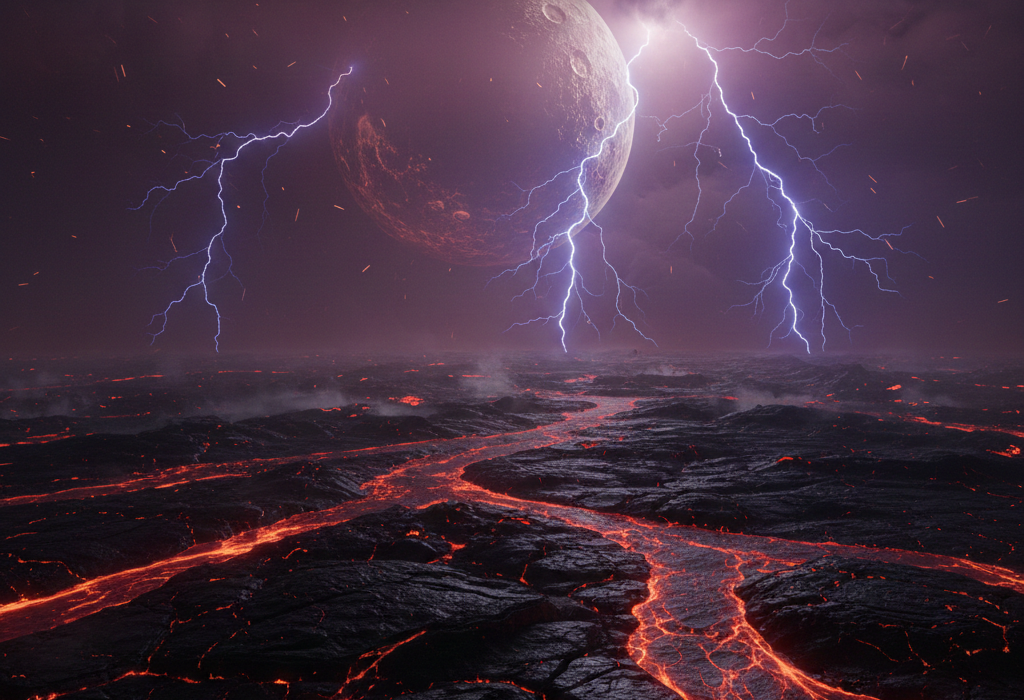
The prehistoric world begins with a planet that would feel utterly alien to us. Early Earth was violent, unstable, and hostile to life as we know it. Volcanoes dominated the landscape, meteor impacts were frequent, and the atmosphere lacked oxygen. The surface of the planet was constantly reshaped by heat and motion, with continents still forming and oceans only beginning to settle into place.
Over immense spans of time, Earth cooled. Water accumulated. Chemical processes in oceans and shallow pools gave rise to the first simple life forms. These earliest organisms were microscopic, yet their impact was profound. They began to alter the planet itself, especially when some evolved the ability to use sunlight to produce energy, releasing oxygen as a byproduct. This slow transformation of the atmosphere would eventually make complex life possible, but it also triggered mass extinctions of organisms that could not survive in an oxygen-rich world.
This early prehistoric era reminds us that life and Earth evolved together. The planet shaped life, and life reshaped the planet, in a continuous feedback loop that still continues today.
The Long Reign of Ancient Life
As time marched forward, life diversified in astonishing ways. Multicellular organisms appeared, filling oceans with strange and beautiful forms. Some creatures developed hard shells and skeletons, leaving behind fossils that would survive for hundreds of millions of years. These fossils are among our most important windows into the forgotten world, preserving moments of life that vanished long before humans existed.
Eventually, life ventured onto land. Plants colonized the shores, stabilizing soils and changing climates. Arthropods followed, and later amphibians, reptiles, and the ancestors of mammals. Forests spread across continents, some composed of plant species unlike anything alive today. The air grew richer in oxygen, and ecosystems became increasingly complex.
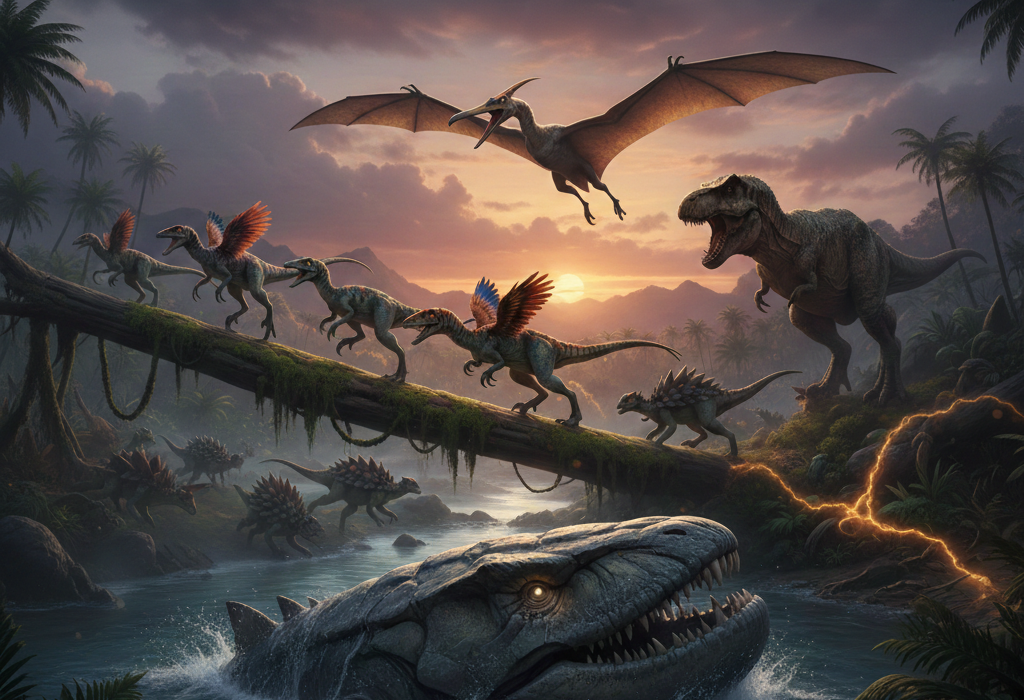
Perhaps the most famous chapter of prehistory belongs to the dinosaurs, who dominated land ecosystems for over 160 million years. They were not merely giant monsters, but diverse animals adapted to countless niches. Some were massive herbivores that reshaped landscapes, others were agile predators, and many were small, feathered creatures whose descendants would become birds. The prehistoric world during this time was vibrant and dynamic, filled with evolutionary experiments that succeeded, failed, and transformed.
Extinction as a Creative Force
One of the most emotionally unsettling truths about prehistory is that extinction is not an exception but a rule. The vast majority of species that have ever lived are gone. Some disappeared gradually, unable to adapt to changing environments. Others were wiped out suddenly by catastrophic events, such as massive volcanic eruptions or asteroid impacts.
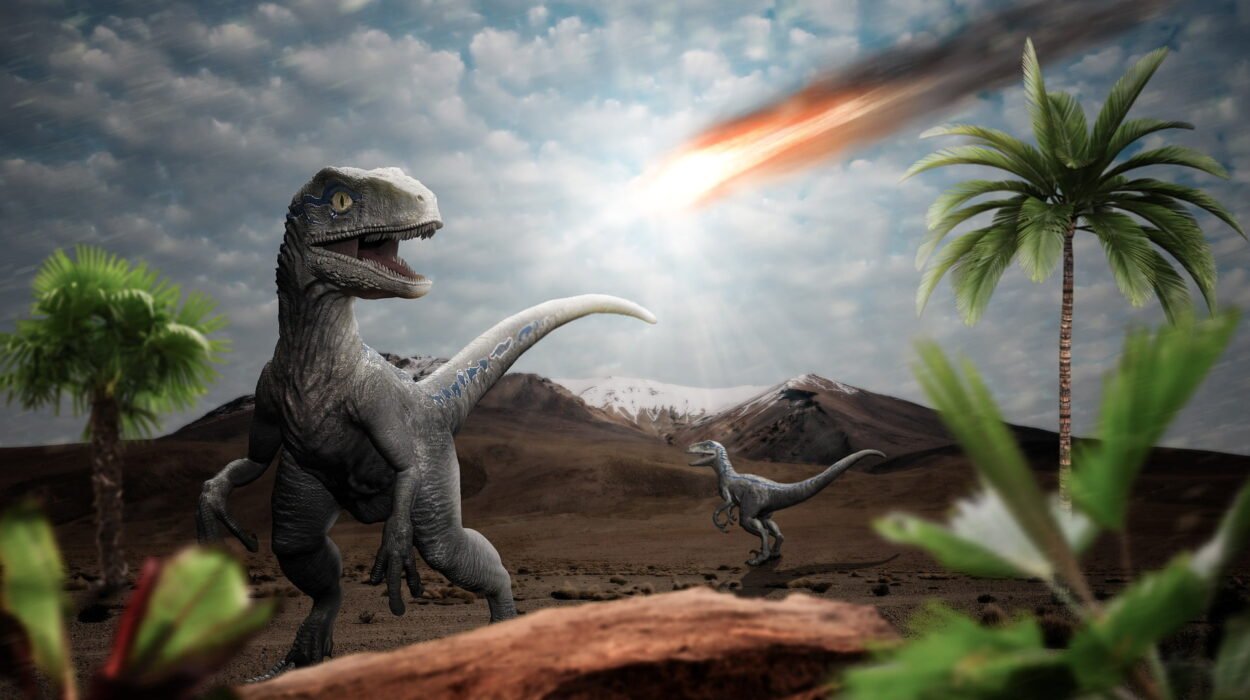
The extinction that ended the age of dinosaurs is among the most dramatic examples. A single event reshaped life on Earth, clearing ecological space for mammals to diversify. What seems like an ending from one perspective becomes a beginning from another. Prehistory teaches us that destruction and creation are deeply intertwined in the story of life.
This realization forces us to confront the fragility of existence. Survival is never guaranteed, even for dominant species. Yet it also highlights the resilience of life itself, which persists, adapts, and reemerges in new forms.
The Slow Emergence of Our Ancestors
Human prehistory occupies only the final moments of this vast timeline, yet it is among the most emotionally resonant chapters. Our story begins not with civilization, but with small, vulnerable creatures navigating dangerous environments. Early hominins walked upright, freeing their hands for tool use and altering how they interacted with the world. This shift was not sudden but gradual, unfolding over millions of years.
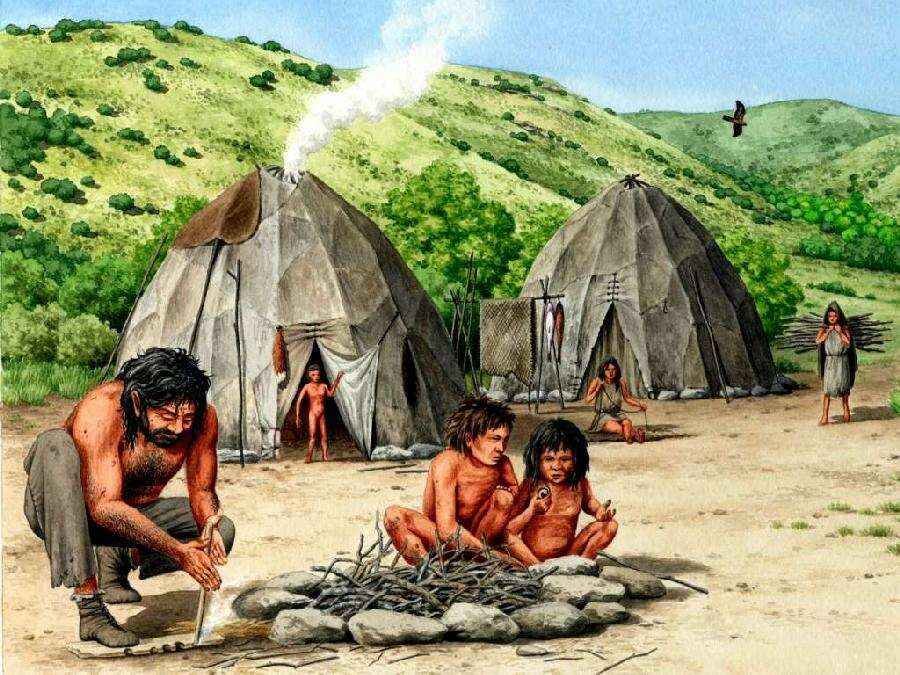
Stone tools mark one of the earliest clear signs of human ingenuity. These simple objects represent a profound cognitive leap: the ability to imagine a shape that does not yet exist and then create it. Fire followed, transforming diets, social structures, and survival strategies. Fire provided warmth, protection, and a new way to interact with the environment.
Language, though invisible in the archaeological record, likely developed during this long prehistoric period. The ability to communicate complex ideas strengthened social bonds and allowed knowledge to accumulate across generations. Culture began to emerge, fragile at first, yet powerful enough to shape evolutionary paths.
Life Without Writing, But Not Without Meaning
The absence of written records does not mean prehistoric humans lacked meaning, emotion, or complexity. Archaeological evidence suggests rich symbolic lives. Cave paintings, carved figurines, and carefully arranged burials point to abstract thought and emotional depth. These early expressions reveal minds capable of imagination, memory, and perhaps spiritual reflection.
Prehistoric societies were deeply connected to their environments. Survival depended on intimate knowledge of landscapes, animals, and seasons. This connection fostered traditions passed down orally, through stories, rituals, and shared practices. Though these traditions are largely lost to time, their echoes remain in the artifacts left behind.
The prehistoric world was not a simple prelude to history but a fully lived human experience. People loved, feared, hoped, and mourned, just as we do today, even though their lives unfolded without cities or written laws.
The Birth of Agriculture and a New World
One of the most transformative moments in prehistory was the shift from hunting and gathering to agriculture. This change did not occur everywhere at once, nor was it necessarily an obvious improvement at first. Farming required hard labor, altered diets, and increased vulnerability to disease. Yet it allowed populations to grow and settle in one place.
Permanent settlements changed how humans related to land and to each other. Concepts of ownership, inheritance, and social hierarchy began to take shape. Technology advanced, with new tools, pottery, and construction methods. Though still prehistoric due to the absence of writing, these societies were laying the foundations for civilization.
This transition highlights an essential truth about prehistory: it is not a single, uniform era but a mosaic of overlapping developments across different regions. While some communities were building villages, others continued nomadic lifestyles that suited their environments perfectly.
The Emotional Weight of Deep Time
Encountering the forgotten world before history began can be emotionally overwhelming. The sheer scale of time involved challenges our sense of importance. Human history, with all its wars, achievements, and tragedies, occupies only a fleeting moment compared to prehistoric time. This perspective can feel humbling, even unsettling.
Yet it can also be deeply comforting. We are part of a story far larger than ourselves. Our atoms have been recycled through ancient stars, prehistoric oceans, and countless life forms. The boundary between past and present becomes porous, reminding us that the ancient world is not truly gone. It lives on in our bodies, our genes, and the planet beneath our feet.
Prehistory teaches patience. Change often unfolds slowly, almost invisibly, until its effects become undeniable. This lesson is especially relevant in a modern world that often demands instant results and immediate answers.
Science as a Time Machine
Our understanding of prehistory exists thanks to science. Fields such as geology, paleontology, archaeology, and genetics allow us to reconstruct the past with remarkable detail. Radiometric dating reveals the age of rocks and fossils. DNA analysis uncovers relationships between species and populations. Microscopic wear on tools tells stories of daily life long vanished.
These methods are not perfect, and interpretations change as new evidence emerges. Prehistory is not a static narrative but an evolving one. Each discovery has the potential to reshape what we thought we knew, reminding us that knowledge itself is a living process.
Science transforms stones into stories. A fragment of bone becomes evidence of migration. A layer of ash becomes a record of catastrophe. Through careful reasoning, the silent world of prehistory begins to speak.
The Edge Where Prehistory Becomes History
The boundary between prehistory and history is defined not by intelligence or culture, but by writing. When humans began to record information in durable symbols, a new kind of memory emerged. Events could now outlast individual lifetimes with greater precision. Laws, myths, and transactions could be preserved in fixed form.
Yet this boundary is more practical than profound. Writing did not suddenly make humans more human. It simply added a new tool to an already rich cultural toolkit. The prehistoric world did not disappear when history began; it continued alongside written societies and still does today in various forms.
Recognizing this continuity prevents us from seeing prehistory as a dark age waiting to be illuminated by civilization. Instead, it becomes clear that history is built upon prehistoric foundations that remain essential.
Why the Forgotten World Still Matters
The prehistoric world matters because it explains who we are. Our bodies, behaviors, and instincts are products of evolutionary pressures that operated long before recorded history. Our attraction to landscapes, our fear responses, and our social tendencies all have roots in deep time.
Understanding prehistory also informs our relationship with the planet. Past climate shifts, extinctions, and adaptations provide crucial context for modern environmental challenges. They remind us that Earth changes, but also that rapid change can have devastating consequences.
Perhaps most importantly, prehistory invites humility and wonder. It asks us to look beyond ourselves and recognize the vast, intricate processes that made our existence possible.
Standing at the Threshold of Memory
The forgotten world before history began is not truly forgotten. It surrounds us, beneath our cities and within our DNA. Though it left no written words, it left traces that science continues to uncover, piece by piece. Each discovery narrows the distance between us and the deep past, revealing a world both strange and familiar.
To engage with prehistory is to stand at the threshold of memory, where silence meets story. It is to acknowledge that before names, before nations, before books, there was already a world alive with meaning and motion. A world that shaped us long before we knew how to write our own history, and a world whose legacy we still carry into the future.