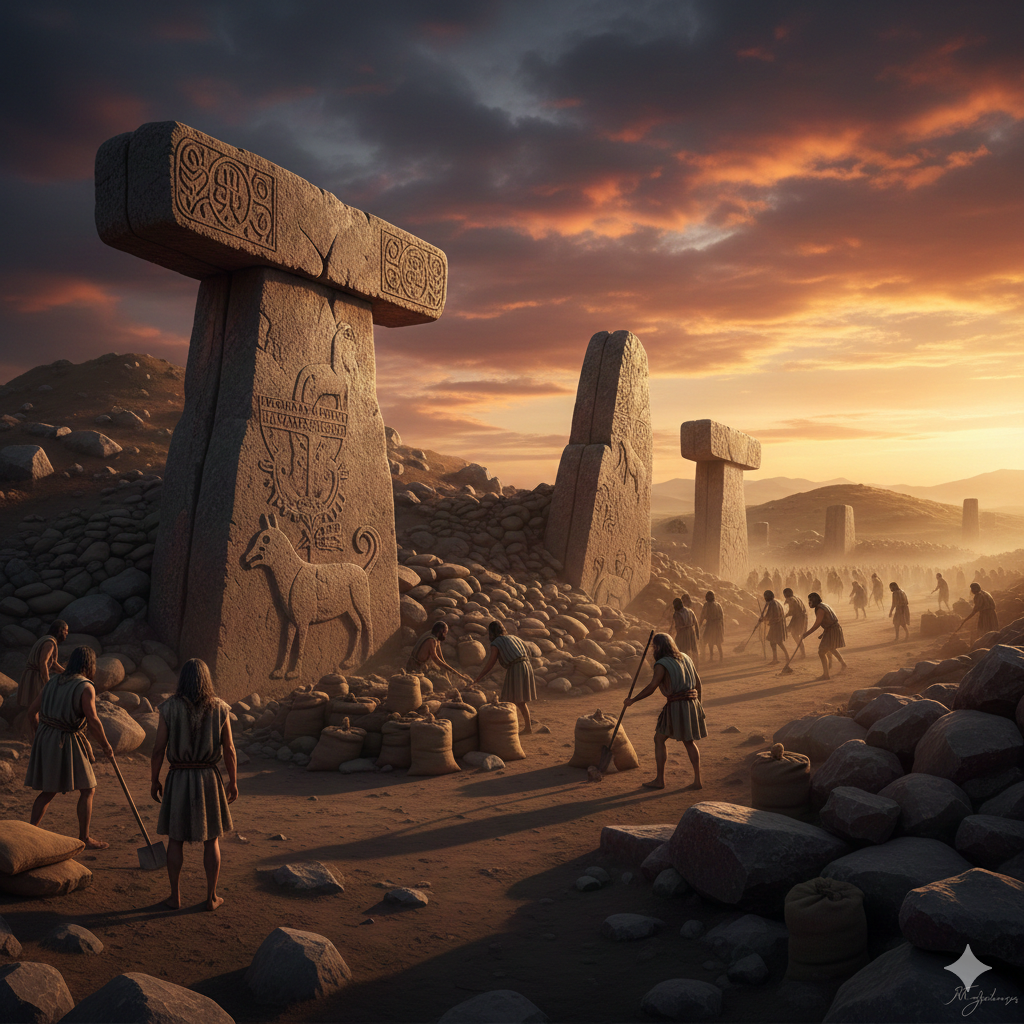
On a windswept hill in southeastern Anatolia, long before cities, before writing, before pottery and agriculture as we know them, human hands raised stone pillars toward the sky. Then, just as deliberately, those same hands buried them. Göbekli Tepe is not just an archaeological site; it is a question carved into bedrock. Why would prehistoric people invest enormous effort to build what appears to be the world’s earliest monumental sanctuary, only to entomb it beneath tons of earth and stone?
This question unsettles everything we thought we knew about the origins of civilization. Göbekli Tepe does not sit comfortably within our traditional story of human progress, where survival leads to farming, farming leads to villages, villages lead to religion and monuments. Instead, it stands as a silent challenge, suggesting that belief, ritual, and shared meaning may have come first. To understand why the world’s first known temple was buried, we must step back into a time when humanity was redefining itself.
The Discovery That Changed Prehistory
Göbekli Tepe remained hidden in plain sight for millennia, a rounded hill rising gently above the plains near modern-day Şanlıurfa in Turkey. Local farmers knew it as a place littered with stones, nothing more. In the 1960s, a brief survey noted the site but dismissed it as a medieval cemetery. The true nature of the hill remained unseen until the 1990s, when archaeologist Klaus Schmidt returned with fresh eyes and a willingness to question assumptions.
What Schmidt and his team uncovered stunned the archaeological world. Beneath the soil lay massive T-shaped limestone pillars, some towering over five meters tall and weighing many tons. These pillars stood in circular and oval enclosures, arranged with careful geometry and purpose. They were decorated with intricate carvings of animals, abstract symbols, and humanoid forms. Radiocarbon dating placed their construction around 9600 BCE, more than eleven thousand years ago.
This date alone was revolutionary. Göbekli Tepe was built at the dawn of the Neolithic period, by people who were still hunter-gatherers. There were no signs of permanent dwellings, no evidence of agriculture, no pottery. Yet here stood monumental architecture on a scale previously thought impossible without settled societies. The hill was not a natural formation at all. It was artificial, shaped by human intention over centuries.
A Temple Before Towns
Göbekli Tepe forces us to reconsider what we mean by a “temple.” There is no definitive evidence of roofs, altars, or daily domestic activity. Instead, the site appears to have been a place set apart from ordinary life. The pillars are arranged in circles, often with two larger central pillars facing one another, surrounded by smaller ones embedded in stone walls.
The carvings suggest a symbolic world rich with meaning. Foxes, snakes, wild boars, cranes, vultures, and scorpions appear repeatedly. Some animals are depicted in motion, others in threatening poses. The T-shaped pillars themselves seem to represent stylized human figures, with arms carved along their sides and hands meeting at the front. In some cases, belts and loincloths are visible, reinforcing the idea that these stones were not abstract supports but symbolic beings.
If Göbekli Tepe was a temple, it was unlike any later religious structure. It was not tied to a settled community living beside it. Instead, it may have been a gathering place for widely scattered groups, drawn together by shared beliefs, rituals, or cosmologies. In this sense, religion may not have been a product of civilization but one of its catalysts.
The Labor of Belief
Building Göbekli Tepe required astonishing effort. Limestone had to be quarried with stone tools, shaped with precision, and transported across uneven terrain. Coordinating such work implies planning, leadership, and cooperation among large groups of people. All of this occurred without metal tools, wheeled vehicles, or domesticated animals.
Why would hunter-gatherers, whose lives were already demanding, devote so much energy to stone monuments? The answer likely lies in belief. Shared rituals and sacred spaces can bind communities together, creating social cohesion and a sense of purpose beyond individual survival. Göbekli Tepe may have been a focal point for such gatherings, reinforcing alliances, transmitting knowledge, and shaping collective identity.
In this light, the site becomes more than a temple. It becomes a social engine, one that may have helped drive the transition from mobile foraging to more settled ways of life. The need to support regular gatherings could have encouraged experimentation with food production, leading eventually to agriculture. If this is true, then Göbekli Tepe reverses the traditional narrative. We did not build temples because we had surplus food; we may have grown surplus food because we wanted temples.
The Intentional Burial
Perhaps the greatest mystery of Göbekli Tepe is not its construction but its burial. After centuries of use, the enclosures were carefully filled in. Stone tools, animal bones, and debris were deliberately packed around the pillars, preserving them remarkably well. This was not abandonment through neglect or destruction by catastrophe. It was a conscious act.
Why bury something so monumental? Several possibilities have been proposed, each revealing different facets of the human mind.
One explanation is ritual closure. Sacred spaces often have life cycles. When their purpose is fulfilled or beliefs change, they may be ceremonially retired. Burying the enclosures could have been a way to honor them, sealing their power and memory rather than leaving them to decay.
Another possibility is social transformation. As communities began to settle and adopt agriculture, the old ways may have lost relevance. Göbekli Tepe, tied to a worldview of hunter-gatherers, may have been deliberately buried as part of a symbolic transition to a new era. In this sense, the burial marks not an end but a beginning.
Environmental factors may also have played a role. The climate at the end of the last Ice Age was changing rapidly. Shifts in vegetation and animal populations could have altered migration patterns and resource availability. As the social landscape changed, the need for a central ritual site may have diminished.
Yet none of these explanations fully captures the emotional weight of the act. To bury Göbekli Tepe was to erase something visible, to hide it from the living world. That choice suggests reverence, fear, or both.
Animals, Symbols, and the Sacred Mind
The imagery carved into Göbekli Tepe’s pillars offers clues to the beliefs of its builders. The animals depicted are not domesticated but wild, powerful, and often dangerous. This suggests a worldview deeply connected to the natural world, where humans existed alongside forces they did not control.
Some researchers have proposed that the site relates to mortuary practices or ancestor worship. Vultures, which appear frequently in the carvings, are known from other Neolithic sites to be associated with sky burials, where bodies were exposed to birds. The imagery may reflect beliefs about death, transformation, and the relationship between the human and animal realms.
The absence of plant imagery is striking. At a site predating agriculture, this may indicate that animals held greater symbolic importance than crops. The carvings seem to speak of a mythic landscape, populated by beings that embodied both threat and meaning.
In this context, Göbekli Tepe may have functioned as a place where stories were told, reenacted, and remembered. The pillars were not passive decorations but participants in a ritual drama that shaped how people understood their world.
The Birth of Monumentality
Göbekli Tepe represents the earliest known example of large-scale monumental architecture. Its builders were experimenting not just with stone, but with space, symbolism, and memory. Monumentality creates permanence. It anchors meaning in the landscape, making ideas tangible and enduring.
By raising stone pillars that outlasted generations, these early humans were asserting something radical: that their beliefs mattered enough to be carved into the earth itself. This act marks a profound shift in human consciousness, from immediate survival to long-term legacy.
The burial of Göbekli Tepe does not negate this achievement. Instead, it completes it. The site was not simply abandoned; it was preserved. The very act of burial ensured that the pillars would survive, hidden but intact, waiting for rediscovery thousands of years later.
Challenging the Linear Story of Civilization
For much of modern history, civilization has been imagined as a straight line of progress. First came tools, then farming, then villages, then religion, art, and monuments. Göbekli Tepe disrupts this sequence. It suggests that symbolic thought and collective ritual were not late developments but foundational ones.
This realization forces archaeologists to rethink the motivations that drive human innovation. Perhaps it was not hunger alone that pushed us to change our way of life, but meaning. Perhaps the desire to gather, to believe, and to belong was just as powerful as the need to eat.
Göbekli Tepe does not provide simple answers. Instead, it opens a space for new questions. What other sites remain undiscovered, buried beneath assumptions as much as soil? How many times has human history taken paths we no longer recognize?
The Silence of the Builders
One of the most haunting aspects of Göbekli Tepe is the silence of its creators. They left no written records, no names, no explicit explanations. All we have are stones and the marks carved into them. Interpreting those marks requires humility. We must resist the urge to project modern ideas onto ancient minds.
Yet even in silence, there is communication. The care with which the site was built and buried speaks of intention. These people were not acting randomly. They were following a logic shaped by their environment, beliefs, and social needs.
The burial of the world’s first temple may have been an act of respect, a way of saying goodbye to a sacred chapter of their lives. Or it may have been an act of protection, hiding something powerful from misuse. It may even have been a message to the future, though unintended, preserving their work beyond their own time.
Rediscovery and Responsibility
Today, Göbekli Tepe stands exposed once more, its pillars rising again into the sunlight. Modern visitors walk among stones older than agriculture, older than cities, older than written language. The site has become a symbol of humanity’s deep past and its enduring capacity for wonder.
With rediscovery comes responsibility. Göbekli Tepe is fragile, vulnerable to weather, tourism, and time. Preserving it requires not only technical care but conceptual respect. We must allow it to remain enigmatic, resisting the urge to force definitive answers where evidence is incomplete.
The true significance of Göbekli Tepe may lie not in solving its mysteries, but in acknowledging them. It reminds us that human history is not a simple ascent, but a complex tapestry of ideas, choices, and beliefs.
Why We Buried the First Temple
So why did we bury the world’s first temple? The most honest answer is that we do not fully know. But within that uncertainty lies a deeper truth. Göbekli Tepe reveals that from the very beginning, humans were driven by more than survival. We sought connection, meaning, and transcendence.
The burial was not an erasure but a transformation. By covering the stones, the builders ensured their survival across unimaginable spans of time. In doing so, they unknowingly sent a message forward, one that we are only now beginning to hear.
Göbekli Tepe stands as a reminder that civilization did not begin with walls and farms, but with stories, symbols, and shared sacred spaces. And sometimes, to move forward, humanity has chosen not to destroy its past, but to gently lay it to rest beneath the earth, trusting that one day, someone would uncover it and ask the same questions all over again.