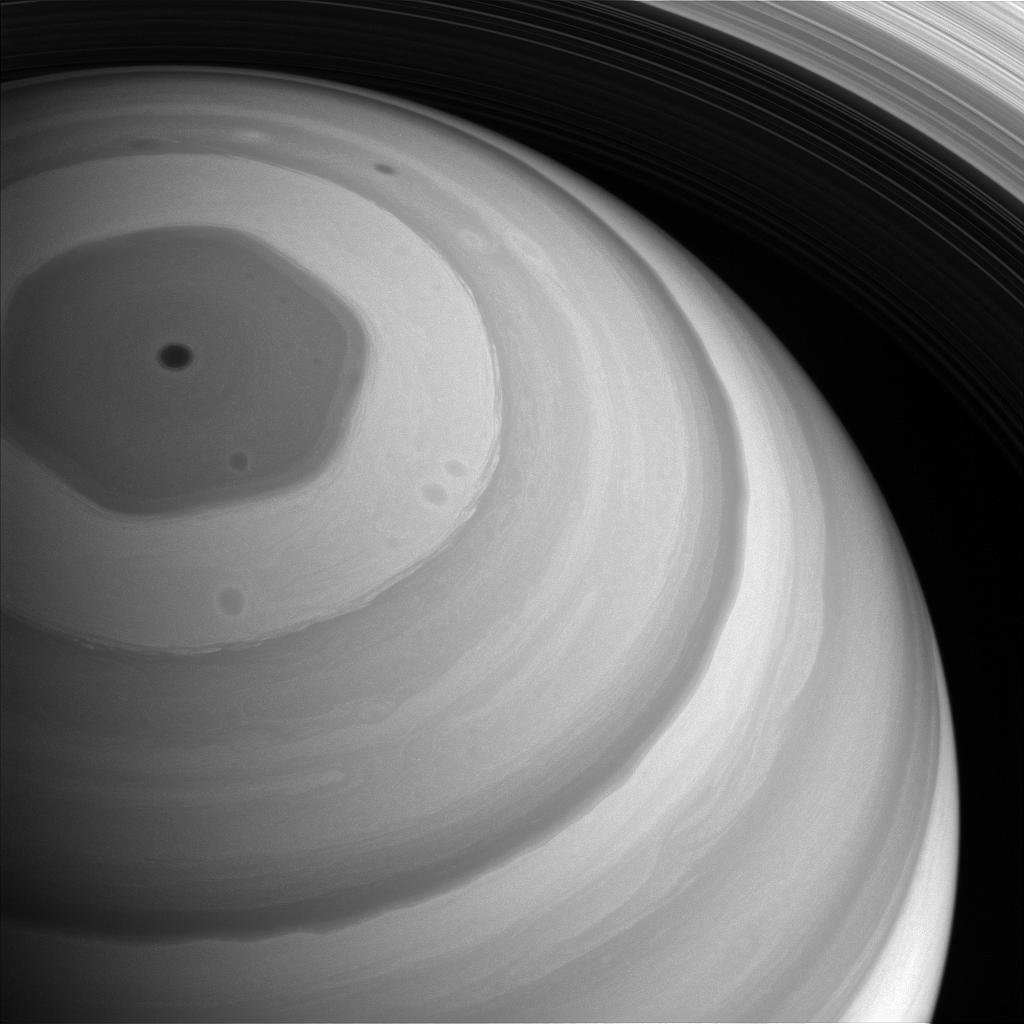
High above the golden clouds of Saturn, at the very crown of the planet’s north pole, a vast, otherworldly storm swirls endlessly—a storm unlike any seen anywhere else in the solar system. Its shape defies nature’s usual chaos. Instead of a round vortex or an amorphous hurricane, this colossal tempest has six perfect sides. It is a hexagon—a geometric wonder of wind and shadow, big enough to swallow four Earths whole.
First discovered in the early 1980s by NASA’s Voyager spacecraft, the hexagon storm has become one of the most haunting and fascinating enigmas of planetary science. For over four decades, it has remained in place, spinning steadily in Saturn’s icy atmosphere, defying the relentless turbulence that constantly reshapes the planet’s other weather systems.
How does a storm form a perfect hexagon? Why does it stay locked in shape and place for decades? What forces of physics and fluid dynamics give rise to such beauty and precision in chaos? To understand the hexagon is to peer into the heart of Saturn’s mysteries—into a dance of air, light, and motion that challenges our very understanding of planetary weather.
The World of Saturn: A Planet of Wind and Wonder
Saturn, the sixth planet from the Sun, is a realm of extremes. It is the second largest planet in the solar system, a giant made mostly of hydrogen and helium—a world without a solid surface, where atmosphere and cloud blend into one another in endless layers.
Beneath its stunning system of rings, Saturn’s weather is ferocious. Winds scream at speeds over 1,800 kilometers per hour—stronger than any hurricane on Earth. The planet’s upper atmosphere is divided into alternating bands of color: pale golds, browns, and creams, created by different layers of gases and hazes that circle the planet in high-speed jets.
These jet streams carve Saturn into stripes of motion, each moving at different speeds and directions, producing storms, waves, and vortices that can last for centuries. Among them, the most famous feature is the Great White Spot—a periodic global storm that erupts roughly once every 30 Earth years.
But the most mesmerizing storm of all lies at the planet’s poles. And the one at the north pole, the hexagon, is utterly unique.
The Discovery: Voyager’s Unbelievable Vision
In 1980 and 1981, NASA’s twin Voyager spacecraft flew past Saturn on their grand tour of the outer solar system. They sent back images that stunned the world: Saturn’s majestic rings, its icy moons, and its swirling, layered atmosphere.
Yet amid the photographs, scientists noticed something bizarre—at the north pole, cloud patterns seemed to form a six-sided shape. At first, many dismissed it as an image artifact, perhaps caused by camera distortion or lighting effects. After all, how could nature produce a geometric figure of such perfection?
But further images confirmed the truth: the shape was real. A massive, hexagonal cloud pattern encircled the north pole of Saturn, measuring about 30,000 kilometers across—larger than the diameter of Earth. Each side stretched more than 13,000 kilometers long. And at its center was a hurricane-like vortex, a dark eye of endless rotation.
The discovery of Saturn’s hexagon was a revelation. Nothing like it had ever been seen before—not on Earth, not on Jupiter, not anywhere else in the solar system. It was as if the laws of nature had drawn geometry into the sky.
The Mystery Deepens
After the Voyager missions, Saturn slipped into darkness. Its northern hemisphere entered its long winter, hidden from sunlight for nearly 15 Earth years. During that time, the planet’s north pole remained unseen, and the mystery of the hexagon deepened.
When NASA’s Cassini spacecraft arrived at Saturn in 2004, scientists eagerly waited for sunlight to return to the north pole. Finally, in 2009, as the planet’s seasons shifted, the pole emerged from the shadows—and the hexagon was still there.
It hadn’t moved. It hadn’t faded. It hadn’t changed shape. For nearly three decades, through the shifting of seasons, the storm had endured. Its edges remained sharp, its structure stable, its motion continuous.
This persistence stunned scientists. On a planet as dynamic and chaotic as Saturn, atmospheric features come and go. Even Jupiter’s Great Red Spot, though ancient, changes over time. But Saturn’s hexagon seemed eternal—a structure that defied the instability of its surroundings.
What Exactly Is the Hexagon?
At first glance, the hexagon appears like a storm system or cloud band, but it’s far more complex. It is a standing wave—a pattern created by the interaction of Saturn’s powerful jet streams.
The hexagon sits at about 78 degrees north latitude, where a high-speed eastward jet stream meets slower-moving air to the north and south. This sharp difference in velocity—what scientists call shear—creates a wave that wraps around the pole. On Earth, similar jet stream instabilities can create undulating waves in clouds, but they never organize into perfect polygons.
On Saturn, however, conditions are extreme. The planet’s rotation, low friction, and vast size amplify these wave patterns into something stable and self-reinforcing. The result is the hexagon—a six-sided jet stream, spinning around a calm center at roughly 120 meters per second.
Inside the hexagon lies a vast polar vortex—a hurricane-like eye spanning 2,000 kilometers, with a swirling wall of clouds around it. The entire system rotates with the planet, staying locked in place, as though carved into the atmosphere itself.
The Geometry of Chaos
How does chaos produce geometry? It is one of the great paradoxes of nature.
When scientists created computer models and laboratory simulations of Saturn’s atmosphere, they discovered that polygonal wave patterns could emerge under specific conditions. By rotating a cylinder of liquid and varying the flow speed, they reproduced similar shapes—triangles, squares, pentagons, and hexagons—depending on the rate of rotation and fluid dynamics.
These experiments suggested that the hexagon might be a natural outcome of Saturn’s unique atmospheric mechanics—a standing wave pattern locked to the planet’s rotation rate. But even this explanation raises deeper questions: why six sides, not five or seven? Why so perfect, and why so stable?
Some theories suggest that the hexagon’s symmetry is a product of resonance—where atmospheric waves “fit” neatly into Saturn’s polar jet stream like sound waves resonating in a musical instrument. Others propose that temperature gradients, pressure differentials, and Saturn’s rotation speed all conspire to stabilize the pattern into six sides.
Whatever the mechanism, the result is astonishing: a natural structure that looks like it was drawn with mathematical precision by the hand of physics itself.
The Colors of a Shifting Sky
As Saturn moves through its 29.5-year orbit around the Sun, its seasons change. And with those seasons, the hexagon’s appearance transforms.
During Saturn’s long winter, the north pole was hidden in darkness, its clouds cold and muted. When Cassini first imaged the region in infrared light, the hexagon appeared as a dark, ghostly shape against the planet’s thermal glow. But as spring returned and sunlight reached the pole, the hexagon began to glow in visible light.
Its colors shifted dramatically—from a steel-gray hue to a golden honey tone. By 2013, the hexagon was shining in shades of gold and amber, while the surrounding clouds reflected soft pastel hues. Scientists believe these color changes are driven by chemical reactions in Saturn’s upper atmosphere, triggered by sunlight breaking down complex molecules and forming hazes.
Even in its coloration, the hexagon reveals Saturn’s dual nature: a planet of icy cold and golden light, of darkness and brilliance intertwined.
A Symphony of Wind and Light
Saturn’s hexagon is not a solid structure—it is made entirely of wind, moving with precision across thousands of kilometers. Each of its six sides acts like a flowing river, merging seamlessly into the next. The jet stream that defines it travels at speeds approaching 320 kilometers per hour, forming a continuous loop that never breaks.
The interior of the hexagon rotates slightly faster than the outer atmosphere, creating a shearing effect that maintains its shape. At the center, the polar vortex spins violently, surrounded by walls of clouds reaching tens of kilometers high.
Viewed from above, the entire formation appears as a celestial eye—a geometrical whirlpool gazing endlessly into space. It is both beautiful and eerie, a storm that seems alive in its persistence, like a breathing pattern etched into the skin of a planet.
Cassini’s Descent into the Mystery
No spacecraft has revealed more about Saturn’s hexagon than Cassini. For thirteen years, it orbited the ringed giant, capturing thousands of images and atmospheric readings. Using its instruments, scientists mapped the hexagon in multiple wavelengths—from visible light to infrared and ultraviolet—uncovering details of its depth, temperature, and motion.
Cassini showed that the hexagon extends deep into the atmosphere, possibly hundreds of kilometers down. It also found that the polar vortex at its center has eye-wall clouds similar to hurricanes on Earth—but on a scale unimaginably larger. The temperatures at the pole are warmer than expected, suggesting that the vortex acts as a kind of heat engine, drawing energy from Saturn’s interior.
In April 2017, during its final mission phase known as the “Grand Finale,” Cassini dove between Saturn and its rings, capturing the most detailed images ever taken of the planet’s poles. It revealed the hexagon in exquisite detail: waves of clouds, gradients of color, and the dark, mysterious eye at the center.
Then, in September 2017, Cassini ended its journey—diving into Saturn’s atmosphere and burning up in a final blaze of data. Its death was both an ending and a beginning, for the data it sent home continues to reveal new insights about the hexagon’s physics and persistence.
The Eternal Dance of the North
Unlike storms on Earth that last days or weeks, Saturn’s hexagon has lasted for decades—perhaps even centuries. It rotates with near-perfect consistency, completing one rotation every 10 hours and 39 minutes, matching Saturn’s internal rotation rate.
Even as the planet’s seasons change, the hexagon endures. The south pole of Saturn has its own vortex, but it is circular, not hexagonal—a reminder that the north’s six-sided symmetry is something unique.
Why the asymmetry between poles? No one knows for sure. It could be due to subtle differences in temperature, wind structure, or even internal dynamics deep within Saturn. Whatever the cause, it adds to the sense that the hexagon is not just a storm, but a planetary signature—an expression of Saturn’s inner nature.
Lessons from a Distant Storm
The study of Saturn’s hexagon is not just an exercise in curiosity—it holds lessons for understanding planetary atmospheres everywhere.
By examining how the hexagon forms and remains stable, scientists can test models of fluid dynamics, turbulence, and wave behavior that apply to all rotating planets, including Earth. The hexagon serves as a natural laboratory—a place where extreme conditions produce patterns that reveal universal laws of motion.
Its stability challenges our understanding of chaos. On Earth, atmospheric systems dissipate quickly; even the most powerful hurricanes weaken once they lose their energy source. But Saturn’s hexagon endures in a delicate balance of forces, suggesting that in certain regimes, nature can sustain order within disorder—structure within turbulence.
The hexagon also helps scientists probe the hidden layers of Saturn’s atmosphere. By tracking its motion, they can infer how deep the jet streams penetrate and how energy moves from the planet’s core to its outer clouds. In this way, a storm becomes a window into the heart of a gas giant.
The Poetry of a Perfect Storm
There is a strange poetry in Saturn’s hexagon. It is both beautiful and impossible—a shape born of chaos, sculpted by the invisible hands of physics. Its six sides are not boundaries, but symmetries of motion, formed by the dance of winds that never cease.
It reminds us that the universe is capable of creating harmony from turbulence. The same laws that stir Saturn’s gases into a hexagon also guide the waves of Earth’s oceans, the flow of air in our atmosphere, even the spiral of galaxies across the cosmos.
In the hexagon, we see nature’s aesthetic power—the ability to make art out of physics, geometry out of chaos, beauty out of pure motion.
The Hidden Depths of Saturn
Beneath the spectacle of the hexagon lies the deeper mystery of Saturn itself. The planet’s atmosphere is layered and complex, with winds that may extend thousands of kilometers deep. Magnetic fields and internal heat drive circulation patterns we barely understand.
Saturn radiates more energy than it receives from the Sun, suggesting an internal heat source—possibly leftover from its formation or caused by helium rain falling through its layers. This energy fuels storms and jet streams, including the one that sustains the hexagon.
Some scientists suspect that the hexagon may connect to processes deep below the visible clouds, perhaps even down to the metallic hydrogen layer that exists under immense pressure. If so, then the hexagon might not just be a surface phenomenon but an echo of Saturn’s very core—an atmospheric fingerprint of its inner rotation.
A Mirror of Cosmic Order
The hexagon storm on Saturn is not merely an oddity—it is a symbol. It reminds us that the cosmos is not chaos but a tapestry of repeating patterns. From the hexagonal crystals of snowflakes on Earth to the honeycomb structures built by bees, hexagons appear wherever efficiency and symmetry intertwine.
On Saturn, that same principle seems to emerge on a planetary scale. The hexagon is a giant version of a universal motif—a form that balances forces, minimizes energy, and stabilizes motion. In a way, it is the universe writing geometry into the language of wind.
Perhaps this is why the hexagon captures the human imagination so deeply. It is familiar yet alien, scientific yet spiritual—a sign that even amid the violence of storms, nature seeks order.
Saturn’s Timeless Watcher
Decade after decade, the hexagon turns. While generations of humans live and die, this colossal storm continues its eternal rotation, unbroken and serene. The same winds that Voyager saw in 1981 were still turning when Cassini fell into Saturn’s clouds in 2017, and they likely continue today, unseen but unchanging.
The hexagon is Saturn’s eye—an eternal watcher at the pole of a world of rings and storms. It witnesses the passage of cosmic time with quiet precision, marking each rotation like the ticking of a planetary clock.
One day, perhaps centuries from now, new explorers—robotic or human—will return to Saturn and gaze again upon its polar crown. They may find the hexagon still there, turning as it always has, indifferent to the passing of eons.
The Legacy of the Hexagon
In the story of exploration, Saturn’s hexagon stands as one of the great revelations of planetary science—a reminder that even in the vastness of space, the universe continues to surprise us with its creativity.
It defies easy explanation, bridging the worlds of art and science, logic and wonder. To study it is to stand at the intersection of mathematics and mystery, where equations give way to awe.
The hexagon will endure long after we are gone, its winds carrying the memory of human curiosity—of the tiny machines that crossed billions of kilometers to capture its image, and the minds that sought to understand it.
The Geometry of Wonder
If one were to describe the hexagon storm in human terms, it would be a paradox—a storm that never rages, a pattern that never fades, a chaos that never breaks. It is Saturn’s crown, spinning endlessly in the dark, sculpted by invisible hands.
We look upon it from across the solar system, through the eyes of our machines and our imagination, and we feel something deep and primal—a sense that even the coldest, most distant worlds hold beauty that speaks to the human spirit.
In the heart of that hexagon, there is movement, heat, and life of another kind—the life of a planet breathing through its atmosphere. And in its steady rotation, we hear the rhythm of the cosmos itself: ancient, vast, and endlessly precise.
The Storm That Teaches Us to See
To understand Saturn’s hexagon is to learn humility. It teaches us that the universe is far stranger, far more elegant, than we ever imagined. It shows that order and chaos are not opposites but partners in creation. It reminds us that even in the farthest reaches of our solar system, beauty blooms in the most unexpected places.
Every turn of the hexagon is a whisper from Saturn, telling us that there are still mysteries worth chasing, still wonders waiting to be seen. And as long as we look up—through telescopes, through spacecraft, through the eyes of curiosity—the hexagon will spin on, a beacon of cosmic harmony in the endless storm.
The Eternal Hexagon
In the silent expanse of space, Saturn turns, and with it, the hexagon turns too. No sound reaches across the billions of kilometers that separate us, yet in the mind’s ear we can almost hear it—the deep, slow pulse of a planet’s heart.
The storm never ends. The pattern never fades. It is geometry made alive, an eternal symbol of nature’s balance between force and form.
Saturn’s hexagon stands as a monument—not of stone or metal, but of motion and time. It is the universe reminding us that beauty does not always need to be gentle, that symmetry can emerge from fury, and that even amid storms, there can be perfect stillness.
The Hexagon Storm remains Saturn’s strange polar mystery—an enigma that spins on in golden twilight, whispering of physics, poetry, and the boundless imagination of the cosmos.