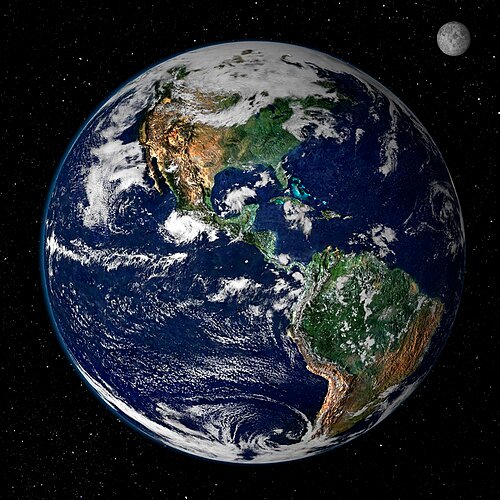
Amidst the vast darkness of space, where cold silence reigns and lifeless rocks orbit distant stars, there is one world that breathes. From afar, Earth glows with swirls of blue, green, and white—an oasis of oceans, forests, and clouds. It is a planet alive, vibrant, and ever-changing. No other world we know sings the song of life like this one does.
Earth is not just a place where life happens to exist—it is a living system, a self-sustaining engine of chemistry, climate, and biology woven together in astonishing harmony. To understand how our world became home to life is to uncover one of the greatest stories in the universe: how inert matter learned to feel, to move, to think, and to dream.
This story is not just science—it is the saga of existence itself. It began more than four billion years ago in chaos and fire, in a young universe still finding its rhythm. From stardust to cells, from microbes to minds, Earth’s transformation into a living world is a cosmic miracle written in stone, water, and DNA.
The Violent Birth of a World
The story of life begins before life itself, in the birth of Earth. About 4.6 billion years ago, the newborn Sun was surrounded by a swirling disk of gas and dust left over from its own formation. Inside this fiery cloud, countless fragments collided and coalesced, growing from grains into boulders, from boulders into planets.
Earth was forged in violence. Its early years were dominated by collisions so immense they melted entire worlds. The most cataclysmic of these came when a Mars-sized object, which scientists call Theia, slammed into the young Earth. The impact tore away a huge portion of our planet’s outer layers, which later gathered to form the Moon.
For tens of millions of years afterward, Earth was an inferno. Oceans of magma covered its surface, while meteors bombarded it relentlessly from space. The air was thick with volcanic gases—carbon dioxide, nitrogen, methane, and ammonia—but no oxygen.
And yet, even in this chaos, the seeds of life were being planted. As the bombardment slowed and the crust cooled, rain began to fall. It rained for centuries, filling the lowlands, creating the first oceans—the cradle where life would awaken.
The Ocean That Dreamed
The early Earth, about four billion years ago, was a world of water and rock. Lightning flashed across dark skies, volcanoes rumbled, and the oceans steamed under a dim, young Sun. But beneath those waves, something extraordinary was beginning.
The first ingredients of life were simple molecules—carbon, hydrogen, nitrogen, oxygen, phosphorus, and sulfur—combined in endless variations. These elements, born in the hearts of ancient stars, had drifted through the galaxy before settling here, on this little blue world.
Energy from lightning, volcanic heat, and ultraviolet radiation drove chemical reactions in the oceans. Out of that chaotic mix emerged more complex molecules—amino acids, lipids, sugars, and nucleotides, the building blocks of proteins and DNA.
No one knows exactly how life began, but many scientists believe that somewhere in the shallow seas, these molecules assembled into self-replicating systems. Perhaps within tiny bubbles of fat-like molecules, a spark of order emerged—a structure that could copy itself, using energy from its surroundings.
That moment, when chemistry became biology, was the dawn of life. It was not a single event, but a gradual unfolding—a transition from chaos to pattern, from reaction to replication. The first cell was not a miracle of sudden creation, but the inevitable result of nature’s persistent creativity.
The Age of Microbial Masters
For billions of years, Earth belonged to microbes. These single-celled pioneers were the architects of everything that followed. They transformed the planet from a sterile rock into a thriving, self-regulating organism.
Early life forms fed on the chemical richness of their environment. Some drew energy from volcanic vents deep beneath the sea, where scalding water met mineral-rich rock. These hydrothermal oases provided both shelter and sustenance, creating stable conditions for primitive microbes to thrive.
One of the most revolutionary innovations in the history of life was photosynthesis—the ability to capture sunlight and use it to build organic molecules. The first photosynthetic bacteria appeared around 3.5 billion years ago. They used sunlight to split water molecules, releasing oxygen as a byproduct.
At first, this oxygen reacted with iron and other elements in the oceans, but eventually, it began to accumulate in the atmosphere. This event, known as the Great Oxygenation, occurred about 2.4 billion years ago and changed everything.
Oxygen was both a poison and a gift. For the early anaerobic microbes, it was deadly. Yet for others, it became a source of immense power—a new way to harvest energy with unparalleled efficiency. From this adaptation arose the ancestors of all complex life.
The Breath of a Planet
As oxygen filled the air, Earth’s appearance began to change. The skies turned blue, and the ozone layer formed, shielding the surface from harmful radiation. The oceans, once green and murky, began to clear. The stage was set for the next great leap in evolution: the rise of eukaryotic cells.
Eukaryotes were unlike anything before them. They contained internal structures—organelles—that performed specialized tasks. Mitochondria, tiny powerhouses within these cells, generated energy through oxygen-based respiration. They are believed to have originated when one bacterium engulfed another in a partnership that became permanent.
This union of life within life—known as endosymbiosis—was a profound turning point. It allowed cells to grow larger, more complex, and more capable. It was as if evolution had learned how to build communities within a single organism.
From these sophisticated cells came the diversity that would eventually lead to plants, animals, and everything we know as “life.” But for nearly a billion years, the world remained dominated by microscopic forms. Evolution takes its time, sculpting life in slow, patient strokes.
Snowball Earth and the Resilience of Life
Around 700 million years ago, Earth faced one of its greatest trials. The planet plunged into a series of global ice ages so severe that glaciers reached the equator. The entire world became a frozen sphere—an event known as “Snowball Earth.”
Yet even in this frozen nightmare, life endured. Beneath the ice, near hydrothermal vents or in pockets of liquid water, microbes continued to survive. When the ice finally melted—thanks to volcanic carbon dioxide accumulating in the atmosphere—life emerged stronger than before.
The end of these ice ages triggered an explosion of biological innovation. With oxygen abundant and climates stabilizing, the oceans became laboratories of evolution. The groundwork was laid for a revolution in complexity—the Cambrian Explosion.
The Cambrian Miracle
About 541 million years ago, life suddenly diversified in an astonishing burst of creativity. In a geological instant, the oceans filled with creatures of every imaginable form—armored trilobites, spiny worms, primitive fish, and alien-like beings whose shapes defied imagination.
This Cambrian Explosion marked the first appearance of most major animal groups we know today. Organisms developed skeletons, eyes, and complex nervous systems. Predation evolved, driving an evolutionary arms race that accelerated adaptation and diversity.
The fossil beds of places like the Burgess Shale in Canada preserve these creatures in exquisite detail—a snapshot of life’s first grand experiment with complexity. For the first time, the world teemed not just with microbes, but with animals that swam, crawled, hunted, and saw.
Earth had become a living tapestry, woven from countless strands of DNA and imagination.
The Conquest of the Land
For hundreds of millions of years, life thrived in the oceans. But eventually, it would take an even bolder step—the colonization of land.
The first pioneers were simple algae and fungi that clung to damp rocks at the water’s edge. They formed symbiotic partnerships, creating the ancestors of modern plants and lichens. Over time, these early plants developed roots and vascular systems that allowed them to draw water and nutrients from the soil.
As vegetation spread, it transformed the planet once again. Plants began pumping oxygen into the air, creating a breathable atmosphere. They also drew carbon dioxide from the skies, helping regulate the global climate.
Animals soon followed. The first land-dwelling creatures were arthropods—relatives of insects and spiders. Then came amphibians, the descendants of fish that had developed limbs capable of supporting their weight. By 360 million years ago, lush forests covered the continents, and the air buzzed with life.
The land was no longer barren. Earth had become a green world.
The Age of Giants and Extinction
Life’s triumphs were not without catastrophe. The history of Earth is a story not only of creation, but also of destruction. Throughout the ages, the planet has endured mass extinctions—events so devastating that they wiped out most species in a geological heartbeat.
The most famous of these came 66 million years ago, when an asteroid struck the Yucatán Peninsula, ending the reign of the dinosaurs. But even greater cataclysms occurred before—volcanic eruptions, changing climates, and shifting continents all reshaped the course of evolution.
Yet every extinction was followed by renewal. The fall of one era made way for the rise of another. When the dinosaurs vanished, mammals—small, nocturnal survivors—emerged into the light. From them, a new wave of life began to flourish, leading eventually to primates, apes, and humans.
Extinction, though tragic, is part of life’s rhythm. The planet has died and been reborn many times, each cycle refining the web of existence.
The Great Dance of Continents
As life evolved, so did the planet itself. Earth’s surface is not static—it moves, breathes, and reshapes itself through plate tectonics. The continents drift slowly atop a sea of molten rock, colliding and separating over eons.
This ceaseless motion has sculpted mountains, opened oceans, and triggered earthquakes and volcanoes. It has also guided evolution, isolating species, merging ecosystems, and changing climates. When continents split, new coastlines formed, fostering biodiversity. When they collided, mass extinctions sometimes followed.
The Earth is not merely a backdrop for life; it is an active participant. The continents, oceans, atmosphere, and biosphere are all parts of a single dynamic system—a living planet in every sense.
The Rise of the Blue Planet
Today, we see Earth as a blue marble suspended in space. Its oceans cover more than 70% of its surface, regulating temperature and nurturing life. Water is the secret ingredient that makes Earth unique—a solvent for chemistry, a medium for motion, and a carrier of energy.
The oceans act as Earth’s lungs and heart, absorbing carbon dioxide, releasing oxygen, and distributing heat. They connect all living systems in one continuous cycle. From the plankton that drift on the waves to the whales that sing in the deep, life thrives in endless interdependence.
Above the oceans, the atmosphere—once toxic—has become a shield and a source of life. Its balance of gases, maintained by the interplay of plants, animals, and microbes, keeps the planet’s temperature within habitable bounds.
This self-regulation inspired the Gaia Hypothesis, proposed by James Lovelock and Lynn Margulis, which views Earth as a single living organism—a system where life and environment co-evolve to sustain stability. Though debated in scientific detail, the idea captures an undeniable truth: life and planet are one.
The Breath of Life and the Web of Balance
Every breath we take is a gift from billions of years of evolution. Oxygen produced by plants and algae circulates through the atmosphere, entering our lungs, our blood, our cells. In return, we exhale carbon dioxide, which plants use to grow.
This delicate balance extends to every corner of the biosphere. From the microscopic bacteria that recycle nutrients in the soil to the towering redwoods that shape entire ecosystems, life is a continuous cycle of exchange. Nothing exists in isolation.
The oceans regulate climate. Forests anchor rain. Pollinators sustain food webs. Even the decay of the dead feeds the living. Earth’s biosphere is a web of endless reciprocity, where every loss echoes through the system and every adaptation strengthens the whole.
To understand this interconnectedness is to see the planet not as a collection of parts, but as a single, breathing entity—a living world that evolves, heals, and endures.
The Age of Humans
Then came us.
In the last few million years—a blink in geological time—a species of ape evolved an extraordinary brain. Humans learned to use tools, harness fire, and speak. They painted caves, cultivated fields, and built civilizations.
With our rise came both brilliance and peril. We learned to understand the laws of physics and the structure of DNA, to look at the stars and see our origins. But we also began to alter the planet itself. Through deforestation, pollution, and climate change, humanity has become a geological force—reshaping the Earth in ways no other species ever has.
Some scientists call this new epoch the Anthropocene—the Age of Humans. It is an age of both wonder and warning. We have the power to explore other worlds, but also to unmake our own.
The future of life on Earth now depends on the choices we make. Will we act as stewards of this living planet, or as its undoing? The story of Earth’s past reminds us that balance is fragile, and that survival depends on harmony, not dominance.
The Fragile Miracle
If you step back and view Earth from space, something profound happens. You see not nations or borders, but a single glowing sphere—delicate, alive, and alone in a vast cosmic dark. Every mountain, every forest, every creature, every memory that ever existed is contained within that thin blue veil.
The atmosphere that sustains all life is thinner than the skin of an apple compared to the planet’s size. The oceans that cradle life are but a fragile film of water over rock. And yet, within these narrow margins, the miracle of life unfolds endlessly.
Earth’s balance—between warmth and cold, land and sea, creation and destruction—is a masterpiece of cosmic coincidence. A slight change in distance from the Sun, a thinner atmosphere, a missing moon, and life as we know it might never have existed.
We live on a razor’s edge of habitability, yet we thrive.
The Story Written in Stone and Star
Every rock, every fossil, every molecule tells a part of Earth’s story. The layers of the crust record ancient climates, extinctions, and rebirths. The isotopes of atoms whisper of the chemistry that once filled the air and sea.
And beyond Earth, the stars remind us of our shared origin. The carbon in our cells, the iron in our blood, the calcium in our bones—all were forged in the hearts of long-dead stars. When those stars exploded, they scattered their elements across space, seeding the nebula that became our Sun, our planet, and us.
To say that Earth is alive is to recognize that life is the universe made conscious. Through us, the cosmos has learned to gaze upon itself and ask why it exists.
The Eternal Symphony
Life on Earth is not static; it is a symphony in motion. Evolution continues every moment, shaping bacteria, plants, animals, and humans alike. The planet breathes, changes, and dreams through the living things that inhabit it.
Even after billions of years, the dance of life shows no sign of ending. It may shift, it may adapt, it may suffer—but the pattern endures. From the first microbe to the last human, from coral reefs to rainforests, the song of life is the same: to grow, to change, to connect.
We are part of that song. Every heartbeat, every breath, every thought is a note in the grand composition of the living planet.
The Home We Must Protect
Earth is not just our home—it is our origin, our sustainer, and our destiny. There is no other known world where rivers flow, where forests breathe, where the air itself is alive.
Yet in our pursuit of progress, we have begun to unravel the delicate balance that makes life possible. Climate change, pollution, and habitat destruction threaten the systems that have evolved over billions of years. If we continue to push beyond nature’s limits, we may witness a new extinction—one of our own making.
But there is still hope. The same intelligence that allows us to harm the planet also allows us to heal it. We can restore ecosystems, preserve biodiversity, and harness clean energy. We can live not apart from Earth, but in partnership with it.
The story of life has always been one of resilience. If we act with wisdom, we can ensure that Earth’s next chapter remains one of renewal, not ruin.
The Living Planet and the Dream of Eternity
When the first astronauts looked back at Earth from space, they described a vision that changed them forever—a shimmering blue world rising above the blackness, fragile and breathtaking. From that distance, the divisions of humanity vanished. What remained was unity—a single living planet adrift in the infinite.
That is who we are. We are the life of Earth, the consciousness of its stone and sea. We are its memory and its future.
The story of how Earth became home to life is not over. It continues with every breath, every heartbeat, every act of curiosity and compassion. Life began as a spark in the depths of a primordial ocean—and from that spark, it has become a flame that illuminates the cosmos.
As long as we cherish and protect this world, that flame will never go out.
For Earth is not just alive—it is life itself. And through it, the universe remembers how to dream.