Earth’s earliest story begins not with words, but with silence. A silence so deep that it has swallowed entire chapters of our planet’s past. When scientists peer back toward the dawn of Earth’s history, they find gaps where memory should be, missing pages torn from the book of time. These absences are not due to neglect or lack of curiosity. They exist because the early Earth was a violent, restless place, constantly rewriting itself, erasing the evidence of its own beginnings.
The planet we walk on today is more than four and a half billion years old, yet the rocks beneath our feet rarely speak of events older than four billion years. The first half-billion years of Earth’s existence—the time when the planet formed, cooled, and became capable of hosting life—has largely vanished from the geological record. These missing chapters are among the greatest mysteries in Earth science, not because they are unknowable, but because they require extraordinary ingenuity to reconstruct.
To understand Earth’s earliest story is to understand ourselves. The conditions that shaped the young planet also shaped the origins of oceans, continents, atmosphere, and life itself. Every missing detail is a missing clue to how a lifeless world became alive.
A Planet Born from Chaos
Earth did not begin as a gentle blue world. It was born from chaos, forged in the swirling debris of a young Sun surrounded by dust, gas, and countless rocky fragments. Gravity pulled these fragments together in a process that was anything but peaceful. Collisions were frequent and catastrophic. Each impact released enormous energy, melting rock and reshaping the growing planet.
In these earliest moments, Earth was not a solid sphere but a molten body, its surface a global ocean of magma. Heavy elements like iron sank toward the center, forming the core, while lighter materials rose to create the mantle and crust. This process of differentiation laid the foundation for Earth’s internal structure, yet almost all physical traces of this time have been destroyed.
The reason lies in heat and motion. Early Earth was hot, not just at the surface but throughout its interior. Rock flowed, melted, and reformed continuously. Any crust that solidified was likely recycled back into the mantle by intense tectonic activity or obliterated by impacts from space. The planet was too young and too restless to preserve its own history.
The Great Collision That Changed Everything
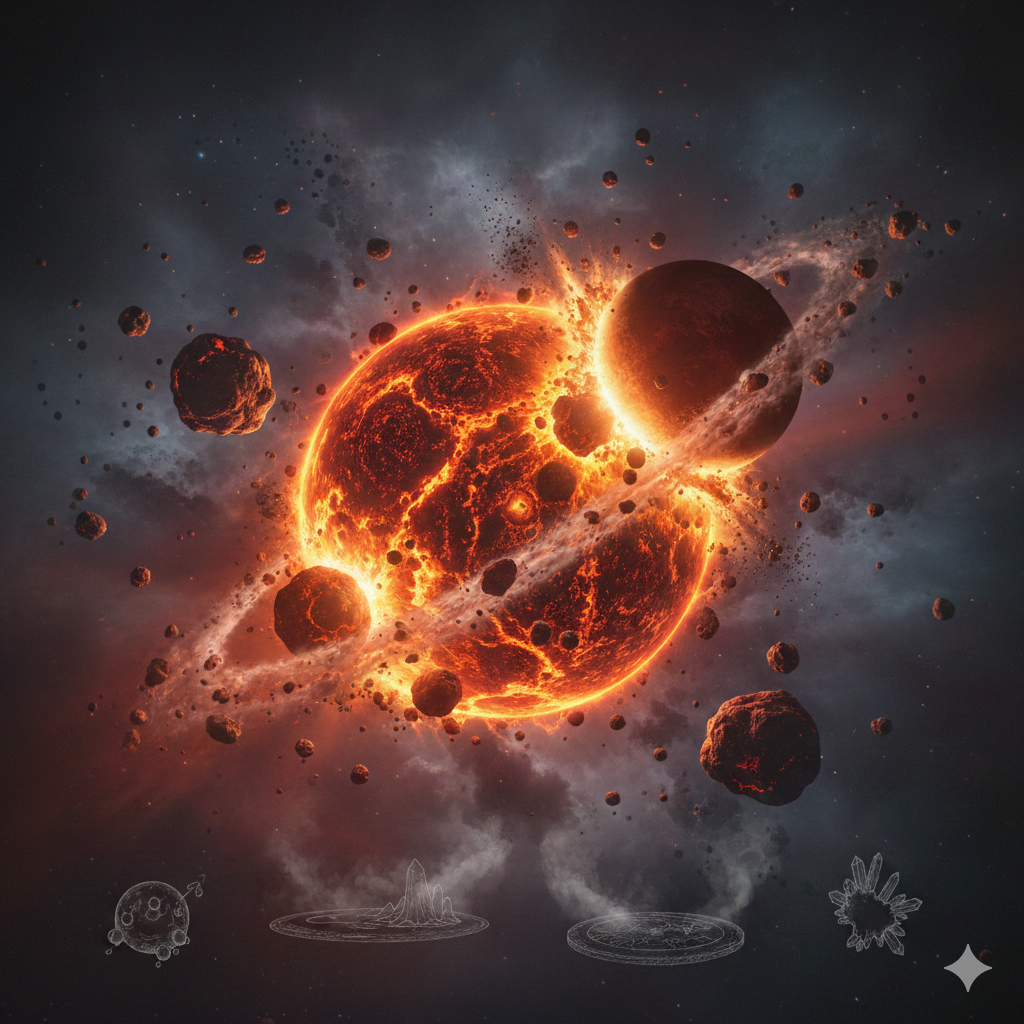
One of the most dramatic missing chapters in Earth’s early story is the event that created the Moon. Evidence strongly suggests that a Mars-sized body collided with the young Earth in a colossal impact. This collision ejected vast amounts of material into orbit, which later coalesced to form the Moon.
This event fundamentally altered Earth’s destiny. It changed the planet’s rotation, tilted its axis, and may have influenced the development of tides that shaped early oceans. Yet we have no direct rock record of the impact itself. The evidence comes instead from subtle chemical similarities between Earth and lunar rocks, and from computer simulations that recreate the physics of such a collision.
The Moon-forming impact likely melted much of Earth’s surface once again, erasing earlier geological features. It was both a destructive and creative moment, wiping away chapters of Earth’s infancy while setting the stage for future stability. Without the Moon, Earth’s climate and rotational behavior might have been far more chaotic, possibly preventing life from gaining a foothold.
The Hadean Eon and the Vanishing World
The earliest named chapter of Earth’s history is the Hadean Eon, a time so hostile it was named after Hades, the underworld of Greek mythology. This period spans from Earth’s formation to about four billion years ago. It is during the Hadean that most of Earth’s missing chapters reside.
For a long time, scientists imagined the Hadean Earth as a hellish landscape, permanently molten and incapable of supporting liquid water. However, this view has softened as new evidence has emerged. Tiny mineral grains called zircons, preserved within much younger rocks, have provided tantalizing glimpses into this lost world.
Some zircons are more than four billion years old and contain chemical signatures suggesting they formed in the presence of liquid water. This implies that Earth may have cooled enough to host oceans far earlier than previously thought. If true, this radically changes our understanding of early Earth, suggesting that habitable conditions may have existed almost as soon as the planet formed.
Yet zircons are fragments, not chapters. They are isolated words torn from a book whose pages have burned away. From them, scientists must infer entire landscapes, climates, and processes that no longer exist in any recognizable form.
The Late Heavy Bombardment and Cosmic Violence
Another missing chapter centers on a period known as the Late Heavy Bombardment, a time when the inner solar system was pummeled by asteroids and comets. Evidence for this event comes primarily from the Moon, whose surface preserves countless impact craters dating to this era.
Earth, by contrast, bears few scars from this bombardment. Plate tectonics, erosion, and volcanic activity have erased most direct evidence of these ancient impacts. Yet their influence may have been profound. Massive collisions could have repeatedly sterilized the planet’s surface, boiling oceans and vaporizing atmosphere, only for conditions to gradually recover.
At the same time, these impacts may have delivered crucial ingredients for life, including water and organic molecules. The Late Heavy Bombardment represents a paradoxical chapter in Earth’s story, one of destruction and possibility intertwined. Its absence from the rock record leaves scientists debating its intensity, duration, and exact role in shaping Earth’s habitability.
The First Atmosphere and the Breath of a Young World
Earth’s earliest atmosphere is another chapter largely lost to time. The gases surrounding the young planet were not like the air we breathe today. They were likely dominated by volcanic emissions such as carbon dioxide, water vapor, methane, and nitrogen, with little or no free oxygen.
This primitive atmosphere played a critical role in regulating temperature, trapping heat through greenhouse effects and preventing Earth from becoming a frozen wasteland. Yet because gases leave few permanent traces, reconstructing this atmosphere requires indirect evidence preserved in ancient rocks and minerals.
Chemical signatures in old sediments suggest that Earth’s surface environment was chemically reducing, meaning oxygen was scarce. This had profound implications for early chemistry and the origin of life. The lack of oxygen allowed organic molecules to form and persist, setting the stage for biological processes.
The transformation of Earth’s atmosphere, from oxygen-poor to oxygen-rich, is one of the most significant transitions in planetary history. Understanding its beginnings requires piecing together faint clues scattered across billions of years.
Oceans from the Void
The origin of Earth’s oceans is another missing chapter filled with mystery. Water is essential to life as we know it, yet its arrival on Earth remains debated. Did water emerge from Earth’s interior through volcanic outgassing, or was it delivered by icy bodies from the outer solar system? Or did both processes contribute?
Geochemical evidence suggests that water was present very early in Earth’s history, possibly during the Hadean Eon. This implies that either Earth retained water during its violent formation or acquired it soon afterward. The presence of early oceans would have moderated temperatures and provided stable environments for chemical reactions.
But oceans are restless archives. They erode coastlines, recycle sediments, and subduct crust into the mantle. As a result, the oldest oceanic crust has been completely destroyed. What remains are subtle isotopic clues locked within minerals, whispers of ancient seas that once covered a newborn world.
Continents Before Memory
Modern continents are built from ancient cores called cratons, some of which are more than three billion years old. Yet even these venerable structures do not reach back to Earth’s very beginning. The nature of the earliest continents, if they existed at all, remains uncertain.
Some scientists propose that early Earth had small, transient landmasses rather than stable continents. These proto-continents may have formed and vanished repeatedly, recycled by intense tectonic processes. If so, they left little trace behind, their existence inferred only through chemical fingerprints.
The emergence of stable continents was a turning point in Earth’s history. Continents influence climate, ocean circulation, and the cycling of elements essential to life. The absence of direct evidence from their earliest formation leaves a critical gap in our understanding of how Earth became a complex, differentiated planet.
The Shadowy Origin of Life
Perhaps the most profound missing chapter in Earth’s earliest story is the origin of life itself. Life appears in the fossil record around 3.5 to 3.8 billion years ago, remarkably soon after the end of the Hadean Eon. This rapid emergence suggests that life arose quickly once conditions allowed.
Yet the steps leading from chemistry to biology are hidden behind a veil of deep time. The earliest life forms were microscopic and left few durable fossils. Any traces they did leave were vulnerable to destruction by heat, pressure, and tectonic recycling.
Scientists study ancient rocks for chemical signatures indicative of biological activity, such as specific carbon isotopic ratios. These clues suggest that life may have existed even earlier than the oldest fossils, pushing the origin of life deeper into Earth’s missing chapters.
The question of how life began is not just a scientific puzzle but a philosophical one. It challenges our understanding of what life is and how it arises from non-living matter. Earth’s silence on this matter is both frustrating and inspiring, driving research across disciplines.
Plate Tectonics and the Great Eraser
One of the main reasons Earth’s earliest chapters are missing is plate tectonics. The movement of tectonic plates reshapes the planet’s surface, creating mountains, opening oceans, and recycling crust into the mantle. This dynamic process is essential to Earth’s long-term habitability, regulating climate and recycling nutrients.
Yet plate tectonics is also a relentless eraser of history. Old crust is destroyed as new crust forms. Rocks are metamorphosed, melted, and reformed, losing the information they once carried. While tectonics keeps Earth alive, it also ensures that its earliest memories are lost.
The onset of plate tectonics itself is a missing chapter. Scientists debate when this process began and how it evolved. Did early Earth have plate tectonics similar to today, or did it operate under a different regime? The answer holds implications for the planet’s thermal evolution and the emergence of life.
Reading the Invisible Through Isotopes
In the absence of direct evidence, scientists turn to isotopes, subtle variations in the atomic makeup of elements. Isotopes act as time capsules, preserving information about ancient processes even when rocks are altered or destroyed.
By studying isotopic ratios in ancient minerals, researchers can infer temperatures, atmospheric composition, and even the presence of water billions of years ago. These techniques have transformed our understanding of early Earth, allowing scientists to read between the missing lines of geological history.
Isotopes do not tell stories outright. They require interpretation, imagination, and rigorous testing. Each measurement adds a fragment to a vast mosaic, slowly revealing a picture of a world that no longer exists.
Earth in a Planetary Context
Earth’s missing chapters gain new meaning when viewed in the context of other planets. Mars, for example, preserves a much older surface, offering a glimpse into what early Earth might have looked like. The Moon serves as a record of early solar system bombardment. Venus provides a cautionary tale of runaway greenhouse conditions.
By comparing Earth with its planetary neighbors, scientists can infer which features are unique and which are common outcomes of planetary evolution. This comparative approach helps fill gaps in Earth’s history, using the solar system itself as a laboratory.
Understanding Earth’s early story also informs the search for life beyond our planet. By learning how habitable conditions emerged here, scientists can better identify worlds elsewhere that might host life.
The Emotional Weight of Missing Time
There is something profoundly moving about Earth’s missing chapters. They remind us of the fragility of memory, even on a planetary scale. Just as human histories can be lost to fire, flood, or neglect, so too can a planet’s past be erased by its own vitality.
Yet this loss is not merely tragic. It is also a testament to Earth’s dynamic nature. The same processes that erased early records also created the conditions for oceans, continents, and life. Destruction and creation are inseparable in Earth’s story.
For scientists, the missing chapters are an invitation rather than a barrier. They challenge us to develop new methods, ask deeper questions, and embrace uncertainty. They teach humility, reminding us that knowledge is always partial and provisional.
Reconstructing a World We Can Never See
The effort to reconstruct Earth’s earliest history is an act of intellectual courage. It requires imagining worlds that no human could witness, based on fragments that barely survived. It demands trust in evidence that is indirect, subtle, and often ambiguous.
Yet progress continues. Each new zircon analyzed, each ancient rock discovered, each improved model brings us closer to understanding the planet’s infancy. The missing chapters may never be fully recovered, but their outlines are becoming clearer.
In this pursuit, science becomes not just a tool for explanation but a form of storytelling grounded in evidence. It allows us to give voice to a silent past, to imagine the fires, oceans, and chemical dances that shaped our world.
Why Earth’s Missing Chapters Matter
Earth’s earliest story is not merely a curiosity for geologists. It is the foundation upon which everything else rests. The formation of the core influences the magnetic field that shields life from harmful radiation. The emergence of oceans shapes climate and chemistry. The origin of life defines our place in the universe.
By seeking to understand these missing chapters, we are ultimately seeking to understand ourselves. We are made of atoms forged in ancient stars, assembled on a planet whose earliest moments remain shrouded in mystery. Our existence is tied to events that occurred billions of years before the first human thought.
The silence at the beginning of time is not empty. It is filled with potential, with stories waiting to be inferred, imagined, and understood. Earth may never reveal all its secrets, but in the search for its missing chapters, we find something equally valuable: a deeper appreciation of the fragile, extraordinary world we inhabit.