Among the ancient myths of Greece, few shine with the same haunting brilliance as the story of Daedalus and Icarus. It is a tale that speaks to the heart of what it means to be human—to dream, to create, to reach for the impossible, and to pay the price of ambition. It’s a story of a father and a son bound together by love and tragedy, of invention and rebellion, and of the fragile line between genius and hubris.
At its surface, it’s the story of two men who flew too close to the sun. But beneath that poetic image lies something deeper: a reflection of our eternal yearning for freedom, our defiance of limits, and the peril that accompanies the pursuit of transcendence.
The Craftsman of Gods and Kings
Before the flight, before the fall, there was Daedalus—the master craftsman, inventor, and architect of unsurpassed skill. In the world of Greek myth, Daedalus was more than a mere artisan; he was the embodiment of human ingenuity. His mind was a labyrinth of ideas, each more daring than the last.
In Athens, Daedalus was celebrated for his genius. He designed tools that could move on their own, statues so lifelike they seemed to breathe, and mechanisms that blurred the boundary between art and magic. His creations earned him fame and envy alike. But genius is often a double-edged sword, and for Daedalus, that brilliance would lead to exile and sorrow.
The myths tell us that Daedalus had a nephew, Talos (or Perdix, depending on the version), who was also gifted with remarkable intellect. Talos invented the saw, inspired by the jaw of a fish, and the compass used to draw perfect circles. When Daedalus saw his young apprentice’s ingenuity, jealousy pierced his heart. Overcome by envy, he hurled the boy from the Acropolis. The gods, pitying the child, transformed him into a partridge before he hit the ground.
For this crime, Daedalus was banished from Athens, his homeland. Thus began his wandering—a man of brilliance cast out by his own weakness.
The Labyrinth of Crete
Daedalus found refuge on the island of Crete, where King Minos ruled—a monarch both mighty and merciless. Minos saw in Daedalus an opportunity: here was a man who could make anything possible. And so Daedalus became the royal craftsman of Crete, building wonders that would echo through legend.
But Crete was no ordinary kingdom. It was the domain of myths and monsters. Queen Pasiphaë, the wife of Minos, had fallen under a strange and divine curse. Poseidon, angered by Minos’ defiance, caused Pasiphaë to fall in love with a magnificent white bull. Consumed by unnatural desire, she begged Daedalus for help.
Daedalus, though disturbed, could not refuse his queen. He built for her a hollow wooden cow covered with real hides. Pasiphaë hid inside it, and from her union with the bull, the Minotaur was born—a creature with the body of a man and the head of a bull.
Ashamed and horrified, Minos demanded a prison that could contain such an abomination. Once again, he turned to Daedalus. And so the craftsman designed his greatest creation: the Labyrinth—a maze so vast and intricate that no one who entered could ever find the way out. Within its twisting corridors, the Minotaur roamed, and Crete’s darkest secret was forever buried beneath stone.
Yet Daedalus’s genius, once again, came at a cost.
The Prisoner of His Own Invention
As years passed, Daedalus grew weary of Crete and its cruelty. He longed to return to Athens with his son, Icarus, but Minos refused to let him leave. The king feared that Daedalus might reveal the secrets of the Labyrinth to his enemies.
To ensure their silence, Minos imprisoned Daedalus and Icarus in a high tower overlooking the sea—an exile from which there seemed no escape.
But Daedalus, ever the inventor, refused to surrender. His mind, born to solve the unsolvable, began to work again. “Minos may command the land and the sea,” he told Icarus, “but he does not command the air.”
And so, with feathers gathered from the seabirds that nested near their prison, Daedalus began his most audacious creation yet—wings.
The Wings of Freedom
Night after night, Daedalus worked, binding feathers together with wax and thread, shaping them into the delicate architecture of flight. He tested each design, observing how the feathers caught the wind, how balance and rhythm turned gravity into grace. Icarus watched in awe, his youthful heart alight with wonder and anticipation.
Finally, when the wings were ready, Daedalus fastened them to his arms and lifted himself into the air. The invention worked—the air held him, and he soared like a god. He returned to Icarus, trembling with exhilaration, and prepared a smaller pair for his son.
Before they took flight, Daedalus gave Icarus a final warning:
“My son,” he said, “keep to the middle path. Fly too low, and the sea’s spray will weigh down your wings. Fly too high, and the sun’s heat will melt the wax. Follow me, and you will be safe.”
But the sky, once touched, is not easily forgotten.
The Flight
When the morning came, the two rose into the air. The ocean shimmered below them; the wind sang around their bodies. Fishermen and shepherds below lifted their eyes in astonishment, thinking they beheld gods. For a moment, the world belonged to them—father and son, free of earth and chain.
Daedalus, cautious and steady, guided their path. But Icarus—young, fearless, and intoxicated by the thrill of flight—forgot his father’s words. The higher he climbed, the smaller the world below became, and the more he longed to touch the heavens themselves.
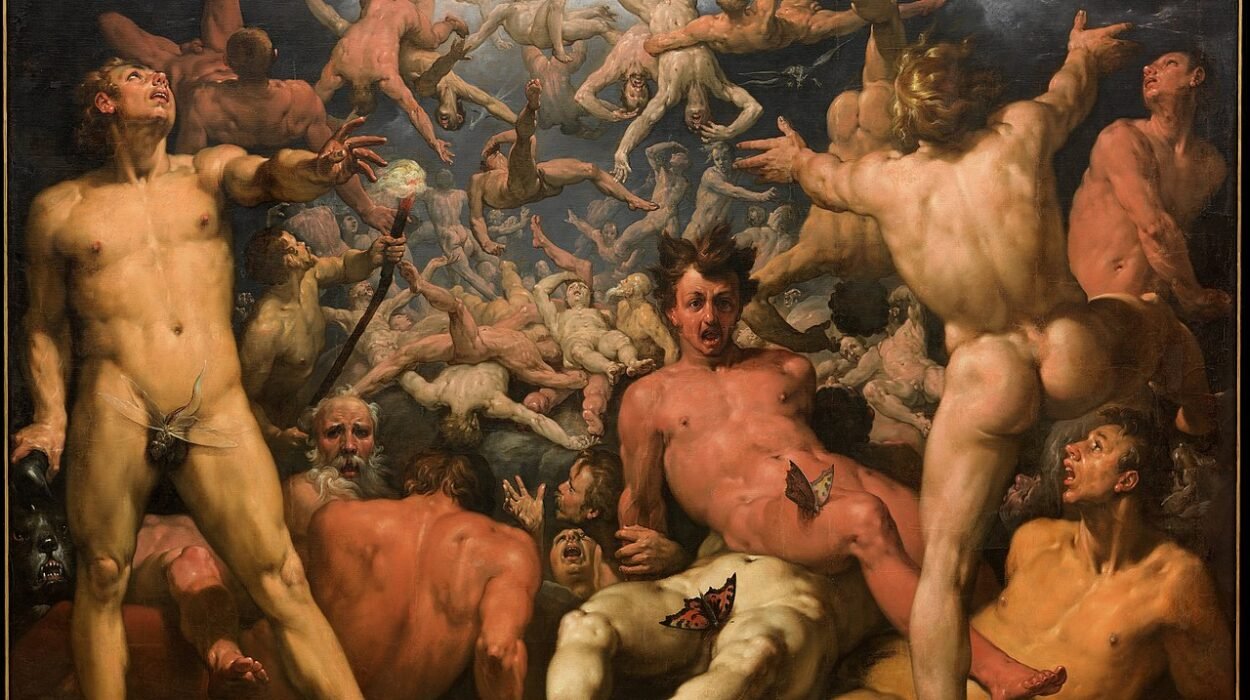
The sun blazed above him, golden and merciless. The wax that held his wings began to soften, then drip. The feathers loosened, scattering like snow in the light. Icarus flailed as his wings disintegrated, and in a moment of terrible beauty, he fell—spinning through the air toward the deep blue sea.
Daedalus watched helplessly as his son vanished beneath the waves. The water closed over him, and silence returned to the sky.
The sea that claimed him was later named the Icarian Sea, and a nearby island took his name—Icaria—so that he would not be forgotten.
The Grief of Daedalus
When Daedalus descended to the shore, his heart was broken. He called out for Icarus, but only the waves answered. He built a tomb for his son and laid down the wings beside it.
In that moment, the triumph of human invention turned to tragedy. The wings that had symbolized freedom and genius had also brought loss. Yet Daedalus did not curse his craft—he understood that invention is both creation and destruction, that genius is shadowed by consequence.
Daedalus eventually found refuge in Sicily, where he continued his work, creating wonders for new kings and temples. But the joy of creation never shone as brightly again. His heart remained tethered to the sea where Icarus had fallen.
The Meaning Behind the Myth
The story of Daedalus and Icarus endures not because it tells us how to fly, but because it teaches us what it means to be human. It is a myth of paradox—of wisdom and folly, love and loss, ambition and restraint.
Daedalus represents the rational, creative mind—the craftsman who seeks mastery over nature. Icarus represents the dreamer, the reckless spirit who dares to go beyond the limits of what is safe. Together, they embody the duality of human nature itself.
We are both Daedalus and Icarus: creators and destroyers, thinkers and dreamers, grounded and soaring.
When Icarus falls, it is not merely punishment for pride—it is the price of freedom. His flight was not failure, but fulfillment. For a brief, blazing moment, he touched the heavens. In doing so, he lived with a fullness that few ever know.
The myth does not end in despair—it ends in memory. Icarus becomes eternal not through survival, but through story. His fall becomes a symbol of humanity’s unending desire to transcend boundaries, even at the risk of destruction.
The Psychology of Flight and Fall
On a deeper level, the myth of Daedalus and Icarus explores the tension between reason and passion. Daedalus embodies intellect—the power to create, control, and protect. Icarus embodies emotion—the longing to experience, to feel, to live without restraint.
This struggle is timeless. It plays out in every generation, every artist, scientist, and dreamer who dares to push beyond convention. The same force that drives discovery also courts disaster. The same imagination that lifts us can lead us too close to the flame.
In Icarus’s fall, we see our own struggles—with ambition, with youth, with the seduction of possibility. His story reminds us that progress without humility is perilous, yet it also warns against living too cautiously.
Daedalus’s warning to “keep to the middle path” is wise—but would we still remember Icarus if he had obeyed?
The Legacy of the Labyrinth
The myth also mirrors the labyrinth itself—a maze of meanings and reflections. Just as the Labyrinth Daedalus built was a prison for the Minotaur, so too is the human mind a labyrinth of desires, fears, and contradictions.
Daedalus escaped one labyrinth by building wings—but entered another, one woven from guilt and grief. The story suggests that freedom and responsibility are inescapably intertwined. Every act of creation builds both a wonder and a danger.
In modern times, the myth has been reinterpreted countless ways. Psychologists see in it the journey of individuation—the child breaking free from the parent’s control. Artists see rebellion against tradition. Scientists see a warning about the ethics of invention. Yet beneath all interpretations lies one enduring truth: to fly is to risk the fall, but to never fly is to never truly live.
The Myth in Art and Memory
For thousands of years, poets, painters, and philosophers have returned to the image of Icarus falling from the sky. In Ovid’s Metamorphoses, the tale is told with heartbreaking simplicity: Daedalus calls to his lost son, the air echoing his cries. In Bruegel’s famous painting, The Fall of Icarus, the boy’s body lies unnoticed in the water, while farmers go on plowing their fields—life continuing, indifferent to tragedy.
This artistic indifference is its own lesson. The world does not stop for our sorrow. Yet the myth survives precisely because of that tension—because it speaks to both the beauty and the indifference of existence.
Each retelling becomes a mirror reflecting the age that tells it. In the Renaissance, Icarus symbolized the rebirth of human potential. In the Romantic era, he became the emblem of passionate rebellion. In the modern world, he warns of technological overreach—the dangers of playing god.
And yet, even as we build machines that soar higher than any myth imagined, we still feel the shadow of the sun above us.
The Father and the Son
At its heart, the myth is not only about ambition—it is about love. The bond between Daedalus and Icarus is what gives the story its lasting emotional power. Daedalus’s love drives him to create, to protect, and ultimately to lose. His genius, his warnings, his grief—all spring from the same well of devotion.
Every parent knows the agony of watching a child reach for independence, of knowing they must one day fall to learn to rise again. Daedalus’s wings are both a gift and a curse—an act of love that cannot shield Icarus from his own choices.
In this, the myth transcends time. It becomes a meditation on the human condition: we give life, we teach, we warn—but each soul must find its own sky.
The Sun and the Sea: Symbols of Destiny
In mythic symbolism, the sun represents enlightenment, divinity, and transcendence. For Icarus, the sun is both goal and doom—the source of all light and the destroyer of those who come too near. It embodies the paradox of aspiration: what draws us upward can also consume us.
The sea, in contrast, represents the unknown, the subconscious, the depths of being. It is both cradle and grave. When Icarus falls into the sea, he does not vanish; he returns to the eternal source from which all life arose. His death, then, is not annihilation but transformation.
Thus, the myth becomes a cosmic cycle: air, fire, water—aspiration, illumination, dissolution. It is a reminder that every ascent carries within it the seed of descent, and every fall contains the whisper of rebirth.
The Echo in the Modern World
Though thousands of years old, the myth of Daedalus and Icarus feels strikingly modern. We live in an age of invention and ambition—of flight, technology, and boundless progress. We send machines to Mars, splice genes, and build artificial intelligence. Like Daedalus, we craft marvels. Like Icarus, we soar higher than ever before.
But with every leap forward comes a question: are we flying too close to the sun? Our innovations hold both promise and peril. The myth’s warning is not to stop dreaming, but to dream wisely—to remember that knowledge must be tempered with humility.
And yet, there is beauty in Icarus’s courage. In a world that often fears failure, his story reminds us that daring to reach is itself a kind of triumph. Better to fall in the pursuit of wonder than to live forever earthbound.
The Immortality of a Moment
The myth of Daedalus and Icarus is not a warning against flight—it is an invitation to balance dream and discipline. It tells us that creation demands courage, and that freedom carries risk. But it also whispers that even in failure, there is glory.
Icarus’s wings melted, but his spirit did not. His story endures, shining through centuries like sunlight on water. Daedalus’s grief echoes in every artist, every inventor, every parent who gives their creation to the world, knowing it may fly or fall.
In that balance between reason and passion, between safety and aspiration, lies the essence of humanity itself.
The Endless Sky
In the end, Daedalus and Icarus are not trapped in the past. They live in every moment of discovery, in every experiment, in every act of creation. The wings they built were not merely tools—they were symbols of humanity’s eternal desire to rise above the limits of flesh and fate.
Even as the wax melts and the feathers scatter, we keep building new wings. We are still Daedalus, shaping our futures from imagination, and still Icarus, longing to touch the sun.
For as long as there is sky above and sea below, their story will live on—not as a tragedy, but as a hymn to the restless, radiant spirit of humankind.