What came before the Big Bang? It’s a question so profound, so dizzying in its implications, that even the greatest minds in science approach it with awe and humility. It is the cosmic riddle that sits at the boundary between knowledge and imagination, where physics, philosophy, and metaphysics converge.
The Big Bang theory tells us that our universe began roughly 13.8 billion years ago from an incredibly hot, dense state—a singularity smaller than an atom yet containing all the matter, energy, space, and time we know today. In an instant, everything expanded, cooled, and began to evolve into the stars, galaxies, planets, and people that now fill the cosmos.
But if time and space themselves were born in that moment, what does it even mean to ask what happened before? Did “before” even exist? Or is the question itself a mirror reflecting the limits of human understanding?
Scientists, philosophers, and dreamers alike have wrestled with this mystery for decades. Modern physics has pushed the frontier of our knowledge to the very first fractions of a second after the Big Bang—down to unimaginably tiny scales of time, such as 10⁻⁴³ seconds, the so-called Planck time. Beyond that, the laws of physics, as we know them, break down. Yet the human spirit refuses to stop there.
The search for what came before the Big Bang is not only a scientific quest—it is an emotional one. It is the desire to understand our ultimate origins, to trace the cosmic story back to its first whisper, to peer beyond the veil that hides the dawn of everything.
The Birth of Everything
To understand the question, we must first appreciate what the Big Bang actually was—and what it was not.
Contrary to the common image, the Big Bang was not an explosion that happened in empty space. It was an expansion of space itself. Every point in the universe was once compressed into an incredibly hot, dense state. There was no center, no edge, and no outside. When the universe expanded, it wasn’t exploding into space—it was space itself stretching and carrying galaxies apart.
As it expanded, the universe cooled, allowing energy to condense into particles, particles into atoms, and atoms into stars and galaxies. The cosmic microwave background—the faint afterglow of that ancient fireball—still bathes the universe today, a silent testament to its fiery beginning.
The equations of general relativity, when traced backward, lead us to that moment of infinite density—a singularity. But physicists know that infinity is a sign of breakdown, not truth. It means our current theories are incomplete. To truly understand what came “before,” we must go beyond general relativity and explore the quantum fabric of spacetime itself.
Time: The Vanishing Dimension
The first challenge in asking what came before the Big Bang is that time itself may have been born in that moment. If time began with the Big Bang, then there was no “before,” just as there is no “north” of the North Pole.
Stephen Hawking famously proposed this idea through his “no-boundary” model. He compared the universe to the surface of the Earth—finite yet unbounded. If you travel north, you eventually reach the pole, but there is no point “beyond” it. In the same way, if we trace time backward, we reach a boundary where time as we know it ceases to exist, but there is no “before.”
In Hawking’s view, the universe doesn’t need a cause or a creator—it simply is. Asking what happened before time began is like asking what’s north of the North Pole: the question loses meaning.
Yet this answer, while mathematically elegant, leaves many unsatisfied. It feels incomplete, as though it explains away the question rather than answering it. For many scientists, it’s not enough to say there was no before. There must be something—some deeper framework or hidden structure—that gave rise to the Big Bang itself.
Quantum Beginnings: When Nothing Fluctuates
In the strange world of quantum physics, “nothing” is never truly nothing. Even in the vacuum of empty space, quantum fields flicker with energy, particles pop in and out of existence, and uncertainty reigns supreme.
This has led some cosmologists to propose that the universe may have emerged from a quantum fluctuation—a spontaneous “something” from “nothing.” But this “nothing” is not absolute emptiness; it’s a sea of potential, a quantum foam humming with possibilities.
According to this view, the universe could have tunneled into existence from a prior quantum state—perhaps a timeless, spaceless realm governed by the laws of quantum gravity. In this model, the Big Bang was not the beginning of all things, but a transition—a quantum event that sparked the birth of space and time.
One of the leading attempts to describe this is the Hartle-Hawking model, which combines general relativity with quantum mechanics. It suggests that before the Big Bang, the universe existed in a kind of quantum “no-time” state. Time, as we experience it, crystallized only after expansion began.
In this sense, asking “what came before” is like asking what came before a wave forms in the ocean—the concept of “before” only applies once the wave exists.
The Bounce: A Universe That Recycles Itself
Another compelling idea is that the Big Bang was not the beginning at all, but a bounce—the rebirth of a universe that has been expanding and contracting forever.
In these “bouncing universe” or “cyclic cosmology” models, the universe goes through endless cycles of Big Bangs and Big Crunches. It expands, cools, and spreads out, then gravity eventually pulls everything back together into a dense state, which triggers another expansion.
This view paints the cosmos as eternal—a cosmic heartbeat pulsing through infinite ages. Each cycle wipes the slate clean, yet perhaps leaves behind subtle traces, ripples in the cosmic background that could be measured today.
Roger Penrose’s Conformal Cyclic Cosmology (CCC) is one of the most fascinating versions of this idea. Penrose proposes that when the universe becomes so large and empty that all matter decays and black holes evaporate, it effectively loses any sense of scale. The dying universe, stretched to infinity, becomes indistinguishable from the ultra-dense beginning of a new one. In this seamless transition, the “end” of one cosmos becomes the “beginning” of the next.
If true, it would mean that our universe carries whispers from a previous one—faint imprints from an earlier cosmic cycle, perhaps hidden within the microwave background radiation.
The Multiverse: Beyond the Cosmic Horizon
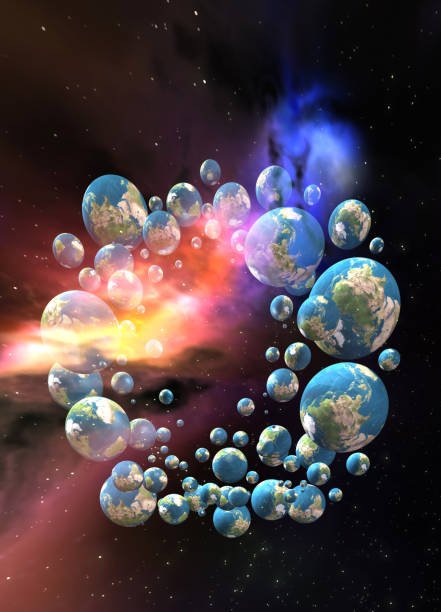
Perhaps our universe is not alone. Perhaps the Big Bang was merely a local event in a much grander multiverse—a vast cosmic ocean of countless universes, each with its own laws, constants, and beginnings.
In some versions of inflation theory, which explains the rapid expansion of the early universe, inflation doesn’t stop everywhere at once. Instead, it continues eternally in some regions, spawning “bubble universes” that form within the inflating space. Each bubble could be a universe like ours, with its own Big Bang.
In this scenario, our Big Bang was simply the birth of one bubble in an infinite cosmic froth. The question “what came before” shifts meaning—it becomes, “What is the nature of the multiverse that gave rise to our bubble?”
Other models, inspired by string theory, suggest that our universe could be a 3-dimensional “brane” floating in higher-dimensional space. Collisions between such branes could trigger Big Bang–like events, giving rise to multiple universes in a vast multidimensional landscape.
While these ideas are still speculative, they open breathtaking possibilities. If true, our universe is but one verse in an eternal cosmic poem, forever creating and recreating itself in infinite variations.
Before Physics: The Edge of Knowledge
As we chase the question of what came before the Big Bang, we encounter the limits of science itself. Our theories—relativity and quantum mechanics—each describe part of the universe beautifully, but together they clash at the singularity. To go beyond, we need a theory of quantum gravity, one that unites the laws of the very large with those of the very small.
String theory and loop quantum gravity are two major contenders. In loop quantum cosmology, space and time are not continuous but made of discrete loops, tiny quantum grains. As the universe contracts toward the Big Bang, these loops resist infinite compression, causing a “bounce” instead of a singularity. The Big Bang, then, was a rebound from a prior universe.
This is one of the most tantalizing answers: before the Big Bang, there was another universe collapsing into itself, and from its ashes, ours was born.
Yet even this may not be the final answer. There could be layers of reality beneath what we call space and time—perhaps a pre-geometry or quantum information field that underlies everything. Some scientists propose that spacetime itself emerges from entanglement, the web of quantum connections linking all particles. In that view, “before” the Big Bang, there may have been pure quantum information—an ocean of potentiality from which reality crystallized.
The Universe as a Quantum Dream
As the frontier of physics grows stranger, so too does our conception of reality. Perhaps the universe is not a mechanical structure at all, but a self-generating system of information and energy. Some theorists argue that the universe might be fundamentally mathematical—a structure of relationships rather than things.
In such a framework, the Big Bang could be the “awakening” of a cosmic computation, a phase transition in the fabric of existence itself. Before it, there was no “thing” to speak of, only the potential for structure.
This idea resonates with ancient philosophies, which often described creation not as a mechanical process, but as the unfolding of potential, the self-expression of an infinite whole. Physics, in its most advanced form, seems to echo those timeless insights.
The Role of Consciousness
When we ask what came before the Big Bang, we are also asking about our place in the story. After all, without consciousness, there is no question, no curiosity, no “before” or “after.”
Some physicists and philosophers wonder whether consciousness itself plays a fundamental role in reality. Could the universe require observers to exist in a meaningful way? Quantum mechanics already tells us that observation affects outcome—that potential becomes actual through measurement. Could the cosmos itself be part of a grand feedback loop between consciousness and creation?
While such ideas tread into metaphysical territory, they remind us that science and mystery are not enemies. They are two sides of the same coin, each fueling the other in the quest for truth.
Perhaps, before the Big Bang, there was not a thing but an awareness—a timeless, dimensionless field of potential that dreamed itself into being. While science cannot test such notions, they reflect the deep poetic yearning that underlies every scientific pursuit: to know the source not just of matter, but of meaning.
The Emotional Gravity of Origin
For scientists, the search for what came before the Big Bang is not just a technical problem—it is a journey into existential wonder. It asks us to confront the ultimate boundary of knowledge, to stare into the face of the unknown and not look away.
Every generation of thinkers has faced its own horizon. Once, the edge of knowledge was the Earth’s curve. Then it was the boundary of the Solar System. Now, it is the first instant of time itself. Beyond that horizon lies a mystery so vast that it challenges not just our intellect, but our imagination.
We are creatures made of stardust, living in the afterglow of creation, daring to ask how it all began. The atoms in our bodies were forged in ancient stars, yet the energy that drives them was born in that first cosmic flash. To ask what came before is to trace our own lineage—not to ancestors of flesh, but to the birth of existence itself.
Science and the Sacred
It’s easy to think of science as cold and detached, but in truth, it is one of humanity’s most spiritual endeavors. To explore what came before the Big Bang is to confront the same mystery that inspired creation myths, philosophies, and prayers across time.
Where ancient storytellers spoke of gods bringing order from chaos, physicists now speak of quantum fluctuations and cosmic inflation. Yet the emotional truth is the same: we long to understand how something can emerge from nothing, how being can arise from void.
The beauty of modern cosmology is that it doesn’t diminish the wonder—it deepens it. The more we learn, the more mysterious reality becomes. We are peeling back layers of the cosmic onion, only to find that beneath each one lies another, subtler question.
Science, at its best, is not a set of answers but a deepening of awe. The search for what came before the Big Bang may never end, but perhaps that is the point. The universe invites us not to solve it, but to join its dance.
The Limit of “Before”
Ultimately, the concept of “before” may lose meaning when we talk about the origin of the universe. Time, after all, is not a background stage—it is part of the play. If the Big Bang created time, then asking what came before may be like asking what is outside of existence itself.
Yet that realization does not close the door. It opens a new one. It suggests that our universe is not an isolated event but part of a larger, timeless reality—one that transcends the very notions of beginning and end.
Perhaps the cosmos did not begin; perhaps it always is. Maybe the Big Bang was simply a transformation, a phase change in the eternal sea of being.
A Universe of Infinite Beginnings
Every answer we find only raises deeper questions. What came before the Big Bang might be unknowable in the traditional sense, yet through our search, we glimpse something extraordinary: that reality is richer, deeper, and more beautiful than our limited language can capture.
Somewhere, perhaps beyond all time, lies the source of all creation—a boundless potential that gave rise to the spark of existence. Whether that source is a quantum vacuum, a higher dimension, a timeless field, or something beyond all conception, it is the womb of everything we are.
When we gaze into the cosmic microwave background, we are not just seeing light from billions of years ago—we are seeing the echo of that birth, the first whisper of everything that ever was and ever will be.
The Eternal Mystery
What came before the Big Bang? Perhaps the question itself is the answer. It is the reflection of the universe’s greatest truth—that creation is not a one-time event, but an ongoing unfolding. The cosmos is still expanding, still evolving, still creating stars, galaxies, and life.
In every atom, every photon, every heartbeat, the Big Bang continues. We are living in its wake, carrying within us the memory of that first light.
And as we ask what came before, we become part of the story. For the universe’s greatest creation is not just matter or energy—it is curiosity. The ability to wonder, to ask, to reach beyond the known.
Perhaps that is the true answer. Before the Big Bang, before time and space, before matter and light, there was the potential to know—to awaken—to question.
The universe dreamed of understanding itself. And from that dream, everything began.