In the silent expanse of the cosmos, where galaxies swirl like cosmic whirlpools and time stretches into eternity, stars live and die in a celestial rhythm older than memory itself. Among all cosmic events, nothing is more breathtaking, more violent, or more transformative than the death of a massive star — the cataclysm known as a supernova.
When a star explodes, it is both a destruction and a creation — a moment when the universe simultaneously ends one story and begins countless others. A supernova is not merely a bright flash in the night sky; it is the ultimate expression of the universe’s endless cycle of life, death, and rebirth.
For millions or even billions of years, a star shines steadily, burning hydrogen into helium through the delicate dance of nuclear fusion. But nothing in the universe lasts forever. Eventually, the fuel runs out, and the forces that kept the star stable begin to fall out of balance. Gravity, the silent sculptor of the cosmos, takes control — and the result is an explosion of unimaginable power.
The Balance Between Fire and Gravity
To understand what happens when a star explodes, we must first understand how it lives. A star is a perfect balance between two opposing forces. On one side, there is gravity, the force that pulls matter inward, trying to collapse the star into a dense ball. On the other side is fusion, the process by which the star’s core fuses lighter elements into heavier ones, releasing immense amounts of energy.
This energy pushes outward, counteracting gravity’s inward pull. For most of its life, a star maintains this equilibrium, shining steadily in a cosmic harmony known as hydrostatic balance.
In the core of the Sun, for example, hydrogen atoms fuse into helium, releasing light and heat that travel across space to warm Earth. In more massive stars, the process is faster and more intense. Their immense gravity compresses the core to such extreme densities and temperatures that fusion proceeds at a furious rate.
But that furious rate comes at a cost. The more massive a star, the shorter its lifespan. While a small, red dwarf may live for trillions of years, a blue supergiant — tens of times the mass of our Sun — might exhaust its fuel in just a few million years.
The Beginning of the End
Eventually, a massive star’s hydrogen runs out. It can no longer sustain the fusion reactions that produce the outward pressure holding gravity at bay. But gravity doesn’t rest. The core contracts, heating up and igniting a new series of nuclear reactions. The star begins to fuse helium into carbon and oxygen, then carbon into heavier elements — neon, magnesium, silicon, and finally, iron.
Each stage of fusion happens faster than the last. What took millions of years with hydrogen may take only days with silicon. The star becomes a layered onion of elements, with lighter ones near the surface and heavier ones deep within the core.
But when the core fills with iron, everything changes. Iron is the final destination in the fusion journey — it cannot release energy through fusion. In fact, trying to fuse iron consumes energy rather than producing it. This is the star’s fatal moment.
Without a new source of energy, the delicate balance collapses. Gravity, unchecked, begins its unstoppable inward crush. The core implodes, collapsing in on itself at speeds of thousands of kilometers per second. Within moments, the outer layers of the star fall inward too, slamming into the collapsing core with unimaginable violence.
The Moment of Catastrophe
Then, in a fraction of a second, everything changes. The implosion stops abruptly when the core’s matter becomes so dense that atomic nuclei are forced together, and protons and electrons merge into neutrons. The collapse halts as the core transforms into an ultra-dense ball of neutrons — a neutron star — or, if massive enough, into a black hole.
The sudden halt creates a rebound — a shockwave that rips outward through the star’s layers. This shockwave, combined with the flood of particles known as neutrinos that burst from the core, releases an explosion of energy so powerful that the star’s outer layers are blasted into space at speeds of tens of thousands of kilometers per second.
The energy released in this moment is beyond comprehension. For a brief time — perhaps a few days — the exploding star outshines its entire galaxy. It releases as much energy in a single instant as our Sun will produce over its entire lifetime.
This is a supernova: the death cry of a massive star, a cosmic explosion that reshapes the universe around it.
The Light That Defies Time
When the light from a supernova reaches Earth, it can transform the night sky. Ancient astronomers recorded supernovae as new stars — novae — appearing suddenly where none had been before. The Chinese, Japanese, and Arab astronomers of antiquity documented these celestial events with awe and reverence.
One of the most famous, the supernova of 1054, was so bright that it could be seen even in daylight for weeks. Its remnants form the Crab Nebula — a ghostly cloud of gas still expanding nearly a thousand years later, glowing with the energy of a spinning neutron star at its heart.
Every supernova leaves behind such echoes — luminous clouds that continue to expand, shine, and seed the cosmos with the heavy elements created in the explosion. These remnants are the fingerprints of stellar death, scattered across the galaxy like cosmic fossils.
But supernovae are not just spectacular displays of light. They are also the forges of creation.
The Alchemy of the Stars
Every atom of oxygen you breathe, every bit of calcium in your bones, every speck of iron in your blood — all were born in the heart of a star, and released in a supernova.
During the explosion, temperatures soar into the billions of degrees. In that brief, furious inferno, nuclei collide with such intensity that new, heavier elements are created — gold, silver, uranium, and countless others. These newly forged atoms are flung into space, carried by the shockwave into the surrounding interstellar medium.
Over millions of years, this material mixes with clouds of gas and dust, enriching them with the elements of life. From these enriched clouds, new stars, planets, and eventually living beings emerge.
In a literal sense, we are the ashes of stars — the living legacy of supernovae that exploded billions of years before the Sun was born. Carl Sagan’s famous words, “We are made of star stuff,” are not poetic exaggeration but scientific fact.
The Types of Stellar Death
Not all stars die the same way. The path a star takes toward its end depends on its mass — its fundamental measure of cosmic destiny.
For stars much larger than the Sun, the collapse of the core triggers the type of explosion known as a core-collapse supernova, or Type II supernova. The core becomes a neutron star or, if it is massive enough, a black hole.
But there is another kind of supernova, one that occurs in binary systems — where two stars orbit each other closely. In these cases, a white dwarf (the remnant of a smaller star) can steal material from its companion until it reaches a critical mass. When it does, the sudden pressure reignites fusion throughout the star all at once, causing a thermonuclear explosion. This is a Type Ia supernova.
Type Ia supernovae are so bright and consistent in their peak luminosity that astronomers use them as “standard candles” to measure distances across the universe. It was through observing these supernovae that scientists discovered one of the most profound truths of modern cosmology: the universe is not only expanding but accelerating, driven by the mysterious force we call dark energy.
The Birth of Neutron Stars and Black Holes
When a massive star explodes, what remains is often as mysterious as the explosion itself.
In many cases, the core collapses into a neutron star — a city-sized sphere of matter so dense that a single teaspoon would weigh billions of tons. These stars are cosmic beacons, spinning rapidly and emitting pulses of radiation that sweep across space like lighthouse beams. We call them pulsars, and their rhythmic flashes are so precise they rival atomic clocks.
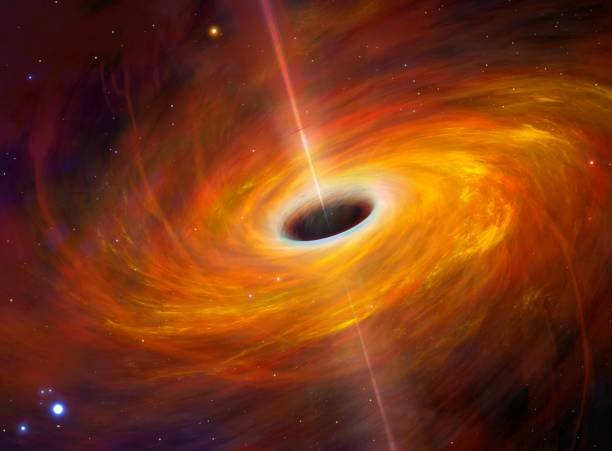
If the original star is massive enough, the collapse does not stop at the neutron star stage. Instead, gravity overwhelms all forces, and the core collapses into a black hole — a region of spacetime so dense that not even light can escape its gravitational grip.
These remnants — neutron stars and black holes — are not just leftovers of destruction; they are laboratories of physics, places where the known laws of nature are pushed to their breaking point.
The Symphony of Neutrinos and Light
One of the most remarkable aspects of a supernova is the flood of neutrinos it releases. These ghostly particles, produced during the collapse of the core, carry away most of the explosion’s energy — yet they rarely interact with normal matter.
When Supernova 1987A exploded in a nearby galaxy, detectors on Earth caught a tiny burst of neutrinos — just a few dozen particles — that arrived hours before the visible light. Those few signals confirmed our understanding of stellar death and provided a direct glimpse into the moment a star’s core collapsed.
In that event, a star that had shone for millions of years ended its life in a flash of brilliance that traveled across 168,000 light-years to reach our telescopes.
Supernovae remind us that light itself is not immortal — it carries the memory of distant death, crossing time and space to tell us stories from the far reaches of the cosmos.
The Ripple Effect: Shockwaves Through Space
When a star explodes, the shockwave it generates doesn’t stop with the star’s destruction. It races outward, sweeping up surrounding gas and dust, compressing it, and sometimes triggering the birth of new stars.
In this way, supernovae are agents of creation as much as destruction. They sculpt galaxies, enrich the interstellar medium, and sow the seeds of new solar systems. The very formation of our own Sun may have been triggered by a nearby supernova billions of years ago.
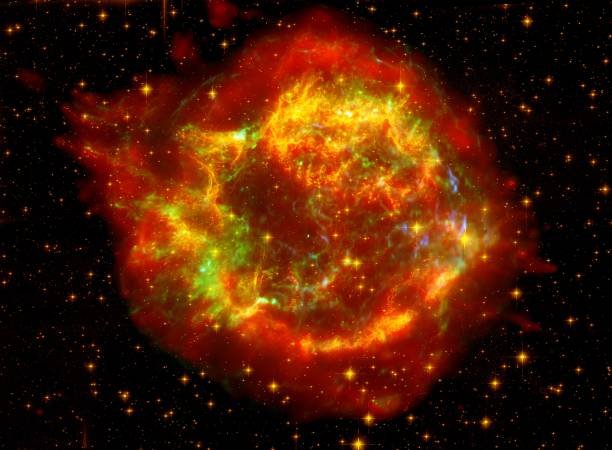
The remains of these explosions, known as supernova remnants, continue to glow for thousands of years. The Crab Nebula, Cassiopeia A, and the Veil Nebula are a few examples — vast, ghostly structures that expand endlessly, their filaments glowing with the energy of their birth. They are the visible afterlife of stars, still shaping the cosmos long after the explosion fades from view.
When Stars Collide: The Power of Merging Neutron Stars
In recent years, astronomers have witnessed another breathtaking consequence of stellar death — the collision of neutron stars.
When two neutron stars orbit each other closely, they slowly spiral inward, losing energy through gravitational waves — ripples in spacetime predicted by Einstein and detected for the first time in 2015. When these stars finally merge, the result is a titanic explosion known as a kilonova — a phenomenon even more powerful than a typical supernova.
These events produce heavy elements like gold and platinum in vast quantities, dispersing them through the universe. Every gold ring, every trace of precious metal on Earth, was once born in such a cosmic collision — the final act of stars that had already died long before.
Supernovae and the Fate of the Universe
Supernovae play a vital role in shaping the evolution of galaxies and the cosmos itself. Without them, the universe would be a simpler, poorer place — filled only with hydrogen and helium. It is through their explosions that complexity arises.
They are also key markers in cosmic history. By studying distant supernovae, astronomers can trace the expansion of the universe and measure how it has changed over billions of years. Through them, we have discovered that the universe is not static but dynamic, driven by forces we are only beginning to comprehend.
Supernovae are the cosmic punctuation marks in the story of existence — explosive reminders that change, even destruction, can be the catalyst for creation.
The Human Connection to Stellar Death
It may seem abstract to think about stars exploding billions of kilometers away, but supernovae are deeply connected to us. Without them, Earth could not exist. Life as we know it would be impossible.
Every breath we take contains oxygen born in a star’s heart. Every heartbeat depends on iron forged in a supernova. Our planet itself is built from the remnants of long-dead stars.
We are, in every literal sense, the children of stellar death. When we gaze up at the night sky, we are looking into the vast ancestral history of our own atoms. The light that reaches us from distant stars carries whispers of our origin — messages written in the language of fire.
The Mystery Still Unfolding
Even now, supernovae continue to surprise scientists. Modern telescopes capture these events in distant galaxies almost weekly, revealing details never before seen — from asymmetric explosions to stars that somehow survive their own deaths.
The James Webb Space Telescope, with its infrared eyes, is uncovering how the first stars in the universe lived and died, shaping the galaxies we see today. We are beginning to understand that every supernova is unique, a reflection of the star’s life, mass, and environment.
Some explode quietly, while others detonate with unimaginable ferocity. Some collapse into black holes, others scatter their remains into space. But all of them, in their final act, participate in the grand cosmic cycle that gives the universe its endless beauty.
The Universe Remembered in Light
A supernova is not the end. It is the moment a star releases everything it ever was — its light, its elements, its energy — back into the universe. What was once a single point of light becomes a thousand new beginnings.
Long after the explosion fades, the dust and gas from that event drift through space, forming new stars, new planets, new possibilities. Somewhere in that cycle, perhaps, life begins anew — life that looks up one day at the night sky and wonders how it all began.
In that sense, every supernova is a kind of cosmic rebirth. The death of one star sows the seeds of countless futures. The universe remembers its dead through creation.
And perhaps, in the most poetic sense, so do we.
When a star explodes, it is not a silent tragedy — it is a symphony. A crescendo of energy and light that reverberates across eternity. It is the universe celebrating its own capacity to renew itself, to transform destruction into beauty, chaos into order, and death into the promise of life.
We are the echoes of those ancient explosions.
We are the children of supernovae.
We are the universe, illuminated by its own dying stars.