There was a time when Earth belonged to creatures so strange that, if seen today, they would seem like inventions of fantasy rather than products of nature. This was not a brief anomaly or a single lost age, but the majority of our planet’s history. For more than ninety percent of the time life has existed, the world was ruled by beings with no direct modern equivalents, organisms shaped by ancient seas, alien atmospheres, drifting continents, and evolutionary experiments that would never be repeated.
When we imagine the past, we often picture dinosaurs, towering reptiles that still capture the human imagination. Yet dinosaurs themselves were latecomers in a much longer story. Before them came worlds dominated by armored fish, towering insects, reef-building organisms unlike corals today, and predators whose body plans vanished entirely. Even after the dinosaurs disappeared, mammals briefly experimented with forms just as bizarre, filling ecological roles that now seem unthinkable.
To understand when the planet belonged to creatures unlike anything today is to confront deep time, a scale so vast that human history becomes a flicker. It is also to realize that the present world, familiar and seemingly stable, is only one version among countless others Earth has hosted.
The First Strange Life in Ancient Seas
Life began in water, and for billions of years the oceans were the only stage on which evolution played. These early seas were nothing like modern oceans. They lacked oxygen, shimmered with dissolved minerals, and were bathed in harsher ultraviolet radiation under a young Sun. The first organisms were microscopic, but even at this scale, strangeness ruled.
Single-celled life dominated for most of Earth’s history, forming mats, filaments, and drifting colonies. Cyanobacteria, through photosynthesis, slowly transformed the planet by releasing oxygen, triggering the Great Oxygenation Event. This was both a creative and destructive moment. Oxygen poisoned many existing organisms while opening the door for new forms of life with higher energy demands.
As multicellular life emerged, it did not follow a predictable path. Early animals experimented wildly with body plans. Some forms had no symmetry at all, others had radial designs, and some developed bilateral symmetry that would later dominate. These early creatures were not stepping stones toward modern animals in a simple sense. Many were evolutionary dead ends, unique solutions to the challenges of their time.
The Cambrian Explosion and the Birth of Alien Forms
Around 540 million years ago, life underwent a dramatic transformation known as the Cambrian Explosion. In a relatively short geological period, an astonishing diversity of animal forms appeared. This was not merely an increase in numbers but a leap in complexity. Eyes, jaws, limbs, and hardened shells emerged, reshaping ecosystems forever.
The creatures of the Cambrian seas were profoundly alien. Some had five eyes, others had spines arranged in patterns unseen today. Many possessed limbs that bore little resemblance to legs or fins, functioning instead as grasping tools, swimming paddles, or feeding structures. Predators like Anomalocaris dominated the oceans with bodies unlike any modern hunter, combining flexible lobes, circular mouths lined with plates, and compound eyes of surprising sophistication.
What makes the Cambrian world so unsettling is not just its diversity but its unpredictability. Evolution had not yet settled on the body plans that would later define animals. Nature was experimenting freely, and the results were forms that seem to defy categorization. Most of these lineages vanished, leaving only a few branches that would give rise to familiar groups.
Ancient Reefs and Forgotten Ecosystems
Modern coral reefs are among the most complex ecosystems on Earth, but they are not the first structures of their kind. Ancient seas were filled with reefs built by organisms that no longer exist or that play minor roles today. Archaeocyathids, sponge-like reef builders of the early Cambrian, formed massive structures before disappearing entirely.
Later reefs were constructed by tabulate corals, rugose corals, and stromatoporoids, organisms with skeletal architectures unlike modern corals. These reefs supported ecosystems filled with strange inhabitants, including trilobites with elaborate spines, brachiopods that superficially resembled clams but followed entirely different evolutionary paths, and echinoderms shaped like flowers or vases rather than starfish.
These forgotten reefs remind us that ecosystems themselves can be temporary. The relationships between species, the architecture of habitats, and the flow of energy through food webs can change radically over time. What seems essential today may once have been irrelevant, and what once dominated can vanish without leaving a modern counterpart.
The Age of Armored Fish and Early Predators
As life diversified in the oceans, vertebrates began their rise. The earliest fish were not sleek swimmers but heavily armored creatures encased in bony plates. These jawless fish, some reaching impressive sizes, patrolled ancient waters alongside invertebrate predators.
Later, jawed fish appeared, transforming ecosystems through a powerful new feeding strategy. Among them were placoderms, a group of armored fish that included giants like Dunkleosteus. With jaws capable of exerting tremendous force and bodies protected by thick armor, these predators ruled Devonian seas.
Placoderms were not ancestors of modern fish but a side branch that flourished and then vanished. Their extinction left no direct descendants, making them another example of evolutionary success followed by total disappearance. Their dominance shows that even highly effective designs can be temporary, shaped by specific conditions that may not last.
When Plants Changed the World
Life’s move onto land was one of the most transformative events in Earth’s history. Early land plants were small and simple, hugging the ground near water sources. Over time, they evolved vascular systems, roots, and leaves, allowing them to grow taller and spread across continents.
The rise of forests altered the planet itself. Trees stabilized soils, reduced erosion, and changed weathering processes. Most importantly, they drew down carbon dioxide from the atmosphere, contributing to global cooling. This environmental shift had profound consequences for life.
The forests of the Carboniferous period were dominated by plants unlike any alive today. Giant clubmosses, towering horsetails, and massive ferns formed dense, swampy landscapes. These plants reproduced through spores rather than seeds and possessed growth strategies that vanished as climates changed.
The remains of these forests were buried and transformed into coal, a reminder that entire ecosystems can become fossilized energy sources for future ages.
Insects the Size of Birds
One of the most startling features of the Carboniferous world was the size of its insects. Dragonfly-like creatures with wingspans exceeding half a meter soared through the air, while giant millipedes crawled through forest floors.
This gigantism was made possible by high atmospheric oxygen levels and the absence of aerial vertebrate predators. Insects breathe through a system of tubes that deliver oxygen directly to tissues, and higher oxygen concentrations allowed for larger body sizes.
These giant insects were not evolutionary failures but highly adapted to their environment. When oxygen levels fell and new predators appeared, their reign ended. Today’s insects are smaller, but their ancient giants remind us that even the limits of biology can shift with changing conditions.
Early Tetrapods and the First Steps on Land
The transition from water to land was not a single moment but a gradual process involving many intermediate forms. Early tetrapods were fish-like creatures with limbs that allowed them to navigate shallow waters, mudflats, and swampy environments.
These animals did not immediately conquer dry land. They remained tied to water for reproduction and survival. Their bodies combined features we now associate with fish and amphibians, creating forms that seem transitional but were perfectly adapted to their time.
Some early tetrapods grew enormous, filling predatory roles later occupied by reptiles and mammals. Their diversity underscores how flexible evolution can be when new ecological opportunities arise.
Reptilian Empires Before Dinosaurs
Before dinosaurs became dominant, other reptilian groups ruled the land. During the Permian period, synapsids, often misleadingly called mammal-like reptiles, occupied many ecological niches. Some were herbivores with elaborate skull structures, others were fearsome predators with saber-like teeth.
These creatures were not dinosaurs and not mammals, but something in between. They represent an evolutionary experiment that would eventually give rise to mammals after surviving catastrophic events.
The Permian world was harsh, marked by shifting climates and the formation of the supercontinent Pangaea. It ended with the largest mass extinction in Earth’s history, wiping out the majority of species and clearing the stage for new rulers.
The Rise of Dinosaurs and Familiar Strangeness
Dinosaurs emerged in the aftermath of the Permian extinction and came to dominate terrestrial ecosystems for over 160 million years. While they are more familiar than earlier life forms, many dinosaurs were still profoundly unlike anything alive today.
Feathered predators, long-necked giants weighing tens of tons, and armored herbivores with complex weaponry roamed diverse landscapes. Dinosaurs filled roles now occupied by mammals, birds, and reptiles combined.
The world they inhabited was warmer, with higher sea levels and different plant communities. Flowering plants appeared late in dinosaur history, reshaping ecosystems once again.
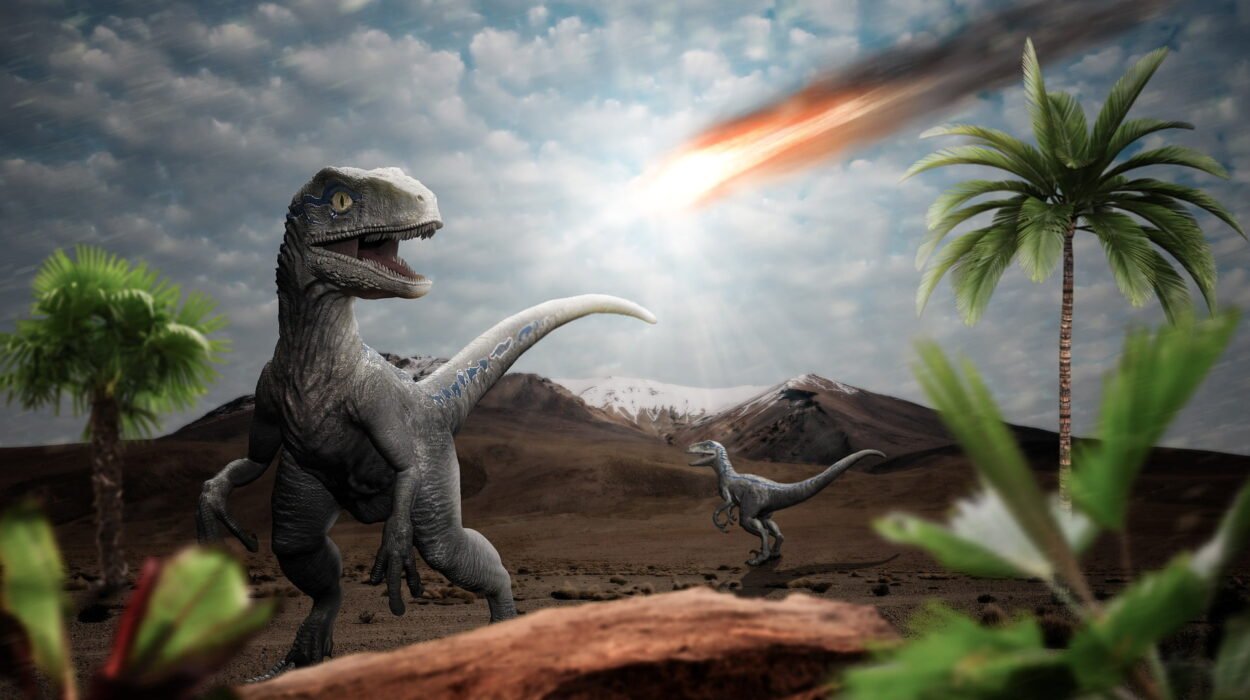
Despite their success, dinosaurs were not immune to change. Their sudden extinction at the end of the Cretaceous, triggered by a massive asteroid impact combined with volcanic activity, marked another turning point in life’s history.
Oceans of Monsters After Dinosaurs
The extinction that ended the dinosaurs did not spare the oceans, but it did create opportunities. Marine reptiles like plesiosaurs and mosasaurs vanished, leaving empty niches.
In the age that followed, sharks, bony fish, and marine mammals diversified. Some early whales retained hind limbs and serpentine bodies, bearing little resemblance to modern whales. Giant predatory fish and massive sharks like Otodus megalodon ruled the seas.
These creatures were not mistakes on the way to modern forms. They were adapted to the conditions of their time, thriving in oceans warmer and richer than today’s.
Mammalian Experiments in a Changing World
With dinosaurs gone, mammals expanded rapidly. Freed from ecological constraints, they evolved into an astonishing array of forms. Some grew to enormous sizes, while others took on predatory roles once held by reptiles.
Early mammalian predators included creatures with crushing jaws and bone-cracking teeth, as well as nimble hunters that resembled no modern carnivore. Herbivorous mammals experimented with body plans that vanished entirely, including massive horned forms and armored grazers.
Even primates, our own lineage, passed through strange stages. Early relatives lived in environments very different from those we associate with humans today, adapting to forests, woodlands, and changing climates.
Mass Extinctions and the Fragility of Dominance
Throughout Earth’s history, mass extinctions have reshaped life repeatedly. These events were not gentle transitions but abrupt crises driven by volcanic eruptions, climate shifts, ocean chemistry changes, and extraterrestrial impacts.
Each extinction ended worlds dominated by unique creatures and opened the door to new forms. The patterns that emerge suggest that dominance is always temporary. No group, no matter how successful, is guaranteed a future.
This realization challenges the idea of progress in evolution. Life does not move toward a predetermined goal. It responds to conditions, exploring possibilities and abandoning them when circumstances change.
The Modern World as a Snapshot in Deep Time
The creatures we consider normal today are survivors of a long series of contingencies. Mammals, birds, reptiles, and flowering plants are not inevitable outcomes but the products of chance, resilience, and opportunity.
If history had unfolded differently, Earth might still be ruled by reptilian predators, giant insects, or lineages we can barely imagine. The present biosphere is a snapshot, a temporary arrangement in an ever-changing story.
Understanding this deep history fosters humility. Humanity is not the culmination of evolution but one branch among many, living in a world shaped by ancient events far beyond our control.
Lessons from Lost Worlds
The ancient worlds filled with creatures unlike anything today teach us that life is both creative and fragile. They show that ecosystems can transform dramatically and that environmental change can erase even the most successful forms.
They also remind us that novelty is not rare in evolution. Given time and opportunity, life explores forms that challenge our imagination. What seems impossible today may have been commonplace millions of years ago.
As we face rapid environmental changes in our own time, these lessons gain urgency. The past shows that life will persist, but it does not guarantee that familiar worlds will endure.
A Planet of Endless Reinvention
When the planet belonged to creatures unlike anything today, it was not broken or incomplete. It was simply different, expressing the possibilities available at that moment in time. Each era of life was coherent, complex, and alive with interactions we are only beginning to understand.
Earth’s history is not a march toward the present but a tapestry woven from countless experiments, many of which ended without descendants. To study these lost worlds is to glimpse the full creativity of nature and to recognize that our own world, too, is temporary.
The planet has belonged to many kinds of creatures, and it will belong to others long after we are gone. In that vast continuum, our moment is brief, but our ability to understand and reflect on this history is rare. Through science, we can hear the echoes of those ancient worlds and appreciate the deep, unsettling beauty of a planet that has never stopped reinventing life.