Why is there something rather than nothing? Few questions cut as deeply into the heart of existence. It is the ultimate inquiry—not only about the universe, but about meaning itself. Why does anything at all exist—the stars, atoms, light, space, time, or consciousness? Why is there a cosmos of breathtaking complexity instead of an eternal void?
This question is as old as philosophy and as deep as science can reach. It transcends disciplines and belief systems, bridging physics, cosmology, and metaphysics. To ask it is to confront the mystery of being—to look into the abyss of nothingness and wonder why, instead of silence, there is the symphony of existence.
Every civilization that has ever gazed at the night sky has pondered this mystery in its own way. Ancient myths invoked gods who created the world from chaos or breathed life into void. Philosophers sought logical reasons for being, theologians searched for divine purpose, and modern scientists probe the fabric of reality, attempting to understand how the universe could have arisen spontaneously from the laws of physics themselves.
To explore this question is to travel from the edge of time to the birth of the cosmos, from the smallest particles to the grandest galaxies, and finally, into the depths of human consciousness itself. For in the end, to ask why there is something rather than nothing is also to ask why we exist to ask it at all.
Defining “Nothing”
Before we can begin to explore why there is “something,” we must confront what we mean by “nothing.” The word seems simple, but in science and philosophy, it hides an extraordinary complexity.
To most people, “nothing” means emptiness—a void, a space without matter or energy. But even that is something: empty space has geometry, laws, and potential. It can bend, expand, and fluctuate. True “nothing,” if it exists, would have no space, no time, no laws, no properties—literally the absence of all being. Yet such a state may be impossible even to imagine, for the very act of conceiving “nothing” gives it a conceptual presence in the mind.
In physics, “nothing” has been redefined. The quantum vacuum, once thought to be empty, teems with activity. Virtual particles flicker into and out of existence, borrowing energy from the fabric of space itself. Even in the absence of matter and radiation, space has a restless energy—a “zero-point energy” that cannot be removed. This quantum foam is not nothing; it is a sea of potential from which particles, forces, and even universes may emerge.
Thus, when scientists ask why there is something rather than nothing, they are not necessarily referring to the philosophical “nothingness” of absolute absence. They are asking how the physical universe, with its laws, particles, and space-time, arose—perhaps from a state that defies our intuitive distinctions between something and nothing.
The Ancient Origins of the Question
Long before telescopes or particle colliders, thinkers grappled with the riddle of being. In ancient Greece, Parmenides declared that “nothing cannot exist,” arguing that existence must be eternal, uncreated, and unchanging. To him, the question was meaningless—something has always existed, because from nothing, nothing can come.
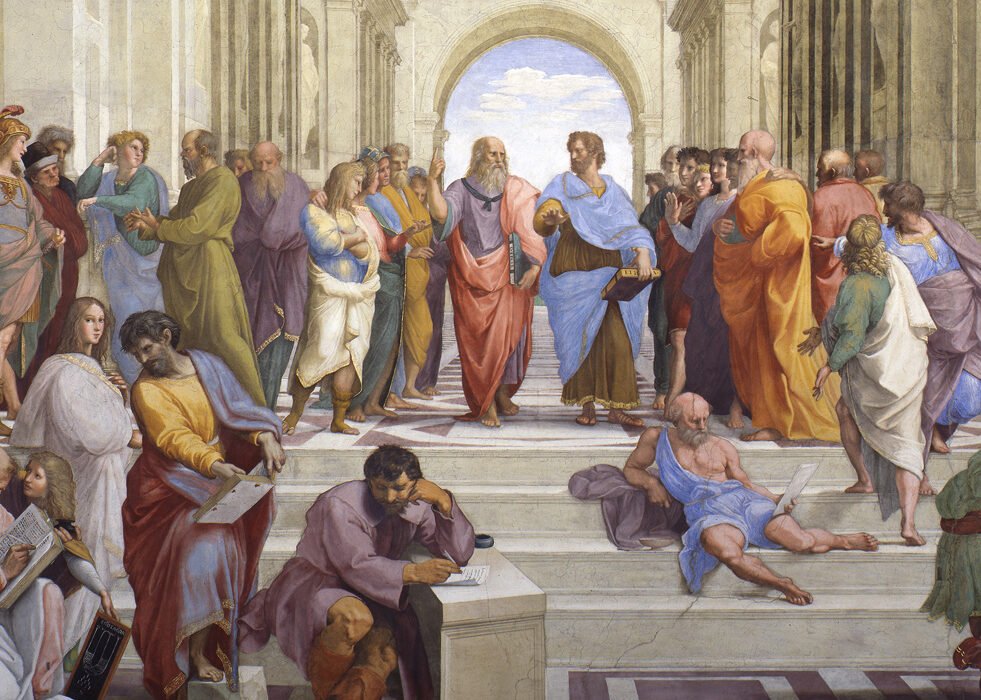
His student, Plato, imagined a divine craftsman—the Demiurge—who shaped the cosmos out of preexisting chaos, while Aristotle envisioned an eternal universe moved by an “Unmoved Mover,” a timeless first cause. These ideas would later influence theology, particularly in the notion of a Creator who brings the world into being ex nihilo—“from nothing.”
In Eastern traditions, similar themes appear. Hindu philosophy speaks of Brahman, the eternal ground of reality from which the universe emanates and to which it returns in endless cycles. In Taoism, the Tao gives rise to all things yet remains beyond being and non-being. Buddhism, more radically, treats “nothingness” (śūnyatā) not as an absence but as the ultimate interdependence of all things—a state in which distinctions dissolve.
Thus, from the beginning, the question of existence has never been purely physical. It has always carried a metaphysical weight: Is the universe contingent or necessary? Did it have a beginning, or has it always been? And if it began, what caused it to begin?
The Scientific Revolution: From Creation to Laws
For centuries, the question of creation was the realm of philosophy and theology. But the rise of modern science in the 17th century changed the nature of the debate. As physicists uncovered mathematical laws that described planetary motion, light, and matter, the universe began to appear as a self-consistent system, operating without the need for continuous divine intervention.
Isaac Newton described gravity as a universal force acting across space, uniting the heavens and Earth under one law. Later, Laplace, a French mathematician, presented a deterministic vision of the cosmos governed entirely by natural laws. When asked by Napoleon why his model contained no mention of God, Laplace famously replied, “I had no need of that hypothesis.”
This marked a profound shift. The question “Why is there something?” began to transform into “How did something arise?”—a shift from metaphysical causes to physical explanations.
The discovery of the law of conservation of energy further complicated the issue. Energy, like matter, cannot be created or destroyed; it only changes form. If energy is eternal, then perhaps the universe has always existed in some form, cycling endlessly through transformation.
But that raised another puzzle: if the universe has always existed, why is it changing? Why is it expanding, cooling, evolving? The search for answers would lead to one of the greatest scientific revelations in human history—the discovery of cosmic beginnings.
The Universe Has a History
For much of human history, people assumed the cosmos was eternal and unchanging. The stars seemed fixed, the heavens eternal. But in the 20th century, that illusion shattered.
In 1929, Edwin Hubble observed that galaxies are moving away from us, their light stretched by cosmic expansion. The universe, it seemed, was not static but growing. If space is expanding, then in the past, it must have been smaller, denser, hotter—until, at some point, all matter and energy were compressed into an unimaginably small state. This realization gave birth to the Big Bang theory.
The Big Bang is not an explosion in space; it is the expansion of space itself from an initial singularity—a state where classical physics breaks down. Time and space themselves began in that moment, around 13.8 billion years ago. Before that, “before” may have no meaning, because time itself may not have existed.
This revelation reframed the question of existence. The universe had a beginning—but what caused it? Why did it happen? Did the Big Bang arise from nothing, or from something deeper still?
The Quantum Birth of the Universe
In the strange realm of quantum physics, reality behaves in ways that defy classical intuition. Particles can appear and vanish spontaneously, energy can fluctuate in empty space, and uncertainty reigns at the smallest scales.
Physicists realized that if the universe obeys quantum laws, then even space and time themselves could fluctuate into existence. The “nothingness” of quantum cosmology is not an absolute void, but a state of potential—a kind of pre-geometry from which space-time can emerge through quantum tunneling.
In this view, proposed by physicists such as Edward Tryon, Alexander Vilenkin, and Stephen Hawking, the universe may have arisen as a quantum fluctuation of the vacuum. The total energy of the universe could be zero, balanced between positive energy (matter and radiation) and negative energy (gravity). If the net energy is zero, then the universe could appear spontaneously without violating conservation laws.
Hawking and James Hartle even proposed a “no-boundary” model of the universe, in which time and space are finite but have no edges or beginning—like the surface of a sphere. In this model, asking what came “before” the Big Bang is as meaningless as asking what lies north of the North Pole. The universe simply is, self-contained and complete.
This explanation, though elegant, raises a deeper question: why are there quantum laws at all? Why does the vacuum exist? Why is there a fabric that can fluctuate rather than absolute nonexistence?
The Enigma of Physical Laws
Even if physics can describe how the universe evolved from a quantum state, it cannot yet explain why the laws themselves exist—or why they have the form they do. Laws of nature are mathematical relationships that appear universal and unchanging. They define what can and cannot happen. But why should such laws exist in the first place?
Some physicists, such as Paul Davies, have suggested that the laws of physics might be emergent rather than eternal—patterns arising from deeper principles we have yet to understand. Others propose that the laws are themselves inevitable, arising from mathematical necessity.
Theoretical physicist Max Tegmark has gone even further, proposing the “Mathematical Universe Hypothesis,” which holds that reality is mathematics—that every consistent mathematical structure exists physically, and our universe is simply one such structure capable of containing conscious observers.
In this interpretation, existence is not arbitrary but inevitable: mathematics cannot “not exist,” and therefore the existence of a universe governed by mathematical laws may be unavoidable. But even this leads to the question—why does mathematics exist? Why should there be logic, structure, or order at all?
The Fine-Tuned Universe
As physicists have measured the constants of nature—the strength of gravity, the charge of the electron, the mass of the proton—they have discovered something astonishing: if any of these quantities were even slightly different, the universe as we know it could not exist. Stars would not form, chemistry would be impossible, and life could never arise.
This “fine-tuning” has led to profound speculation. Some see it as evidence of purpose or design—a cosmos tailored for life. Others propose the anthropic principle: we observe these laws precisely because they allow our existence. If the universe were different, we simply wouldn’t be here to notice.
In the multiverse hypothesis, our universe is just one of countless others, each with different physical constants. Most universes are sterile, but a few—like ours—support complexity and consciousness. In this view, there is “something” rather than “nothing” because every possible configuration of laws and matter exists somewhere. We happen to inhabit the one where existence is possible.
Yet, while elegant, the multiverse shifts the mystery rather than solves it. Why should a multiverse exist at all? Why should there be any reality capable of generating universes instead of an eternal void without potential?
The Role of Consciousness
Perhaps the question cannot be answered without considering the observer. For centuries, physicists sought to describe an objective reality independent of mind. But quantum mechanics introduced a startling complication: observation affects the outcome of events. At the quantum level, particles exist in superpositions until measured, at which point they “collapse” into definite states.
Some interpretations of quantum theory suggest that consciousness plays a fundamental role in this process. If observation is necessary to define reality, then mind and universe may be intertwined.
This idea echoes ancient philosophies that see consciousness as a fundamental aspect of existence rather than a byproduct. From this perspective, “something” exists because awareness exists; reality and mind arise together, inseparable and co-dependent.
Such ideas remain controversial, but they reveal how deeply the question of existence cuts across both science and metaphysics. If consciousness is part of the fabric of reality, then the emergence of “something” may be not a physical accident but an inevitable flowering of awareness itself.
Nothingness Reconsidered
Modern cosmology, philosophy, and quantum theory have blurred the line between something and nothing. The “nothing” of physics is not the nothing of philosophy. Even a vacuum possesses structure, laws, and potential energy. Absolute nothingness—a state without space, time, laws, or potential—is not something we can describe within any scientific framework.
Perhaps true nothingness is impossible. As philosopher Quentin Smith once wrote, “Nothingness is unstable.” Given the possibility of existence, the probability of something emerging may be one. In this view, being is more natural than non-being; reality is inevitable.
Alternatively, it may be that “nothing” has never existed. The universe, or some meta-reality beyond it, may be eternal—without beginning or end, cycling through infinite transformations. What we call “the beginning” may simply be the latest bloom in an endless cosmic garden.
The Universe as a Self-Explaining Whole
Some thinkers have suggested that the universe may be a self-contained system requiring no external cause. If the total energy of the universe is zero, if time and space are finite yet unbounded, then the universe could exist without external input. It is not created from nothing—it is simply a self-existent structure.
Stephen Hawking once wrote, “Because there is a law such as gravity, the universe can and will create itself from nothing.” Critics argue that invoking laws of physics to explain creation presupposes their existence. But Hawking’s point was that the universe may be a spontaneous manifestation of these very laws—a closed loop of cause and effect without external origin.
In this sense, asking “why” there is something might be like asking why a circle exists rather than a line: it is a property of the system itself. The universe may not require an external “why,” only internal consistency.
The Mystery That Remains
No scientific or philosophical explanation has yet resolved the riddle completely. Each answer only deepens the mystery, pushing the question back another layer. Why are there quantum laws? Why mathematics? Why order, energy, or even potential? Why is there something rather than the absolute absence of all things, including possibility itself?
Perhaps the question cannot be answered because it presupposes a distinction—something versus nothing—that breaks down at the most fundamental level. If reality and void are not opposites but complementary aspects of the same underlying truth, then existence may not need a reason. It may simply be.
Physicist John Archibald Wheeler proposed the idea of a “participatory universe,” in which reality emerges through interaction between the cosmos and conscious observers. In his poetic words, “We are tiny patches of the universe looking at itself and building itself.” In that sense, the question “Why is there something rather than nothing?” is not merely about the universe—it is the universe asking itself.
The Human Longing for Meaning
Beyond its scientific implications, the question touches something deeply human. To wonder why there is something rather than nothing is to feel awe, humility, and yearning. It is to confront our own impermanence and yet sense our belonging in the vastness.
We live on a fragile world orbiting an ordinary star in a galaxy among billions, yet we possess the consciousness to ask this question—a question that may have no final answer. Perhaps that very capacity is the answer itself: the universe exists so that it can be aware of its own existence.
From the birth of stars to the rise of life, from the flicker of atoms to the fire of human thought, existence has evolved toward self-awareness. We are not observers standing outside reality; we are its expression. Through us, the universe awakens and wonders.
A Universe That Breathes
If we see the cosmos not as a static entity but as a process—a great unfolding—then being and nothingness may be two moments in its eternal rhythm. Stars are born, burn, and die; galaxies form and fade; matter collapses into black holes and reemerges as radiation. Even the vacuum may teem with creation and annihilation.
The universe breathes: expansion and contraction, creation and dissolution, order and chaos. “Nothing” is not an end but a phase—a pregnant silence between cosmic heartbeats. In this view, the universe exists not instead of nothing, but through nothing, continually emerging from the depths of potential.
The Silence Beyond Answers
At the limits of knowledge, language falters. The words “something” and “nothing” may describe conditions that do not exist outside human thought. We are creatures of time and space trying to imagine what lies beyond them.
Yet perhaps the most truthful response to the question is not an answer, but an attitude—one of wonder. The mystery of existence is not a puzzle to be solved once and for all, but a horizon that recedes as understanding grows. The deeper we probe, the more we encounter awe.
As physicist Richard Feynman said, “I think it’s much more interesting to live not knowing than to have answers which might be wrong.” The beauty of science, and of philosophy, lies not in eliminating mystery, but in deepening our relationship with it.
The Eternal Flame
So why is there something rather than nothing? Perhaps because existence is the most natural state possible. Perhaps because the universe is self-creating, or because nothingness cannot hold. Perhaps because consciousness and cosmos are inseparable. Or perhaps there is no reason at all—only the fact that we are here, asking, feeling, and marveling.
The question endures because it reflects our own nature. We are beings who seek meaning in the face of the infinite. In wondering why there is something, we affirm that we, too, are part of that something—a fleeting yet conscious expression of the universe’s boundless creativity.
The night sky, filled with stars scattered across the dark, is the perfect metaphor for this paradox: endless emptiness, yet shining with light. Between those two poles—between void and being—lies the mystery of all things.
And so, as long as there are minds to wonder, this question will never fade. It will echo through every generation, whispered by galaxies and hearts alike: Why is there something rather than nothing?
Perhaps the only answer worth giving is the simplest and most profound of all—because the universe could not bear to be silent.