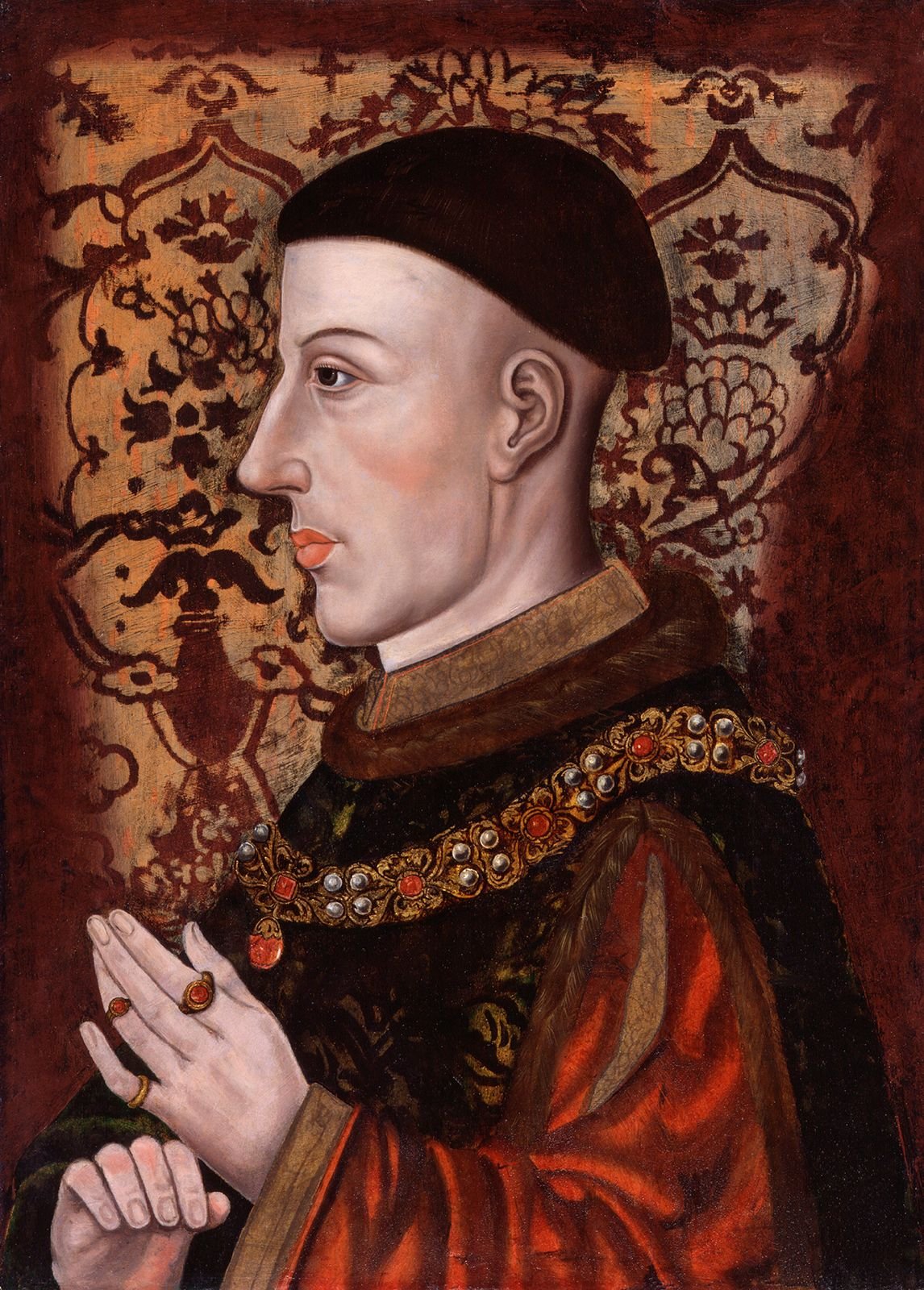
Henry V (born September 16, 1386, at Monmouth Castle in Monmouth, Wales—died August 31, 1422, at Vincennes, near Paris, France) was King of England from 1413 until his death in 1422. A member of the House of Lancaster, he was the son of King Henry IV and Mary de Bohun. Henry V is best known for his military victories during the Hundred Years’ War, particularly his victory over the French at the Battle of Agincourt in 1415, and for securing the Treaty of Troyes in 1420, which recognized him as heir to the French throne.
Early Life and Family Background
Henry was born during the reign of his grandfather, King Edward III, when England was still involved in the long-running conflict with France known as the Hundred Years’ War. His father, Henry Bolingbroke, was an influential nobleman who later became King Henry IV. His mother, Mary de Bohun, came from an important English noble family.
Henry spent part of his childhood during a period of political uncertainty. In 1399, his father overthrew his cousin, King Richard II, and took the English throne. Henry Bolingbroke became Henry IV, making his young son the heir to the crown.
As the new king’s eldest surviving son, Henry received the title Prince of Wales. He was also made Duke of Cornwall and later became Duke of Lancaster. These titles placed him among the most important figures in the kingdom while giving him responsibilities beyond those normally expected of a young nobleman.
His education included reading, writing, religious instruction, and the skills needed by a future ruler. He also learned about military leadership, government, and the responsibilities of managing powerful nobles. Although detailed records of his childhood are limited, his later political and military abilities suggest that he received substantial preparation for public life.
Henry’s early years were shaped by his father’s struggle to maintain power. Henry IV faced rebellions, challenges from powerful families, and financial difficulties. These problems gave the young prince early experience of the political pressures surrounding the English monarchy.
Education and Early Military Experience
Henry began taking on important responsibilities while still a teenager. His father needed trusted representatives to help govern England, particularly in regions where royal authority faced serious challenges.
In 1400, Henry became involved in the military response to the Welsh revolt led by Owain Glyndŵr. The rebellion threatened English control of Wales and developed into a major conflict. Henry gradually became more involved in campaigns against the Welsh forces.
One of his most important early experiences came at the Battle of Shrewsbury on July 21, 1403. He fought alongside his father against rebel forces led by Henry Percy, known as Hotspur.
During the battle, the prince was struck in the face by an arrow. The injury was serious, but he survived after receiving medical treatment. The arrow was eventually removed, and Henry recovered.
His participation demonstrated that he was willing to face the dangers of military service rather than remain safely away from the battlefield. The experience also gave him practical knowledge of warfare at a relatively young age.
Over the following years, Henry continued to serve in the campaigns against the Welsh rebellion. He gained experience in organizing troops, managing supplies, and working with military commanders. These responsibilities helped prepare him for the larger conflicts he would later lead in France.
Growing Political Responsibilities
As Henry grew older, his relationship with his father became increasingly important to the government of England. Henry IV suffered from recurring illness, which sometimes prevented him from carrying out his royal duties effectively.
The prince gradually took on more responsibilities in the royal administration. He became involved in discussions about military spending, government finances, and the management of royal territories.
His growing influence occasionally brought him into disagreement with his father and the king’s advisers. Henry supported stronger action in some political and military matters, while the king sometimes preferred a more cautious approach.
These disagreements reflected different views about how England should be governed rather than a simple personal conflict between father and son. Henry was eager to demonstrate his ability to rule, but Henry IV remained determined to protect his authority.
The prince’s experience in Wales and at court gave him a combination of military and political knowledge. By the time he became king, he had already spent years dealing with the practical difficulties of leadership.
Marriage to Catherine of Valois
In 1420, Henry married Catherine of Valois, the daughter of King Charles VI of France and Queen Isabeau of Bavaria. The marriage formed part of a major political agreement between England and France.
Catherine’s marriage to Henry was intended to strengthen the English claim to the French throne and establish a lasting settlement between the two kingdoms.
The couple had one son, Henry, who was born on December 6, 1421. He later became King Henry VI of England and, for a time, King of France under the terms of the Treaty of Troyes.
Henry V’s marriage was therefore closely connected to his political and military ambitions. It was designed to secure his position in France and provide a successor who could continue his family’s claims.
Becoming King of England
Henry IV died on March 20, 1413, and Henry V succeeded him as King of England. He was crowned at Westminster Abbey on April 9, 1413.
At the beginning of his reign, Henry faced the challenge of bringing together a kingdom that had experienced years of political conflict. His father’s rise to power had divided parts of the nobility, and the new king needed to establish his authority.
Henry worked to strengthen royal government and reduce the influence of those who might challenge his rule. He also showed a willingness to reconcile with former political opponents when doing so served the interests of the kingdom.
One notable example involved Richard II, whose remains were moved to Westminster Abbey during Henry’s reign. This action formed part of the new king’s effort to address some of the divisions left by his father’s seizure of the throne.
Henry also supported religious conformity and took action against people considered heretics by the established Church. One group that faced persecution was the Lollards, religious reformers whose ideas challenged certain teachings and practices of the medieval Church.
The king’s government treated religious dissent as a threat to both religious and political authority. Henry’s reign therefore combined efforts to strengthen the monarchy with strict enforcement of established religious beliefs.
The Decision to Invade France
One of Henry’s main goals was to strengthen England’s position in the ongoing conflict with France. The English monarchy had long claimed rights to French territories and, at times, the French crown itself.
The French kingdom was experiencing serious internal problems during this period. King Charles VI suffered from recurring mental illness, and rival noble factions competed for control of the government.
The two most powerful factions were associated with the dukes of Burgundy and Orléans. Their rivalry weakened French political unity and created opportunities for English intervention.
Henry also wanted recognition of English claims to territories in France. Negotiations between the two kingdoms failed to produce an agreement that satisfied him.
In August 1415, Henry launched an invasion of France. His forces landed in Normandy and began a campaign that included the siege of Harfleur, an important port.
The siege lasted several weeks, and the English eventually captured the town. However, the campaign had weakened Henry’s army through disease, casualties, and the demands of the prolonged siege.
Instead of returning directly to England, Henry decided to march toward Calais, which was under English control. His army had to cross hostile territory while facing shortages of food and other supplies.
The French gathered a much larger force to stop the English advance. The two armies eventually met near the village of Agincourt in northern France.
The Battle of Agincourt
The Battle of Agincourt took place on October 25, 1415. It became the most famous military victory of Henry V’s reign.
The English army was significantly smaller than the French force. Although exact numbers remain uncertain, the French had a substantial numerical advantage.
Henry’s troops were also tired and affected by illness after the campaign in Normandy. Many English soldiers were archers armed with longbows, while the French army included large numbers of heavily armored men-at-arms.
The battlefield played an important role in the outcome. Recent rain had made the ground muddy, particularly in the narrow area where the French troops had to advance.
Henry positioned his army carefully and used defensive stakes to protect his archers from mounted attacks. As the French advanced, their heavily armored soldiers struggled through the mud.
The English longbowmen fired repeated volleys of arrows, disrupting the French formations. The crowded battlefield made it difficult for the French soldiers to move freely or use their numerical advantage effectively.
English troops then attacked the weakened French forces. Large numbers of French nobles and soldiers were killed or captured.
Henry’s victory was decisive, although the English army also suffered losses. The battle demonstrated his ability to maintain discipline and make effective decisions under difficult conditions.
Agincourt greatly increased Henry’s reputation in England and across Europe. It also weakened the French nobility by killing or capturing many important military and political leaders.
Further Campaigns in France
After Agincourt, Henry returned to England, where he received a favorable welcome. However, he did not abandon his plans to expand English control in France.
In 1417, he launched another invasion, this time concentrating on the conquest of Normandy. Rather than relying on a single major battle, Henry used a systematic campaign of sieges to capture towns, castles, and fortified positions.
The city of Caen fell to English forces in 1417 after a prolonged siege. Other Norman towns gradually came under English control.
Rouen, one of the most important cities in Normandy, became a major target. Henry’s forces surrounded the city in 1418 and maintained the siege until it surrendered in January 1419.
The capture of Rouen gave England control of a large and valuable part of northern France. Henry established English administration in the conquered territories and worked to maintain order.
His approach to warfare combined military force with political organization. He sought to make English control permanent by securing towns, collecting revenues, and establishing loyal officials.
These campaigns also placed severe pressure on the French government, which was struggling with internal divisions and the continuing conflict between rival noble factions.
The Treaty of Troyes
Henry’s military successes helped him gain a powerful position in negotiations with the French government.
In 1420, he reached an agreement with King Charles VI of France known as the Treaty of Troyes. The treaty was signed on May 21, 1420, and represented a major diplomatic achievement for Henry.
Under its terms, Henry married Catherine of Valois and was recognized as the heir to the French throne. He was also given an important role in governing France alongside Charles VI.
The treaty disinherited Charles VI’s son, the future Charles VII, and transferred the succession to Henry and his heirs.
This agreement appeared to give Henry a path toward ruling both England and France. However, it did not receive universal acceptance among the French population or the supporters of Charles VII.
Much of southern France remained outside English control, and the supporters of Charles VII continued resisting the English presence.
The treaty also depended on the survival of Henry and Charles VI. Neither king would live long enough to oversee the planned transfer of power in the way the agreement intended.
Government and Personal Character
Henry V spent much of his reign directing military campaigns, but he also paid attention to the administration of his kingdoms.
He was known for his discipline, strong religious beliefs, and attention to royal duties. Medieval accounts describe him as a serious and determined ruler who expected loyalty and obedience from those around him.
He maintained close relationships with military commanders and government officials who supported his campaigns. His ability to organize men and resources helped sustain England’s military operations in France over several years.
Henry also supported the Church and presented himself as a ruler whose authority was connected to religious duty. His government, however, could be harsh toward those who challenged royal or religious authority.
Although later accounts sometimes portray him as an ideal medieval king, his rule was also shaped by the demands of conquest. His military campaigns involved destruction, heavy casualties, and the occupation of French communities.
His personal life is less fully documented than his military career. Much of what is known about his character comes from official records and accounts written by people living during or shortly after his reign.
Final Campaign and Death
By 1421, Henry had secured important English gains in France, but the war was far from over. French resistance continued, and maintaining control over conquered territories required constant military attention.
In June 1421, Henry returned to France to continue his campaigns. His wife, Catherine, remained in England with their infant son.
Henry spent his final months directing military operations and trying to strengthen English control. During the campaign, he became seriously ill, reportedly suffering from dysentery.
His condition worsened, and he died on August 31, 1422, at the Château de Vincennes near Paris. He was 35 years old.
Henry’s death came less than two months before that of Charles VI of France, who died on October 21, 1422. Under the Treaty of Troyes, Henry’s infant son inherited the English throne and was also proclaimed King of France.
Henry VI was only about nine months old when his father died. Because he was too young to govern, England and its French territories were administered by powerful nobles and royal officials.
Henry V was buried in Westminster Abbey in London. His death ended a reign marked by major military victories and extensive English expansion in France, while leaving behind an unresolved conflict and a young son who would face considerable difficulties ruling two kingdoms.