There are few mysteries in the cosmos as mesmerizing—or as terrifying—as the black hole. It is the ultimate paradox of existence, where gravity grows so fierce that not even light, the swiftest traveler in the universe, can escape. A black hole is not just a celestial object; it is a boundary between what can be known and what forever remains hidden. It swallows information, bends space and time, and challenges the very foundation of physics.
For centuries, humanity has peered into the heavens and wondered about the forces that shape them. Yet, nothing compares to the enigma of the black hole—a place where our most trusted laws of nature seem to collapse under their own weight. It is the cosmic embodiment of mystery itself, a region where our equations whisper but reality roars.
But is the black hole truly a one-way door into oblivion? Can anything escape its inescapable grasp? To answer that, we must venture deep into the heart of one of nature’s most extreme creations—where light is trapped, time slows to a crawl, and the line between science and philosophy begins to blur.
The Birth of a Cosmic Monster
A black hole is born from death. When a massive star, many times heavier than our Sun, exhausts its nuclear fuel, it can no longer resist the inward pull of gravity. The outer layers explode in a supernova—an explosion of unimaginable power—while the core collapses inward. If the remaining mass is great enough, gravity overwhelms all other forces, compressing matter into an infinitely dense point called a singularity.
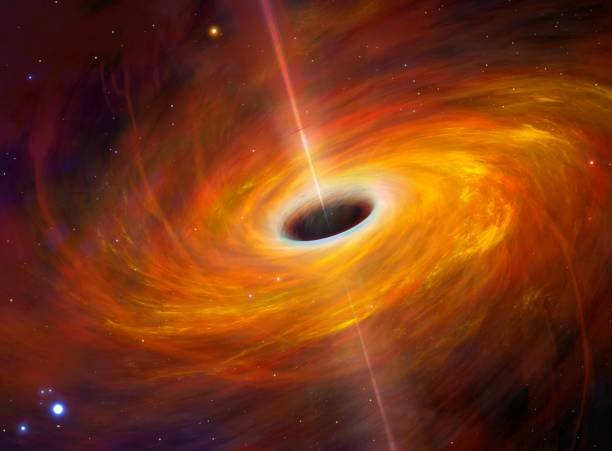
Around this singularity lies the event horizon—the ultimate boundary. It marks the edge of the black hole, the point of no return. Anything that crosses it, whether a photon of light or a star, is forever lost to the outside universe. To an observer, it is as if the object freezes at the edge, fading away into darkness.
What remains is a silent, invisible monster—curved space wrapped around a gravitational abyss. Black holes do not emit light, yet their presence can be felt through their influence: stars orbiting empty space, gas spiraling inward at near-light speeds, and X-rays blazing from the friction of doomed matter.
In these cosmic crucibles, physics reaches its breaking point. The known laws of nature, from Einstein’s relativity to quantum mechanics, begin to clash. And within that clash lies the answer to one of the deepest questions we can ask: can anything ever truly escape?
The Gravity That Warps Reality
Gravity, as Einstein described it, is not a force in the traditional sense but a curvature of spacetime itself. Matter tells spacetime how to curve, and spacetime tells matter how to move. Imagine placing a heavy ball on a rubber sheet—near it, the sheet dips, and smaller balls roll toward the center. The heavier the object, the deeper the dip.
A black hole takes this idea to the extreme. It does not just curve spacetime; it tears a well so deep that nothing can climb out. At its center, spacetime curves infinitely, and our understanding of physics fails.
If you were to fall toward a black hole, you would experience effects both surreal and horrifying. As you approach the event horizon, the pull of gravity would differ between your head and feet, stretching your body into a shape physicists grimly call spaghettification. From your own perspective, time would seem normal, but to an outside observer, your descent would appear to slow, your image fading into red and vanishing as light itself bends away.
Inside the event horizon, all paths—no matter which direction you move—lead inevitably toward the singularity. There is no escape, no turning back. Even light, the fastest entity in existence, cannot overcome the inward drag of spacetime. The universe, it seems, has built the perfect trap.
Light and the Point of No Return
Light travels at 299,792 kilometers per second—nothing can go faster. Yet near a black hole, even light’s ultimate speed is not enough. The event horizon represents the surface where the escape velocity equals the speed of light. To escape from that point, you would need to move faster than light, which the laws of physics forbid.
Outside the event horizon, light can still struggle and sometimes win. A photon emitted near—but not too near—a black hole may be stretched and redshifted, losing energy as it fights to climb out of the gravitational well. This is called gravitational redshift. The closer the photon is emitted to the horizon, the more energy it loses, until at the very edge, it has no energy left to escape at all.
Thus, the black hole appears black—not because it absorbs light in the conventional sense, but because it allows none to leave. It is a cosmic void from which no signal can return. Yet, as we shall see, this absolute darkness is not as absolute as it seems.
The Singularity: Where Physics Breaks
At the core of a black hole lies the singularity—a point where density and curvature become infinite, and time and space lose their meaning. Here, all known laws of physics fail. Relativity predicts the singularity’s existence but cannot describe it. Quantum mechanics, which governs the very small, also fails to handle such infinity.
The singularity is, in many ways, a mirror to human ignorance. It tells us that our understanding of the universe is incomplete. Somewhere, hidden beyond the event horizon, lies a truth that neither of our great theories can fully reveal. To truly understand a black hole, we must reconcile the language of gravity with the language of quantum mechanics—a task that may one day give birth to a theory of quantum gravity.
But even without complete understanding, black holes have already changed how we think about the universe. They have forced us to confront the limits of knowledge, and they have revealed one of the most astonishing paradoxes in all of science.
Hawking’s Revelation: Black Holes Can Glow
In the 1970s, physicist Stephen Hawking made a discovery that shook the foundations of physics. He realized that black holes are not entirely black. According to quantum theory, empty space is not truly empty—it teems with “virtual particles” that constantly pop in and out of existence.
Near the event horizon of a black hole, these particle pairs can become separated—one falls in, while the other escapes. The escaping particle becomes real, stealing a tiny amount of energy from the black hole. This phenomenon, now known as Hawking radiation, means that black holes can slowly lose mass over time.
This revelation changed everything. If black holes can emit radiation, then something can indeed escape their gravity—not matter or light directly, but energy through quantum processes. Over immense timescales, a black hole could theoretically evaporate entirely, fading into nothing.
Hawking’s discovery was profound not only because it revealed a new property of black holes, but because it hinted at a deep connection between gravity, quantum mechanics, and thermodynamics. Black holes, once thought to be eternal prisons, now seemed mortal. They could die, releasing information in ways still poorly understood.
The Paradox of Lost Information
Hawking’s insight led to one of the greatest scientific debates of the modern era: the black hole information paradox.
According to quantum mechanics, information about a physical system can never be truly destroyed. Yet if a black hole swallows matter, and that matter later evaporates into random radiation, where does the information go? Does it vanish, violating the principles of quantum physics? Or does it somehow remain encoded in the radiation itself, hidden in subtle correlations that we cannot yet decipher?
This paradox sits at the crossroads of the two great pillars of modern physics. General relativity tells us that nothing escapes the event horizon. Quantum mechanics insists that information cannot be lost. Both theories are correct in their own domains—yet they clash when combined.
Over decades, physicists have proposed many possible answers: that information is preserved on the event horizon in a holographic form; that it escapes slowly through Hawking radiation; or that our very notion of space and time breaks down at the quantum level.
The resolution of this paradox may hold the key to a unified understanding of the universe—a theory that can describe everything from the birth of galaxies to the smallest quantum fluctuations of reality.
The Holographic Universe
One of the most fascinating ideas to emerge from black hole physics is the holographic principle. Proposed by Gerard ’t Hooft and Leonard Susskind, it suggests that all the information contained within a volume of space can be represented on its boundary surface—just like a hologram, which encodes a three-dimensional image on a two-dimensional surface.
In the context of black holes, this means that all the information about what falls into a black hole might be stored on its event horizon. The black hole, therefore, acts like a cosmic storage device—its surface encoding the data of everything it has consumed.
This idea extends beyond black holes themselves. Some physicists propose that our entire universe may be holographic in nature—that the three-dimensional world we experience is a projection of information encoded on a distant boundary of spacetime. If true, it would mean that reality, at its core, is not matter but information.
In this holographic universe, nothing is truly lost—only transformed. Even in the heart of darkness, information persists, whispering the secrets of existence in ways we are only beginning to grasp.
Escaping the Inescapable: Wormholes and White Holes
While classical physics forbids any escape from a black hole, the frontier of theoretical physics is more imaginative. Some solutions to Einstein’s equations suggest the existence of wormholes—tunnels through spacetime that could, in theory, connect distant regions of the universe.
A wormhole might allow information or matter to enter a black hole and emerge somewhere else, perhaps even in another universe. Such structures, however, remain purely hypothetical, requiring forms of “negative energy” to stay open—something not yet observed in nature.
There is also the concept of a white hole, the mirror opposite of a black hole. A white hole cannot be entered from the outside, but it can emit matter and energy that once fell into a black hole. Some physicists have speculated that black holes and white holes might be two ends of the same entity—connected through time, perhaps forming a bridge from one universe to another.
While these ideas remain speculative, they serve a deeper purpose. They remind us that physics is not just about what we know, but what we can imagine—and that imagination is often the seed of discovery.
The Supermassive Titans
Black holes are not all equal. At the centers of galaxies, including our own Milky Way, lie supermassive black holes—millions or even billions of times heavier than the Sun. These giants, formed over cosmic timescales, shape the evolution of entire galaxies.
The black hole at our galaxy’s core, Sagittarius A*, is a relatively quiet giant. But others, like those in active galactic nuclei or quasars, blaze with unimaginable power. As matter spirals toward them, it forms an accretion disk that heats to millions of degrees, emitting radiation across the electromagnetic spectrum.
In these cosmic furnaces, black holes do not merely consume—they also create. Their outflows and jets seed galaxies with energy, driving the birth of stars and influencing cosmic evolution. Paradoxically, from the darkest regions of the universe emerge the brightest lights.
Time and the Black Hole’s Grasp
A black hole does not merely trap matter—it traps time itself. Near the event horizon, time slows relative to distant observers. To someone watching from afar, a falling object never truly crosses the horizon—it just appears to freeze, its light stretched into oblivion. But to the falling observer, the crossing happens in finite time.
This duality of experience challenges our intuition about time and reality. It suggests that “past” and “future” are not absolute, but relative—woven into the curvature of spacetime itself. A black hole, in this sense, is not just an object; it is a portal into the nature of time.
Some physicists even speculate that the singularity inside a black hole may be connected to the birth of a new universe—that our own cosmos might have arisen from the heart of a black hole in another. If so, then every black hole could be a seed of creation—a paradoxical womb born from destruction.
The Song of Gravity: Gravitational Waves
In 2015, humanity heard the universe speak in a new language. The Laser Interferometer Gravitational-Wave Observatory (LIGO) detected ripples in spacetime itself—gravitational waves—produced by the collision of two black holes more than a billion light-years away.
These waves carried information not in light, but in gravity, revealing the final moments of a cosmic dance before the two giants merged into one. It was the first direct confirmation of a prediction Einstein made a century earlier.
Through gravitational waves, black holes no longer remain silent. They sing across the universe, their merging hearts sending vibrations through the very fabric of existence. Each detection brings us closer to understanding their nature—and perhaps, one day, to uncovering how information truly behaves within their depths.
Black Holes and the Edge of Human Knowledge
To study black holes is to stand at the edge of what is knowable. They represent the boundary between the visible and the invisible, between understanding and mystery. Every new discovery—Hawking radiation, gravitational waves, the first direct image of a black hole’s shadow captured by the Event Horizon Telescope—brings us closer, yet each step reveals new depths of complexity.
Black holes teach us humility. They remind us that even in the age of supercomputers and quantum experiments, there remain questions that dwarf our imagination. They are not simply cosmic vacuum cleaners but laboratories where the universe experiments with its own rules.
Can Anything Truly Escape?
So, can anything escape a black hole’s gravity? The answer depends on what we mean by “escape.”
Nothing—no matter, no light—can cross the event horizon and return. The laws of relativity forbid it. Yet through the strange dance of quantum physics, black holes can emit Hawking radiation, slowly losing energy. Information may not be lost after all—it may escape in ways that challenge our understanding of space, time, and entropy.
In that sense, a black hole does not mark the end of everything, but a transformation. It is the ultimate alchemist, turning matter into energy, order into chaos, and perhaps death into rebirth.
The Poetry of the Abyss
At first glance, a black hole seems like a symbol of destruction, a void devouring all that dares approach. But look deeper, and it becomes something else: a mirror reflecting the universe’s creativity. From its event horizon to its singularity, from Hawking’s radiation to the birth of galaxies, the black hole embodies the eternal rhythm of the cosmos—creation and annihilation intertwined.
When we study black holes, we are not peering into a distant abyss—we are looking into the heart of reality itself. The same physics that governs their gravity also governs the atoms in our bodies and the light from our Sun. We are bound to these cosmic mysteries by the same fabric of spacetime.
Perhaps the black hole’s greatest lesson is not that nothing escapes, but that even in the darkest corners of existence, there is still a whisper of light—a flicker of information, a trace of meaning, a remnant of creation’s song.
The Eternal Horizon
Black holes challenge everything we know about the universe. They test the limits of physics, philosophy, and imagination. They show us that the universe is not a static machine but a living mystery—one that hides its most profound truths behind a curtain of darkness.
Yet in that darkness, there is beauty. There is wonder. And there is hope that one day, through the union of quantum mechanics and relativity, through the courage to question and to dream, we will understand not only how black holes work—but why the universe made them at all.
Until then, we stand at the edge of the event horizon of knowledge, gazing into infinity, asking the same question that has haunted physicists for generations:
Can anything escape a black hole’s gravity?
And perhaps the universe, in its timeless silence, replies:
Not easily—but even the darkest night glows faintly with the promise of dawn.