Invisible, silent, and yet immeasurably powerful, Earth’s magnetic field is one of nature’s most elegant and vital phenomena. It is our planet’s invisible armor, shielding life from the relentless fury of the cosmos. Every second, streams of charged particles from the Sun—known as the solar wind—race toward Earth at supersonic speeds. Without our magnetic field, these cosmic tempests would strip away the atmosphere, boil away the oceans, and render our planet as barren as Mars.
But we are protected—not by walls of steel, but by an unseen force born deep within the Earth itself. The magnetic field deflects, traps, and redirects dangerous radiation, turning deadly solar storms into harmless auroras that dance across polar skies. It is both warrior and artist, defender and painter of the heavens.
This shield has existed for billions of years, evolving alongside the planet it protects. It has reversed its polarity, fluctuated in strength, and shaped the conditions that allow life to exist. To understand it is to uncover one of the most profound connections between the heart of the Earth and the vast expanse of space.
The Birth of an Invisible Force
The story of Earth’s magnetic field begins at the dawn of planetary formation, more than 4.5 billion years ago. In the violent chaos of the early solar system, countless collisions forged and reshaped our young world. As Earth grew, heavier elements like iron and nickel sank toward the center, forming a dense metallic core.
It is from this core that the magnetic field arises. The core is divided into two parts: a solid inner core and a liquid outer core. The inner core is a sphere of iron roughly the size of the Moon, compressed to extraordinary density by immense pressure. Surrounding it lies the molten outer core—a sea of liquid iron and nickel swirling at thousands of kilometers per hour.
These turbulent flows of electrically conductive metal generate electric currents, and according to the principles of electromagnetism, moving electric charges create magnetic fields. This self-sustaining process is called the geodynamo. It is a planetary engine of extraordinary complexity—a natural power plant that continuously converts the motion of molten metal into magnetic energy.
As long as the core continues to convect and spin, Earth’s magnetic shield remains alive.
The Shape of an Invisible World
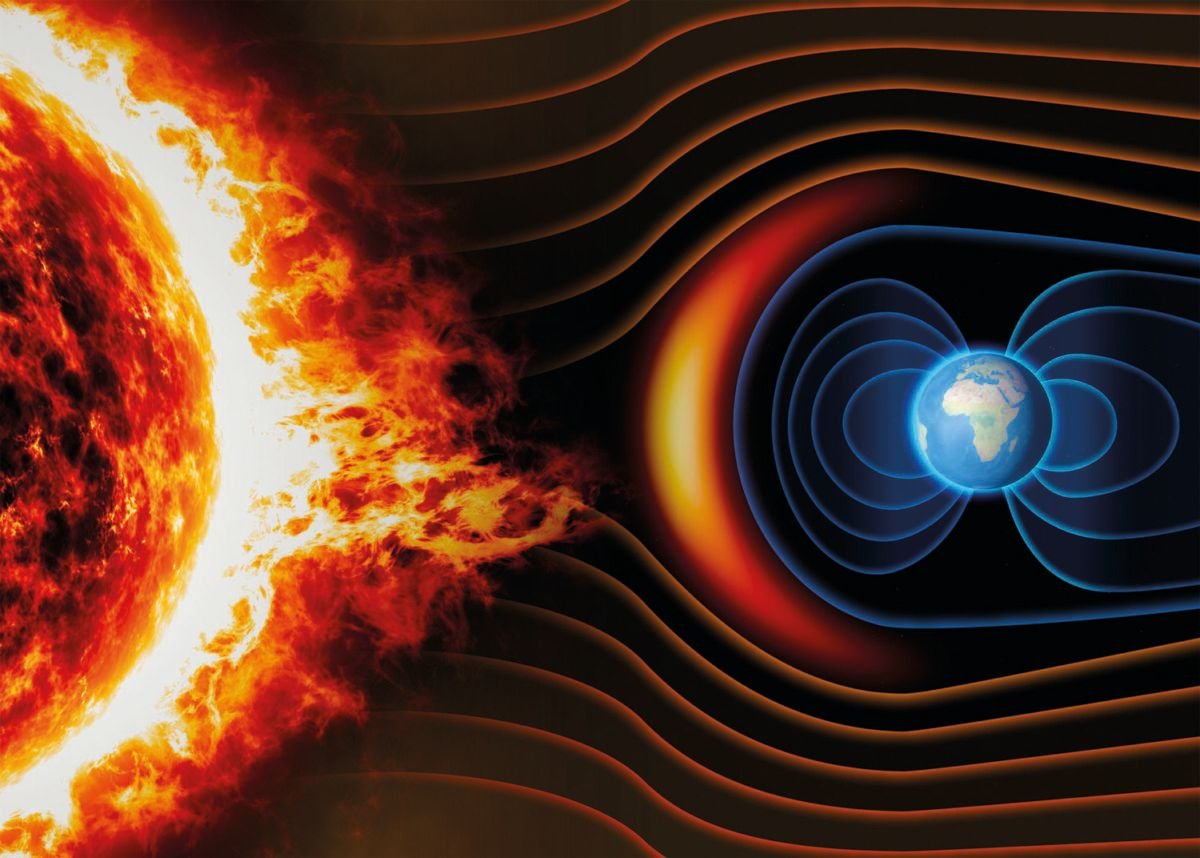
If we could see the magnetic field with our eyes, the Earth would appear cocooned in a vast, shimmering bubble extending far into space. This structure, called the magnetosphere, stretches tens of thousands of kilometers above the planet and interacts constantly with the solar wind.
Near the equator, the magnetic field lines loop smoothly from one hemisphere to the other, forming graceful arcs. But on the side facing the Sun, the magnetosphere is compressed by solar pressure, reaching only about 10 Earth radii. On the night side, it stretches out into a long tail—the magnetotail—that extends more than a million kilometers into space.
This magnetic bubble is dynamic and alive. It pulses, ripples, and shifts as solar storms crash against it. The field lines bend and reconnect, releasing bursts of energy that can send charged particles racing toward the poles. When they collide with the upper atmosphere, they produce one of nature’s greatest spectacles—the aurora.
From space, the magnetosphere looks like a vast teardrop-shaped shield protecting a delicate blue world from an endless solar wind.
The Dynamo at Earth’s Core
The physics of the geodynamo is among the most fascinating and complex subjects in planetary science. Deep within the Earth, temperatures soar to over 6,000°C—hotter than the surface of the Sun. In the outer core, molten iron and nickel move in swirling convection currents driven by heat escaping from the inner core.
Because the Earth rotates, these fluid motions are twisted and aligned by the Coriolis effect, forming spiraling columns of motion that organize the flow into patterns. The motion of this conductive liquid generates electric currents, and these currents in turn create magnetic fields. Those fields reinforce the flow that created them—a self-amplifying feedback loop.
It is an elegant dance of physics: energy becomes motion, motion becomes electricity, electricity becomes magnetism, and magnetism sustains itself through motion.
The geodynamo is not constant, however. It fluctuates, oscillates, and sometimes reverses entirely. These changes ripple outward, influencing everything from satellite orbits to the migration patterns of animals. The field is alive in every sense—a planetary heartbeat that never stops.
A Sky Painted by Magnetism
The most visible manifestation of Earth’s magnetic field lies not underground, but in the sky. When charged particles from the Sun are trapped by the magnetosphere, they spiral along magnetic field lines toward the poles. There, they collide with atoms and molecules in the upper atmosphere, exciting them to higher energy states. When these atoms relax, they release light—green, red, purple, and blue.
This phenomenon, known as the aurora borealis in the north and the aurora australis in the south, is one of the most breathtaking sights in nature. The magnetic field, in essence, transforms deadly radiation into a light show that has inspired humanity for millennia.
To witness the aurora is to see the invisible become visible—to watch the Earth’s magnetic shield at work, not as an abstraction, but as living art. Every flicker, every curtain of light, is a silent message from space, telling us that the shield still holds.
The Solar Wind and the Eternal Battle
The Sun is both giver and destroyer. It bathes our world in warmth and light, but it also releases a constant stream of charged particles—electrons and protons—known as the solar wind. These particles move at speeds of up to 800 kilometers per second, carrying with them the Sun’s own magnetic field.
When this wind meets Earth’s magnetosphere, the two fields interact in a complex dance of pressure and energy. Most solar particles are deflected around the planet, but some become trapped within magnetic belts encircling the Earth—known as the Van Allen radiation belts. These zones store high-energy particles that can damage satellites and pose risks to astronauts.
During solar storms, when the Sun unleashes powerful bursts of plasma called coronal mass ejections, the magnetic field is bombarded with intense energy. The magnetosphere flexes, compresses, and sometimes cracks open, allowing streams of particles to penetrate deeper. These events can disrupt communications, knock out power grids, and even alter the orbits of satellites.
Yet, despite these assaults, Earth’s shield holds firm. It absorbs, redirects, and diffuses the Sun’s rage, ensuring that the fragile atmosphere—and the life beneath it—remain safe.
The Magnetic Compass of Life
Earth’s magnetic field is not just a planetary shield—it is also a guiding force woven into the fabric of biology itself. Many species, from migratory birds to sea turtles to bacteria, have evolved an extraordinary ability to sense the planet’s magnetism.
This phenomenon, called magnetoreception, allows organisms to navigate with astonishing precision. Birds, for example, use the magnetic field as a kind of invisible map, guiding them across continents and oceans. Sea turtles hatch on tropical beaches and then travel thousands of kilometers before returning, decades later, to the same shore—guided in part by magnetic cues imprinted at birth.
Even humans, though less sensitive, are influenced by magnetism. Some studies suggest that tiny magnetic crystals exist within our brains, remnants of an ancient biological compass inherited from early life. Whether we feel it or not, the field flows through us, connecting every living being to the planet’s magnetic pulse.
Without the magnetic field, not only would our atmosphere vanish, but life itself might never have evolved the way it did.
The Shifting Poles
Though the magnetic field feels stable, it is in constant motion. The magnetic poles—where field lines converge—are not fixed points, but wander across the globe in slow, erratic paths.
At present, the north magnetic pole is racing from Canada toward Siberia at nearly 50 kilometers per year—a speed unprecedented in recorded history. The south magnetic pole, too, drifts slowly across Antarctica. This wandering is caused by changes in the molten flow deep within the outer core, where the geodynamo operates.
Even more dramatic are the magnetic reversals, when the entire field flips, and north becomes south. These reversals have occurred hundreds of times throughout Earth’s history, on average every few hundred thousand years, though not at regular intervals. The last full reversal—called the Brunhes–Matuyama reversal—occurred about 780,000 years ago.
During a reversal, the field weakens, becomes chaotic, and may temporarily split into multiple poles. While such events can affect satellite systems and radiation exposure, they are not catastrophic for life. Fossil evidence shows no major extinctions coinciding with reversals. The field may waver, but it never disappears completely.
Still, the prospect of a future reversal fascinates and unsettles scientists. If the field were to weaken significantly, Earth’s technological civilization could face disruptions unlike anything seen before.
The Magnetic Shield and Human Civilization
In our modern world, the magnetic field plays a crucial, if often unnoticed, role in daily life. Navigation systems, power grids, and communication satellites all depend on stable magnetic conditions. A strong geomagnetic storm—triggered by a massive solar flare—can cause widespread technological damage.
In 1989, for example, a powerful solar storm induced electric currents in the ground that shut down Quebec’s entire power grid within minutes. In 1859, an even larger event, known as the Carrington Event, set telegraph wires ablaze and produced auroras visible near the equator.
If such an event occurred today, with our dependence on satellites and electronics, the consequences could be catastrophic. GPS systems could fail, spacecraft could be damaged, and electrical networks could collapse on a global scale.
Our invisible protector is not invincible—it can be overwhelmed, if only briefly, by the Sun’s might. This is why scientists constantly monitor space weather, watching for signs of incoming solar storms, and designing technologies to withstand them.
Magnetic Memories in Stone
Long after the field shifts or reverses, its traces remain etched into the Earth itself. As molten rock cools from volcanic eruptions or seafloor spreading, magnetic minerals within it align with the current direction of the magnetic field. These tiny magnetic signatures lock in place as the rock solidifies, preserving a record of the field’s past.
By studying these magnetic fossils, geophysicists can reconstruct the history of Earth’s magnetism over millions of years. They have discovered patterns of reversals, fluctuations, and even near-collapses. These records also helped confirm the theory of plate tectonics—the movement of Earth’s continents.
When scientists found symmetrical magnetic patterns on either side of mid-ocean ridges, they realized the seafloor was spreading, creating new crust that recorded the field’s periodic reversals like a cosmic barcode. Thus, the magnetic field not only protects life—it also preserves the geological memory of the planet’s evolution.
The Weakening Field: Myth or Warning?
In recent decades, researchers have observed a steady decrease in the magnetic field’s overall strength—about 10% over the last 150 years. This decline has fueled speculation that a reversal may be approaching.
One particularly weak region, known as the South Atlantic Anomaly, stretches from South America to Africa. Here, the field is so weak that satellites passing overhead are bombarded by increased radiation. Instruments aboard the International Space Station must shut down temporarily when passing through this zone to avoid damage.
Some scientists believe this anomaly may signal the early stages of a reversal, while others see it as part of normal fluctuations. Either way, it serves as a reminder that the magnetic field is dynamic, not static. Like a living organism, it breathes, changes, and adapts over time.
Even if a reversal were underway, it would unfold over thousands of years—too slow for us to witness, but fast enough to test humanity’s technological resilience.
Magnetism Beyond Earth
Earth is not alone in possessing a magnetic field, though ours is among the strongest of any rocky planet. Mercury, surprisingly, has a weak but detectable field. Jupiter and Saturn boast colossal magnetic bubbles that dwarf Earth’s magnetosphere, powered by metallic hydrogen deep within their interiors. Uranus and Neptune have wildly tilted, asymmetric fields that defy easy explanation.
Mars, however, tells a darker story. Once, it too had a global magnetic field, generated by a molten core. But as the planet cooled and its core solidified, the dynamo died. Without its shield, Mars’s atmosphere was stripped away by the solar wind. Its surface became a desert of rust and radiation.
Mars is a reminder of what could happen if Earth’s magnetic engine ever stopped. Our invisible protector is not eternal—it depends on the motion of molten metal deep beneath our feet. Should that motion cease, the shield would fade, and Earth would slowly lose its atmosphere, just as Mars did billions of years ago.
The Future of the Magnetic Field
What lies ahead for Earth’s magnetic shield? Most scientists agree that the field will continue to fluctuate, strengthen, and weaken in cycles, as it has throughout history. Eventually, it may reverse again, but not soon enough to threaten our survival.
The true challenge lies in understanding the subtle processes that drive the geodynamo. New computer models and satellite missions, such as ESA’s Swarm constellation, are mapping the magnetic field in unprecedented detail, revealing how it changes over days, years, and centuries. These observations help us predict magnetic storms, protect satellites, and prepare for long-term shifts.
Humanity’s growing exploration of space also depends on the field. Future missions to Mars, the Moon, and beyond must reckon with the dangers of unshielded radiation. Earth’s magnetic field is a privilege—a natural defense that makes our planet uniquely habitable. When we leave its protection, we step into a universe that has no mercy for the unguarded.
The Poetry of an Invisible Force
There is something deeply poetic about the magnetic field. It is a bridge between the visible and the unseen, between the fiery core and the vast heavens. It binds the fate of our planet to the mysteries of electromagnetism, spinning endlessly in the dark, unseen by any eye yet shaping every moment of existence.
We cannot touch it, yet we feel its presence in the steady north of a compass, in the shimmering curtains of the aurora, in the quiet hum of life protected from cosmic chaos. The magnetic field is the silent song of the Earth—a melody of motion and magnetism that has played for billions of years.
It is humbling to know that our world’s safety depends on the restless heart of molten iron beneath our feet. Every sunrise, every breath, every moment of calm owes itself to that churning sea of metal that never sleeps.
The Eternal Shield
The Earth’s magnetic field is more than a scientific curiosity—it is the essence of our planet’s endurance. It has guarded us through eons of solar storms, through cosmic bombardments, through reversals and fluctuations. It has shaped the evolution of life, the behavior of the atmosphere, and the very definition of what it means to be a living world.
When astronauts look back at Earth from the emptiness of space, they see not just a blue marble, but a protected oasis—a planet wrapped in invisible light. The magnetic field is the reason that oasis exists.
One day, our descendants may journey to other worlds, carrying with them technology to recreate the shield that nature gave us freely. But no artificial magnetosphere will ever match the elegance of this one—the ancient, self-sustaining force born of fire and motion.
It is a guardian we rarely acknowledge, yet without it, there would be no oceans, no sky, no us.
The next time you see the northern lights ripple across the night, remember: you are watching your planet’s heart, projected upon the heavens. The magnetic shield that keeps you alive is not just a field—it is a miracle.
And it hums ceaselessly beneath your feet, unseen, unending, and utterly indispensable—the invisible protector of Earth.