Among the countless worlds orbiting the Sun, none burn quite like Io. It is a realm of eternal fire, a tortured moon that seethes, trembles, and roars beneath the gaze of Jupiter. Volcanoes taller than Mount Everest erupt with fountains of molten rock, lakes of sulfur boil in infernal light, and mountains crumble under forces that reshape the surface almost daily. Io is not merely alive—it is in constant agony, a world locked in a cycle of destruction and renewal.
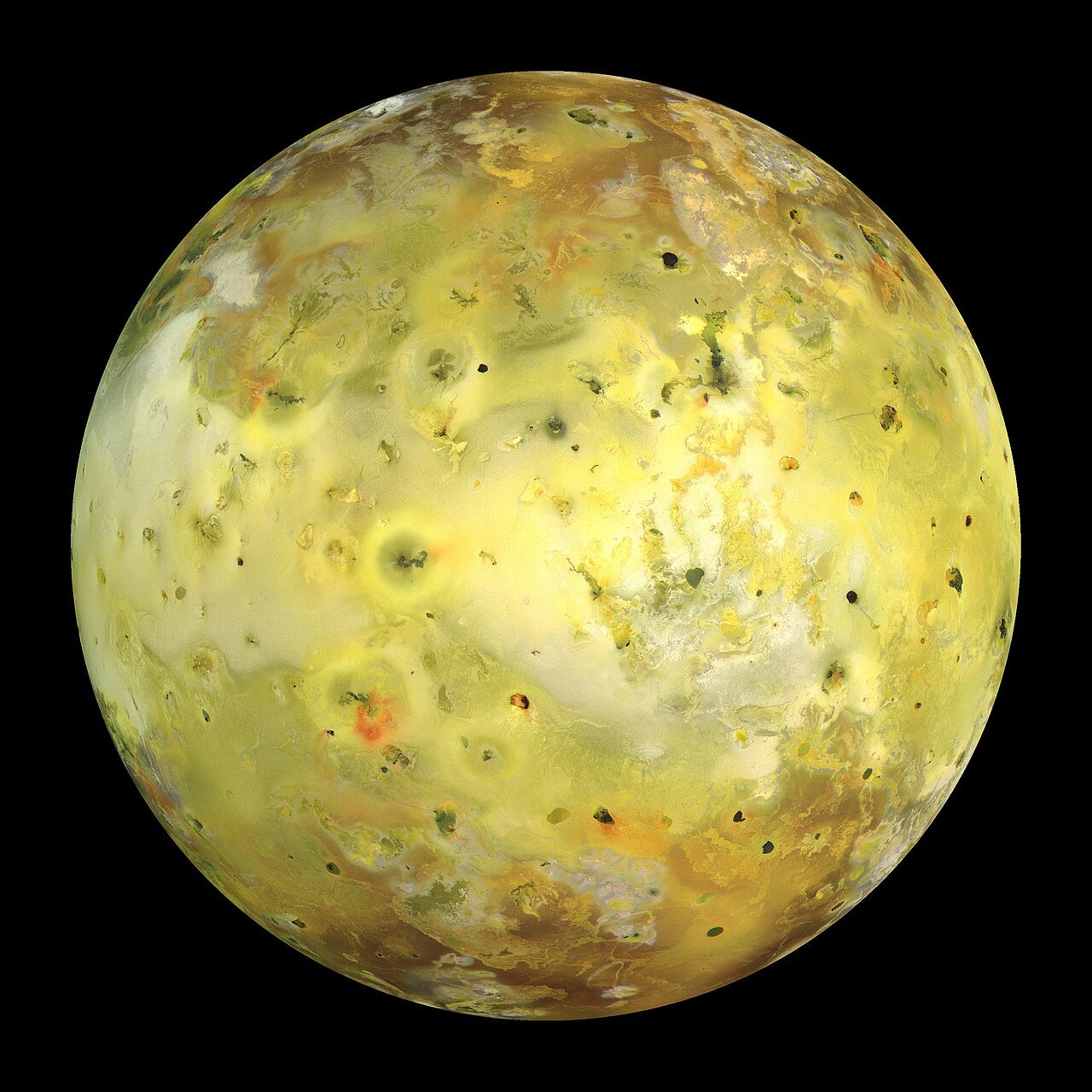
To gaze upon Io is to glimpse both beauty and terror intertwined. From a distance, its surface glows in hues of gold, orange, and red—like a cosmic ember drifting in the dark. But beneath this vivid palette lies chaos: a landscape in ceaseless turmoil, a place where the ground itself breathes heat.
Io is one of Jupiter’s four great Galilean moons, discovered by Galileo Galilei in 1610. While Europa hides oceans beneath its ice and Ganymede and Callisto bear ancient scars of impact, Io stands apart as the most geologically active body in the Solar System. It is a world of extremes—a place where gravity, heat, and chemistry collide in spectacular fury. Its existence tells the story of power, motion, and the unrelenting forces that shape planetary worlds.
Discovery and the Dawn of Understanding
When Galileo first turned his primitive telescope toward Jupiter, he could not have imagined what he had uncovered. On January 7, 1610, he observed four bright points of light aligned with Jupiter’s equator. Over subsequent nights, these points moved relative to the planet, revealing themselves as moons—worlds orbiting another world. One of these was Io.
This discovery shattered the ancient belief that all celestial bodies orbited Earth. It marked the beginning of modern astronomy and transformed humanity’s understanding of its place in the cosmos. Yet for centuries, Io remained a distant, mysterious dot of light—an astronomical curiosity, not the infernal wonder we know today.
The veil began to lift in 1979, when NASA’s Voyager 1 spacecraft passed by Jupiter. As it approached Io, cameras captured images that astonished scientists. Instead of a cratered, ancient surface like Earth’s Moon, Io appeared strangely smooth, mottled with vibrant patches of yellow, orange, and white. Most astonishingly, Voyager’s instruments detected active volcanic plumes—some soaring hundreds of kilometers high. Io was alive, erupting before human eyes for the first time in history.
The discovery of Io’s volcanism was revolutionary. Until then, Earth was the only known geologically active world. Suddenly, the Solar System seemed far more dynamic than anyone had imagined. Io was not a cold relic, but a world of raging energy, constantly reshaping itself under the relentless pull of Jupiter’s gravity.
The Power Beneath the Surface
What drives Io’s unending eruptions? The answer lies in a phenomenon both elegant and violent—tidal heating. Io’s orbit around Jupiter is slightly elliptical, and as it moves closer and farther from the giant planet, immense gravitational forces flex and squeeze its interior. The result is frictional heat, generated deep within Io’s mantle, enough to melt rock and fuel a planetary furnace.
This heating is amplified by Io’s relationship with its sibling moons—Europa and Ganymede. The three are locked in an orbital resonance: for every orbit Ganymede completes, Europa circles Jupiter twice, and Io four times. This gravitational rhythm keeps Io’s orbit from settling into a perfect circle, ensuring that the tidal forces never relent. The moon is trapped in a cosmic tug-of-war, its insides kneaded like dough every day of its existence.
The consequences are astonishing. Beneath Io’s colorful crust lies a molten interior with magma chambers that stretch for kilometers. Its thin lithosphere floats atop a restless ocean of liquid rock, constantly pierced by fissures through which lava bursts forth. The surface, though solid in appearance, is continually reborn—a skin of ash covering a heart of fire.
Io radiates immense amounts of heat—over a hundred times more than Earth does per square meter. This heat escapes through hundreds of active volcanoes, each one a vent to the inferno below. Some eruptions produce glowing lava flows that can stretch for hundreds of kilometers, while others hurl sulfurous gases high into space, forming vast plumes visible even from orbit.
A Landscape of Hellish Beauty
Io’s surface is one of the most alien yet strangely beautiful sights in the Solar System. The world’s palette comes from its rich chemistry: sulfur, sulfur dioxide, and various compounds that paint the terrain in yellows, reds, greens, and blacks. These colors shift as volcanic gases condense and react under sunlight, giving Io a patchwork appearance reminiscent of a diseased world—yet hauntingly vibrant.
One of its most iconic features is Loki Patera, a massive, horseshoe-shaped lava lake over 200 kilometers across. Loki is the most powerful volcano known anywhere; it brightens and dims cyclically as its crust cools and sinks into the molten interior below. When Loki erupts fully, it releases more heat than all of Earth’s volcanoes combined.
Other volcanic sites—such as Pele, Prometheus, and Tvashtar—are equally dramatic. Pele, named after the Hawaiian goddess of fire, sends plumes of sulfur 300 kilometers into space, coating the surrounding landscape in scarlet frost. Prometheus, meanwhile, produces persistent lava flows that interact with sulfur dioxide frost, creating glowing blue and orange patterns.
Between these fiery regions lie mountains—some rising higher than Everest—formed not by tectonic collision but by the relentless overturning of Io’s crust. Because the surface constantly renews, older regions are pushed upward, creating massive plateaus and ridges. These mountains, sculpted by collapse and pressure, crumble under their own weight, leaving jagged scars that tell of Io’s violent interior.
From orbit, the moon’s surface appears almost alive. New lava flows appear, cool, and fade within months. Ash blankets plains that were bright yesterday and dark today. Every eruption reshapes the world, ensuring that no two images of Io are ever quite the same.
The Atmosphere of Fire and Ice
Despite its activity, Io’s atmosphere is thin—so thin it could scarcely be called one. Composed mainly of sulfur dioxide, it forms a tenuous envelope that freezes out when Io passes into Jupiter’s shadow and reappears when sunlight warms the surface. This atmospheric “breathing” is a daily rhythm of condensation and sublimation, a fragile dance between fire and frost.
The volcanic plumes also feed this atmosphere, injecting sulfur, oxygen, and other gases high above the surface. Some of this material escapes Io’s weak gravity and becomes trapped in Jupiter’s immense magnetic field. As these charged particles spiral along magnetic lines, they create intense radiation belts that bathe Io in deadly energy—enough to kill an unprotected human in minutes.
This constant bombardment also produces stunning phenomena. Io’s interaction with Jupiter’s magnetic field generates electric currents that flow along magnetic lines to the planet itself. These currents create auroras in Jupiter’s atmosphere directly opposite Io’s position—vast, glowing footprints that mark the moon’s presence like cosmic shadows.
Meanwhile, charged particles ejected from Io form a massive torus—a doughnut-shaped cloud of plasma encircling Jupiter. This plasma torus, rich in sulfur and oxygen ions, is both a byproduct of Io’s volcanism and a key driver of Jupiter’s complex magnetosphere. Thus, Io is not just influenced by Jupiter—it actively shapes the giant planet’s environment.
A World Without Rest
On Earth, volcanic activity is a punctuation in geological time—rare, dramatic, but localized. On Io, it is perpetual. Every square kilometer of the surface has been resurfaced within the last few million years, some parts within mere decades. Craters from ancient impacts are almost nonexistent, erased by the ceaseless upwelling of magma and ash.
Io’s hyperactivity makes it both mesmerizing and volatile. Plumes of molten sulfur rise like geysers, raining frozen crystals that cover the ground in vivid patterns. The temperature differences are extreme: lava can reach 1,600°C, while nearby regions plunge to -150°C in shadow. These contrasts produce constant thermal stress, fracturing the crust and opening new vents for eruption.
The speed of change is breathtaking. Observations from spacecraft and Earth-based telescopes show that new hot spots appear regularly, while others fade away. Flows that were kilometers wide last year can vanish beneath new deposits the next. To study Io is to watch geology in fast motion—planetary processes that unfold before our eyes.
Yet Io’s violence is also strangely ordered. Its activity follows cycles dictated by orbital resonance and tidal stress. Certain regions erupt predictably as the moon’s orbit stretches and compresses its crust. In this way, Io’s fury is not random but rhythmic—a pulse tied to the heartbeat of Jupiter itself.
The Role of Jupiter: The Tyrant’s Grip
Io’s tormentor is also its sculptor. Jupiter, the largest planet in the Solar System, exerts a gravitational force hundreds of times stronger than Earth’s. Its pull distorts Io into an ellipsoid shape, stretching and squeezing the moon as it orbits. The energy released by this tidal flexing keeps Io’s interior molten, but at a terrible cost.
If Io were slightly farther away, it might be cold and dead like our Moon. Slightly closer, and it might be torn apart by Jupiter’s gravity. It exists in a precarious balance—a world perpetually tortured but never destroyed.
Jupiter’s magnetic field also dominates Io’s environment. As the planet rotates rapidly—once every ten hours—it drags its magnetic field around like a spinning blade. Io moves through this field, generating electric currents that reach millions of amperes. These currents connect Io and Jupiter in an electromagnetic embrace, lighting auroras on both worlds.
The relationship is symbiotic in its violence. Io feeds Jupiter’s magnetosphere with plasma, while Jupiter’s field strips Io’s atmosphere and bombards its surface. Together, they form one of the most energetic systems in the Solar System—a dance of electricity, gravity, and fire.
Observing the Inferno: Spacecraft Encounters
Since Voyager’s discovery, a succession of spacecraft has deepened our understanding of Io. In the 1990s, NASA’s Galileo orbiter spent eight years studying Jupiter and its moons, flying repeatedly past Io. Its instruments captured stunning images of erupting volcanoes, glowing lava lakes, and surface changes over time.
Galileo also measured Io’s gravity and magnetic field, confirming the existence of a partially molten interior. Data suggested that beneath its crust lies a global layer of magma or a molten ocean mixed with silicate rock. This discovery cemented Io’s status as a world powered from within, not merely heated by the Sun.
Subsequent missions, including New Horizons (en route to Pluto) and Juno (currently orbiting Jupiter), have continued to observe Io from afar. Juno’s recent close flybys are expected to provide the most detailed data yet on Io’s internal heat and magnetic interactions. Even telescopes on Earth—such as the Large Binocular Telescope and ALMA—regularly monitor Io’s changing surface and eruptive activity.
These observations reveal a world in perpetual flux. Eruptions alter the landscape within months, and glowing hotspots appear and fade like embers in a cosmic forge. Io is not merely a geological curiosity—it is a living laboratory for planetary science, a window into how worlds evolve through energy and stress.
Chemistry of Chaos
Io’s surface and atmosphere are dominated by sulfur and its compounds, creating a chemical environment unlike any other. The intense heat drives reactions that transform sulfur between its many forms: yellow crystalline deposits, red molten streams, and black volcanic glass.
Sulfur dioxide, a key gas in Io’s atmosphere, condenses into frost in cold regions, forming bright patches visible from space. When heated, it sublimates back into vapor, feeding the thin air and participating in the moon’s daily cycle of condensation and evaporation. Other compounds—sodium, potassium, chlorine—exist in trace amounts, contributing to the colors and glow seen in volcanic plumes.
These materials also escape into space, where they are ionized by sunlight and collisions. The result is a colorful plasma environment that envelops Io like an invisible halo. Scientists studying this chemistry find clues about the processes that may occur on exoplanets orbiting close to their stars—worlds where heat, magnetism, and radiation shape bizarre and extreme environments similar to Io’s.
Mountains, Plains, and Pits
Io’s mountains are not formed by tectonic plates like Earth’s but by the constant overturning of its crust. As new material erupts, older layers are forced downward or uplifted, creating immense ridges and peaks. Some mountains rise over 10 kilometers high—taller than the Himalayas—but they are unstable, prone to collapse as magma chambers shift below.
Between these mountains lie smooth plains coated in sulfur frost and lava flows that cool into bizarre textures. Pit craters—formed by collapsing lava chambers—dot the landscape, sometimes merging into massive calderas tens of kilometers wide. These features make Io one of the most complex geological worlds known, where processes seen on Earth, Mars, and even Venus all coexist in exaggerated form.
Every surface feature tells a story of stress and release. Io is a planet in fast-forward, its crust stretching, fracturing, and renewing in cycles that mirror billions of years of geological history elsewhere.
The Influence Beyond Its Borders
Io’s fiery activity has consequences that extend far beyond its surface. The plasma torus it creates around Jupiter affects the entire Jovian system, influencing the radiation environment experienced by spacecraft and other moons.
Material escaping from Io contributes to the formation of Jupiter’s auroras and even deposits sulfur and oxygen onto nearby Europa and Ganymede. In this way, Io participates in a grand planetary ecosystem, linking the Jovian moons in a web of shared material and energy.
For scientists, this interaction provides a natural laboratory for studying magnetospheric dynamics—how charged particles move, collide, and radiate in magnetic fields. It also demonstrates how one moon’s activity can shape the evolution of an entire planetary system.
The Meaning of Io
Beyond its scientific importance, Io holds a symbolic power. It reminds us that even in the cold outer reaches of the Solar System, energy and motion persist. It is a world of contradictions—frozen in distance yet burning within, locked in orbit yet in perpetual change.
Io’s existence challenges our notions of planetary habitability. It shows that life, as we know it, could not survive there—yet its ceaseless energy fuels a kind of geological life unmatched anywhere else. It demonstrates how gravity itself can be a source of heat and power, capable of transforming an icy moon into a volcanic inferno.
In mythology, Io was a mortal woman transformed into a cow and tormented by Hera’s jealousy. The name is fitting: Jupiter’s Io, too, is tormented by forces beyond its control, forever punished by its master’s immense gravity. Yet in its suffering, it glows with unmatched splendor—its agony turned to beauty.
Future Exploration
Despite its dangers, Io continues to beckon explorers. NASA’s Juno mission is currently providing unprecedented close-up views, and proposals for dedicated Io orbiters have long been on the table. The Io Volcano Observer concept, for instance, envisions a spacecraft designed to map Io’s eruptions and measure heat flow in detail.
Future missions could help answer lingering questions: How deep is Io’s magma ocean? How does tidal heating operate on such scales? Can its volcanic chemistry shed light on other worlds’ evolution? Understanding Io may even help scientists decipher the inner workings of Earth itself, revealing how heat and motion sculpt planetary crusts.
But visiting Io will not be easy. Its environment is one of the most hostile in the Solar System—bathed in radiation, wracked by gravity, and unpredictable in behavior. Any spacecraft must endure temperatures, particles, and fields that would cripple ordinary instruments. Yet where danger lies, discovery often follows.
A World of Eternal Fire
Io stands as a symbol of energy in motion—a place where physics, chemistry, and geology converge in a symphony of fire. It is the living heart of the Jovian system, a restless engine powered by the embrace of a giant planet. Its eruptions light the dark of space, its gases color Jupiter’s skies, and its tortured surface records the ceaseless struggle between gravity and resistance.
To study Io is to witness creation in real time. It reminds us that worlds are not static spheres but evolving entities shaped by forces both visible and invisible. And in its unending fury, Io whispers a universal truth: that energy, once set in motion, can never truly rest.
In the grand theater of the Solar System, Io burns as a testament to the power of gravity, the persistence of change, and the beauty of chaos. It is a world of fire and fury—a reminder that even in the cold darkness beyond Earth, there are places where the universe still burns with the heat of its birth.