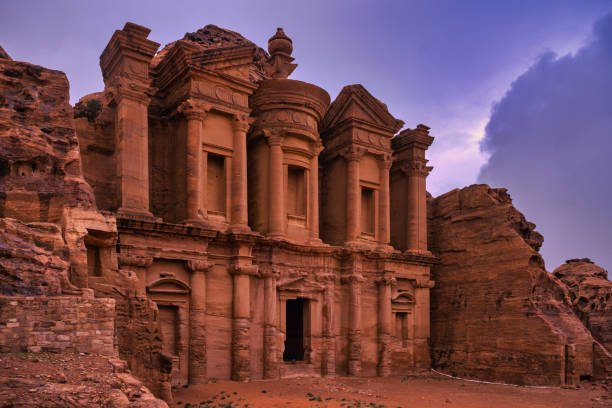
Imagine walking through a narrow canyon where towering sandstone walls rise hundreds of feet above your head. The passage twists and turns, blocking the view ahead. Then, suddenly, the canyon opens, and an enormous monument carved directly into rose-red rock appears before your eyes.
For many travelers, the first glimpse of Petra feels almost unreal.
The ancient city seems less like a human creation and more like something imagined in a dream. Its magnificent facades emerge from cliffs as though nature itself sculpted them. Temples, tombs, stairways, and entire neighborhoods are carved into mountainsides. In the midst of a harsh desert landscape stands one of the most extraordinary archaeological sites ever discovered.
Yet Petra is more than a beautiful ancient city. It is also one of history’s greatest mysteries.
Who built this remarkable place? How did they create such an advanced city in a dry desert environment? Why did they choose this remote location? And perhaps most intriguingly, why was Petra eventually abandoned, allowing one of the ancient world’s greatest cities to fade into obscurity?
For centuries, these questions have fascinated historians, archaeologists, and travelers alike. Although modern research has revealed many answers, Petra still guards some of its secrets.
Its story is one of innovation, trade, survival, wealth, and transformation. It is also a reminder that even the most impressive civilizations can rise, flourish, and eventually disappear.
The Location of Petra
Petra is located in present-day Jordan, in a rugged region of mountains and desert valleys.
At first glance, the location seems an unlikely place for a major city.
The area receives limited rainfall. Summers can be intensely hot. The landscape appears harsh and unforgiving.
Yet this seemingly isolated region occupied an important position in the ancient world.
Petra stood at the crossroads of trade routes connecting Arabia, Egypt, the Mediterranean, and Mesopotamia. Merchants carrying valuable goods passed through the region for centuries.
These routes transformed Petra into a strategic center where cultures, products, languages, and ideas met.
What appears remote today was once connected to some of the most important commercial networks in the ancient world.
The Lost City Rediscovered
Although local communities always knew of Petra’s existence, much of the outside world lost awareness of the city for centuries.
Following its decline, Petra gradually disappeared from the historical consciousness of Europe.
By the Middle Ages, stories of the city had largely faded.
Then, in 1812, a Swiss explorer named Johann Ludwig Burckhardt succeeded in reaching the site.
Disguised as a traveler interested in visiting a local shrine, Burckhardt convinced guides to take him into the hidden valley.
When he saw the magnificent ruins, he realized he had encountered one of the greatest archaeological discoveries of his era.
News of Petra spread across Europe.
Artists, scholars, and explorers became fascinated by the city.
Since then, Petra has become one of the world’s most celebrated archaeological treasures.
Who Built Petra?
The builders of Petra were the Nabataeans.
The Nabataean Kingdom emerged as a powerful civilization in the centuries before the Common Era.
Originally, the Nabataeans were Arab people who occupied regions of northwestern Arabia and southern Jordan.
For many years, outsiders viewed them as nomadic desert tribes.
Modern archaeology has revealed a far more complex reality.
The Nabataeans were highly skilled traders, engineers, architects, and political leaders.
They created a prosperous kingdom that controlled important trade routes across the Middle East.
Their ability to connect distant regions allowed them to accumulate enormous wealth.
Petra became the capital of this flourishing kingdom.
From there, Nabataean rulers managed commercial networks that stretched across vast distances.
The city became both a political center and a symbol of Nabataean power.
The Rise of the Nabataean Kingdom
The rise of the Nabataeans was closely tied to trade.
In the ancient world, luxury goods traveled long distances before reaching major markets.
Among the most valuable commodities were frankincense and myrrh.
These aromatic resins were highly prized for religious ceremonies, perfumes, medicines, and luxury products.
Caravans carried these goods from southern Arabia toward Mediterranean markets.
The Nabataeans occupied key locations along these routes.
By controlling trade corridors and providing security for merchants, they became increasingly wealthy.
Their influence expanded steadily.
As trade grew, Petra developed into a thriving urban center.
Its prosperity attracted artisans, merchants, laborers, and travelers from diverse backgrounds.
Over time, the city evolved into one of the richest settlements in the region.
Why Build a City in the Desert?
One of the greatest mysteries surrounding Petra concerns its location.
Why establish a major city in such a challenging environment?
The answer involves both geography and strategy.
The surrounding mountains provided natural protection.
Approaching armies faced difficult terrain and narrow passages.
Petra’s most famous entrance, known as the Siq, forms a narrow canyon that creates a natural defensive barrier.
Enemies could not easily launch large-scale attacks through such confined spaces.
The location also offered access to important trade routes.
Petra sat in an ideal position for monitoring commerce moving between Arabia and the Mediterranean.
Perhaps most importantly, the Nabataeans possessed extraordinary expertise in water management.
What seemed like an inhospitable desert contained hidden opportunities for those who understood how to harness them.
The Engineering Genius of Petra
Many visitors focus on Petra’s beautiful facades.
Archaeologists often focus on something even more impressive.
Water.
Without advanced water systems, Petra could never have supported a large population.
The Nabataeans developed sophisticated techniques for collecting, storing, transporting, and conserving water.
They constructed reservoirs, cisterns, channels, dams, and pipelines throughout the region.
Rainwater from seasonal storms was carefully captured and directed into storage systems.
Flash floods, which might otherwise destroy settlements, became valuable sources of water.
These innovations transformed a difficult environment into a sustainable urban landscape.
The engineering achievements of Petra rank among the most remarkable accomplishments of the ancient world.
The Siq: Gateway to Petra
The journey into Petra begins through the Siq.
This dramatic canyon stretches for more than a kilometer and winds through towering sandstone cliffs.
In some places, the walls rise over 80 meters high.
The experience is unforgettable.
Sunlight filters down from above, creating shifting patterns of light and shadow.
The rock displays shades of red, orange, pink, purple, and gold.
Ancient water channels carved into the canyon walls reveal the engineering skills of Petra’s builders.
The Siq served multiple purposes.
It acted as a protected entrance, a transportation route, and part of the city’s water management system.
For visitors arriving in ancient times, the passage would have created a powerful sense of anticipation.
That anticipation reaches its climax with Petra’s most famous monument.
The Treasury and Its Secrets
At the end of the Siq stands Petra’s most iconic structure.
Known today as the Treasury, or Al-Khazneh, the monument is one of the world’s most recognizable archaeological landmarks.
Its elaborate facade rises nearly 40 meters high.
Columns, statues, decorative carvings, and intricate architectural details emerge directly from the sandstone cliff.
The structure appears astonishingly well preserved.
For centuries, local legends claimed the monument concealed hidden treasure, giving rise to its modern name.
In reality, archaeologists believe it likely served as a royal tomb or ceremonial monument.
Many questions remain unanswered.
The identities of the individuals associated with the structure are still debated.
Its exact function continues to be studied.
The Treasury remains one of Petra’s most captivating mysteries.
A City Carved Into Mountains
The Treasury is only a small part of Petra.
Beyond it lies an extensive urban landscape.
Hundreds of tombs line the cliffs.
Temples occupy strategic locations.
Public buildings, stairways, streets, and gathering spaces spread across the valley.
The scale of the city surprises many visitors.
Petra was not merely a collection of isolated monuments.
It was a functioning metropolis.
Its residents lived, worked, traded, worshipped, and governed within this remarkable environment.
The amount of labor required to create these structures was enormous.
Workers carved directly into sandstone using simple tools and extraordinary skill.
The results remain impressive more than two thousand years later.
Nabataean Architecture
Nabataean architecture reflects a fascinating blend of cultural influences.
The kingdom occupied a crossroads connecting multiple civilizations.
As a result, architectural styles from different regions merged in unique ways.
Greek influences appear in columns and decorative elements.
Egyptian motifs can be seen in certain carvings.
Local Arabian traditions contributed distinctive features.
Rather than simply copying foreign styles, Nabataean builders adapted and transformed them.
The result was an architectural identity unlike any other.
Petra stands as a testament to cultural exchange and creative innovation.
Life in Ancient Petra
What was everyday life like in Petra?
Archaeological evidence paints a picture of a vibrant and diverse city.
Merchants arrived from distant lands carrying luxury goods.
Artisans produced pottery, jewelry, textiles, and decorative objects.
Religious ceremonies took place in temples and sacred spaces.
Markets buzzed with activity.
Government officials managed trade and taxation.
Families lived in homes scattered throughout the city and surrounding region.
The population likely included people from various ethnic and cultural backgrounds.
Petra was not isolated.
It was deeply connected to broader networks spanning much of the ancient world.
Religion and Sacred Landscapes
Religion played an important role in Nabataean society.
The landscape around Petra contains numerous temples, shrines, altars, and sacred monuments.
The Nabataeans worshipped multiple deities associated with nature, protection, fertility, and power.
Many sacred sites occupy elevated locations overlooking the surrounding terrain.
Some were carved directly into rock formations.
Others incorporated natural features into religious practices.
This connection between architecture and landscape reveals how the Nabataeans understood their environment.
The mountains surrounding Petra were not merely scenery.
They formed part of the city’s spiritual identity.
Petra and the Roman Empire
The Nabataean Kingdom eventually attracted the attention of a growing superpower.
The Roman Empire expanded steadily across the Mediterranean and Middle East.
In 106 CE, Petra became part of Roman territory.
Rather than destroying the city, the Romans integrated it into their empire.
New buildings appeared.
Roads improved.
Economic activity continued.
Roman influence became visible in architecture and urban planning.
For a time, Petra remained prosperous.
However, larger changes were already beginning to reshape the region.
The Beginning of Decline
Petra’s decline did not occur suddenly.
Instead, it unfolded gradually over centuries.
One major factor involved changing trade routes.
Economic networks constantly evolve.
New transportation corridors emerged that bypassed Petra.
As trade shifted elsewhere, the city’s commercial importance diminished.
Income declined.
Population growth slowed.
Economic activity weakened.
The very trade system that had created Petra’s prosperity began moving in different directions.
The city faced challenges that even its remarkable achievements could not overcome.
Earthquakes and Natural Disasters
Natural disasters also contributed to Petra’s decline.
The region experiences seismic activity.
Historical records indicate that powerful earthquakes struck Petra at various times.
These events damaged buildings, roads, water systems, and infrastructure.
Although residents repaired some structures, repeated destruction imposed significant costs.
A major earthquake in the fourth century caused extensive damage.
Additional earthquakes followed in later centuries.
For a city dependent on complex engineering systems, such disruptions were especially serious.
Nature gradually undermined the foundations of urban life.
Why Did People Leave Petra?
The question of why Petra was abandoned has fascinated researchers for generations.
The answer appears to involve multiple factors rather than a single dramatic event.
Declining trade reduced economic opportunities.
Earthquakes damaged infrastructure.
Political changes altered regional power structures.
New commercial centers emerged elsewhere.
As conditions changed, fewer people found reasons to remain.
Some residents likely relocated gradually.
Others adapted to smaller communities in the surrounding region.
The city was not instantly deserted.
Instead, Petra experienced a long process of transformation and decline.
Over time, its population dwindled until the once-great capital became a shadow of its former self.
Was Petra Ever Completely Lost?
One popular misconception is that Petra vanished entirely from human knowledge.
The reality is more nuanced.
While the city faded from broader international awareness, local communities continued to know about the site.
Bedouin groups maintained connections to the region for generations.
Knowledge of the ruins never disappeared completely.
What vanished was Petra’s prominence within global historical memory.
Outside the region, the city gradually became forgotten.
Its rediscovery by European explorers reflected not the discovery of an unknown place but the reintroduction of a remarkable site to the wider world.
Modern Archaeology Reveals New Secrets
Archaeological research continues to transform understanding of Petra.
Excavations have uncovered new structures, inscriptions, and artifacts.
Remote sensing technologies reveal features hidden beneath the surface.
Satellite imagery provides insights into the broader landscape.
Researchers continue investigating residential areas, ceremonial spaces, water systems, and trade networks.
Each discovery adds another piece to the puzzle.
Far from being fully understood, Petra remains an active field of research.
Many mysteries remain unsolved.
The Hidden Monuments
One of the most exciting aspects of Petra is the possibility that significant discoveries still await.
The visible monuments represent only part of the ancient city.
Large areas remain unexplored.
Buried structures may lie beneath sediments.
Unexcavated tombs may contain valuable information.
Advanced technologies allow archaeologists to identify potential sites without extensive digging.
These methods have already revealed previously unknown features.
Future discoveries may reshape understanding of Petra’s history and development.
Petra as a Symbol of Human Creativity
Petra’s significance extends beyond archaeology.
The city demonstrates what human ingenuity can achieve under challenging conditions.
Its builders transformed a desert landscape into a thriving urban center.
They mastered water management in an arid environment.
They integrated architecture with natural geology in ways that continue to inspire admiration.
The city reflects creativity, resilience, and adaptability.
Even after centuries of abandonment, its monuments retain extraordinary power.
Visitors often leave Petra with a sense of wonder difficult to describe.
The city speaks across time.
Petra in Popular Culture
Modern audiences often encounter Petra through books, documentaries, photographs, and films.
Its dramatic appearance makes it one of the most visually striking archaeological sites on Earth.
The city’s hidden setting contributes to its mystique.
Stories of lost cities have always fascinated people.
Petra embodies many of the qualities that make such stories compelling.
It is beautiful, mysterious, ancient, and partially understood.
Its combination of historical reality and lingering mystery ensures continuing public fascination.
What Petra Teaches Us About Civilization
The story of Petra offers important lessons about the rise and fall of civilizations.
Success often depends on adapting to changing circumstances.
The Nabataeans prospered because they mastered trade and environmental challenges.
When larger economic and political systems changed, their city faced new pressures.
No civilization exists in isolation.
Cities depend on networks of commerce, resources, infrastructure, and social stability.
Petra’s history illustrates both the possibilities and vulnerabilities of human achievement.
Its monuments remind us that greatness can be temporary.
Yet they also demonstrate that cultural achievements can outlast the societies that created them.
The Enduring Mystery of Petra
Despite centuries of study, Petra still holds unanswered questions.
Researchers continue debating aspects of Nabataean society, religion, governance, and urban planning.
The precise functions of certain monuments remain uncertain.
Many inscriptions have yet to reveal all their secrets.
New discoveries frequently challenge previous assumptions.
This ongoing mystery contributes to Petra’s appeal.
The city is not merely a relic of the past.
It is an active historical puzzle.
Each generation brings new methods, new questions, and new perspectives.
Conclusion
Petra is one of humanity’s most extraordinary creations. Hidden among the sandstone mountains of Jordan, it stands as a monument to the ingenuity, ambition, and resilience of the Nabataean people. Far from being simple desert nomads, the Nabataeans built a sophisticated kingdom that transformed trade, mastered water engineering, and created an urban landscape unlike any other in the ancient world.
The mystery of Petra revolves around two central questions: who built it and why they left. Archaeology has largely answered the first question. The city was the achievement of the Nabataeans, a remarkable civilization that flourished through trade and innovation. The second question is more complex. Petra’s decline resulted from changing trade routes, economic shifts, earthquakes, and broader political transformations. Rather than a sudden disappearance, the city experienced a gradual fading over centuries.
Yet even with these answers, Petra retains its sense of wonder. Its towering monuments, hidden canyons, sacred spaces, and unfinished mysteries continue to captivate the imagination. More than two thousand years after its greatest period of prosperity, the rose-red city still inspires awe.
Petra reminds us that civilizations can rise from unlikely places, achieve extraordinary things, and leave lasting marks on history. It also reminds us that beneath every ancient stone lies a human story—one of dreams, labor, survival, and change. That story is what makes Petra not only an archaeological treasure but one of the most fascinating mysteries of the ancient world.