Few archaeological discoveries are as fascinating as an object that refuses to explain itself.
Most ancient artifacts tell at least part of their story. A sword reveals its purpose through its blade. A coin carries the image of an emperor. A cooking pot bears the marks of fire and food preparation. Even when details are missing, archaeologists can often make educated conclusions about how an object was used and why it was made.
But every so often, history leaves behind something that seems determined to keep its secrets.
The Roman dodecahedron is one of those objects.
For more than two centuries, archaeologists, historians, engineers, and amateur researchers have puzzled over these strange bronze artifacts. More than a hundred examples have been discovered across Europe, yet no one can say with certainty why they were made. No ancient Roman text describes them. No surviving artwork clearly depicts them in use. No inscription explains their purpose.
The objects themselves seem almost designed to provoke curiosity.
They are beautifully crafted, geometrically precise, and surprisingly consistent in design. Yet despite decades of study and countless theories, their true function remains unknown.
The Roman dodecahedron is not simply an archaeological puzzle. It is a reminder that even one of the best-documented civilizations in history still holds mysteries that continue to challenge modern understanding.
A Strange Object Emerges from the Ground
Imagine standing in a field in northern France, Germany, or Britain. Workers are digging foundations, farmers are plowing land, or archaeologists are carefully excavating an ancient Roman site.
Suddenly, a small bronze object emerges from the soil.
At first glance, it looks almost modern.
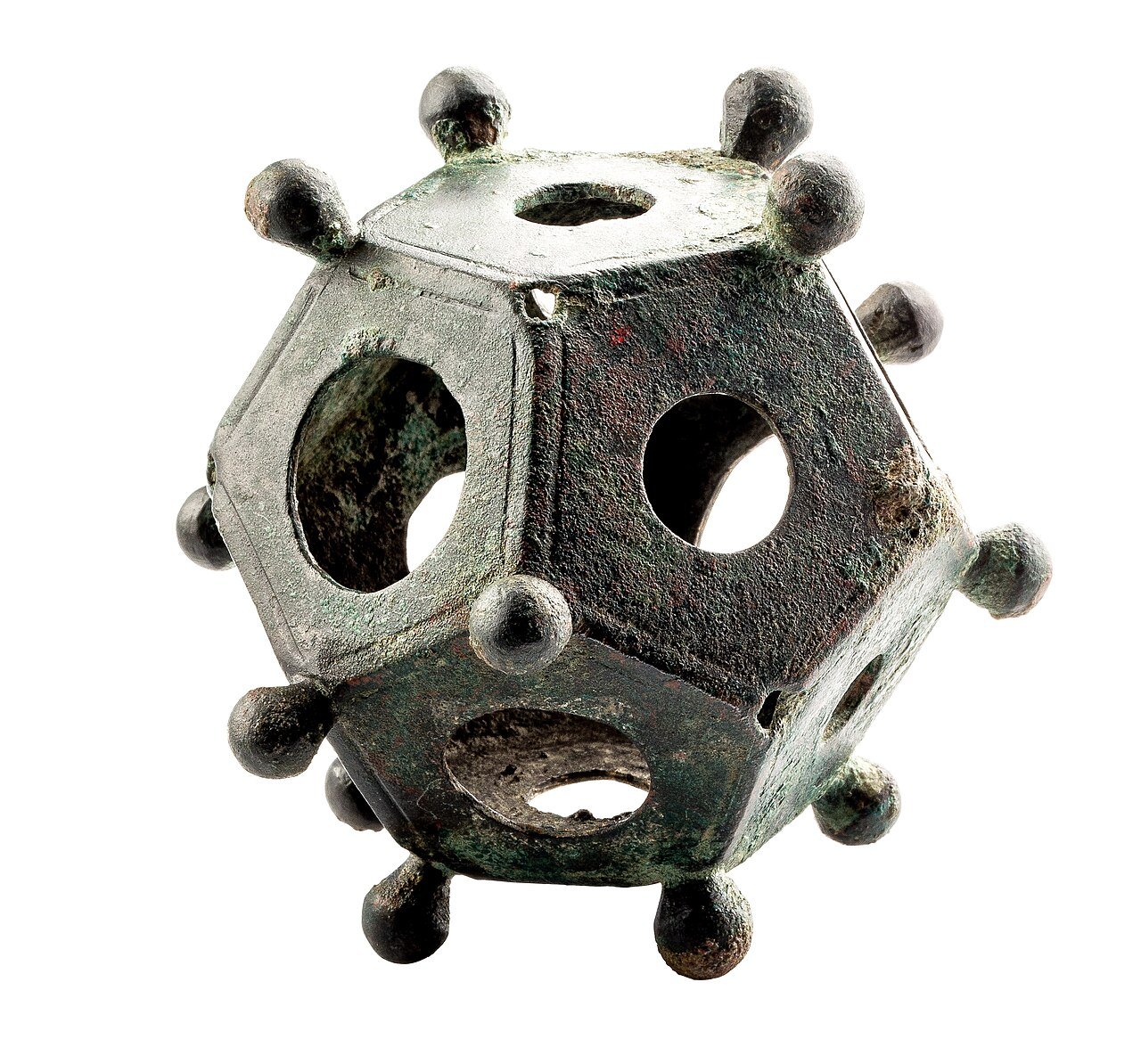
It resembles a hollow geometric ball with twelve flat pentagonal faces. Each face contains a circular hole. The holes vary in size from one face to another. At each corner sits a rounded knob, creating a curious appearance unlike anything commonly associated with ancient Rome.
The object is neither large nor heavy. Most examples measure between four and eleven centimeters in diameter. They fit comfortably in a person’s hand.
Yet the moment researchers examine one closely, questions begin to multiply.
Why does it have twelve faces?
Why are the holes different sizes?
Why are there knobs at every corner?
Why was so much effort invested in making such a peculiar object?
And most importantly, what was it actually used for?
Those questions have haunted archaeology for more than 250 years.
The Discovery of Roman Dodecahedrons
The first known Roman dodecahedron was discovered in the eighteenth century.
Since then, more than 120 examples have been found throughout parts of the former Roman Empire.
Their distribution is one of the first clues—and one of the first mysteries.
Nearly all known examples have been found in regions that once formed the northwestern frontier of Roman territory. Discoveries have occurred in modern-day France, Germany, Belgium, Luxembourg, the Netherlands, Switzerland, Austria, and the United Kingdom.
Curiously, they are absent from many other regions of the empire.
Ancient Rome controlled vast territories stretching from Spain to the Middle East and from North Africa to Britain. Yet Roman dodecahedrons appear concentrated in a relatively limited geographic area.
This unusual distribution immediately raises questions.
If they were common household tools, why are they not found throughout the empire?
If they had military significance, why do they appear only in certain regions?
If they served a religious purpose, why is there no clear evidence of their role in Roman worship elsewhere?
The geographic pattern suggests that whatever purpose they served may have been connected to local customs, frontier life, or specialized activities.
But that is only the beginning of the mystery.
What Exactly Is a Roman Dodecahedron?
To understand the puzzle, it helps to examine the object itself.
A dodecahedron is a three-dimensional geometric shape composed of twelve pentagonal faces.
The Roman versions are usually cast from bronze, though a few examples made from stone have also been discovered.
Each face contains a circular opening.
The openings differ in diameter, often significantly. One hole might be only a few millimeters across, while another may be much larger.
The corners where the faces meet are topped with small rounded projections, sometimes called knobs or balls.
The objects are hollow inside.
Many are remarkably well crafted, suggesting skilled metalworking techniques and considerable effort during production.
The precision of their construction is striking.
These were not crude tools quickly assembled for practical use. They were carefully manufactured objects requiring time, expertise, and valuable materials.
This level of craftsmanship suggests that they possessed some importance to the people who created them.
Yet importance does not necessarily reveal purpose.
An object can be valuable, symbolic, practical, ceremonial, or all of these at once.
Without written evidence, archaeologists must rely heavily on clues from the artifacts themselves.
Unfortunately, Roman dodecahedrons offer clues that are both intriguing and frustrating.
The Silence of Roman Records
One reason the mystery remains unsolved is the complete absence of clear written references.
The Romans were prolific record keepers.
They wrote about government, military campaigns, engineering projects, agriculture, architecture, religion, trade, medicine, and daily life.
Thousands of texts survive from the Roman world.
If Roman dodecahedrons served an important empire-wide function, one might expect at least a passing mention in surviving literature.
Yet no known Roman author clearly describes them.
No instruction manual exists.
No military handbook explains their use.
No merchant’s record identifies them.
No surviving letter mentions owning one.
No artwork unmistakably shows a person using one.
This silence is extraordinary.
Archaeologists often solve mysteries by connecting physical evidence with written sources. In the case of Roman dodecahedrons, that bridge appears to be missing.
The result is a rare situation in which an object survives but its meaning does not.
The Archaeological Context
When archaeologists discover artifacts, context is often as important as the object itself.
Where was it found?
What other items were nearby?
Was it buried intentionally?
Was it inside a house, a military fort, or a temple?
Roman dodecahedrons have appeared in a wide variety of contexts.
Some have been found in settlements.
Others have emerged from military sites.
A number have been recovered from areas associated with wealth or high status.
Several were discovered alongside coins or valuable possessions.
In some cases, they seem to have been deliberately deposited rather than accidentally lost.
Unfortunately, the contexts are not consistent enough to provide a definitive answer.
If every dodecahedron had been found inside temples, a religious interpretation would seem likely.
If all were recovered from military camps, a military function would gain support.
Instead, the evidence points in multiple directions at once.
This ambiguity has fueled endless debate.
The Theory of a Measuring Device
Among the most popular explanations is the idea that Roman dodecahedrons functioned as measuring instruments.
This theory emerged because of the varying hole sizes.
Researchers noticed that looking through aligned holes creates specific viewing angles.
Some suggested that users could estimate distances to objects of known size.
Imagine a soldier observing an enemy formation.
By looking through particular openings and comparing what is seen, it might be possible to calculate range.
Such methods are not entirely implausible. Distance-measuring devices have existed in various forms throughout history.
Supporters of this theory argue that the geometric design and carefully varied holes indicate intentional measurement functions.
Experimental archaeologists have even demonstrated ways the objects could theoretically be used for estimating distances.
Yet significant problems remain.
No two dodecahedrons are exactly alike.
If they were standardized measuring tools, greater consistency might be expected.
Additionally, no surviving Roman military text describes such an instrument.
While the measuring-device theory remains attractive, it is far from proven.
The Military Rangefinder Hypothesis
Closely related is the military rangefinder theory.
The Roman army was among the most sophisticated military forces of the ancient world.
Accurate distance estimation could have provided advantages in warfare.
Some researchers propose that dodecahedrons helped determine the effective range of projectiles such as arrows, javelins, or artillery.
The varying hole diameters might have allowed soldiers to estimate distances under different conditions.
At first glance, the idea seems reasonable.
The concentration of finds near frontier regions appears compatible with military activity.
Roman forts existed throughout many of the areas where dodecahedrons have been discovered.
However, critics point out several weaknesses.
The objects are relatively rare compared with the scale of the Roman military.
If they were essential equipment, far more examples might be expected.
Furthermore, there is no direct evidence linking them specifically to military operations.
The theory remains possible, but not universally accepted.
The Candle Holder Theory
One of the most visually appealing explanations involves candles.
Some researchers have suggested that dodecahedrons functioned as candle holders.
Experiments have shown that candles can indeed be inserted into the holes.
When lit, light shines through the openings, producing attractive patterns.
The knobs may help stabilize the object on different surfaces.
Modern recreations can create beautiful displays.
For many people, the theory feels satisfying because it demonstrates a practical use.
Yet archaeologists remain cautious.
Just because an object can hold a candle does not mean that was its original purpose.
Very few ancient examples contain clear traces of wax.
Moreover, creating such an elaborate bronze structure simply to hold a candle may seem unnecessarily complex.
The candle-holder theory is intriguing but lacks decisive evidence.
A Religious or Ritual Object?
Religion permeated Roman life.
Temples, shrines, rituals, offerings, and sacred ceremonies formed a major part of everyday existence.
For this reason, many scholars have proposed a religious interpretation.
Perhaps dodecahedrons were ceremonial objects used in rituals now lost to history.
Their geometric form may have carried symbolic meaning.
The number twelve itself held significance in many ancient traditions.
There were twelve months in the year, twelve zodiac signs, and numerous religious associations connected to the number.
The careful craftsmanship of the objects could indicate ceremonial importance.
Some discoveries in apparently significant locations have strengthened this possibility.
Yet the evidence remains indirect.
No inscription identifies a sacred function.
No temple artwork depicts them.
No religious text explains their role.
As with many theories surrounding Roman dodecahedrons, the idea is plausible but unproven.
The Astronomical Instrument Theory
Another fascinating proposal links the objects to astronomy.
The Romans inherited sophisticated astronomical knowledge from earlier civilizations.
Astronomy played important roles in navigation, agriculture, and calendar systems.
Some researchers have suggested that dodecahedrons may have helped determine important seasonal dates.
By aligning holes and observing sunlight, users might identify specific positions of the Sun during the year.
This could potentially assist agricultural planning.
The geometric structure certainly invites such speculation.
Ancient cultures often created devices for tracking celestial movements.
However, critics note that no consistent design standards exist among known dodecahedrons.
Astronomical instruments generally require precision and standardization.
The variability among examples weakens this interpretation.
Still, the theory remains part of the ongoing debate.
A Tool for Knitting Gloves?
One of the most unusual explanations emerged relatively recently.
Some enthusiasts proposed that Roman dodecahedrons served as knitting tools.
Specifically, they suggested that the objects could help create knitted gloves.
By wrapping yarn around the structure and using different hole sizes, crafters can indeed produce finger-like tubes.
Experimental demonstrations have shown that glove-making with replica dodecahedrons is possible.
The idea gained public attention because it provided a practical explanation for the varying hole diameters.
Yet most professional archaeologists remain skeptical.
There is no direct evidence linking dodecahedrons to textile production.
Roman knitting itself is not well documented compared with later periods.
While the theory is imaginative and technically feasible, it lacks archaeological support.
The Possibility of Multiple Functions
One challenge in solving the mystery is the assumption that there must be a single answer.
What if there wasn’t?
Modern objects often serve multiple purposes.
A smartphone functions as a telephone, camera, navigation device, calculator, entertainment system, and communication platform.
Ancient objects could also have varied uses.
Perhaps Roman dodecahedrons began as one type of object but acquired additional functions over time.
Different communities may have used them differently.
Some may have possessed symbolic value while others served practical purposes.
The diversity of archaeological contexts might support such complexity.
Human behavior rarely fits into neat categories.
The search for one universal explanation may itself be part of the problem.
Why the Mystery Endures
Many ancient puzzles are eventually solved through new discoveries.
An inscription appears.
A forgotten manuscript is found.
A new excavation uncovers critical evidence.
Yet Roman dodecahedrons continue to resist explanation.
Part of the reason lies in the nature of archaeology itself.
Archaeology rarely provides complete information.
Objects survive while stories disappear.
Materials decay.
Records are lost.
Entire traditions vanish without leaving clear traces.
Roman dodecahedrons occupy a particularly difficult position because they exist in a gap between evidence and interpretation.
We have the objects.
We lack the instructions.
That combination creates fertile ground for debate but makes certainty elusive.
What the Dodecahedrons Reveal About the Roman World
Even if their precise function remains unknown, Roman dodecahedrons still teach us valuable lessons.
They demonstrate the skill of Roman metalworkers.
Creating such complex geometric forms required technical expertise.
The objects reveal networks of trade and craftsmanship extending across frontier regions.
They remind us that Roman society was more diverse than often imagined.
The empire was not a single uniform culture. It encompassed countless local traditions, languages, and customs.
The concentration of dodecahedrons in northwestern Europe may hint at regional practices that left few written records.
The artifacts also highlight the limitations of historical knowledge.
People sometimes assume that scholars know everything important about ancient Rome.
In reality, many questions remain unanswered.
The dodecahedrons are proof that even famous civilizations still contain mysteries.
Modern Experiments and Ongoing Research
Researchers continue to investigate Roman dodecahedrons using modern techniques.
Three-dimensional scanning allows detailed comparisons between artifacts.
Computer modeling helps test hypotheses involving measurement, optics, and astronomy.
Experimental archaeology enables researchers to create replicas and explore potential uses.
Each experiment contributes valuable information.
Some theories become less likely.
Others gain credibility.
Yet no explanation has achieved broad consensus.
The mystery remains alive precisely because evidence can support multiple interpretations without conclusively proving any of them.
This ongoing uncertainty keeps interest high among both scholars and the public.
The Human Attraction to Unsolved Mysteries
Part of the fascination surrounding Roman dodecahedrons comes from human psychology.
People love mysteries.
We are naturally drawn to unanswered questions.
A solved puzzle becomes history.
An unsolved puzzle becomes a story.
The dodecahedrons occupy a rare position where scientific investigation and imagination meet.
They invite us to think like detectives.
Every observer sees possibilities.
Every theory offers a glimpse into how ancient people might have lived.
The mystery becomes a conversation across centuries between modern curiosity and ancient silence.
Could the Answer Be Surprisingly Simple?
One possibility deserves consideration.
What if the true function is far less dramatic than many theories suggest?
History contains numerous examples of objects that seemed mysterious until a mundane explanation emerged.
An artifact may appear enigmatic simply because the cultural context has disappeared.
Perhaps Roman dodecahedrons were specialized tools used in a profession that left few records.
Perhaps they served a local custom unknown elsewhere.
Perhaps they belonged to a tradition that vanished entirely.
The ultimate answer may not involve secret rituals, advanced instruments, or hidden knowledge.
It may be something surprisingly ordinary.
Yet until evidence emerges, even the simplest explanation remains speculation.
The Future of the Mystery
Every new discovery has the potential to change the conversation.
A dodecahedron found in an undisturbed archaeological context could provide critical clues.
An overlooked ancient text might contain a forgotten reference.
Advances in scientific analysis may reveal traces of materials previously undetectable.
Future archaeologists may eventually uncover the evidence needed to solve the puzzle.
Or they may not.
Some historical mysteries endure for centuries because key information has been permanently lost.
The Roman dodecahedrons may belong to that category.
If so, they will continue challenging generations of researchers.
Conclusion
The Roman dodecahedrons stand among the most intriguing unsolved mysteries of the ancient world. These small bronze objects, with their twelve pentagonal faces, varying holes, and distinctive corner knobs, have puzzled researchers since their discovery. More than a hundred examples have been found across northwestern Europe, yet no surviving Roman text clearly explains their purpose.
Over the years, scholars have proposed countless theories. They may have been measuring devices, military rangefinders, astronomical instruments, candle holders, ritual objects, textile tools, or something entirely different. Each theory explains certain features while leaving others unresolved.
What makes the mystery so compelling is not merely the absence of an answer. It is the realization that even after centuries of study, one of history’s greatest civilizations can still surprise us. The Romans built roads, aqueducts, cities, and monuments that continue to shape the modern world. Yet a small bronze object that fits in the palm of a hand remains stubbornly unexplained.
The Roman dodecahedrons remind us that history is never completely known. Beneath fields, forests, and forgotten ruins, pieces of the past still wait to be discovered. Some reveal their stories immediately. Others guard their secrets for centuries.
And among those enduring secrets, few are as captivating as the mystery of the Roman dodecahedrons—a puzzle from antiquity whose true function remains unknown.