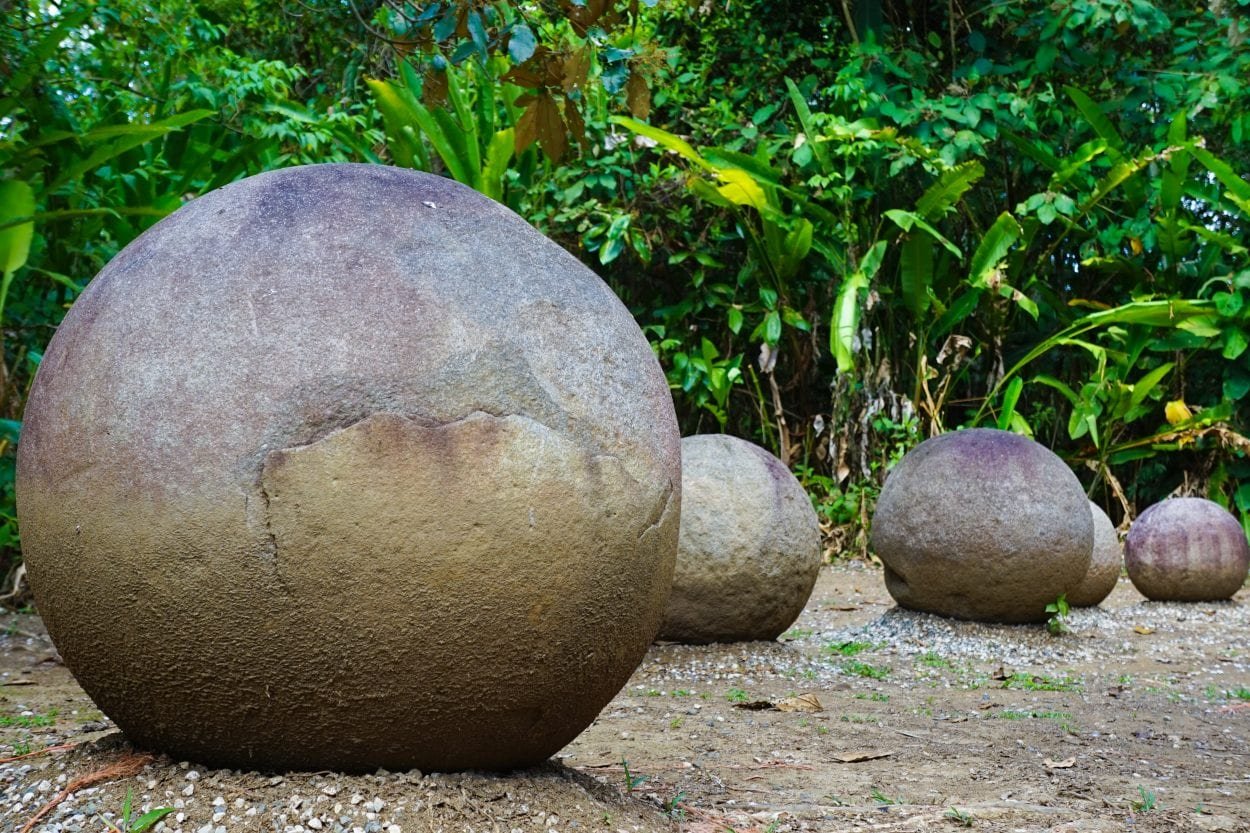
Deep within the lush tropical landscapes of southern Costa Rica lies one of archaeology’s most intriguing mysteries. Scattered across valleys, forests, plantations, and ancient settlement sites are hundreds of nearly perfect stone spheres. Some are small enough to fit in a person’s hands, while others weigh several tons and stand taller than an adult. Their smooth surfaces and remarkable symmetry immediately capture attention. At first glance, they almost seem artificial in a way that feels impossible for ancient societies without modern machinery.
For decades, these mysterious objects have inspired wonder, speculation, and endless questions. Who made them? How were they created with such precision? Why did people spend enormous amounts of time and labor shaping massive stones into perfect spheres? Were they symbols of power, markers of sacred places, astronomical tools, or something entirely different?
The mystery becomes even more fascinating because the people who created them left behind no written records explaining their purpose. The civilizations that once flourished in the region disappeared long before Europeans arrived, taking many of their secrets with them.
Today, the stone spheres of Costa Rica stand as silent witnesses to a forgotten world. They are among the most impressive archaeological achievements in the Americas and remain one of humanity’s most captivating ancient puzzles.
The Discovery That Surprised the Modern World
Although local communities had known about some of the stone spheres for generations, the wider world became aware of them only in the twentieth century.
In the 1930s, workers clearing land for banana plantations in Costa Rica’s Diquís Delta began uncovering large stone spheres hidden beneath dense vegetation and layers of soil. The region was undergoing rapid agricultural development, and vast areas of rainforest were being cut down.
As trees disappeared, strange round stones emerged from the landscape.
The workers were astonished. Some of the spheres appeared almost perfectly round. Others were arranged in patterns that seemed intentional. Their unusual appearance immediately sparked curiosity.
Rumors quickly spread throughout the region. Some people believed the spheres concealed treasure. Stories circulated claiming that gold was hidden inside them. As a result, several spheres were damaged or destroyed when people attempted to break them open.
Unfortunately, these efforts revealed nothing. The spheres were solid stone.
Yet the treasure hunters had unintentionally made the mystery even deeper. If the spheres contained no riches, why had ancient people created them in the first place?
The Land of the Stone Spheres
Most of the famous stone spheres are found in the Diquís Delta, a fertile region in southern Costa Rica near the Pacific coast.
Today, the area is known for its rivers, wetlands, forests, and agricultural lands. Thousands of years ago, however, it was home to thriving Indigenous societies that developed complex settlements and extensive trade networks.
The environment played an important role in shaping human life. Rich soils supported agriculture, while rivers provided transportation routes connecting communities across the landscape.
The stone spheres were often discovered near ancient villages, ceremonial centers, burial sites, and plazas. This association suggests that they were deeply connected to the social and cultural life of the people who lived there.
The region itself was not isolated. Archaeological evidence indicates that local communities maintained connections with neighboring areas throughout Central America. Goods, ideas, and traditions flowed across considerable distances.
The people who created the spheres were part of a sophisticated world that existed long before European colonization.
How Many Stone Spheres Exist?
The exact number of stone spheres remains uncertain.
Archaeologists have documented more than 300 examples, but additional spheres may remain undiscovered. Some have been relocated from their original positions. Others were destroyed during agricultural development or construction projects.
The smallest spheres measure only a few centimeters across. The largest reach more than two meters in diameter and can weigh over fifteen tons.
What makes them extraordinary is not merely their size but their precision.
Many are astonishingly round. Creating such symmetry without modern measuring instruments would have required exceptional skill and patience.
The existence of hundreds of spheres indicates that this was not an isolated experiment. It was a long-standing cultural tradition practiced over generations.
Who Built the Stone Spheres?
Modern archaeological evidence points to the Indigenous peoples of the Diquís culture as the creators of the stone spheres.
The Diquís culture flourished in southern Costa Rica between approximately 500 and 1500 CE, although some spheres may have origins extending further back in time.
These communities developed organized settlements, sophisticated craftsmanship, and extensive social networks. They worked with stone, gold, ceramics, and other materials, demonstrating considerable technical expertise.
For many years, some writers proposed more exotic explanations for the spheres. Speculations involved lost civilizations, mysterious visitors, or forgotten advanced technologies.
However, archaeological research has found no evidence supporting such claims.
Everything discovered so far indicates that the spheres were the work of Indigenous peoples who possessed remarkable engineering and artistic abilities.
Their achievement becomes even more impressive when we recognize that they accomplished it using the resources available to them.
The spheres are not evidence of outsiders. They are evidence of human ingenuity.
The Materials Used to Create the Spheres
Most of the stone spheres were carved from a hard igneous rock known as gabbro.
Gabbro is a dense and durable material formed deep beneath Earth’s surface as molten rock slowly cooled.
Some spheres were also made from limestone and sandstone, but gabbro appears to have been the preferred material for many of the largest examples.
The choice of stone was significant.
Hard rock is difficult to shape, especially without metal tools.
Creating a nearly perfect sphere from such material would have required enormous labor and expertise.
The artisans likely selected large boulders and carefully transformed them over extended periods.
Every sphere represented a substantial investment of time and energy.
How Were the Spheres Made?
One of the most fascinating questions concerns the manufacturing process itself.
How could ancient craftspeople create such remarkably round objects?
Although no written instructions survive, archaeologists have developed reasonable explanations based on available evidence.
The process probably began with selecting a suitable stone boulder.
Workers then used hammerstones made from harder rock to remove large portions of material.
Gradually, the rough shape became more spherical.
Heating and cooling techniques may also have been employed. By exposing sections of stone to fire and then rapidly cooling them with water, craftspeople could create fractures that made shaping easier.
Once the basic form emerged, finer work began.
Repeated grinding, pecking, and polishing slowly improved the sphere’s symmetry and smoothness.
This process would have required extraordinary patience.
Rather than being completed quickly, some of the largest spheres may have taken months or even years to finish.
The final result demonstrates a level of craftsmanship that continues to impress modern observers.
The Challenge of Transportation
Creating the spheres was only part of the challenge.
Many of them had to be moved considerable distances.
Some source quarries were located kilometers away from the sites where spheres were eventually placed.
Transporting stones weighing several tons without wheels, trucks, or cranes was a monumental undertaking.
Researchers believe that large groups of people likely worked together to move the spheres using ropes, wooden rollers, sledges, and carefully prepared routes.
River transport may also have played a role in some cases.
The effort required suggests that the spheres held great importance. Societies do not mobilize large numbers of workers for projects they consider trivial.
The transportation process itself may even have carried ceremonial or social significance.
The Remarkable Precision of the Spheres
Perhaps the most striking feature of the stone spheres is their geometric accuracy.
Many appear astonishingly close to perfect spheres.
This raises an obvious question.
How did ancient people achieve such precision without modern instruments?
The answer likely lies in careful observation and repeated refinement.
Humans possess a natural ability to recognize symmetry. Skilled artisans can detect subtle irregularities through sight and touch.
By continuously rotating, measuring, and reshaping the stone, craftspeople could gradually improve its form.
The achievement reflects not only technical skill but also a cultural appreciation for symmetry and perfection.
The creators clearly valued geometric beauty.
The spheres were not rough practical objects.
They were deliberate works of craftsmanship.
The Social World Behind the Spheres
To understand why the spheres were created, it helps to imagine the society that produced them.
The Diquís region contained settlements of varying sizes, suggesting social organization and political leadership.
Archaeological evidence indicates the existence of chiefs or elite individuals who exercised authority within their communities.
Large public works often reflect social cooperation and leadership structures.
The creation of massive stone spheres would have required planning, coordination, and labor management.
This implies that the societies responsible were capable of organizing substantial collective efforts.
The spheres may therefore provide clues about power, identity, and social relationships.
They were not merely stones.
They were products of a complex human community.
Were the Spheres Symbols of Power?
One of the leading interpretations is that the spheres functioned as symbols of status and authority.
Many were found near important buildings or prominent locations within settlements.
Their visibility would have made them powerful markers of prestige.
Imagine approaching an ancient community and seeing enormous perfectly crafted stone spheres displayed near the residences of leaders.
The message would have been unmistakable.
These were communities capable of mobilizing labor, demonstrating skill, and creating impressive monuments.
The spheres may have communicated wealth, influence, and legitimacy.
Much like monumental architecture elsewhere in the world, they could have reinforced social hierarchies and political authority.
The Possibility of Religious Meaning
Another possibility is that the spheres held spiritual or religious significance.
Many ancient cultures viewed circles and spheres as symbols of cosmic order, eternity, balance, or perfection.
The shape itself may have carried sacred meaning.
Some archaeological sites suggest that spheres were placed in ceremonial areas.
If so, they may have played roles in rituals, religious gatherings, or sacred performances.
Unfortunately, the absence of written records makes certainty impossible.
We can observe patterns and contexts, but the beliefs of the people themselves remain largely hidden.
Yet it would not be surprising if such extraordinary objects possessed symbolic importance beyond practical considerations.
Human societies frequently invest sacred meaning in remarkable creations.
Could They Have Been Astronomical Markers?
Some researchers have proposed astronomical interpretations.
According to this idea, certain sphere arrangements may have aligned with celestial events or important directions.
Ancient cultures around the world often observed the movements of the Sun, Moon, and stars.
Astronomical knowledge played important roles in agriculture, navigation, ritual life, and calendar systems.
A few sphere groupings appear to have been arranged deliberately.
However, evidence for precise astronomical functions remains limited.
While some alignments may be meaningful, others could be coincidental.
Most archaeologists remain cautious about assigning specific astronomical purposes without stronger supporting evidence.
Still, the possibility remains intriguing.
The sky has inspired monument building throughout human history.
The Mystery of the Arrangements
One of the most interesting aspects of the spheres is that some were discovered in organized patterns.
Certain sites contained lines, triangles, rectangles, or other arrangements.
These patterns suggest intentional placement rather than random distribution.
Unfortunately, many original arrangements were disturbed before archaeologists could document them properly.
Agricultural development, treasure hunting, and relocation efforts altered numerous sites.
As a result, valuable information was lost.
Even so, surviving evidence indicates that placement mattered.
The location of a sphere was often as important as the sphere itself.
This suggests that meaning may have emerged through spatial relationships and site design.
Why Were Some Spheres Moved?
Over time, many stone spheres were removed from their original locations.
Some were transported to government buildings, parks, museums, private gardens, and public spaces.
People admired their beauty and wanted them displayed prominently.
While this helped increase public awareness, it also created challenges for archaeologists.
When a sphere is removed from its original context, important clues disappear.
Archaeology relies heavily on location.
The position of an artifact can reveal information about its purpose, age, and cultural significance.
Moving a sphere may preserve the object itself while erasing part of its story.
This loss has complicated efforts to fully understand the ancient landscapes in which the spheres once existed.
The Arrival of Europeans and Cultural Change
The societies that created the stone spheres underwent profound transformations following European contact.
Disease, conflict, displacement, and colonial policies dramatically altered Indigenous life throughout the Americas.
Many traditional practices disappeared.
Communities were fragmented.
Knowledge that had been passed down through generations was interrupted.
As a result, the original meanings of the spheres may have been lost long before modern archaeology began studying them.
This historical tragedy helps explain why so many questions remain unanswered.
The creators left no surviving written explanations.
The voices that once understood the spheres firsthand largely vanished from the historical record.
The Rise of Fantastic Theories
Whenever a mystery lacks complete answers, imagination rushes in to fill the gaps.
The stone spheres have inspired countless unusual theories.
Some people have claimed they were created by Atlantis.
Others have suggested extraterrestrial involvement.
Various pseudoscientific explanations continue to circulate online and in popular media.
These ideas often emerge because the spheres seem so impressive.
People underestimate the capabilities of ancient societies and assume extraordinary achievements require extraordinary explanations.
Yet archaeology consistently demonstrates that human beings are capable of remarkable accomplishments.
No evidence supports alien intervention or lost super-civilizations.
The spheres are best understood as products of Indigenous ingenuity, creativity, and determination.
The real story is already extraordinary.
Scientific Research Continues
Modern archaeologists continue investigating the spheres using increasingly sophisticated methods.
Excavations, mapping technologies, geological analyses, and spatial studies provide new insights into their origins and functions.
Researchers examine tool marks, quarry sites, settlement patterns, and environmental evidence.
Every new discovery helps refine our understanding.
Although many questions remain, the picture has become clearer over time.
The spheres were not isolated curiosities.
They were integrated into broader cultural systems involving settlement organization, social identity, political authority, and symbolic expression.
The mystery is gradually yielding its secrets, even if some aspects remain elusive.
UNESCO Recognition
In 2014, the stone spheres gained international recognition when the archaeological sites containing them were designated a UNESCO World Heritage Site.
This designation acknowledged their exceptional cultural importance.
The recognition also highlighted the achievements of the Indigenous peoples who created them.
For many years, discussions about the spheres focused primarily on mystery.
UNESCO’s recognition helped shift attention toward the human communities behind the artifacts.
The spheres are not merely puzzles.
They are evidence of a rich cultural heritage deserving respect and preservation.
Their inclusion on the World Heritage List ensures greater protection for future generations.
What Makes the Spheres So Special?
Many ancient civilizations created monuments.
Many carved stone sculptures.
Many built impressive structures.
Yet the Costa Rican spheres remain unique.
Their combination of size, precision, quantity, and mystery is unmatched.
No other known archaeological tradition produced hundreds of nearly perfect stone spheres on this scale.
Their elegance is striking.
A sphere is one of the simplest geometric forms, yet achieving perfection is extraordinarily difficult.
The creators pursued a level of craftsmanship that continues to command admiration centuries later.
Their work demonstrates not only technical skill but also artistic vision.
Hidden Messages from the Past
The stone spheres can be viewed as messages from a vanished world.
Although we cannot read those messages completely, fragments remain visible.
They tell us that ancient Costa Rican societies possessed organizational abilities, engineering knowledge, artistic talent, and cultural sophistication.
They reveal that people invested tremendous effort into projects whose significance extended beyond immediate practical needs.
The spheres remind us that human creativity is universal.
Complex achievements are not limited to famous civilizations.
Remarkable accomplishments emerged in many places throughout history.
The Diquís culture deserves recognition among the great builders of the ancient world.
The Enduring Mystery
Despite decades of research, the ultimate purpose of the spheres remains uncertain.
Perhaps they served multiple functions.
They may have symbolized authority, marked sacred spaces, reflected cosmological beliefs, and reinforced social identity simultaneously.
Human creations often carry layered meanings.
A monument does not need a single purpose.
The spheres may have evolved over time as different generations interpreted them in new ways.
This complexity is part of what makes the mystery so compelling.
Every answer seems to open additional questions.
Conclusion
The stone spheres of Costa Rica are among the most extraordinary archaeological treasures in the Americas. Created by the Indigenous peoples of the Diquís region, these remarkable objects demonstrate a level of craftsmanship, organization, and cultural sophistication that continues to inspire admiration today.
Archaeological evidence shows that the spheres were carefully carved from hard stone, transported across challenging landscapes, and placed in meaningful locations. Their creators invested immense effort in producing forms of astonishing precision. Yet the exact reasons for that effort remain uncertain.
They may have been symbols of power, markers of sacred spaces, expressions of religious beliefs, or representations of social identity. They may have served several purposes at once. The absence of written records means that some aspects of their meaning may never be fully recovered.
What is certain is that the stone spheres are not relics of fantasy, lost super-civilizations, or extraterrestrial visitors. They are achievements of real people whose ingenuity transformed stone into one of the world’s most enduring mysteries.
Today, as the spheres sit beneath tropical skies much as they have for centuries, they continue to provoke wonder. They remind us that the past is often more complex, creative, and fascinating than we imagine. And they invite us to keep asking the same question that first captivated those who discovered them emerging from the Costa Rican soil:
Who built these perfect stone spheres, and why?
The answers may never be complete, but the search itself continues to reveal the remarkable story of a forgotten civilization and its extraordinary vision.