Human history is filled with mysteries. Every year, archaeologists uncover new evidence that helps us understand how ancient people lived, traveled, built cities, and viewed the world. Most discoveries eventually find a place within the larger puzzle of history. Yet some artifacts refuse to fit neatly into any explanation.
These objects challenge assumptions, raise difficult questions, and remind us how much remains unknown about the ancient world. Contrary to sensational claims often found online, these artifacts do not prove the existence of lost super-civilizations, aliens, or supernatural forces. Scientists approach them with caution, relying on evidence rather than speculation. Even so, there are cases where the evidence remains incomplete, and researchers still cannot confidently explain an artifact’s purpose, meaning, or method of creation.
The most fascinating mysteries are not those with wild answers, but those with no answer at all.
These ancient artifacts have survived wars, natural disasters, the rise and fall of empires, and the passage of thousands of years. They are silent witnesses from distant ages, carrying secrets that modern science has not yet fully unlocked.
Why Some Ancient Artifacts Remain Unexplained
Before exploring these remarkable objects, it is important to understand why some mysteries endure.
Archaeology rarely provides complete information. Many ancient civilizations left few written records. Organic materials decay over time. Entire cities disappear beneath forests, deserts, or oceans. Artifacts are often discovered far from their original locations, stripped of the context needed for interpretation.
Sometimes an object survives while the culture that created it vanishes. Without written explanations, researchers must rely on clues from materials, craftsmanship, and archaeological surroundings.
In other cases, historians understand how an artifact was made but not why. Sometimes they know its purpose but not its symbolism. Occasionally, they know almost nothing at all.
The following artifacts belong to that intriguing category where important questions remain unanswered.
1. The Roman Dodecahedrons
Among the greatest archaeological mysteries of the ancient world are the Roman dodecahedrons.
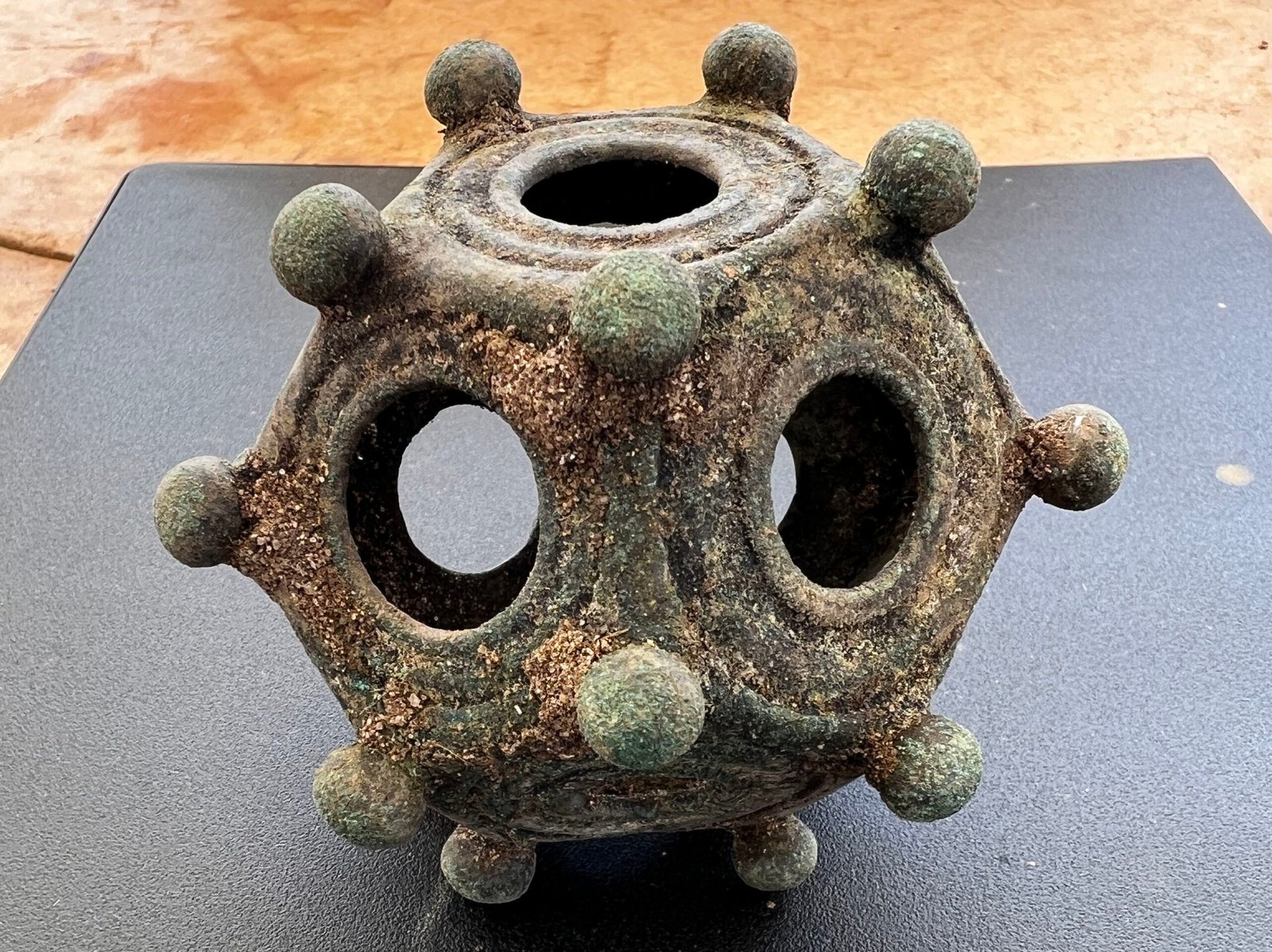
These small hollow objects, typically made of bronze, have been discovered across parts of Europe once controlled by the Roman Empire. More than a hundred examples have been found, dating roughly between the second and fourth centuries CE.
At first glance, they appear almost modern. Each artifact consists of twelve pentagonal faces with circular holes of varying sizes. Small knobs protrude from each corner.
The mystery is astonishing because nobody knows what they were used for.
The Romans were prolific record keepers. They documented military campaigns, engineering projects, religious practices, and daily life. Yet no surviving Roman text clearly describes these objects.
Researchers have proposed numerous theories. Some suggest they were measuring instruments. Others believe they may have been religious objects, candlestick holders, surveying tools, knitting aids, or astronomical devices.
Each explanation solves certain problems but creates others.
If they were practical tools, why are they found in such varied sizes? If they served religious purposes, why are there no written references? If they were military instruments, why are they absent from Roman military records?
For centuries, these bronze objects have remained stubbornly silent.
Today, the Roman dodecahedron stands as one of archaeology’s most famous unsolved mysteries.
2. The Antikythera Mechanism
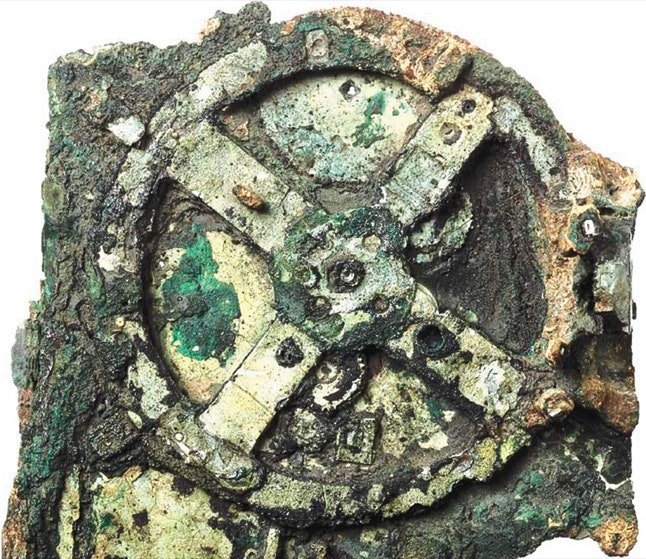
When sponge divers discovered a shipwreck near the Greek island of Antikythera in 1901, they had no idea they were about to uncover one of the most extraordinary artifacts ever found.
Recovered from the wreck was a corroded lump of bronze that initially seemed unremarkable. Only later did researchers realize they had discovered something astonishing.
The object contained dozens of intricate gears arranged with incredible precision.
Dating to around the second century BCE, the Antikythera Mechanism is widely considered the world’s oldest known analog computer.
Scientists now understand much of what it did. It could predict astronomical events, track planetary movements, forecast eclipses, and calculate calendar cycles.
Yet major mysteries remain.
How did ancient Greek engineers develop technology so advanced? Why did similar machines disappear from the historical record for over a thousand years? Were there many such devices, or was this a unique masterpiece?
The sophistication of the mechanism was not matched again until medieval astronomical clocks appeared centuries later.
Its existence suggests that ancient technological capabilities may have been far greater than historians once believed.
The Antikythera Mechanism continues to amaze researchers because it appears far ahead of its time.
3. The Voynich Manuscript
Some mysteries are hidden not in metal or stone but in ink and parchment.
The Voynich Manuscript is one of the world’s most baffling books.
Created sometime during the early fifteenth century, the manuscript contains hundreds of pages filled with strange illustrations and text written in an unknown script.
Its pages feature mysterious plants, unusual astronomical diagrams, naked figures bathing in elaborate pools, and symbols unlike any known language.
For decades, cryptographers, linguists, historians, and computer scientists have attempted to decipher its contents.
None have succeeded.
The text appears structured like a real language. Statistical analysis suggests it follows patterns found in human writing rather than random nonsense. Yet no one has conclusively identified the language or code behind it.
Some researchers believe it may represent a lost language. Others think it is an elaborate cipher. A few suggest it could be a sophisticated hoax.
The mystery deepens because modern analytical tools have failed to provide a definitive answer.
The manuscript sits in a library today, its pages open for study, yet its message remains inaccessible.
It is like receiving a letter from the past written in a language humanity has forgotten.
4. The Phaistos Disc
Discovered in 1908 on the island of Crete, the Phaistos Disc is one of archaeology’s most perplexing objects.
Made of fired clay, the disc dates to the Bronze Age and contains symbols arranged in a spiral pattern.
The symbols were stamped into the clay before it hardened, making the disc one of the earliest known examples of a form of printing.
The problem is simple.
No one knows what the symbols mean.
The disc contains forty-five distinct signs depicting humans, animals, plants, and tools. Despite extensive study, scholars have not been able to connect the symbols conclusively to any known language.
Some believe it may contain a prayer, a hymn, a ritual text, or an administrative record. Others think it could represent a game or educational exercise.
A major obstacle is that only one disc has ever been found.
Without additional examples for comparison, decipherment becomes extremely difficult.
The Phaistos Disc remains an isolated voice from a civilization that vanished thousands of years ago.
5. The London Hammer
The London Hammer is often cited in sensational stories as evidence of impossible ancient technology.
The reality is more complicated and more interesting.
The artifact consists of a hammer partially embedded within a rock formation discovered in Texas during the 1930s.
Claims sometimes suggest the hammer is hundreds of millions of years old, which would overturn modern geology.
However, scientific evidence does not support such extraordinary conclusions.
The real mystery lies elsewhere.
Researchers generally believe the hammer itself is relatively recent, perhaps dating to the nineteenth century. Yet questions remain regarding the unusual mineralization surrounding it and the precise processes that encased it.
While it does not rewrite human history, the artifact demonstrates how natural geological processes can create puzzling appearances that invite speculation.
Even today, debate continues over certain aspects of its formation.
6. The Baghdad Battery
In the 1930s, archaeologists discovered a clay jar near Baghdad containing a copper cylinder and an iron rod.
Dating estimates place the artifact within the Parthian or Sassanian periods.
The object became famous because some researchers suggested it might function as a primitive battery.
When replicas are filled with acidic liquids such as vinegar, they can indeed generate small amounts of electricity.
This possibility sparked enormous excitement.
Could ancient people have understood electricity?
The evidence remains inconclusive.
No wires, electrical devices, or supporting infrastructure have been found alongside the jars. Alternative explanations suggest they may have served religious, medicinal, or storage purposes.
Scientists continue to debate whether the electrical interpretation reflects ancient reality or modern imagination.
The artifact remains fascinating precisely because both possibilities seem plausible.
7. The Sacsayhuamán Stonework
High above the city of Cusco in Peru stands Sacsayhuamán, an enormous Inca ceremonial complex famous for its extraordinary stone walls.
The mystery is not that the walls exist.
The mystery is how they were built with such precision.
Some stones weigh over one hundred tons. Many possess complex polygonal shapes that fit together so tightly that inserting a knife blade between them is nearly impossible.
Researchers understand the general methods used by the Inca. They quarried stone, transported massive blocks, and shaped them using stone tools and abrasion techniques.
Yet questions remain regarding the exact processes that achieved such remarkable precision.
No mortar was used. The stones fit together naturally, creating structures capable of surviving earthquakes that have destroyed later buildings.
Standing before these walls today evokes a sense of awe. They seem less constructed than assembled by giants.
Even though archaeologists understand much about Inca engineering, the finest details of their stoneworking techniques remain uncertain.
8. The Cochno Stone
Near Glasgow, Scotland, lies one of Europe’s most mysterious prehistoric carvings.
Known as the Cochno Stone, this massive rock surface is covered with intricate symbols dating back roughly five thousand years.
The carvings include circles, spirals, grooves, and geometric patterns that stretch across the stone in elaborate arrangements.
Scientists know who likely made the markings: prehistoric communities living during the Neolithic or Bronze Age.
What they do not know is what the carvings mean.
Some researchers suggest astronomical significance. Others propose territorial markers, religious symbolism, maps, or ritual purposes.
The patterns appear intentional and sophisticated, yet their message remains elusive.
The Cochno Stone illustrates a recurring challenge in archaeology. Understanding who created something is often easier than understanding what it meant to them.
Thousands of years later, the stone still guards its secret.
9. The Lycurgus Cup
At first glance, the Lycurgus Cup appears to be an impressive example of Roman glasswork.
Then something extraordinary happens.
Under reflected light, the cup appears green. When light shines through it from behind, it glows deep red.
This dramatic color change astonished modern scientists.
The cup dates to the fourth century CE and contains tiny particles of gold and silver embedded within the glass. These nanoparticles interact with light in complex ways.
Researchers now understand the scientific mechanism responsible for the color-changing effect.
The mystery lies in how Roman craftsmen achieved such sophisticated results.
Did they intentionally engineer the nanoparticles? Was the effect discovered through experimentation? How widespread was this knowledge?
Modern nanotechnology only began developing in recent decades, yet Roman artisans somehow created a material displaying nanoscale optical properties over sixteen centuries ago.
The Lycurgus Cup serves as a reminder that ancient craftspeople sometimes possessed practical knowledge far beyond what modern observers expect.
10. The Giant Stone Spheres of Costa Rica
Scattered across Costa Rica are hundreds of nearly perfect stone spheres.
Some are small enough to carry, while others measure over two meters in diameter and weigh many tons.
Created by pre-Columbian cultures between approximately 300 and 1500 CE, these spheres are among the most striking archaeological objects in the Americas.
The mystery is not how they were made. Researchers generally believe artisans shaped them using stone tools, controlled heating, and grinding techniques.
The greater question concerns their purpose.
Why invest so much effort creating near-perfect spheres?
Some appear associated with settlements and ceremonial centers. Others were arranged in patterns that may have held symbolic significance.
The original cultural meanings have largely been lost.
For generations, myths linked the spheres to Atlantis, extraterrestrials, and lost civilizations. Scientific evidence supports none of these claims.
Yet the genuine mystery remains compelling enough.
The people who made the spheres clearly considered them important. Unfortunately, they left no written explanation.
Today these smooth stone monuments stand as elegant reminders of knowledge that disappeared long ago.
Why These Mysteries Matter
It is tempting to view unexplained artifacts as failures of science. In reality, they represent one of science’s greatest strengths.
Science does not pretend to know everything.
When evidence is incomplete, researchers acknowledge uncertainty. They test ideas, challenge assumptions, and revise conclusions when new information emerges.
Many historical mysteries that once seemed impossible have eventually found explanations. Ancient scripts have been deciphered. Lost cities have been rediscovered. Forgotten technologies have been reconstructed.
Some of today’s mysteries may become tomorrow’s solved puzzles.
Others may remain unsolved indefinitely.
That uncertainty is part of what makes archaeology so fascinating.
Every unexplained artifact reminds us that history is not a finished story. The past still holds secrets waiting beneath deserts, oceans, forests, and ancient ruins.
The Endless Search for Answers
Human beings have always been drawn to mysteries.
Perhaps it is because mysteries spark imagination. They force us to ask questions and challenge assumptions. They remind us that knowledge has limits.
The Roman dodecahedrons, the Antikythera Mechanism, the Voynich Manuscript, the Phaistos Disc, the Baghdad Battery, and the other artifacts on this list all share something remarkable. They connect us directly with people who lived centuries or millennia ago, yet whose intentions remain partly hidden.
We can hold their creations in our hands. We can measure them, scan them, photograph them, and analyze them with advanced technology. We can uncover chemical compositions, manufacturing methods, and historical contexts.
And still, some questions remain unanswered.
There is something profoundly moving about that reality.
Across vast stretches of time, these objects seem to whisper from another world. They remind us that countless human stories have been lost, forgotten, or buried beneath history itself.
Yet they also inspire hope.
Every archaeological discovery begins with a question. Every excavation offers the possibility of new understanding. Somewhere, perhaps beneath an untouched layer of earth or inside an overlooked archive, the clues needed to solve these mysteries may already exist.
Until then, these ancient artifacts continue to stand at the boundary between knowledge and wonder, inviting each generation to look a little deeper into humanity’s extraordinary past.