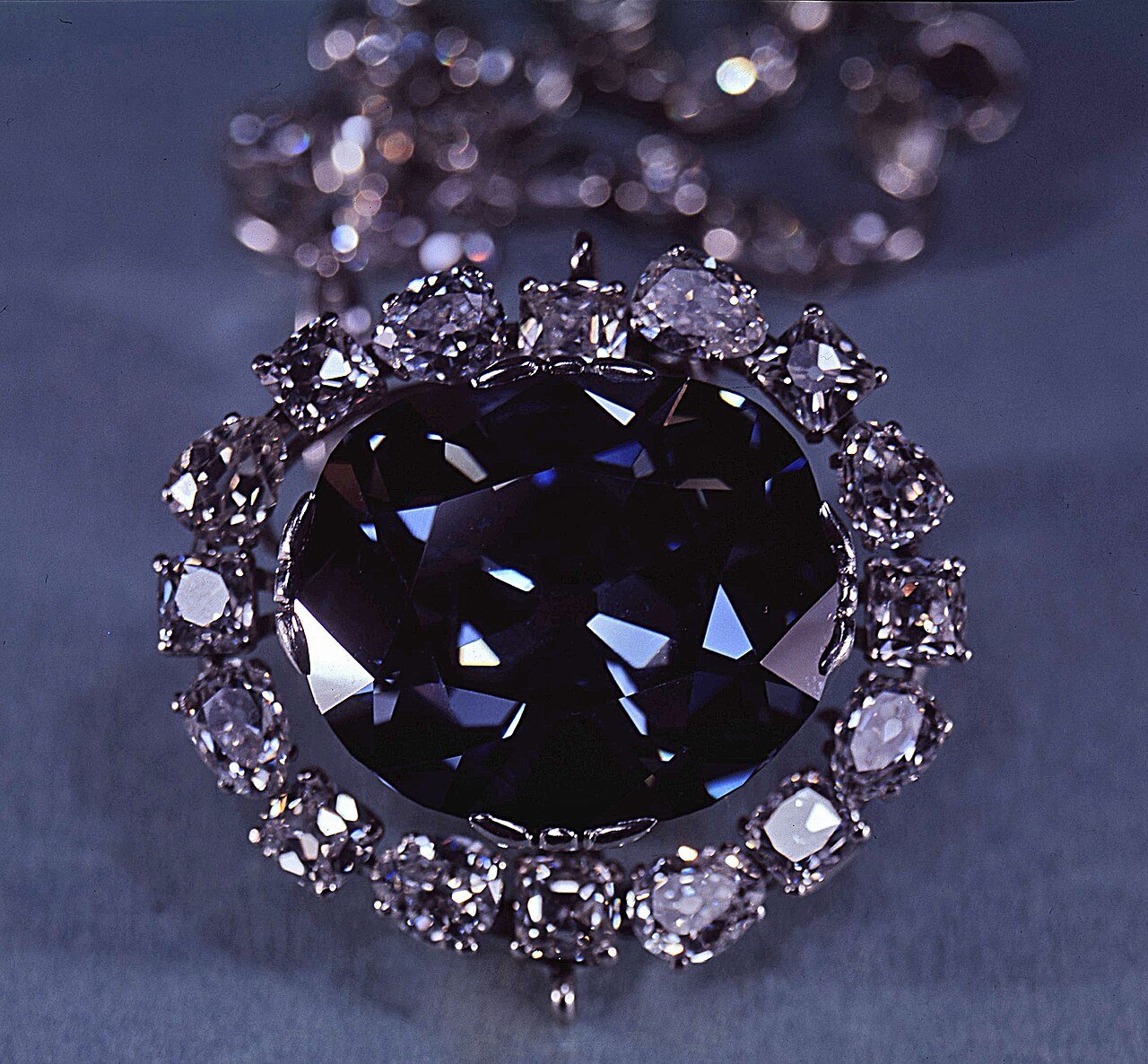
The Hope Diamond is one of the most famous gemstones on Earth. Its deep blue color is mesmerizing, its history stretches across centuries, and its reputation has become almost as legendary as the diamond itself. For generations, people have whispered about a curse attached to the stone. According to popular stories, anyone who owns it suffers terrible misfortune. Kings lose their power, wealthy collectors go bankrupt, families fall apart, and tragedy follows wherever the diamond goes.
It is a story that seems perfectly designed for mystery novels and Hollywood films. Yet what makes the Hope Diamond so fascinating is that it is not merely fiction. The diamond is real. Its journey across continents is real. Many of the people who owned it truly experienced difficult lives. The question that has captivated historians, journalists, and ordinary visitors for more than a century is simple: does the Hope Diamond actually bring bad luck?
The answer is not as straightforward as believers in the curse would like. Behind the legends lies a complicated story of royal courts, colonial trade, scientific discovery, media sensationalism, and human psychology. The Hope Diamond’s history is filled with both fact and fiction, and separating the two reveals something even more interesting than the curse itself.
Today, millions of people visit the diamond each year, staring through glass at its brilliant blue glow and wondering the same thing generations before them wondered. Is it merely a beautiful gemstone, or is there something darker hidden within its story?
A Diamond Unlike Any Other
Even before discussing its alleged curse, it is important to understand why the Hope Diamond attracts so much attention.
The gemstone is extraordinary in appearance. Weighing 45.52 carats, it possesses a rare deep blue color unlike most diamonds. While many diamonds are colorless, the Hope Diamond’s distinctive hue comes from tiny traces of boron within its crystal structure.
Under ultraviolet light, the stone displays an unusual reddish glow that can linger for several seconds after the light source is removed. This effect has fascinated scientists for decades.
Its beauty is difficult to describe fully in words. Visitors often expect a large sparkling jewel, but what surprises many people is the depth of its color. The blue appears almost alive, shifting slightly as light moves across its surface.
The diamond is not merely valuable because of its size. Its rarity, color, history, and cultural significance have made it one of the most famous gemstones ever discovered.
Yet its remarkable physical characteristics are only part of the story.
The Diamond’s Origins in India
The story begins centuries ago in India, a land that was once the world’s primary source of diamonds.
Most historians believe the Hope Diamond originated in the Kollur Mine, located in the Golconda region of southern India. During the seventeenth century, this area produced some of the most famous diamonds in history.
At the time, diamonds were even rarer than they are today. Large gemstones often became symbols of wealth, political power, and divine favor.
The original rough stone from which the Hope Diamond was eventually cut is believed to have weighed more than 100 carats. Even in its uncut form, it would have been an astonishing sight.
The circumstances of its discovery remain uncertain. Historical records from the period are incomplete, and many details have been lost over time.
This uncertainty created fertile ground for myths.
One popular legend claimed that the diamond was stolen from a sacred temple where it served as part of a religious statue. According to the story, a thief removed the gemstone and unleashed a terrible curse upon anyone who possessed it.
The problem is that historians have found no reliable evidence supporting this tale.
Like many stories connected to the Hope Diamond, the temple theft appears to be a later invention rather than a documented historical event.
Jean-Baptiste Tavernier and the Journey to Europe
The first well-documented figure associated with the diamond is Jean-Baptiste Tavernier.
Tavernier was a French merchant who traveled extensively through Asia during the seventeenth century. He acquired numerous valuable gems during his journeys and eventually brought many of them back to Europe.
Among these treasures was a remarkable blue diamond that became known as the Tavernier Blue.
The stone weighed approximately 112 carats and was significantly larger than the modern Hope Diamond.
Tavernier later sold the diamond to the court of Louis XIV.
This transaction marked the beginning of the diamond’s long association with European royalty.
Curse legends often claim that Tavernier suffered a horrific fate after taking possession of the stone. Some stories insist he was torn apart by wild animals. Others describe various gruesome endings.
Historical evidence tells a different story.
Tavernier actually lived into his eighties, an impressive age for the period. While his life certainly included hardships, there is no evidence that he suffered an extraordinary or mysterious death connected to the diamond.
The first supposed victim of the curse was therefore probably not a victim at all.
The Sun King’s Treasure
Once the diamond entered the French royal collection, it underwent a transformation.
Louis XIV ordered the stone to be recut into a more symmetrical shape. The resulting gem became known as the French Blue.
The new diamond weighed approximately 67 carats and became one of the crown jewels of France.
The king’s court represented one of the most glamorous centers of power in Europe. Wealth, luxury, and political influence surrounded the diamond.
At first glance, this does not seem like the beginning of a curse.
Louis XIV ruled for more than seventy years, one of the longest reigns in European history.
Yet hindsight would eventually cast a darker shadow over the diamond’s royal connections.
The French monarchy that once appeared invincible would face catastrophe in the generations ahead.
As later storytellers looked back on history, they found plenty of tragedies they could connect to the gemstone.
Marie Antoinette and the Birth of a Curse
No figure contributed more to the Hope Diamond’s cursed reputation than Marie Antoinette.
Although the exact details of her relationship with the diamond remain debated, she became closely linked to stories about it.
Marie Antoinette’s life ended during the French Revolution, one of the most dramatic upheavals in European history.
The monarchy collapsed.
The royal family was imprisoned.
Eventually, both Marie Antoinette and Louis XVI were executed.
These events shocked Europe.
To later generations, the downfall of the French monarchy seemed almost tailor-made for a curse narrative.
A magnificent blue diamond passes through royal hands, and those hands eventually lose everything.
The problem, however, is obvious.
The French Revolution affected countless people who never came near the diamond. Political, economic, and social factors explain the revolution far more convincingly than supernatural forces.
Yet legends rarely depend on logic.
The dramatic deaths of famous rulers helped cement the diamond’s growing reputation.
The Great Theft
One of the most mysterious chapters in the diamond’s history occurred during the chaos of the French Revolution.
In 1792, thieves broke into a royal storage facility in Paris and stole many crown jewels.
Among the missing treasures was the French Blue.
The diamond vanished.
For years, no one knew what had happened to it.
This disappearance added another layer of mystery.
Had the gem been destroyed?
Was it hidden somewhere in Europe?
Had it been smuggled overseas?
The uncertainty fueled speculation and legends.
When a famous object disappears, people naturally begin imagining extraordinary explanations.
The missing diamond became even more intriguing because nobody could trace its whereabouts.
For two decades, the mystery remained unsolved.
The Reappearance of the Diamond
In the early nineteenth century, a blue diamond appeared in London.
This stone was smaller than the original French Blue but displayed striking similarities.
Most historians believe the original diamond had been recut to disguise its identity and avoid detection.
The new gem eventually became associated with a wealthy banking family named Hope.
It was from this family that the stone received its modern name: the Hope Diamond.
The recutting likely reduced its weight to approximately 45.52 carats, the size it remains today.
The transformation helped erase evidence linking the diamond to the French crown jewels.
At least physically.
Its legends, however, were only beginning.
The Hope Family and Financial Troubles
The Hope family possessed considerable wealth and influence.
Yet later generations experienced financial difficulties.
As stories about the diamond spread, these problems became part of the curse narrative.
According to believers, the gemstone brought ruin upon its owners.
In reality, financial troubles are hardly unusual among wealthy families over long periods. Economic downturns, poor investments, changing circumstances, and inheritance issues affect many fortunes.
Nevertheless, once people begin looking for evidence of a curse, ordinary misfortunes can appear extraordinary.
This tendency would become a recurring theme throughout the diamond’s history.
How Journalists Created the Curse
One of the most surprising facts about the Hope Diamond’s curse is that much of it appears to have been deliberately manufactured.
During the late nineteenth and early twentieth centuries, newspapers competed fiercely for readers.
Sensational stories sold papers.
A mysterious blue diamond with a dramatic history offered perfect material.
Journalists began collecting tragedies associated with various owners and linking them together.
In some cases, events were exaggerated.
In others, completely fictional stories were invented.
Deaths from natural causes became evidence of supernatural punishment.
Financial setbacks became proof of a curse.
Unrelated accidents were woven into a growing narrative.
The more dramatic the stories became, the more readers wanted to hear them.
By the early twentieth century, the curse had become one of the diamond’s defining features.
Ironically, the legend increased the stone’s fame and value.
The Arrival of Pierre Cartier
A key figure in spreading the curse story was Pierre Cartier.
Cartier hoped to sell the diamond to wealthy American customers.
One potential buyer was socialite Evalyn Walsh McLean.
According to popular accounts, Cartier skillfully used the curse legend as a marketing tool.
Rather than discouraging buyers, the mysterious reputation made the diamond more attractive.
People are often drawn to stories that combine danger and glamour.
The curse transformed the diamond from a valuable gemstone into a cultural phenomenon.
Cartier understood this perfectly.
The mystery became part of the product.
Evalyn Walsh McLean and Personal Tragedy
Evalyn Walsh McLean became perhaps the most famous owner of the Hope Diamond.
She loved wearing it and frequently displayed it at social events.
Her ownership, however, is often cited as evidence supporting the curse.
Over the years, McLean experienced several personal tragedies.
Her young son died in an automobile accident.
Her husband struggled with serious mental health issues and alcoholism.
Financial problems affected parts of her family’s fortune.
To believers, these events seemed impossible to ignore.
Yet historians point out that tragedy touches many lives, regardless of whether a famous diamond is involved.
The challenge lies in determining whether the stone caused these events or whether people simply connected unrelated hardships to a preexisting legend.
Human beings are naturally inclined to find patterns, even when no real connection exists.
Why Humans Believe in Curses
The story of the Hope Diamond reveals something important about human psychology.
People dislike randomness.
When bad things happen, we often search for explanations.
A curse provides a simple answer to complicated events.
Instead of accepting that life contains uncertainty, chance, and unpredictability, the curse offers a clear cause.
This tendency appears throughout history.
Objects, places, and individuals have repeatedly been blamed for misfortunes that likely occurred for entirely natural reasons.
The Hope Diamond became a perfect candidate because its owners were often wealthy, famous, and highly visible.
When something tragic happened to them, newspapers reported it.
Millions of ordinary people experienced similar hardships without attracting attention.
The famous owners became part of the legend because their stories were easier to remember.
Scientific Interest in the Diamond
While the public focused on curses, scientists became fascinated by the diamond itself.
Researchers studied its unique color and physical properties.
The stone’s boron content provided clues about how certain diamonds form deep within Earth’s mantle.
Its unusual red phosphorescence attracted significant scientific attention.
The Hope Diamond became valuable not only as a historical artifact but also as a scientific specimen.
Modern analytical techniques have revealed details about its composition that earlier generations could never have imagined.
The gemstone serves as a reminder that natural wonders can be extraordinary without requiring supernatural explanations.
Its beauty alone is remarkable enough.
The Diamond Arrives at the Smithsonian
One of the most surprising chapters in the diamond’s history occurred in 1958.
Jeweler Harry Winston donated the Hope Diamond to the Smithsonian Institution.
Even more remarkably, the diamond was mailed through the postal service.
The package arrived safely.
No curse intervened.
Since then, the Hope Diamond has become one of the most visited museum attractions in the world.
Millions of people have viewed it without suffering any obvious supernatural consequences.
The museum itself has thrived.
Employees who work near the stone daily generally appear unaffected by any mysterious forces.
This fact creates an interesting challenge for believers in the curse.
If the diamond truly spreads misfortune, why has it spent decades peacefully displayed in a museum?
The Modern Reputation of the Hope Diamond
Today, the Hope Diamond occupies a unique place in popular culture.
It is simultaneously a scientific specimen, a historical artifact, a work of natural art, and a legendary cursed object.
Visitors often approach it with mixed feelings.
Part of them admires its beauty.
Part of them remembers the stories.
Even people who do not believe in curses sometimes feel a slight thrill when standing before it.
This reaction demonstrates the power of storytelling.
The curse has become inseparable from the diamond’s identity.
Whether true or false, it shapes how people experience the gemstone.
Examining the Evidence
When historians evaluate the curse, they focus on evidence rather than anecdotes.
The results are revealing.
Many supposed victims never actually owned the diamond.
Some tragedies attributed to the curse never occurred.
Several famous stories were invented by journalists seeking dramatic headlines.
Other misfortunes happened decades apart and involved individuals connected only loosely to the stone.
When examined closely, the pattern begins to weaken.
The curse appears far less convincing than popular accounts suggest.
In fact, many owners lived long and successful lives.
Their stories receive less attention because they do not fit the narrative.
This selective focus is common in curse legends.
People remember evidence supporting the myth and ignore evidence contradicting it.
The Power of a Good Story
The Hope Diamond demonstrates that stories can become almost as valuable as the objects they describe.
Without its legends, the stone would still be extraordinary.
Its size, color, rarity, and history guarantee that.
Yet the curse transformed it into something larger than a gemstone.
It became a symbol.
People love mysteries.
They love treasure.
They love tales of danger and intrigue.
The Hope Diamond combines all three.
Its curse survives because it satisfies a deep human desire for wonder.
Fact, Fiction, and the Space Between
The most interesting aspect of the Hope Diamond may be the way fact and fiction intertwine.
The diamond itself is real.
Its journey across centuries is real.
Many of its owners experienced genuine hardships.
At the same time, numerous details have been exaggerated, distorted, or invented.
The result is a legend built upon a foundation of historical truth.
This mixture makes the story difficult to dismiss entirely.
The facts are fascinating enough to support the myth.
The myth, in turn, makes people more interested in the facts.
Together they create one of the world’s most enduring mysteries.
The Enduring Fascination of the Hope Diamond
More than three hundred years after it first appeared in historical records, the Hope Diamond continues to captivate audiences.
Its blue glow still attracts crowds.
Its history still inspires books and documentaries.
Its curse still sparks debates.
Perhaps this fascination persists because the diamond represents something larger than itself.
It embodies humanity’s relationship with mystery.
We want answers, yet we also enjoy uncertainty.
We seek explanations, yet we are drawn to legends.
The Hope Diamond sits perfectly between these impulses.
It offers enough evidence to seem real and enough mystery to remain magical.
Conclusion
The Hope Diamond is one of the most extraordinary gemstones ever discovered. Its rare blue color, remarkable journey through history, and association with kings, queens, collectors, and museums have secured its place among the world’s greatest treasures.
But does it really bring misfortune?
The historical evidence suggests that the answer is probably no. Most stories supporting the curse collapse under careful examination. Many were exaggerated by journalists, altered through retelling, or created entirely to make the diamond more intriguing. The tragedies connected to its owners, while often genuine, are not significantly different from the hardships experienced by countless other people.
Yet dismissing the curse entirely misses an important truth.
The legend itself has become part of the diamond’s identity. The stories surrounding the Hope Diamond have transformed it from a rare gemstone into a cultural icon. Its reputation for misfortune may not be supported by science or history, but it continues to influence how people perceive the stone.
In the end, the Hope Diamond’s greatest power is probably not supernatural at all. It lies in its ability to inspire wonder, curiosity, and imagination. Long after the details of individual owners have faded from memory, people will likely continue standing before its deep blue glow, asking the same timeless question:
What if the stories are true?