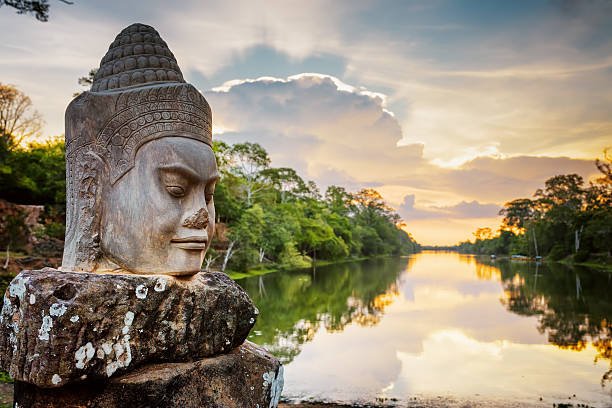
There are few places on Earth that inspire wonder quite like Angkor.
Imagine walking through a dense tropical forest at dawn. Towering trees stretch toward the sky. Thick roots snake across ancient stones. The sounds of birds and insects fill the humid air. Then, through the mist, enormous towers begin to emerge. Massive walls covered with intricate carvings rise from the jungle floor. Long-forgotten temples appear like scenes from a dream.
For centuries, Angkor seemed to belong more to legend than to history.
Hidden beneath the forests of Cambodia, this vast urban landscape was once the heart of one of the most powerful empires in Southeast Asia. At its peak, Angkor was among the largest and most sophisticated cities in the world. It was a center of religion, politics, engineering, art, and commerce. Millions of stones were shaped and transported to create monuments of astonishing beauty. Complex water systems supported enormous populations. Kings ruled from magnificent temples that symbolized both earthly power and divine authority.
Then, slowly, the city faded.
Its great monuments remained standing, but much of the surrounding urban landscape disappeared beneath advancing vegetation. As centuries passed, stories of Angkor spread across the world. Travelers described mysterious ruins consumed by nature. Explorers arrived searching for answers. Archaeologists uncovered evidence of a civilization far larger and more advanced than anyone had imagined.
Today, Angkor is one of the greatest archaeological treasures on Earth. Yet it remains an enigma. How did such a magnificent city rise? Why was it built? What caused its decline? And how could a metropolis of such immense scale seemingly vanish into the jungle?
The story of Angkor is one of ambition, innovation, resilience, and mystery. It is also a reminder that even the greatest civilizations can be transformed by the passage of time.
The Birth of the Khmer Empire
To understand Angkor, it is necessary to understand the civilization that created it.
The city was the heart of the Khmer Empire, a powerful state that dominated much of mainland Southeast Asia for centuries. The empire emerged during a period of political transformation in the region.
In the early ninth century, a ruler named Jayavarman II is traditionally regarded as the founder of the Khmer Empire. Through military strength, diplomacy, and political vision, he unified territories that had previously been fragmented.
His reign marked the beginning of a new era.
The Khmer kings sought not only political power but also spiritual legitimacy. They embraced religious traditions influenced by India, particularly Hinduism and later Buddhism. These beliefs became deeply intertwined with kingship and state authority.
The rulers viewed themselves as representatives of divine order. Monumental architecture became a way of expressing that sacred connection.
The foundations were laid for one of history’s most remarkable civilizations.
Why Angkor Was Built
The region where Angkor developed offered important advantages.
Located near the vast freshwater body known as Tonlé Sap, the area benefited from fertile land and abundant water resources. Seasonal floods enriched agricultural fields, allowing farmers to produce large quantities of rice.
Rice was the lifeblood of the Khmer Empire.
Successful agriculture supported population growth, economic stability, and military strength. The more food a kingdom could produce, the more people it could support.
As royal power increased, kings invested in ambitious building projects. Temples, reservoirs, roads, canals, and administrative centers transformed the landscape.
Over time, Angkor grew into a sprawling urban complex unlike anything else in the region.
Rather than being a single city enclosed by walls, Angkor developed as a vast network of temples, neighborhoods, agricultural areas, and water-management systems spread across hundreds of square kilometers.
It was both a city and a living landscape.
The Meaning of Angkor
The word “Angkor” derives from a Sanskrit term meaning “city” or “capital.”
For the Khmer rulers, however, Angkor was far more than a political center.
It represented a sacred vision of the universe.
Many temples were designed according to religious concepts that symbolized cosmic order. Their architecture reflected ideas about mountains, oceans, gods, and the structure of the cosmos.
The kings believed that maintaining harmony between heaven and Earth was essential for prosperity.
Temple construction was therefore not merely an artistic activity. It was an expression of religious devotion, royal authority, and cosmic balance.
Every stone carried symbolic meaning.
Angkor Wat: The Crown Jewel
No structure better represents the glory of Angkor than Angkor Wat.
Today it is one of the most famous archaeological sites in the world and appears on the Cambodian national flag.
Constructed during the twelfth century under King Suryavarman II, Angkor Wat was originally dedicated to the Hindu god Vishnu.
The scale of the monument is breathtaking.
Its enormous moat surrounds a vast temple complex. Long galleries display intricate carvings depicting mythology, historical events, and religious narratives. Towering structures rise above the surrounding landscape, creating one of the most recognizable silhouettes in world architecture.
What makes Angkor Wat especially remarkable is the precision of its design.
The builders aligned the structure with astronomical and religious principles. Every measurement and arrangement reflected deeper symbolic meanings.
The temple was intended to represent Mount Meru, the sacred mountain at the center of the Hindu universe.
Visitors today often describe a sense of awe when watching the sunrise behind its towers. That emotional impact is not accidental. The monument was designed to inspire wonder.
Nearly nine centuries later, it still succeeds.
The Engineering Marvel of Angkor
The beauty of Angkor’s temples often overshadows another extraordinary achievement: engineering.
The Khmer civilization developed one of the most sophisticated water-management systems of the preindustrial world.
The region experiences dramatic seasonal variations. During the rainy season, enormous amounts of water arrive. During dry periods, water becomes far scarcer.
Managing these fluctuations was essential.
The Khmer engineers constructed canals, reservoirs, embankments, and waterways on a massive scale. These systems stored water, distributed it across agricultural lands, and helped support large populations.
Some reservoirs were enormous, stretching for several kilometers.
Modern researchers continue to study how these systems functioned. Their complexity reveals impressive knowledge of hydrology, planning, and landscape management.
Without these engineering achievements, Angkor could never have reached its remarkable size.
A City Larger Than Anyone Imagined
For many years, scholars viewed Angkor primarily as a collection of temples.
The surrounding forests concealed much of the ancient city.
As a result, researchers underestimated its true scale.
Recent technological advances transformed understanding of Angkor dramatically.
Using aerial surveys, satellite imagery, and laser-mapping technology known as LiDAR, scientists discovered evidence of an immense urban network hidden beneath vegetation.
Roads, canals, residential areas, ponds, agricultural fields, and previously unknown structures emerged from the data.
The findings revealed that Angkor was not merely a ceremonial center.
It was one of the largest urban complexes in the world during its time.
Millions of people may have lived within the broader Angkorian landscape.
What appeared to be isolated monuments were actually components of a vast interconnected city.
The jungle had concealed this reality for centuries.
Daily Life in Ancient Angkor
The great temples tell only part of the story.
Most people living in Angkor were farmers, artisans, traders, laborers, priests, and officials. Their lives revolved around agriculture, family, religion, and community.
Rice cultivation dominated daily existence.
Farmers depended on seasonal cycles and water-management systems. Successful harvests provided food for both local populations and the royal administration.
Markets bustled with activity.
Merchants exchanged goods from across Southeast Asia and beyond. Textiles, ceramics, spices, metals, and luxury products moved through regional trade networks.
Religious ceremonies shaped community life.
Temples served not only as sacred spaces but also as social and economic centers. Priests conducted rituals, while festivals brought people together.
Although many wooden houses have disappeared, archaeological evidence suggests that Angkor was a vibrant and dynamic urban environment filled with human activity.
The Art of the Khmer World
The artistic achievements of Angkor remain among its most celebrated features.
Temple walls are covered with extraordinary carvings.
These stone reliefs depict gods, battles, royal processions, mythological stories, and scenes from everyday life. They provide invaluable insights into the beliefs and culture of the Khmer people.
One of the most famous examples is the depiction of the Churning of the Ocean of Milk, a major story from Hindu mythology.
The craftsmanship is astonishing.
Artists carved thousands of figures with remarkable detail and precision. Expressions, clothing, jewelry, and movement are rendered with extraordinary skill.
These artworks transformed stone into storytelling.
Centuries later, they continue to communicate across time.
Religion and Transformation
Religion played a central role in Angkor’s history.
Early Khmer rulers primarily embraced Hindu traditions. Temples honored deities such as Vishnu and Shiva.
Over time, however, religious practices evolved.
Buddhism gradually became increasingly influential. By the late Angkorian period, Buddhist traditions occupied a dominant position within society.
This transition did not occur abruptly.
Elements of Hinduism and Buddhism often coexisted, influencing architecture, rituals, and artistic expression.
One remarkable aspect of Angkor is its religious continuity.
Many ancient sacred sites remained important even as spiritual traditions changed.
Rather than abandoning older monuments entirely, later generations adapted them to new religious contexts.
The result is a rich cultural landscape reflecting centuries of spiritual development.
The Faces of Bayon
Among Angkor’s most mysterious monuments is Bayon.
Located within the ancient city of Angkor Thom, Bayon is famous for its enormous stone faces.
Dozens of towers rise above the temple. Each tower displays serene faces gazing in multiple directions.
The identity of these faces remains a subject of discussion.
Some scholars believe they represent the bodhisattva Avalokiteshvara, an important figure in Mahayana Buddhism.
Others suggest they may incorporate features of King Jayavarman VII himself.
Regardless of their exact meaning, the faces create an unforgettable atmosphere.
Visitors often describe feeling watched as they move through the temple.
The expressions appear calm, compassionate, and timeless.
They are among the most iconic images in world archaeology.
Nature Begins to Reclaim the City
One of the most powerful aspects of Angkor’s story is its relationship with nature.
For centuries, human labor transformed the landscape. Forests were cleared. Canals were excavated. Temples rose from the earth.
Yet nature never disappeared.
When political power weakened and populations shifted, vegetation gradually reclaimed parts of the city.
Trees took root among stone blocks.
Roots expanded through walls and foundations.
Jungle growth concealed roads, buildings, and reservoirs.
Some temples became nearly invisible beneath dense vegetation.
This process created the haunting beauty that later captivated explorers and travelers.
Angkor became a symbol of nature’s ability to outlast even the grandest human achievements.
The Mystery of Decline
One of the greatest questions surrounding Angkor concerns its decline.
For generations, people imagined a sudden collapse caused by invasion or catastrophe.
Modern research suggests a more complex story.
Angkor did not vanish overnight.
Instead, its transformation appears to have occurred gradually over time.
Political challenges, military conflicts, environmental pressures, and economic changes likely combined to weaken the system.
The capital eventually shifted southward toward regions better connected to maritime trade routes.
As political priorities changed, Angkor lost its status as the empire’s primary center.
The city was not completely abandoned, but its importance diminished.
This gradual transition contrasts with the dramatic image of an instant disappearance.
History is often more complicated than legend.
Climate and Environmental Stress
Recent scientific studies have highlighted the role of environmental change.
Evidence suggests that the Angkor region experienced periods of severe drought interspersed with intense monsoon rains.
Such fluctuations would have placed enormous strain on water-management systems.
Infrastructure designed for predictable seasonal cycles may have struggled under increasingly extreme conditions.
Canals could become damaged.
Reservoirs could fail to function as intended.
Agricultural productivity could suffer.
These environmental pressures alone may not explain Angkor’s decline, but they likely contributed to broader challenges facing the civilization.
The story illustrates how even highly sophisticated societies remain connected to environmental conditions.
Foreign Visitors and Rediscovery
Although Angkor never completely disappeared from local knowledge, much of the wider world became unaware of its significance.
In later centuries, travelers arriving in the region encountered magnificent ruins surrounded by forest.
Their descriptions sparked international curiosity.
European explorers of the nineteenth century were particularly impressed by the scale and beauty of the monuments.
Accounts of towering temples hidden within the jungle captured public imagination.
Many readers struggled to believe such structures existed in Southeast Asia.
The rediscovery of Angkor challenged outdated assumptions about world history and demonstrated the remarkable achievements of the Khmer civilization.
Archaeology Unlocks the Past
Archaeologists have spent more than a century studying Angkor.
Their work has revealed a civilization of extraordinary complexity.
Excavations uncovered inscriptions that provide historical information about kings, religious practices, administration, and daily life.
Researchers documented architectural techniques and artistic traditions.
Conservation teams stabilized damaged structures and protected fragile carvings.
Every discovery added new pieces to the puzzle.
Yet many mysteries remain.
Large portions of the Angkorian landscape continue to be investigated, and new technologies regularly reveal previously unknown features.
The city still has stories to tell.
The Role of Modern Technology
One of the most exciting developments in Angkor research has been the use of LiDAR technology.
LiDAR works by sending laser pulses from aircraft toward the ground. These pulses can penetrate vegetation and create detailed maps of underlying landscapes.
In Angkor, LiDAR revolutionized understanding of the city.
Features hidden beneath forests suddenly became visible.
Researchers identified extensive road systems, canals, embankments, and urban layouts.
The technology confirmed that Angkor was far larger than previously believed.
What appeared from the ground as isolated ruins became visible as parts of a massive urban network.
The jungle had hidden an entire city in plain sight.
Angkor’s Legacy
The influence of Angkor extends far beyond archaeology.
For Cambodia, it represents a source of national pride and cultural identity.
The monuments stand as reminders of a period of remarkable achievement.
Artists, historians, architects, and scholars continue to draw inspiration from the site.
Visitors from around the world travel to Angkor each year.
Some come to admire the architecture.
Others seek historical understanding.
Many arrive simply to experience the atmosphere of a place where nature and human creativity intertwine.
Few leave unimpressed.
Lessons from a Lost Metropolis
The story of Angkor carries important lessons.
It demonstrates the power of human ingenuity.
The Khmer people transformed landscapes, built monumental architecture, and developed sophisticated infrastructure.
At the same time, Angkor reminds us that civilizations are not permanent.
Political systems change.
Economic priorities shift.
Environmental conditions evolve.
Even the greatest cities can experience transformation.
Yet decline does not erase achievement.
The temples of Angkor continue to inspire admiration centuries after the empire that built them faded from power.
Conclusion
Angkor is one of humanity’s greatest archaeological wonders—a city of astonishing ambition, artistic brilliance, and engineering mastery. Hidden for centuries beneath the forests of Cambodia, it emerged from the jungle to reveal the story of a civilization that once stood among the most powerful in the world.
Its magnificent temples, vast water systems, intricate carvings, and sprawling urban landscape testify to the creativity and determination of the Khmer people. Modern discoveries have shown that Angkor was not merely a collection of monuments but a sophisticated metropolis that supported enormous populations and reshaped its environment on a grand scale.
Yet Angkor is more than a story of success. It is also a story of change. Environmental pressures, political shifts, economic transformations, and the relentless passage of time altered the city and eventually diminished its central role. Nature reclaimed many of its structures, wrapping roots around stones and concealing entire neighborhoods beneath dense vegetation.
Today, Angkor stands as both a triumph and a mystery. It reminds us of what human societies can achieve, while also illustrating how fragile even the greatest civilizations can be. Its towers still rise above the forest canopy, its carved faces still gaze across the centuries, and its hidden landscapes continue to reveal new secrets.
The ancient city swallowed by the jungle was never truly lost. It was waiting patiently beneath the trees, preserving the memory of a remarkable civilization and inviting future generations to uncover its story once again.