More than four thousand years ago, a civilization flourished across vast regions of what are now Pakistan and northwestern India. Its cities were carefully planned, its streets were organized, its drainage systems were among the most advanced in the ancient world, and its people participated in extensive trade networks stretching across great distances. Yet despite decades of archaeological research and remarkable discoveries, one of its greatest secrets remains locked away.
Scattered among the ruins of ancient cities are thousands of small carved objects known as Indus Valley seals. They are often no larger than a modern postage stamp. Many display beautifully engraved animals, mysterious symbols, and short inscriptions. At first glance, they may seem like simple artifacts from a forgotten age.
But these seals contain one of archaeology’s greatest unsolved mysteries.
The symbols carved onto them appear to represent a writing system. If scholars could decipher this script, they might finally hear the voices of a civilization that has remained silent for millennia. They could learn how its people thought, what language they spoke, how their society functioned, and perhaps even why their civilization eventually declined.
Yet despite more than a century of study, nobody has been able to read these inscriptions with certainty.
The Indus Valley seals stand as tiny messages from the distant past, waiting patiently for someone to unlock their meaning.
Discovering a Lost Civilization
For much of recorded history, the civilization that created the seals was completely forgotten.
Unlike ancient Egypt, which left towering pyramids and abundant written records, or Mesopotamia, whose clay tablets preserved vast amounts of information, the civilization of the Indus Valley vanished from memory.
The story began to change in the nineteenth century when archaeologists working in South Asia started noticing unusual ancient ruins.
The true breakthrough came during the early twentieth century when excavations revealed remarkable cities such as Harappa and Mohenjo-daro.
The discoveries shocked the archaeological world.
These were not small settlements or isolated villages. They were sophisticated urban centers dating back to approximately 2600 BCE.
Wide streets followed organized layouts. Houses often included bathrooms and drainage systems. Public buildings demonstrated impressive engineering skills.
It became clear that researchers had uncovered one of the great civilizations of the ancient world.
Today, this culture is commonly known as the Indus Valley Civilization or the Harappan Civilization.
As archaeologists continued their excavations, they discovered thousands of mysterious seals.
These small objects would become one of the civilization’s most important and puzzling legacies.
What Exactly Are the Indus Valley Seals?
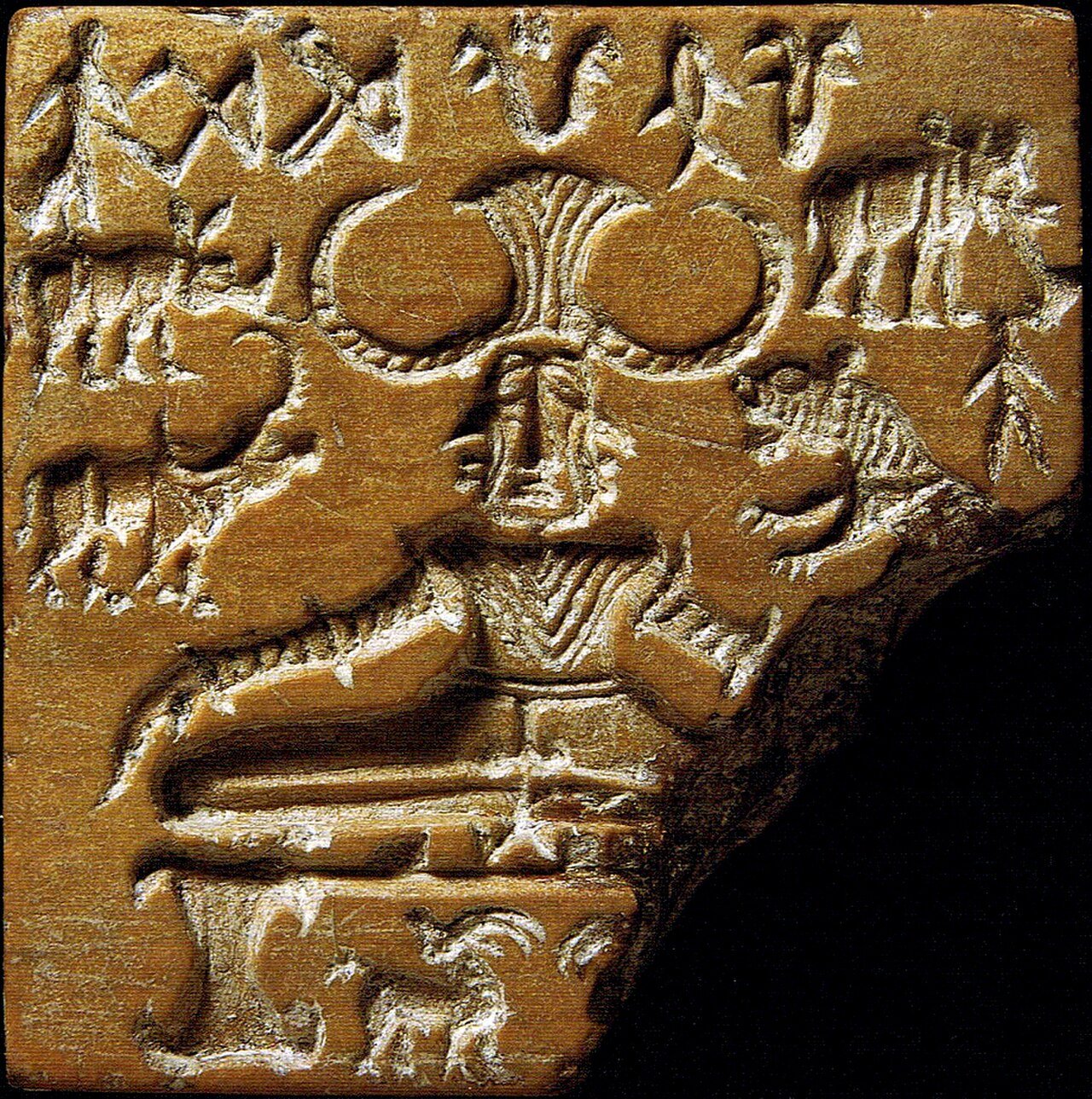
Most Indus Valley seals are small square objects made from a soft stone called steatite.
After being carved, the seals were usually heated, making them harder and more durable.
Many contain a loop or projection on the back, suggesting they may have been worn, carried, or attached to cords.
The front surfaces typically feature two elements.
One is an image, often depicting an animal.
The other is a line of symbols positioned above the image.
These symbols form what scholars call the Indus script.
The craftsmanship is remarkable.
Even though many seals are only a few centimeters across, the engravings display extraordinary detail and precision.
The artisans who created them possessed considerable skill.
Every seal seems to have been carefully designed, suggesting that these objects held significant importance within Harappan society.
The Fascinating Animals of the Seals
One of the most striking features of Indus seals is the variety of animals they depict.
Many show creatures that would have been familiar to ancient inhabitants of the region.
Bulls appear frequently.
Elephants, rhinoceroses, buffaloes, and tigers are also represented.
Some seals feature goats or composite creatures that combine characteristics of multiple animals.
Perhaps the most famous image is the so-called “unicorn.”
This creature resembles a bull but possesses a single long horn extending from its forehead.
Strangely, the unicorn is one of the most common animals found on Indus seals.
Yet no such animal existed in reality.
Why Harappan artists repeatedly chose this figure remains one of many mysteries.
Some scholars believe the unicorn may have been a symbolic creature associated with particular groups, professions, clans, or religious ideas.
Others suggest it may represent an artistic convention rather than a mythical beast.
Without understanding the accompanying script, no one can know for certain.
The Script That Nobody Can Read
The symbols engraved above the animals form one of the world’s most famous undeciphered writing systems.
More than four hundred distinct signs have been identified, although the exact number remains debated.
Some symbols resemble fish.
Others look like jars, plants, combs, arrows, or geometric shapes.
Many are highly abstract.
The inscriptions are usually very short.
Most contain only a few symbols.
The average inscription consists of about five signs.
Very few contain more than twenty.
This brevity creates a major challenge.
When scholars decipher ancient scripts, they often rely on long texts that provide patterns, repeated words, and contextual clues.
The Indus script offers almost none of these advantages.
Researchers possess thousands of inscriptions, but most are frustratingly brief.
Imagine trying to decipher an unknown language if every surviving text contained only a few words.
That is essentially the challenge facing scholars today.
Why Deciphering Ancient Scripts Is Usually Easier
Many people wonder why the Indus script remains unread when other ancient writing systems have been successfully deciphered.
The answer lies partly in the nature of the available evidence.
Ancient Egyptian hieroglyphs became understandable largely because of the discovery of the Rosetta Stone.
This artifact contained the same text written in multiple scripts, providing researchers with a crucial translation key.
Similarly, ancient Mesopotamian cuneiform was deciphered because scholars had access to large collections of texts and multilingual inscriptions.
The Indus script lacks such advantages.
No bilingual inscription has ever been found.
No equivalent of the Rosetta Stone exists.
No lengthy documents have survived.
Researchers are trying to solve a puzzle without having all the necessary pieces.
The Geographic Reach of the Civilization
The civilization that produced the seals covered an enormous area.
At its height, it stretched across more than a million square kilometers.
This made it one of the largest civilizations of the ancient world.
Archaeological sites have been discovered throughout present-day Pakistan and India, with additional locations extending into Afghanistan.
Hundreds of settlements have been identified.
Some were major cities.
Others were smaller towns and villages.
Despite this vast geographic spread, remarkable cultural consistency is visible.
Standardized weights, similar architectural styles, and shared artistic traditions appear across great distances.
The seals themselves help demonstrate this cultural unity.
Similar symbols and imagery appear at sites separated by hundreds of kilometers.
This suggests widespread communication and common cultural practices.
What Were the Seals Used For?
One of the biggest questions concerns the purpose of the seals.
Most scholars believe they served practical functions in administration, trade, or identification.
The engraved designs could be pressed into clay to create impressions.
Such impressions may have marked goods, sealed containers, or identified ownership.
In this respect, the seals may have functioned somewhat like signatures, trademarks, or official stamps.
However, the story may be more complicated.
Some seals show signs of wear that suggest they were carried regularly.
Others may have possessed religious or symbolic significance.
The animal images themselves seem too carefully chosen to be purely decorative.
The seals may have combined economic, social, and spiritual functions.
Without reading the inscriptions, their full purpose remains uncertain.
Evidence of Long-Distance Trade
The Indus Valley Civilization did not exist in isolation.
Archaeological evidence reveals extensive trade connections with neighboring regions.
Indus seals have been discovered far beyond the civilization’s core territory.
Examples have been found in ancient Mesopotamia, where they appear at sites associated with long-distance commerce.
Mesopotamian texts refer to a distant land called Meluhha.
Many scholars believe Meluhha was the Indus Valley Civilization.
Trade likely involved precious stones, metals, timber, ivory, and other valuable materials.
The seals may have played important roles in regulating these exchanges.
If so, they could contain information about merchants, products, institutions, or commercial transactions.
Deciphering the script could dramatically improve our understanding of ancient global trade.
The Search for Linguistic Clues
One of the greatest challenges in deciphering the script is determining which language it represents.
A writing system records language.
Without knowing the underlying language, decipherment becomes far more difficult.
Numerous theories have been proposed.
Some scholars suggest the script represents an early Dravidian language.
Modern Dravidian languages include Tamil, Telugu, Kannada, and Malayalam.
Others argue for connections to early Indo-Aryan languages.
Additional proposals involve entirely lost language families.
The problem is that none of these hypotheses has been conclusively demonstrated.
The seals remain frustratingly silent.
Does the Script Actually Represent Language?
An even more controversial question concerns whether the symbols represent writing at all.
Most researchers believe they do.
The symbols display structured patterns that suggest deliberate organization.
Certain signs appear consistently at the beginnings or ends of inscriptions.
Some combinations occur frequently.
Others are rare.
These characteristics resemble genuine writing systems.
However, a minority of scholars argue that the symbols may function more like religious or political symbols rather than full writing.
According to this view, the inscriptions might not encode spoken language.
Instead, they could represent identities, affiliations, or ritual concepts.
This debate remains active because the available evidence is limited.
Yet many specialists continue to favor the interpretation that the symbols constitute a genuine writing system.
The Role of Computers in Decipherment
Modern technology has introduced new tools into the search for answers.
Researchers now use computers to analyze patterns within the inscriptions.
Large databases allow scholars to compare thousands of examples simultaneously.
Statistical studies examine how symbols appear together and how frequently certain sequences occur.
Interestingly, some analyses suggest the script displays characteristics similar to known writing systems.
The ordering of symbols appears neither completely random nor excessively rigid.
Instead, it occupies a middle ground often associated with language-based scripts.
Artificial intelligence and machine learning have expanded these investigations.
Although computers have not yet deciphered the script, they have helped reveal structural patterns that might eventually lead to breakthroughs.
Daily Life Behind the Symbols
Every seal represents a connection to real people who lived thousands of years ago.
These were individuals with families, occupations, beliefs, and ambitions.
They walked along the streets of Harappa and Mohenjo-daro.
They traded goods, built homes, raised children, and participated in community life.
Yet their voices remain inaccessible.
Archaeologists can study their buildings and artifacts.
They can reconstruct aspects of diet, trade, technology, and urban planning.
But without reading the script, many personal dimensions of Harappan life remain hidden.
The seals tantalize us because they seem so close to revealing those voices.
The symbols are right there before our eyes.
We simply cannot understand them.
Religion and the Seals
The seals may also offer clues about Harappan religious beliefs.
Some depict unusual scenes involving humans, animals, and symbolic motifs.
One famous seal shows a seated figure surrounded by animals.
Some researchers have suggested connections to later South Asian religious traditions, although such interpretations remain debated.
Other seals feature sacred-looking objects or ritual scenes.
Because the inscriptions cannot be read, scholars must rely heavily on visual analysis.
This creates uncertainty.
Religious symbolism can be difficult to interpret even when texts survive.
Without written explanations, understanding ancient beliefs becomes even more challenging.
The seals therefore remain crucial but incomplete windows into Harappan spirituality.
The Mystery of Civilization’s Decline
Around 1900 BCE, the Indus Valley Civilization began undergoing major changes.
Large urban centers gradually declined.
Long-distance trade networks weakened.
Many cities were abandoned or transformed.
For decades, researchers proposed dramatic explanations involving invasions or sudden catastrophes.
Today, the picture appears more complex.
Evidence suggests multiple factors may have contributed.
Environmental changes likely played important roles.
Shifting river systems may have disrupted agriculture and settlement patterns.
Climate fluctuations could have affected water availability.
Economic and social transformations may have compounded these pressures.
Yet many questions remain unanswered.
Deciphering the script could potentially shed light on this critical period.
Perhaps the seals contain information about administration, resources, or social organization.
Until the script is understood, key pieces of the puzzle remain missing.
Why the Seals Continue to Fascinate the World
Few archaeological mysteries capture public imagination quite like the Indus script.
Part of the fascination comes from its accessibility.
Unlike ruined monuments or buried cities, the seals are tangible objects that can be displayed in museums.
Visitors can look directly at the symbols.
The inscriptions appear clear and deliberate.
They seem readable.
Yet they resist every attempt at interpretation.
This creates a powerful sense of mystery.
We are confronted with messages from people who lived four thousand years ago.
The messages survive.
The writers are gone.
And the meaning remains locked away.
That combination is irresistible.
Lessons from Other Decipherments
History teaches us that seemingly impossible puzzles can eventually be solved.
Ancient Egyptian hieroglyphs remained unread for centuries.
So did cuneiform.
The script known as Linear B baffled scholars until the twentieth century.
In each case, persistence eventually produced results.
Researchers gathered evidence, tested hypotheses, rejected weak ideas, and refined stronger ones.
The process often took generations.
The Indus script may require similar patience.
A future discovery could transform everything.
An unexpected inscription, a bilingual text, or a new analytical technique might provide the breakthrough researchers need.
Until then, the mystery endures.
What We Might Learn If the Script Is Deciphered
The potential rewards of decipherment are enormous.
For the first time, historians could hear the voices of the Harappans themselves.
They might learn personal names.
They might discover details about government, trade, religion, and social organization.
The inscriptions could reveal linguistic connections linking ancient populations with modern communities.
They might provide evidence concerning migration, cultural exchange, and historical development.
Perhaps most importantly, decipherment would transform the Indus Valley Civilization from a civilization known primarily through archaeology into one known through its own words.
The difference would be profound.
Instead of merely observing the civilization from the outside, we could begin understanding it from within.
A Conversation Across Four Thousand Years
There is something deeply human about the mystery of the Indus seals.
The people who created them were not abstract historical figures.
They laughed, worried, celebrated, worked, and dreamed.
They lived complex lives within thriving cities.
At some point, individuals carefully carved symbols into stone because those symbols mattered.
They expected others to understand them.
The inscriptions were not intended to become mysteries.
They were written to communicate.
Yet time intervened.
Languages changed.
Cities disappeared.
Knowledge was lost.
Today, we stand on the opposite side of four thousand years, staring at messages that once seemed perfectly ordinary.
The gap between their world and ours feels immense.
And yet the seals remind us of our shared humanity.
We, too, leave messages for future generations.
We, too, hope to be understood.
Conclusion
The Indus Valley seals are among the most remarkable artifacts ever discovered. Small enough to fit in the palm of a hand, they contain one of archaeology’s greatest unsolved puzzles. Their beautifully carved animals and mysterious symbols connect us to a sophisticated civilization that flourished more than four thousand years ago across South Asia.
Despite more than a century of research, the script found on these seals remains undeciphered. Scholars continue debating the language behind it, the precise function of the inscriptions, and even the nature of the writing system itself. Advanced technology, statistical analysis, and archaeological discoveries have brought valuable insights, but a definitive breakthrough has yet to occur.
What makes the seals so compelling is not merely their mystery. It is the possibility that they preserve the voices of an entire civilization. Hidden within those tiny symbols may be stories, names, beliefs, transactions, laws, or ideas that have been inaccessible for millennia.
The people of the Indus Valley left behind magnificent cities, ingenious engineering, and a rich material culture. Yet their words remain trapped behind a barrier of time. The seals continue to wait, silently carrying messages from the ancient past.
Someday, perhaps through a new discovery or a fresh insight, that silence may finally be broken. And when it is, one of humanity’s oldest unread conversations may at last begin to speak again.