Every generation creates its own ghost stories. In the past, haunted tales spread through whispered conversations around campfires or were passed from grandparents to grandchildren. Today, the internet has become the world’s largest storyteller. A single photograph, a strange video, or an unusual online auction can travel across the globe within hours, capturing millions of imaginations.
Few internet legends illustrate this better than The Hands Resist Him.
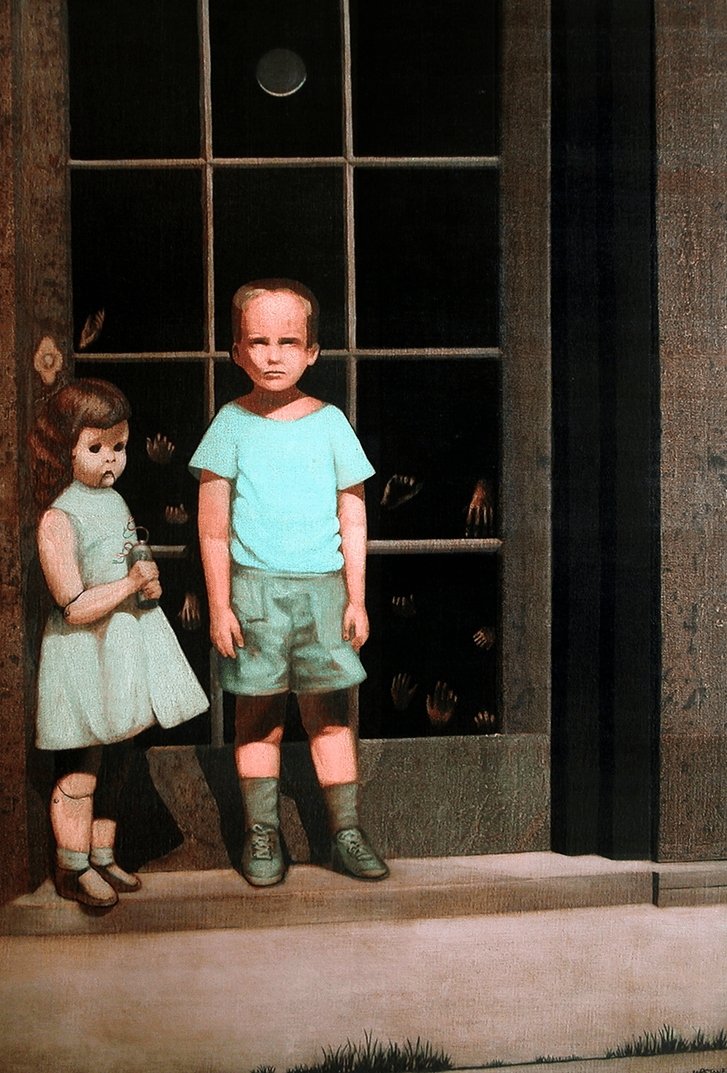
At first glance, it appears to be an unsettling but ordinary painting. It shows a young boy standing beside a life-sized doll in front of a glass door. Behind the glass, dozens of mysterious hands press outward from the darkness. The children’s expressions are difficult to interpret. The doll’s eyes seem strangely lifeless. The hidden hands create an immediate feeling that something unseen is trying to reach into the world.
For many people, the painting is simply unusual artwork.
For others, it is one of the most famous allegedly haunted objects ever discussed online.
The legend exploded in the year 2000 after the painting appeared in an eBay auction accompanied by a chilling description. According to the sellers, people who viewed the painting experienced strange feelings, children cried after seeing it, and mysterious events supposedly occurred around it. Some readers even claimed they became physically ill merely by looking at the online photograph.
Within days, the auction became an internet sensation.
News websites reported the story.
Television programs investigated it.
Paranormal enthusiasts debated its meaning.
Skeptics dismissed it as clever marketing.
Millions of people downloaded the image simply to see whether they would experience anything unusual.
More than two decades later, The Hands Resist Him remains one of the internet’s most enduring haunted-object legends.
But what is the real story behind the painting?
Was it ever intended to be frightening?
Who created it?
Did mysterious events actually surround it?
Or did a combination of psychology, storytelling, and the early internet create one of the greatest modern urban legends?
The true history of The Hands Resist Him is every bit as fascinating as the ghost story itself.
The Painting That Started It All
The Hands Resist Him was painted in 1972 by American artist Bill Stoneham.
Unlike many artists whose works become famous immediately, Stoneham had no idea that one of his paintings would eventually become one of the internet’s most discussed works of art.
The painting measures approximately 36 by 24 inches.
Its central image is unforgettable.
A young boy stands beside a female doll.
Behind them is a glass-paneled door.
Beyond the glass, dozens of dark human hands press toward the surface.
The composition feels dreamlike rather than realistic.
Everything appears slightly wrong.
The doll resembles a human child but also looks mechanical.
The boy’s expression seems serious beyond his years.
The shadowy hands remain disconnected from visible bodies.
The longer viewers look, the more unsettling the painting becomes.
Yet nothing in the image explicitly depicts violence or horror.
Its disturbing atmosphere comes largely from mystery.
Who Is Bill Stoneham?
Bill Stoneham was born in 1947.
His early life was marked by difficult experiences.
He spent time in an orphanage before eventually being adopted.
These childhood experiences deeply influenced his artistic vision.
Throughout his career, Stoneham often explored themes involving memory, identity, dreams, childhood, and the subconscious mind.
Many of his paintings contain surreal imagery that encourages emotional rather than literal interpretation.
Unlike horror artists who deliberately aim to frighten audiences, Stoneham generally sought to explore psychological and symbolic ideas.
His work invites viewers to ask questions instead of providing clear answers.
Ironically, his most famous painting became known less for its artistic meaning than for the ghost stories that later surrounded it.
The Real Meaning Behind the Painting
The true inspiration for The Hands Resist Him is surprisingly personal.
Stoneham has explained that the painting was based on an old childhood photograph of himself at around five years of age.
The boy in the painting represents the young artist.
The doll symbolizes a guide leading him between reality and the world of dreams.
The glass door acts as a barrier separating waking life from imagination or unconscious experience.
The mysterious hands pressing against the glass represent countless possible lives, memories, opportunities, or unseen forces existing beyond ordinary awareness.
Rather than depicting ghosts or demons, the painting explores the psychological boundary between childhood imagination and reality.
Its unsettling quality arises because dreams rarely follow ordinary logic.
Like many dreams, familiar objects appear strangely distorted.
Children become dolls.
Doors separate impossible worlds.
Unknown figures remain hidden in darkness.
Understanding the symbolism reveals a thoughtful work of surrealist art rather than an intentionally haunted image.
The First Exhibition
Soon after its completion, The Hands Resist Him appeared in an art exhibition.
According to later accounts, the painting attracted attention because of its unusual imagery.
An art critic reviewed the exhibition.
Actor John Marley, best known for his role in The Godfather, reportedly purchased the painting.
Years later, another strange coincidence entered the story.
Both the art critic who had reviewed the exhibition and Marley died after the exhibition, although at unrelated times and from natural causes.
These unrelated events later became incorporated into the haunted legend.
There is no evidence linking either death to the painting.
Nevertheless, such coincidences often fuel supernatural stories.
The Painting Disappears
Following John Marley’s ownership, the painting largely disappeared from public attention.
Its whereabouts remained uncertain for years.
Then, according to the later eBay description, someone discovered it abandoned near an old brewery in California.
Exactly how it ended up there remains unclear.
The couple who reportedly found the painting decided to take it home.
This ordinary decision would unexpectedly launch one of the internet’s most famous ghost stories.
The Famous eBay Auction
Everything changed in February 2000.
The painting appeared for sale on eBay.
Normally, old paintings attracted little attention.
However, this listing was anything but ordinary.
The sellers included a dramatic warning.
They explained that after bringing the painting home, strange events supposedly began occurring.
Their young daughter reportedly claimed that the figures inside the painting moved during the night.
She allegedly said the boy and doll sometimes left the painting.
Motion-triggered cameras supposedly captured unexplained activity.
The sellers carefully stated they were making no claims about supernatural causes while describing deeply unsettling experiences.
They even warned potential buyers to bid “at your own risk.”
This unusual presentation transformed an ordinary online auction into a global phenomenon.
The Story Goes Viral
Today, viral internet stories appear every hour.
In 2000, however, the internet looked very different.
Social media platforms did not yet dominate online communication.
Stories spread through email chains, forums, personal websites, and online message boards.
The haunted painting quickly became one of the web’s earliest viral mysteries.
People forwarded the auction to friends.
Paranormal websites copied the description.
News organizations noticed growing interest.
Millions of curious viewers visited the listing simply to examine the image.
Many had no intention of buying it.
They only wanted to know whether the frightening stories could possibly be true.
Strange Reactions From Viewers
Perhaps the most fascinating aspect of the legend involved people who never physically encountered the painting.
Some viewers claimed that simply looking at the digital image made them uncomfortable.
Others reported headaches.
A few described nausea.
Some insisted they felt watched.
Others experienced nightmares after viewing the auction.
From a scientific perspective, these reactions are not necessarily mysterious.
Human expectations strongly influence emotional responses.
When people are repeatedly told that an object is cursed or dangerous, anxiety can produce genuine physical sensations.
Psychologists call this the nocebo effect.
Just as positive expectations can sometimes improve perceived well-being, negative expectations may increase discomfort.
The reactions themselves were real to those experiencing them, even if no supernatural cause existed.
The Final Buyer
After receiving numerous bids and extraordinary public attention, the painting eventually sold for just over one thousand dollars.
The buyer was Kim Smith, owner of an online art gallery specializing in unusual works.
Unlike paranormal investigators, Smith approached the painting primarily as art.
After purchasing it, he reportedly received countless emails from people offering advice about handling haunted objects.
Some warned him not to display it.
Others suggested religious rituals.
Still others requested updates about strange events.
Smith displayed the painting in his gallery and generally reported no dramatic supernatural experiences.
The painting remains associated with his collection.
Did the Painting Actually Move?
One of the central claims in the eBay story involved movement.
The sellers suggested the painted figures changed positions during the night.
Motion-sensitive cameras allegedly captured evidence.
However, no independently verified documentation confirms these claims.
No publicly available photographs demonstrate actual movement.
No controlled scientific investigation recorded paintings coming to life.
The movement story remains part of the legend rather than established historical fact.
Still, because the image itself appears dynamic and psychologically unsettling, many viewers easily imagine motion where none exists.
This reflects the remarkable power of human perception.
Why the Painting Feels So Disturbing
Even without ghost stories, The Hands Resist Him produces an unusual emotional response.
Several artistic choices contribute to this effect.
The doll occupies an uncanny space between human and machine.
Psychologists often refer to this phenomenon as the “uncanny valley.”
Objects that appear almost human but not quite can provoke discomfort.
The boy avoids smiling.
His expression remains emotionally ambiguous.
The hands behind the glass create unresolved tension.
Because viewers never see the people attached to them, the imagination naturally fills the missing information.
The door itself suggests separation.
Something remains trapped.
Or perhaps something is trying to escape.
None of these elements explicitly depict horror.
Instead, they invite viewers to create their own unsettling interpretations.
The Power of Suggestion
One reason the painting became so famous involves suggestion.
Imagine encountering the image in a museum without knowing its reputation.
You might simply regard it as surreal artwork.
Now imagine seeing exactly the same painting after reading that viewers supposedly suffered nightmares and mysterious illnesses.
Your experience immediately changes.
Expectation shapes perception.
This psychological principle has been demonstrated repeatedly in scientific research.
When people anticipate fear, their brains become more sensitive to ambiguous stimuli.
Normal events may appear extraordinary.
Ordinary sounds seem suspicious.
Coincidences acquire deeper meaning.
The haunted reputation therefore became part of the artwork itself.
The Artist Responds
Bill Stoneham has frequently commented on the legend surrounding his painting.
He has consistently explained its symbolic meaning.
Rather than encouraging paranormal interpretations, he emphasizes its autobiographical and psychological origins.
Stoneham has expressed surprise that one painting overshadowed much of his broader artistic career.
In response to public interest, he later created additional paintings continuing the story of the original characters.
These sequels explore their imagined lives over subsequent decades.
The haunting legend was never part of his original artistic intention.
The Internet Creates a Modern Legend
The story of The Hands Resist Him illustrates how modern folklore develops.
Traditional ghost stories often evolved gradually over generations.
The internet accelerated this process dramatically.
Within weeks, thousands of people had contributed new details.
Some claimed personal experiences.
Others invented additional rumors.
Each retelling strengthened the legend.
Over time, separating fact from fiction became increasingly difficult.
The haunted painting became one of the earliest examples of internet-born mythology.
Haunted Objects Throughout History
Although the internet popularized The Hands Resist Him, haunted objects have existed in folklore for centuries.
Ancient cultures told stories about cursed jewelry.
Victorian ghost tales featured haunted mirrors.
Legends describe possessed dolls, mysterious portraits, musical instruments, and family heirlooms.
These stories often reflect emotional attachment to meaningful objects.
When something valuable passes through many lives, people naturally associate it with memory and mystery.
The painting fits comfortably within this much older storytelling tradition.
Can Paintings Be Haunted?
From a scientific perspective, there is no credible evidence demonstrating that paintings become supernaturally haunted.
Claims involving cursed or possessed objects generally rely upon anecdotal reports rather than repeatable observations.
This does not mean people fabricate every experience.
Emotions, expectations, environmental factors, sleep disturbances, coincidence, and psychological suggestion can all produce sincere experiences that feel extraordinary.
Science simply requires independently verifiable evidence before accepting supernatural explanations.
To date, The Hands Resist Him has not provided such evidence.
Why People Love Haunted Stories
Humans are natural storytellers.
Mysteries capture attention because they encourage imagination.
A haunted object combines familiar reality with impossible possibilities.
Unlike monsters hidden deep in forests, paintings exist inside ordinary homes.
This familiarity makes the story more relatable.
The painting also leaves many questions unanswered.
Why the hands?
Why the doll?
Why does the boy appear so serious?
Ambiguity allows countless personal interpretations.
The less a story explains, the longer it survives.
The Painting Today
Today, The Hands Resist Him remains one of the world’s most recognizable allegedly haunted artworks.
Thousands of websites continue discussing it.
Videos analyzing its symbolism receive millions of views.
Collectors of paranormal stories regularly include it among famous cursed objects.
Meanwhile, art historians continue appreciating it as an example of surrealist painting rich in personal symbolism.
Its significance now exists on two levels.
One belongs to art history.
The other belongs to internet folklore.
Both stories have become inseparable.
Separating Fact From Fiction
Understanding the painting requires distinguishing documented history from legend.
Certain facts are well established.
Bill Stoneham painted the work in 1972.
It was inspired by a childhood photograph.
The doll symbolizes a guide between worlds of consciousness.
The hands represent alternate possibilities or hidden realities.
The painting appeared in a widely viewed eBay auction in 2000.
The listing described alleged paranormal experiences.
It sold after attracting enormous public attention.
Beyond these facts lies folklore.
Claims about moving figures, supernatural attacks, mysterious illnesses, and haunted activity remain anecdotal.
No independently verified scientific evidence confirms them.
Recognizing this distinction allows appreciation of both the artwork and the remarkable legend it inspired.
The Lasting Legacy of The Hands Resist Him
Very few paintings become cultural phenomena.
Even fewer inspire worldwide legends decades after their creation.
The Hands Resist Him accomplished both.
It demonstrated how the internet could transform an obscure artwork into global folklore.
It blurred the boundary between art, psychology, marketing, mystery, and storytelling.
Most importantly, it revealed something fundamental about human nature.
People are drawn toward mysteries they cannot fully explain.
Whether the painting is viewed as surreal art, psychological symbolism, or a modern ghost story depends largely upon the observer.
That very uncertainty ensures its lasting fascination.
Conclusion
The story of The Hands Resist Him is one of the most remarkable examples of modern folklore in the digital age. Painted in 1972 by Bill Stoneham as a deeply personal and symbolic exploration of childhood, dreams, and the boundary between reality and imagination, the artwork spent decades in relative obscurity before an extraordinary eBay auction transformed it into an international sensation. Through a combination of unsettling imagery, dramatic storytelling, and the rapid spread of information across the early internet, it became known as the “haunted eBay painting.”
Despite countless paranormal claims, there is no verified scientific evidence that the painting possesses supernatural powers or that it has caused mysterious illnesses, moving figures, or other unexplained events. Most documented facts point instead to a powerful work of surrealist art whose emotional impact is amplified by the stories attached to it. Psychology helps explain why viewers may experience fear or discomfort, especially when they approach the image expecting something disturbing.
Yet reducing the painting to either “haunted” or “not haunted” misses the deeper reason for its enduring appeal. Its mysterious composition invites endless interpretation, while its internet legend demonstrates how modern myths are created and shared. Today, The Hands Resist Him exists simultaneously as a respected artwork, a cultural curiosity, and one of the internet’s most famous ghost stories.
More than fifty years after it was painted and more than two decades after its legendary eBay auction, the mysterious boy, the lifeless doll, and the countless shadowy hands behind the glass continue to captivate audiences around the world. Whether viewed as psychological symbolism or supernatural folklore, The Hands Resist Him remains a powerful reminder that sometimes the most haunting stories are those created not by ghosts, but by the human imagination itself.