High in the snow-covered Alps, where jagged peaks pierce the clouds and icy winds sweep across ancient mountain passes, a remarkable discovery changed archaeology forever. On September 19, 1991, two German hikers crossing a glacier near the border between Italy and Austria noticed what appeared to be the body of a recently deceased climber. A head and part of a shoulder protruded from the melting ice, and at first glance, the scene looked tragic but ordinary.
It was anything but ordinary.
When experts arrived, they realized they were looking at something extraordinary. The frozen body had not been lying there for days or even years. It had rested beneath the glacier for more than 5,000 years.
The man became known as Ötzi the Iceman, named after the Ötztal Alps where he was found. He remains one of the oldest and best-preserved natural human mummies ever discovered. His clothing, tools, weapons, last meal, tattoos, and even the pollen trapped inside his digestive system have provided scientists with an unprecedented glimpse into life during the Copper Age.
But while researchers celebrated this incredible archaeological discovery, another story slowly began to emerge.
Within a few years of Ötzi’s discovery, several people connected with the mummy died unexpectedly. Journalists noticed the pattern. Newspapers began asking a dramatic question: Had Ötzi cursed those who disturbed his final resting place?
The idea spread rapidly. Some compared it to the so-called “Curse of the Pharaohs” associated with the tomb of Tutankhamun. Others believed the ancient traveler was somehow taking revenge on everyone who disturbed his peace.
As more deaths occurred, the legend grew stronger.
Was it merely a series of tragic coincidences?
Or was something far stranger taking place?
The real story behind the so-called Iceman’s Curse is a fascinating mixture of archaeology, psychology, probability, media influence, and one of history’s greatest prehistoric discoveries.
Who Was Ötzi the Iceman?
Ötzi was a man who lived approximately 5,300 years ago during Europe’s Copper Age.
Scientists estimate he died around 3300 BCE.
At the time of his death, he was about 45 years old, stood roughly 160 centimeters tall, and weighed around 50 kilograms.
For someone living more than five millennia ago, reaching his mid-forties represented a respectable age.
His remarkably preserved body allowed researchers to examine details that are normally lost forever in ancient human remains.
His skin, internal organs, stomach contents, hair, clothing, equipment, and even microscopic traces of pollen survived because the glacier rapidly froze and protected his body.
Very few archaeological discoveries have preserved so much information about a single individual.
The Discovery in the Alps
The discovery happened almost by accident.
German hikers Erika and Helmut Simon were descending a glacier in the Ötztal Alps when they noticed a body emerging from melting ice.
Authorities initially believed the remains belonged to a modern mountaineer who had died in a climbing accident.
Because only part of the body was visible, recovering it proved difficult.
Workers used ice axes and even pneumatic tools to free the frozen corpse.
Unfortunately, these early efforts caused some damage before anyone realized the body’s true age.
Once archaeologists examined the remains, excitement spread rapidly.
Radiocarbon dating soon confirmed that the body was thousands of years old.
Europe had gained one of its greatest archaeological treasures.
Why Ötzi Is So Important
Most ancient human skeletons reveal only bones.
Ötzi preserved almost everything.
His clothing survived.
His shoes remained intact.
His backpack frame, copper axe, knife, bow, arrows, and other equipment accompanied him.
Scientists even recovered the contents of his stomach.
Because of this extraordinary preservation, Ötzi provides an incredibly detailed picture of daily life during the Copper Age.
Researchers have reconstructed his diet, health, occupation, travel routes, and final hours with remarkable accuracy.
Few prehistoric individuals have ever told historians so much.
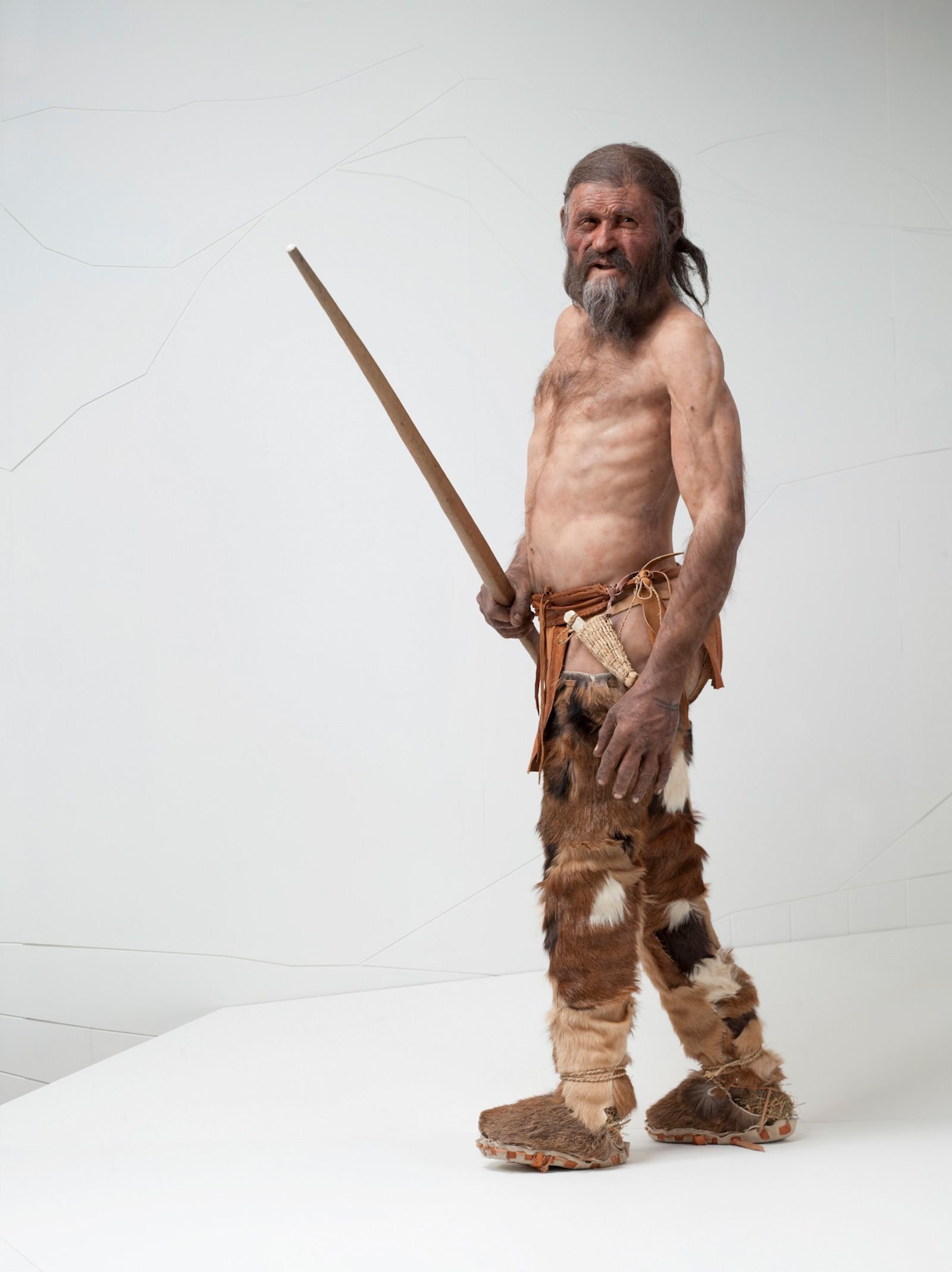
What Was Ötzi Wearing?
Ötzi’s clothing demonstrates impressive craftsmanship.
He wore a coat sewn from pieces of goat and sheep hide.
His leggings were made from animal skin.
His shoes contained bearskin soles, deer leather uppers, and grass insulation that helped keep his feet warm.
He also carried a woven grass cape that probably served as rain protection.
A bearskin hat completed his outfit.
These garments reveal that prehistoric people possessed sophisticated knowledge of tailoring and survival in harsh mountain environments.
His Remarkable Equipment
Among Ötzi’s possessions, one object stands out above all others.
He carried a copper-bladed axe.
Copper was an advanced material during his lifetime.
Possessing such a valuable tool suggests Ötzi may have held relatively high status within his community.
He also carried a flint knife, unfinished longbow, arrows, containers made from birch bark, cordage, mushrooms used for medicinal or fire-starting purposes, and other survival equipment.
Everything indicates careful preparation for traveling through mountainous terrain.
The Last Meal
For many years, scientists debated what Ötzi ate before dying.
Modern imaging eventually located his stomach in an unexpected position.
Its preserved contents revealed his final meal.
He had eaten meat from Alpine ibex and red deer.
He also consumed einkorn wheat and other plant foods.
Remarkably, the meal contained large amounts of fat.
Researchers believe this high-energy food would have helped sustain him during travel through cold mountain conditions.
Even thousands of years later, his last dinner still tells its story.
How Did Ötzi Die?
One of the greatest mysteries surrounding Ötzi concerned his death.
At first, researchers assumed he simply froze during a storm.
Later discoveries completely changed that interpretation.
A CT scan revealed an arrowhead lodged in his left shoulder.
The arrow had damaged a major artery.
Scientists concluded that severe bleeding likely caused his death.
Further examination revealed cuts on his hands.
These injuries suggest he had recently participated in violent conflict.
His body also showed evidence of head trauma, although researchers continue debating whether it occurred before, during, or after death.
Today, most experts believe Ötzi was murdered.
His death was not a peaceful accident.
It was the violent conclusion of a dramatic series of events more than five thousand years ago.
A Window Into Ancient Health
Ötzi also revealed surprising information about prehistoric health.
Scientists discovered hardened arteries, indicating cardiovascular disease.
Genetic analysis suggested he had inherited a predisposition toward heart disease.
His body contained evidence of arthritis.
He suffered from intestinal parasites.
His teeth showed significant wear.
Despite living an active outdoor life, he experienced many health problems familiar to modern humans.
This reminds us that ancient life was not necessarily healthier than today.
The Mystery of His Tattoos
Ötzi bears over sixty tattoos.
Unlike modern decorative tattoos, these consist mainly of simple lines and crosses.
Interestingly, many appear near joints affected by arthritis.
Some researchers believe they represent an early therapeutic practice similar to acupuncture.
Others suggest ritual or symbolic meanings.
Their exact purpose remains uncertain.
Nevertheless, they constitute some of the oldest known tattoos ever discovered.
The Birth of the Curse Legend
The idea of the Iceman’s Curse did not appear immediately after Ötzi’s discovery.
Instead, it emerged gradually.
As years passed, several people associated with the mummy died unexpectedly.
Journalists began connecting these unrelated deaths.
Headlines suggested an ancient curse.
The story spread internationally.
Each additional death strengthened public fascination.
Before long, many people genuinely wondered whether disturbing Ötzi’s resting place had triggered supernatural revenge.
The First Death
One of the earliest widely publicized deaths involved forensic scientist Rainer Henn.
He had examined Ötzi shortly after discovery.
Several years later, Henn died in a car accident while traveling to deliver a lecture.
Because he had worked with the mummy, newspapers included him among the alleged victims of the curse.
Yet statistically, traffic accidents unfortunately occur every day around the world.
No evidence connected his death to Ötzi beyond coincidence.
More Reported Victims
Additional individuals connected to Ötzi later died from various causes.
Mountain guide Kurt Fritz, who had helped recover the body, died in an avalanche.
Journalist Rainer Hölzl, who documented the discovery, died from a brain tumor.
Helmut Simon, one of the hikers who discovered Ötzi, tragically died after falling during a mountain hike in 2004.
Ironically, Simon had spent years involved in legal disputes regarding recognition for the discovery before his accidental death.
Dieter Warnecke, who led Simon’s rescue operation, died of a heart attack only hours after Simon’s funeral.
These tragedies received enormous media attention.
Soon, newspapers referred to them collectively as victims of the Iceman’s Curse.
Why the Curse Seemed Convincing
Humans naturally search for patterns.
When several unusual events occur within the same story, our brains instinctively connect them.
This tendency helped ancient humans survive by recognizing meaningful relationships in nature.
However, it can also lead people to perceive connections where none actually exist.
The deaths associated with Ötzi occurred over many years.
Numerous scientists, archaeologists, conservators, police officers, photographers, journalists, and officials worked with the mummy.
Only a tiny fraction experienced untimely deaths.
Thousands of others lived normal lives.
The media focused on dramatic cases while ignoring everyone else.
This created the illusion of a mysterious pattern.
The Psychology Behind Curses
Stories about curses appeal to something deeply human.
People enjoy mysteries.
They are fascinated by ancient civilizations.
Supernatural explanations capture attention far more easily than ordinary statistics.
Psychologists recognize a phenomenon called confirmation bias.
Once people believe a curse exists, they pay special attention to events supporting that belief while overlooking contradictory evidence.
Every unexpected death reinforces the legend.
Every ordinary outcome is forgotten.
This selective attention strengthens belief in the curse even when no objective evidence supports it.
Similar Ancient Curse Stories
Ötzi is not the first archaeological discovery linked to supernatural revenge.
The most famous example involves the so-called Curse of the Pharaohs after the opening of Tutankhamun’s tomb in 1922.
Following several deaths among individuals connected to the excavation, newspapers claimed the young pharaoh had cursed intruders.
Later analysis showed that most expedition members lived long lives.
The curse narrative persisted because dramatic stories attract readers.
Ötzi’s curse follows a remarkably similar pattern.
What Scientists Think
Archaeologists overwhelmingly reject the curse explanation.
No scientific evidence suggests ancient mummies can cause supernatural deaths.
Researchers emphasize probability.
When hundreds or thousands of people become associated with a famous discovery over several decades, some will inevitably die unexpectedly.
Given enough individuals and enough time, unusual coincidences naturally occur.
The curse reflects storytelling rather than measurable reality.
Scientists remain fascinated by Ötzi himself—not by supernatural claims surrounding him.
What DNA Revealed
Modern genetic research has transformed understanding of Ötzi.
Scientists successfully sequenced much of his genome.
The results revealed fascinating details.
He had brown eyes.
He was likely lactose intolerant.
He possessed genetic risk factors for cardiovascular disease.
He had ancestry related to early European farming populations.
Recent studies also suggest his appearance differed somewhat from earlier facial reconstructions.
His skin may have been darker than originally believed.
His hair was probably thinner.
These discoveries continue refining our understanding of his life.
Ancient Diseases
Researchers also identified traces of ancient pathogens.
Evidence suggests Ötzi carried the bacterium responsible for Lyme disease.
This represents one of the earliest known cases.
Scientists also detected Helicobacter pylori, a stomach bacterium still common today.
Studying these ancient microbes helps researchers understand the long evolutionary history of infectious diseases.
Ötzi continues contributing to modern medical science.
Life Five Thousand Years Ago
Beyond the curse legend, Ötzi provides an extraordinary glimpse into prehistoric Europe.
His tools reveal technological innovation.
His clothing demonstrates adaptation to mountain environments.
His final journey reflects long-distance travel.
His injuries suggest interpersonal violence already existed.
His stomach contents reveal agricultural practices.
His tattoos hint at medical traditions.
One frozen individual has illuminated an entire civilization.
Few archaeological discoveries possess comparable richness.
Why the Legend Refuses to Die
Even after scientists explain the coincidences, the curse story remains popular.
Part of the reason lies in human imagination.
Ancient mummies naturally inspire mystery.
Frozen bodies preserved for thousands of years seem almost supernatural.
People enjoy asking “what if?”
Could disturbing ancient graves carry consequences?
Could forgotten civilizations protect their dead?
These questions belong more to folklore than science, yet they remain emotionally compelling.
Legends often survive because they entertain rather than because they are true.
Ötzi’s Home Today
Today, Ötzi is preserved in the South Tyrol Museum of Archaeology in Bolzano, Italy.
He rests inside a specially designed cold chamber maintained at temperatures and humidity levels similar to those of the glacier where he spent over five millennia.
Visitors observe him through a small viewing window.
Strict environmental controls protect the fragile mummy from deterioration.
Scientists continue studying him using increasingly sophisticated technologies.
Even decades after his discovery, new findings regularly emerge.
The Real Legacy of Ötzi
The greatest story surrounding Ötzi is not revenge.
It is discovery.
His frozen body revolutionized archaeology.
He transformed understanding of prehistoric Europe.
He showed that ancient people possessed advanced clothing technology, metalworking skills, medical practices, and remarkable survival abilities.
His body revealed how ancient humans lived, traveled, fought, ate, dressed, and died.
His scientific importance far outweighs the sensational legend attached to his name.
Separating Fact From Fiction
The evidence is clear.
Ötzi existed.
He lived more than 5,000 years ago.
He died violently after suffering an arrow wound.
His body remained preserved by glacial ice.
Several people associated with his discovery later died under ordinary circumstances over many years.
No credible scientific evidence supports the existence of an Iceman’s Curse.
The curse belongs to popular culture.
Ötzi belongs to archaeology.
Understanding this distinction allows us to appreciate both the fascinating legend and the remarkable scientific reality.
Conclusion
The story of Ötzi the Iceman is one of the most extraordinary archaeological discoveries in history. Preserved for more than 5,000 years beneath Alpine ice, his body has provided an unparalleled window into life during Europe’s Copper Age. From his clothing and tools to his tattoos, diet, diseases, and violent death, Ötzi has revealed details about prehistoric life that no ordinary archaeological excavation could ever provide.
Alongside this scientific treasure grew the legend of the Iceman’s Curse. A series of tragic but unrelated deaths among people connected to the discovery led newspapers and popular culture to suggest that Ötzi was somehow taking revenge on those who disturbed his final resting place. Although these stories captured the public imagination, careful examination shows that they are best explained by coincidence, selective attention, and the human tendency to create meaningful narratives from unrelated events. No scientific evidence supports the existence of a supernatural curse.
Yet the legend itself tells us something important—not about ancient magic, but about ourselves. Human beings have always been drawn to mystery. We enjoy stories that blur the line between history and legend. Ancient discoveries naturally inspire imagination because they connect us with people who lived in worlds so different from our own.
In the end, Ötzi does not need a curse to remain unforgettable. His real legacy is far more remarkable than any supernatural tale. Frozen in time, he continues to teach us about technology, medicine, travel, violence, survival, and everyday life from more than five millennia ago. Every new scientific study adds another chapter to his story, reminding us that sometimes the greatest mysteries are not found in legends of revenge, but in the extraordinary truths preserved within the silent witness of the past.