History often feels like a completed puzzle. We learn about ancient Egypt, Rome, the Maya, China, Mesopotamia, and countless other civilizations as though every important question has already been answered. Museums display carefully labeled artifacts, textbooks present established timelines, and documentaries confidently explain how ancient people lived.
Yet behind this appearance of certainty lies a different reality.
Archaeologists and historians frequently disagree. New discoveries overturn long-held beliefs. Objects emerge from the ground with no obvious purpose, no surviving instructions, and no clear place in the historical record. Some artifacts challenge assumptions about technology. Others raise difficult questions about religion, politics, trade, or human creativity. Many are understood only partially, while a few remain almost completely mysterious.
Contrary to sensational claims found across the internet, these objects do not prove the existence of extraterrestrials, lost super-civilizations, or forgotten advanced technologies. Extraordinary claims require extraordinary evidence, and in most cases such evidence simply does not exist.
What does exist, however, is something equally fascinating: genuine uncertainty.
These artifacts represent some of history’s greatest unanswered questions. Scientists continue to study them using archaeology, chemistry, linguistics, geology, engineering, and advanced imaging technologies. Even after decades—or centuries—of research, experts still debate exactly what these objects were, how they were used, or why they were created.
The mysteries are real.
And that makes them far more captivating than fiction.
Why Historians Disagree About Ancient Artifacts
People often imagine archaeology as a science that produces clear answers. In reality, it is often more like detective work.
Artifacts rarely come with written instructions explaining their purpose. Many are found broken, incomplete, or far from where they were originally used. Entire civilizations disappeared without leaving readable records. Organic materials decay, buildings collapse, and floods, earthquakes, wars, and looting destroy valuable evidence.
Historians must reconstruct the past from fragments.
An object’s material, location, craftsmanship, wear patterns, and surrounding archaeological context all provide clues. Yet clues can point toward multiple explanations.
Sometimes scholars agree about an artifact’s age but debate its purpose.
Sometimes they understand its function but disagree about its cultural meaning.
Occasionally they cannot even agree on what kind of object it actually is.
These disagreements are not weaknesses in historical research. They are signs that science remains open to new evidence.
The following fifteen artifacts continue to inspire lively debate among experts around the world.
1. The Roman Dodecahedrons
Few ancient objects have generated as many competing theories as the Roman dodecahedrons.
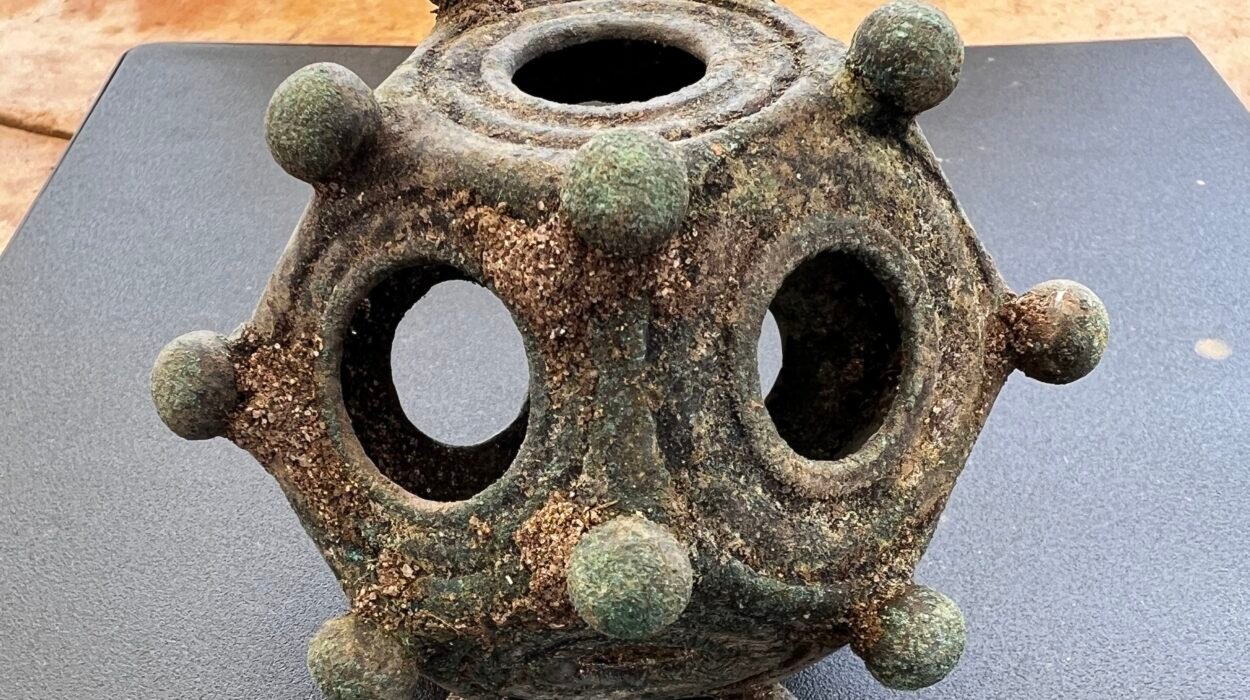
More than one hundred examples have been discovered across former Roman territories, especially in modern-day France, Germany, Belgium, Britain, and the Netherlands. Most date between the second and fourth centuries CE.
Each bronze object has twelve pentagonal faces with circular holes of varying sizes. Small knobs decorate every corner.
Beyond those basic facts, certainty disappears.
No Roman text describes them.
No surviving artwork clearly depicts them.
No instruction manual exists.
Over the years, historians have proposed dozens of explanations. Some believe they served as surveying instruments. Others suggest candle holders, religious objects, astronomical tools, military rangefinders, knitting devices, or ceremonial artifacts.
Experimental archaeologists have tested many of these ideas, but none has gained universal acceptance.
The greatest mystery may be why such carefully crafted objects appear across a large region of the Roman Empire while remaining almost completely absent from written history.
2. The Antikythera Mechanism
The discovery of the Antikythera Mechanism transformed our understanding of ancient engineering.
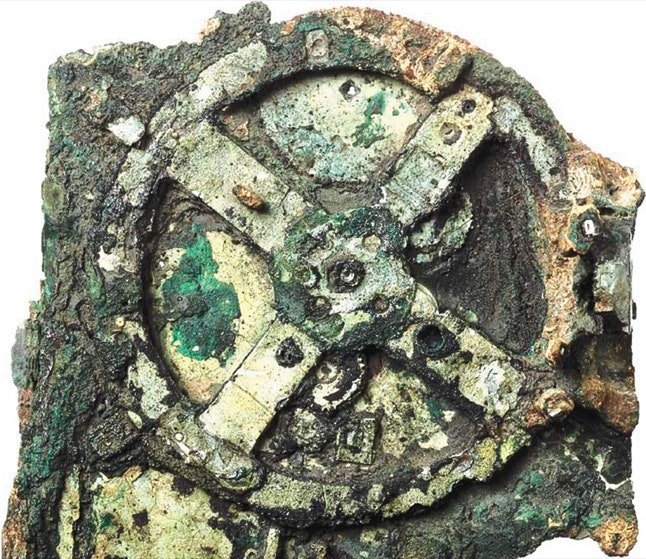
Recovered from a Greek shipwreck in 1901, the heavily corroded bronze object initially appeared insignificant. X-ray imaging later revealed an astonishing network of precision gears unlike anything previously known from the ancient world.
Researchers now understand much of its operation.
The mechanism predicted eclipses, tracked planetary movements, calculated lunar cycles, and followed several ancient calendars.
Yet significant questions remain.
Who invented such advanced technology?
How widespread was this knowledge?
Why have no comparable machines survived from the same period?
The engineering displayed by the mechanism rivals technologies that would not become common again until medieval Europe.
Historians continue debating whether this remarkable instrument represented an isolated masterpiece or part of a broader tradition now lost forever.
3. The Phaistos Disc
Discovered in 1908 within the Minoan palace of Phaistos on Crete, this fired clay disc remains one of archaeology’s greatest linguistic puzzles.
Its surface contains a spiral arrangement of stamped symbols.
Unlike handwritten inscriptions, these symbols were pressed into the clay using individual stamps before firing, making the artifact an early example of reusable printing technology.
The disc contains forty-five distinct symbols.
No one knows what they mean.
Some scholars believe the inscription records a religious hymn.
Others suggest a legal document, calendar, ritual text, prayer, game board, or educational exercise.
The greatest obstacle is the lack of comparison material.
Only one authentic Phaistos Disc has ever been found.
Without additional examples, deciphering the script remains extraordinarily difficult.
4. The Voynich Manuscript
Perhaps no book has frustrated scholars more than the Voynich Manuscript.
Radiocarbon dating places its parchment in the early fifteenth century, yet its mysterious script has resisted every serious attempt at decipherment.
The manuscript contains hundreds of pages filled with strange botanical drawings, astronomical diagrams, bathing women, pharmaceutical illustrations, and flowing text written in an unknown writing system.
Linguists, cryptographers, artificial intelligence researchers, and historians have all attempted to unlock its meaning.
Despite decades of study, no interpretation has gained scholarly consensus.
Some researchers argue it represents an encrypted language.
Others believe it records an otherwise unknown natural language.
A minority propose that it is an elaborate medieval hoax.
Computer analysis suggests the text follows statistical patterns typical of genuine languages rather than random symbols.
Even so, its meaning remains hidden.
5. The Baghdad Battery
Few artifacts have inspired more public fascination than the so-called Baghdad Battery.
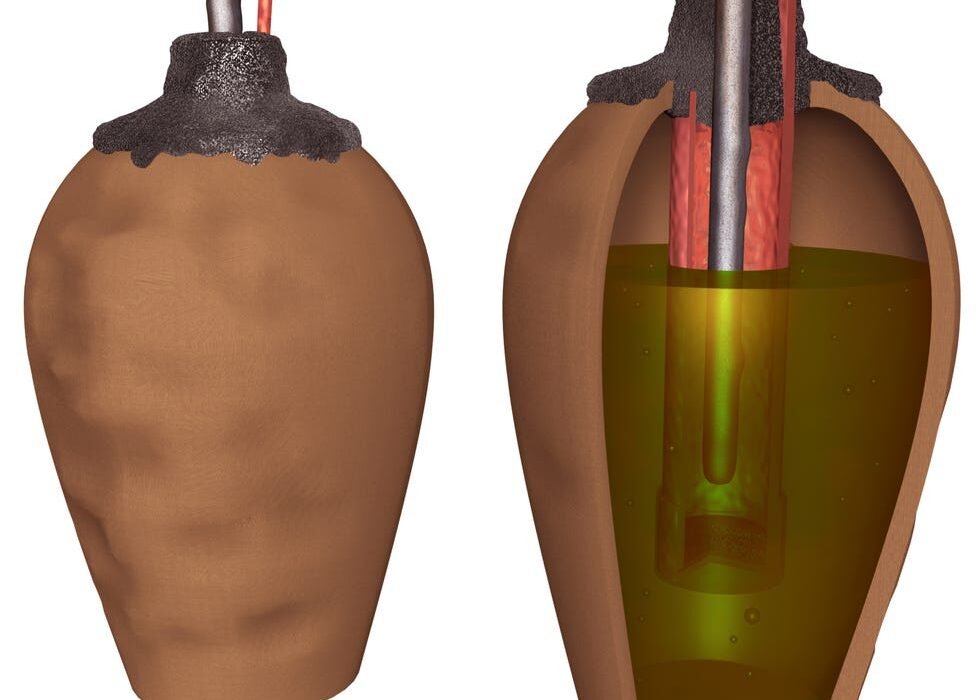
Discovered near Baghdad during the twentieth century, the object consists of a ceramic jar containing a copper cylinder and an iron rod.
When modern researchers recreated the design using acidic liquids, the replicas generated small electrical currents.
This led to the famous hypothesis that ancient people may have constructed primitive batteries.
The idea remains controversial.
Supporters argue the design naturally produces electricity.
Critics note that no electrical devices, wiring, or supporting evidence have been found alongside these jars.
Alternative explanations include storage containers for scrolls, religious objects, or vessels used in manufacturing processes.
Historians continue debating whether the electrical interpretation reflects ancient reality or simply modern curiosity projected onto the past.
6. The Saqqara Bird
In 1898 archaeologists uncovered a small wooden bird inside an ancient Egyptian tomb dating to roughly the third century BCE.
At first glance it appears to be an ordinary carved bird.
Closer examination raises intriguing questions.
Unlike most decorative bird carvings, the artifact possesses features resembling a vertical tail fin similar to those found on modern aircraft.
Some enthusiasts have suggested it functioned as a glider model.
Professional Egyptologists remain skeptical.
Many scholars believe it served symbolic or religious purposes, while others see it as a simple toy or decorative object.
Experiments with replicas have produced mixed results.
The artifact’s exact purpose continues to generate debate.
7. The Cochno Stone
Hidden beneath the Scottish countryside lies one of Europe’s largest collections of prehistoric rock art.
The Cochno Stone stretches across an enormous rock surface covered with circles, spirals, grooves, and mysterious geometric carvings created approximately five thousand years ago.
The carvings clearly held significance for the people who made them.
What significance remains uncertain.
Researchers have suggested astronomical maps, religious symbolism, territorial markers, ceremonial pathways, artistic expression, or combinations of several meanings.
No written records survive to explain the designs.
The stone remains a remarkable example of prehistoric communication whose message has largely disappeared.
8. The Vinča Symbols
Across southeastern Europe archaeologists have discovered thousands of pottery fragments bearing mysterious symbols associated with the Vinča culture, which flourished roughly between 5700 and 4500 BCE.
Some scholars argue these marks represent one of humanity’s earliest writing systems.
Others disagree.
Critics believe the symbols functioned as ownership marks, religious signs, potters’ signatures, or decorative motifs rather than true writing.
The distinction matters enormously.
If the Vinča symbols constitute genuine writing, they would significantly alter our understanding of literacy’s origins.
At present, historians remain divided.
9. The Lycurgus Cup
The Lycurgus Cup appears almost magical.
Viewed under reflected light, the Roman glass vessel looks green.
When illuminated from behind, it turns brilliant red.
Modern scientific analysis revealed that microscopic particles of gold and silver embedded within the glass create this remarkable optical effect.
The chemistry is understood.
The historical mystery is not.
Did Roman artisans intentionally manipulate nanoparticles?
Or was the effect discovered accidentally through generations of experimentation?
The answer remains uncertain.
Whatever the explanation, the cup demonstrates astonishing craftsmanship that continues to impress modern materials scientists.
10. The Shigir Idol
Discovered in a peat bog within Russia’s Ural Mountains, the Shigir Idol is the world’s oldest known monumental wooden sculpture.
Radiocarbon dating places it at roughly 12,000 years old.
Its surface contains geometric carvings and several carved human-like faces.
The idol predates Stonehenge, the pyramids, and agriculture in many parts of the world.
Researchers know its age.
They know it was intentionally carved.
They do not know precisely what it represented.
Suggestions include ancestor worship, spiritual beliefs, territorial markers, mythological storytelling, or ritual symbolism.
Because wood rarely survives for thousands of years, comparable artifacts are almost nonexistent.
The Shigir Idol offers an extraordinary glimpse into Ice Age belief systems while leaving many questions unanswered.
11. The Giant Stone Spheres of Costa Rica
Hundreds of nearly perfect stone spheres lie scattered across Costa Rica.
Some measure only a few centimeters across.
Others exceed two meters in diameter and weigh several tons.
Archaeologists generally agree they were created by pre-Columbian societies between approximately 300 and 1500 CE.
The mystery concerns their purpose.
Some spheres stood near important settlements.
Others appear arranged in geometric patterns.
Possible explanations include symbols of political authority, astronomical alignments, territorial markers, ceremonial monuments, or displays of elite power.
Without written records, certainty remains elusive.
12. The Fuente Magna Bowl
The Fuente Magna Bowl, reportedly discovered near Lake Titicaca in Bolivia, has generated decades of controversy.
The bowl bears markings that some researchers have claimed resemble ancient Mesopotamian cuneiform alongside local iconography.
If genuine and accurately interpreted, such similarities would imply unexpected ancient connections across vast distances.
Most specialists remain unconvinced.
Questions persist regarding the bowl’s discovery, documentation, archaeological context, and interpretation of its inscriptions.
Because of these uncertainties, historians continue debating whether the artifact represents a remarkable historical connection, misidentified symbols, or a modern misunderstanding.
13. The Cascajal Block
Discovered in Mexico, the Cascajal Block contains sixty-two carved symbols unlike any other known inscription.
Many researchers believe it represents the oldest known writing system in the Americas, associated with the Olmec civilization.
Others remain cautious.
The block lacks secure archaeological context because it was reportedly recovered during road construction rather than formal excavation.
Its unusual circumstances have fueled debate.
If authentic, the inscription could reshape understanding of literacy in ancient Mesoamerica.
Until additional examples are discovered, however, many questions remain unresolved.
14. The Nebra Sky Disc
Found in Germany, the Nebra Sky Disc dates to around 1600 BCE and ranks among Europe’s most remarkable Bronze Age discoveries.
The bronze disc features gold inlays depicting celestial objects.
Many researchers interpret the design as an astronomical representation of the sun, moon, stars, and perhaps the Pleiades star cluster.
Yet disagreement continues regarding its precise purpose.
Was it an astronomical instrument?
A ceremonial object?
A religious symbol?
A teaching device?
Some scholars believe its meaning evolved over generations as additional gold elements were added.
The artifact continues to challenge assumptions about prehistoric European astronomy.
15. The Crystal Skulls
Few artifacts have inspired as many myths as crystal skulls.
Some were once claimed to be ancient Mesoamerican masterpieces possessing mysterious powers.
Modern scientific investigations have complicated that narrative.
Detailed microscopic analysis indicates that many famous crystal skulls were likely manufactured during the nineteenth century using tools unavailable to ancient Mesoamerican civilizations.
However, historians still debate the origins of certain lesser-known examples, the motivations behind their creation, and the historical circumstances that allowed these objects to become legendary.
Rather than ancient supernatural relics, crystal skulls have become fascinating case studies in archaeology, collecting history, and the power of myth.
Why Disagreement Is a Strength, Not a Weakness
To many people, disagreement among historians appears frustrating.
Shouldn’t experts already know the answers?
In reality, disagreement often signals healthy scientific inquiry.
Researchers constantly evaluate new evidence.
Improved dating techniques produce more accurate ages.
Chemical analyses reveal manufacturing methods.
Microscopic studies uncover tool marks.
Artificial intelligence identifies patterns invisible to the human eye.
Every technological advance provides new opportunities to revisit old mysteries.
Science progresses not by defending certainty but by questioning it.
Many artifacts once considered mysterious are now well understood because scholars challenged earlier assumptions.
Today’s debates may become tomorrow’s accepted knowledge.
Separating Mystery from Myth
One reason these artifacts fascinate the public is that genuine uncertainty often attracts extraordinary claims.
When answers are missing, speculation quickly fills the gap.
Aliens.
Atlantis.
Time travelers.
Lost advanced civilizations.
While such ideas make entertaining stories, they rarely survive scientific examination.
The true wonder of archaeology lies elsewhere.
Ancient humans accomplished astonishing feats using the knowledge and resources available to them.
The construction of monuments, development of mathematics, creation of writing, mastery of astronomy, and production of sophisticated artwork required intelligence, patience, creativity, and generations of accumulated experience.
Recognizing genuine human achievement is far more rewarding than attributing every mystery to impossible explanations.
The Future of Ancient Mysteries
History is constantly changing.
Every year archaeologists uncover new settlements beneath deserts, forests, and oceans. Ancient DNA transforms our understanding of migration. Improved imaging technologies reveal hidden inscriptions. Satellite surveys identify thousands of previously unknown archaeological sites.
One discovery can solve a mystery that has endured for centuries.
A newly excavated inscription could explain the Roman dodecahedrons.
Another Phaistos Disc might finally reveal its script.
A forgotten library could contain records describing artifacts that today seem incomprehensible.
The past still has countless stories waiting to be uncovered.
That is what makes archaeology one of humanity’s greatest adventures.
These fifteen artifacts remind us that history is not a finished book but a living investigation. Every unanswered question invites curiosity. Every disagreement encourages deeper research. Every mysterious object challenges us to look beyond assumptions and continue searching for evidence.
Perhaps the greatest lesson these discoveries offer is one of humility.
Even with satellites orbiting Earth, artificial intelligence analyzing ancient texts, and laboratories capable of examining individual atoms, humanity still cannot explain everything our ancestors left behind.
And perhaps that is exactly as it should be.
The unknown keeps history alive. It inspires new generations of archaeologists, historians, linguists, engineers, and curious minds to continue asking questions that have echoed across centuries.
Somewhere beneath layers of soil, hidden inside forgotten tombs, resting on the floor of ancient seas, or preserved in silent caves, the next discovery may already exist—waiting patiently to settle one debate while creating ten new ones.