In the spring of 1974, a group of farmers in China’s Shaanxi Province set out to dig a well during a period of drought. Instead of finding water, their shovels struck something unexpected—fragments of ancient pottery buried beneath the earth. At first, it seemed like nothing more than broken clay. But as archaeologists began excavating the site, they uncovered one of the greatest archaeological discoveries in human history.
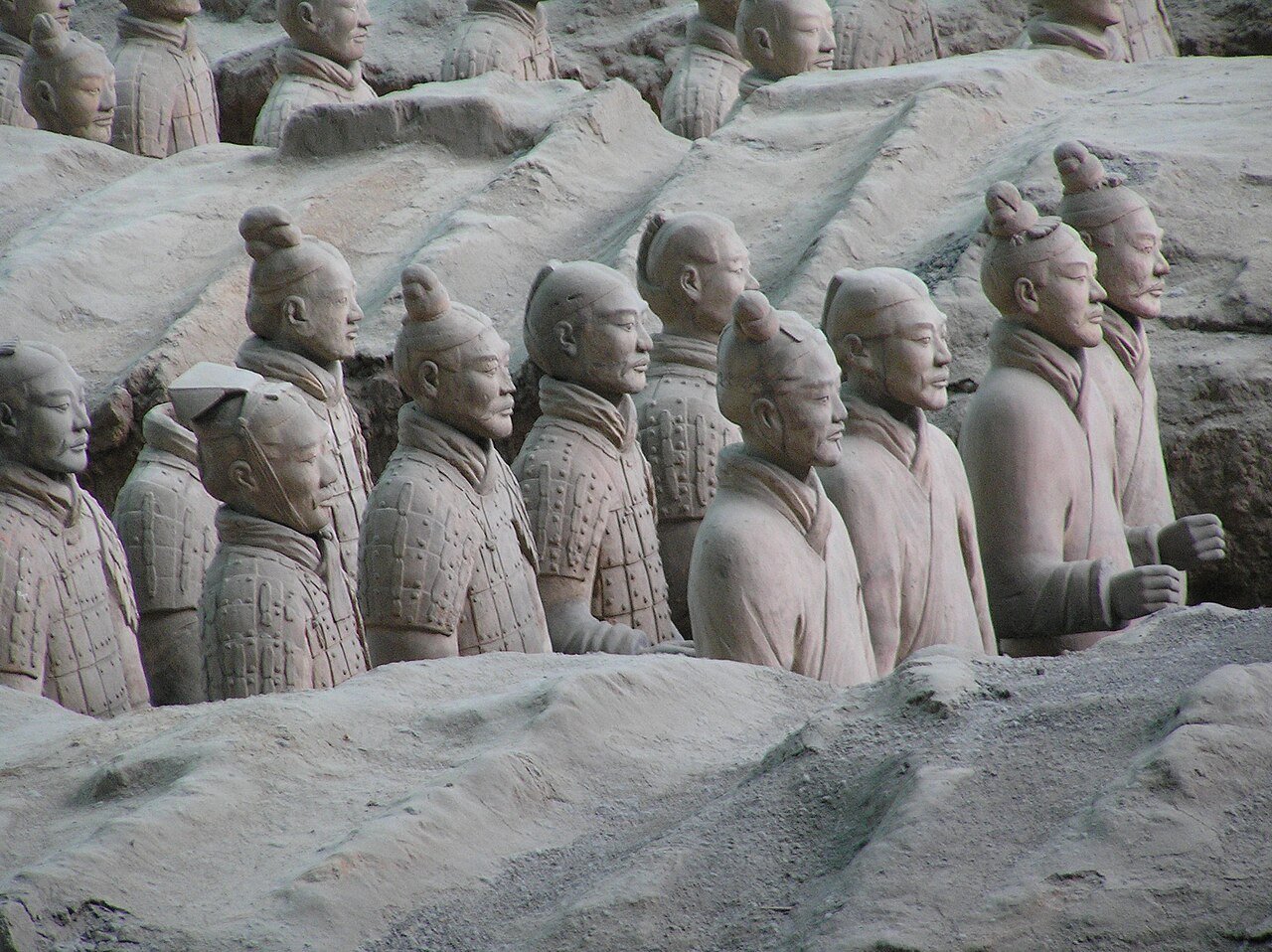
Hidden underground for more than 2,000 years stood thousands of life-sized clay soldiers, each with unique facial features, hairstyles, armor, and expressions. They stood in battle formation, silently guarding the tomb of China’s first emperor, Qin Shi Huang.
The discovery amazed the world.
Yet almost immediately, another story began to spread.
People whispered about mysterious deaths, strange accidents, ancient curses, hidden traps, rivers of poisonous mercury, and restless spirits protecting the emperor’s eternal resting place.
Could the Terracotta Army be cursed?
Or were these simply modern myths inspired by one of history’s most extraordinary archaeological sites?
The truth is both more fascinating and more mysterious than many fictional stories.
There is no scientific evidence that a supernatural curse protects the Terracotta Army. However, the tomb of Qin Shi Huang is surrounded by genuine historical mysteries that continue to puzzle archaeologists today. Ancient records describe deadly booby traps, underground rivers of mercury, hidden treasures beyond imagination, and a ruler so obsessed with immortality that he spent much of his life searching for eternal life.
These remarkable facts have inspired centuries of legends.
To understand the myths surrounding the Terracotta Army, we must first understand the extraordinary emperor who ordered its creation—a man whose ambition forever changed China and whose legacy continues to captivate the world.
Who Was Qin Shi Huang?
More than 2,200 years ago, China was not a single nation.
Instead, it consisted of several powerful kingdoms that constantly fought one another during a period known as the Warring States era.
One of these kingdoms was Qin.
In 259 BCE, a prince named Ying Zheng was born into the royal family of Qin.
He became king at just thirteen years old.
Although still young, he eventually proved to be an extraordinary military and political leader.
Over the following decades, Qin armies conquered one rival kingdom after another.
In 221 BCE, Ying Zheng achieved something no ruler had accomplished before.
He united much of China under a single government.
To celebrate this unprecedented achievement, he adopted a new title: Qin Shi Huang, meaning “First Emperor of Qin.”
His reign marked the beginning of imperial China.
A Ruler Who Changed History
Qin Shi Huang transformed China in ways that still influence the country today.
Before unification, each kingdom used different currencies, systems of measurement, writing styles, and even axle widths for carts.
Travel and trade were often difficult.
The emperor introduced sweeping reforms.
He standardized Chinese writing.
He created a unified currency.
He established common weights and measures.
He built an extensive road network.
He strengthened defensive walls that later contributed to what became the Great Wall of China.
Although his rule could be harsh, his reforms helped unite diverse regions into a more centralized empire.
Many historians regard him as one of the most influential rulers in world history.
The Emperor’s Fear of Death
Despite his enormous power, Qin Shi Huang shared one fear common to nearly every human being.
He feared death.
Ancient Chinese texts describe an emperor deeply obsessed with achieving immortality.
He sent expeditions across distant seas searching for magical islands where immortals supposedly lived.
He consulted alchemists who promised secret formulas capable of granting eternal life.
Ironically, some of these so-called elixirs contained mercury, which modern science recognizes as highly poisonous.
Many historians believe mercury poisoning may actually have contributed to the emperor’s death.
His desperate search for immortality ultimately failed.
Yet his fear of death inspired one of history’s greatest construction projects.
Building an Eternal Empire
Qin Shi Huang believed his rule should continue even after death.
Rather than preparing for the end of life, he planned an afterlife that mirrored his earthly empire.
Construction of his enormous mausoleum reportedly began soon after he became king.
According to ancient historian Sima Qian, hundreds of thousands of workers participated in building the vast burial complex.
The project continued for decades.
The emperor wanted everything he might need beyond death.
His underground kingdom would include palaces, treasures, officials, entertainers, weapons, horses, and soldiers.
The Terracotta Army formed only one part of this enormous funerary landscape.
The Discovery of the Terracotta Army
For centuries, the emperor’s buried army remained forgotten.
Local people occasionally found pottery fragments while farming, but no one understood their significance.
Everything changed in 1974.
As farmers dug their well, they unknowingly uncovered Pit 1.
Excavations soon revealed thousands of clay warriors standing in military formation.
Additional pits contained cavalry, chariots, horses, officers, archers, and command units.
The scale astonished archaeologists.
More than 8,000 warriors are believed to have originally guarded the tomb complex.
Many remain buried today.
The discovery quickly became one of archaeology’s greatest achievements.
Every Warrior Is Different
One of the most remarkable aspects of the Terracotta Army is its individuality.
At first glance, the soldiers appear identical.
Closer examination reveals something extraordinary.
Each face is unique.
Different hairstyles indicate military rank.
Armor varies according to position.
Facial expressions differ.
Some warriors have beards.
Others appear younger.
Although many parts were produced using standardized molds, skilled craftsmen finished each statue individually.
The result creates the impression of a real army composed of distinct individuals rather than identical copies.
More Than Just Soldiers
The Terracotta Army includes much more than infantry.
Archaeologists have discovered cavalry horses, war chariots, generals, officers, musicians, acrobats, civil officials, and strongmen.
These figures suggest the emperor intended to recreate his entire imperial court underground.
Rather than merely protecting his tomb, the statues symbolized a complete government prepared to serve him forever.
This extraordinary vision reflects Qin Shi Huang’s immense ambition.
Even death would not end his authority.
The Ancient Tomb That Remains Sealed
Surprisingly, the emperor’s central burial chamber has never been fully excavated.
Although the Terracotta Army has been extensively studied, the main tomb beneath a large burial mound remains unopened.
This decision is deliberate.
Modern archaeologists recognize that excavation can permanently damage fragile artifacts.
Current technology may not yet be capable of preserving everything inside the chamber.
Instead of rushing to uncover its secrets, researchers have chosen patience.
Future generations equipped with more advanced techniques may eventually investigate the tomb more safely.
For now, one of history’s greatest archaeological mysteries remains undisturbed.
Rivers of Mercury
One reason the tomb attracts so much fascination comes from an ancient historical account.
Historian Sima Qian described an underground palace containing rivers and seas made from liquid mercury.
For centuries, many scholars considered this description legendary.
Modern scientific investigations have produced surprising results.
Soil surrounding the burial mound contains unusually high concentrations of mercury.
Although researchers cannot yet confirm the exact arrangement described in ancient texts, these elevated mercury levels suggest the historical account may contain significant truth.
If enormous quantities of mercury exist within the sealed tomb, they present serious conservation and safety challenges.
The Legend of Deadly Traps
Ancient writings also describe sophisticated defensive mechanisms.
According to Sima Qian, crossbows were supposedly installed inside the tomb.
Anyone attempting to enter illegally would trigger deadly arrows.
No modern excavation has confirmed these traps because the burial chamber remains sealed.
Whether the mechanisms still function after more than two thousand years is impossible to know.
Nevertheless, the story contributes greatly to the tomb’s mysterious reputation.
Unlike fictional curses, mechanical traps were entirely possible using ancient engineering.
The Birth of the Curse Legend
Where did the idea of a curse originate?
Unlike the famous “Curse of Tutankhamun,” there is no ancient inscription warning visitors away from Qin Shi Huang’s tomb.
Instead, the curse developed gradually through popular imagination.
The emperor himself inspired fear.
Ancient texts portrayed him as powerful, ruthless, and determined to preserve his authority forever.
His hidden tomb, mysterious mercury, possible traps, and thousands of silent soldiers naturally encouraged stories of supernatural protection.
Books, movies, documentaries, and television programs amplified these legends over time.
Are There Strange Deaths?
Some people claim individuals connected with the Terracotta Army experienced mysterious deaths.
However, careful examination reveals no convincing evidence supporting a supernatural pattern.
Many archaeologists, conservators, workers, and researchers have spent decades studying the site without unusual incidents beyond the ordinary risks associated with archaeological work.
As with many famous discoveries, coincidence sometimes becomes transformed into legend.
Human beings naturally seek dramatic explanations for unexpected events.
Yet no scientific investigation has demonstrated the existence of a curse.
Why People Believe in Archaeological Curses
Curse stories appear repeatedly throughout history.
Ancient tombs inspire mystery.
They contain human remains, forgotten treasures, hidden chambers, and long-lost civilizations.
People often feel uneasy disturbing burial places.
This emotional response encourages supernatural explanations.
When accidents occur after excavations—as they sometimes do in any large project—stories quickly connect unrelated events.
The Terracotta Army follows this familiar pattern.
Its extraordinary discovery invited extraordinary myths.
The Emperor’s Reputation
Qin Shi Huang’s historical reputation also fuels curse legends.
Ancient historians often portrayed him as both brilliant and ruthless.
He ordered massive public works requiring enormous labor.
Some records describe severe punishments for opponents.
He reportedly burned certain books and persecuted some scholars, although historians continue debating aspects of these accounts.
Because of this reputation, later generations found it easy to imagine his spirit guarding the tomb fiercely.
Whether entirely accurate or partly shaped by later political biases, these stories strengthened the emperor’s legendary image.
Did Workers Die Building the Tomb?
Ancient texts describe immense labor devoted to constructing the mausoleum.
Some historical accounts suggest many workers died during the project because of harsh conditions.
Others claim laborers were sealed inside to protect the tomb’s secrets.
Modern archaeology provides evidence that construction demanded enormous effort.
However, claims that all workers were intentionally buried alive remain uncertain.
Some stories likely became exaggerated over centuries.
As with many ancient monuments, separating fact from legend can be difficult.
Hidden Treasures
Legends often describe unimaginable riches inside the emperor’s burial chamber.
Historical accounts mention gold, jade, pearls, bronze, precious objects, miniature palaces, and elaborate decorations.
Because the central tomb remains unopened, its true contents remain unknown.
Archaeologists believe extraordinary artifacts almost certainly await discovery.
However, sensational stories of limitless treasure should be treated cautiously until supported by evidence.
Why Archaeologists Have Not Opened the Tomb
Many people wonder why researchers simply do not excavate the emperor’s burial chamber.
The answer reflects lessons learned from previous discoveries.
When the Terracotta Warriors were first uncovered, many retained brilliantly painted surfaces.
Within minutes of exposure to air, much of the paint began peeling away.
Irreplaceable information disappeared forever.
Modern archaeology emphasizes preservation over rapid excavation.
Scientists prefer waiting until improved conservation techniques can better protect fragile artifacts.
Sometimes leaving a site untouched represents the most responsible scientific decision.
The Original Colors
Most visitors today see gray clay warriors.
Originally, they were brightly painted.
Their armor displayed vivid colors.
Faces appeared lifelike.
Clothing featured detailed decorative patterns.
The statues must have looked astonishing when first completed.
Unfortunately, exposure to oxygen caused much of the ancient paint to deteriorate rapidly after excavation.
Researchers continue developing methods to preserve remaining pigments.
This hidden color reminds us that the ancient world was far more vibrant than many people imagine.
How the Army Was Made
Creating thousands of life-sized figures required remarkable organization.
Craftsmen produced body parts using molds.
They then assembled and customized each warrior.
Artists sculpted facial details individually.
Weapons were manufactured separately.
Finally, painters added realistic colors.
The project resembled an enormous state-run manufacturing system.
It demonstrates impressive craftsmanship, planning, and quality control.
The Terracotta Army represents both artistic achievement and administrative excellence.
The Weapons Were Real
Unlike many ceremonial statues, the Terracotta Warriors originally carried genuine bronze weapons.
Archaeologists discovered swords, spears, crossbows, arrowheads, and other military equipment.
Many remained surprisingly sharp despite centuries underground.
Advanced bronze-working techniques contributed to their excellent preservation.
These were not decorative toys.
They reflected actual military technology used during Qin Shi Huang’s reign.
What the Army Really Represents
Although popular culture often portrays the Terracotta Army as supernatural guardians, historians interpret them differently.
The statues express ancient Chinese beliefs concerning death and the afterlife.
The emperor expected to continue ruling beyond death.
His underground army symbolized eternal protection and imperial authority.
Rather than literal magical guardians, they represented political power extending into the next world.
Understanding this cultural context makes the monument even more meaningful.
The Legacy of Qin Shi Huang
Qin Shi Huang remains one of history’s most controversial rulers.
Some admire his achievements.
Others criticize his authoritarian methods.
Yet few deny his historical importance.
He unified China.
He standardized administration.
He initiated lasting reforms.
He commissioned one of humanity’s greatest archaeological monuments.
His empire lasted only a short time after his death, but many of its institutions influenced later Chinese dynasties for centuries.
His tomb continues reflecting both his remarkable accomplishments and his deep fear of mortality.
Separating Myth from Reality
When examining the Terracotta Army’s supposed curse, the evidence becomes clear.
No scientific proof supports the existence of supernatural forces protecting the site.
Stories of mysterious deaths, haunted warriors, and magical punishments belong to folklore rather than archaeology.
Yet the real history remains extraordinary.
A ruler sought immortality.
He built an underground empire.
Thousands of artisans created an army unlike anything the world had ever seen.
Ancient historians described rivers of mercury and hidden traps.
Modern science has confirmed unusually high mercury levels around the tomb.
These authentic mysteries require no supernatural embellishment.
Reality is already astonishing.
Why the Terracotta Army Continues to Fascinate Us
More than fifty years after its discovery, the Terracotta Army continues captivating millions.
It combines art, history, engineering, archaeology, mystery, and human emotion.
Visitors stand before silent ranks of warriors who have guarded their emperor for more than two millennia.
The sealed tomb still conceals unknown secrets.
Future discoveries may transform our understanding of ancient China.
Until then, imagination naturally fills the gaps.
Perhaps that is why myths continue thriving alongside historical facts.
Conclusion
The Terracotta Army stands as one of the greatest archaeological discoveries in history and one of the most enduring symbols of ancient China’s remarkable achievements. Created more than 2,200 years ago to guard the tomb of Qin Shi Huang, the first emperor of a unified China, these thousands of life-sized clay warriors represent extraordinary craftsmanship, careful planning, and an ambitious vision of eternal rule. Every statue, every weapon, and every carefully arranged battle formation reflects the emperor’s determination to carry his power into the afterlife.
Over the centuries, stories of curses, hidden treasures, deadly traps, restless spirits, and supernatural guardians have surrounded the site. While these legends continue to inspire books, films, and popular culture, modern archaeology has found no convincing evidence of a genuine curse. Instead, researchers have uncovered something far more compelling: a real historical mystery shaped by remarkable engineering, ancient beliefs about death, possible rivers of mercury, and a still-sealed imperial tomb whose greatest secrets remain hidden beneath the earth.
The enduring fascination of the Terracotta Army lies not in supernatural tales but in the extraordinary reality behind them. Qin Shi Huang was a ruler who transformed China, yet he could not escape the universal human fear of death. His search for immortality failed, but his legacy achieved something perhaps even greater. More than two thousand years after his empire disappeared, his silent army continues to stand watch, inspiring wonder, curiosity, and countless questions.
As archaeological science advances, future generations may one day unlock the mysteries of the emperor’s unopened burial chamber. Until that time, the Terracotta Army reminds us that history itself can be more astonishing than legend. The true story of the First Emperor is not one of magical curses, but of ambition, innovation, power, and humanity’s timeless desire to be remembered forever.