Every civilization leaves behind traces of its existence. Some build monuments that stand for thousands of years. Others leave pottery, tools, temples, or cities buried beneath forests and deserts. But perhaps the most intimate legacy any civilization can leave is its writing. Written words preserve ideas, beliefs, laws, scientific knowledge, personal stories, and memories across generations. They allow people long gone to speak directly to the future.
Yet not every ancient voice can still be heard.
Throughout history, countless writing systems have disappeared. Some vanished because the civilizations that created them collapsed. Others were replaced by new languages or forgotten after conquest and migration. Manuscripts decayed. Wooden tablets rotted. Libraries burned. Scribes died without passing on their knowledge. Over centuries, once-familiar symbols became mysterious patterns that no one could understand.
Modern linguistics and archaeology have achieved extraordinary successes in deciphering ancient scripts. Egyptian hieroglyphs, once considered unreadable, yielded their secrets after the discovery of the Rosetta Stone. Mesopotamian cuneiform, Maya glyphs, and several other writing systems have also been deciphered through decades of careful scholarship.
But some texts continue to resist every attempt at interpretation.
These are not simply puzzles waiting for clever solutions. They are scientific challenges involving linguistics, archaeology, cryptography, statistics, history, and increasingly, artificial intelligence. Researchers analyze grammar, compare symbol frequencies, examine archaeological context, study ancient trade networks, and apply sophisticated computational models. Even so, a handful of ancient texts remain stubbornly silent.
Their symbols are visible. Their pages survive. Their inscriptions can be photographed in extraordinary detail. Yet their meaning remains hidden.
The following five ancient texts are among the greatest unsolved linguistic mysteries in human history.
1. The Voynich Manuscript
Among all undeciphered texts, none has inspired more fascination than the mysterious Voynich Manuscript.
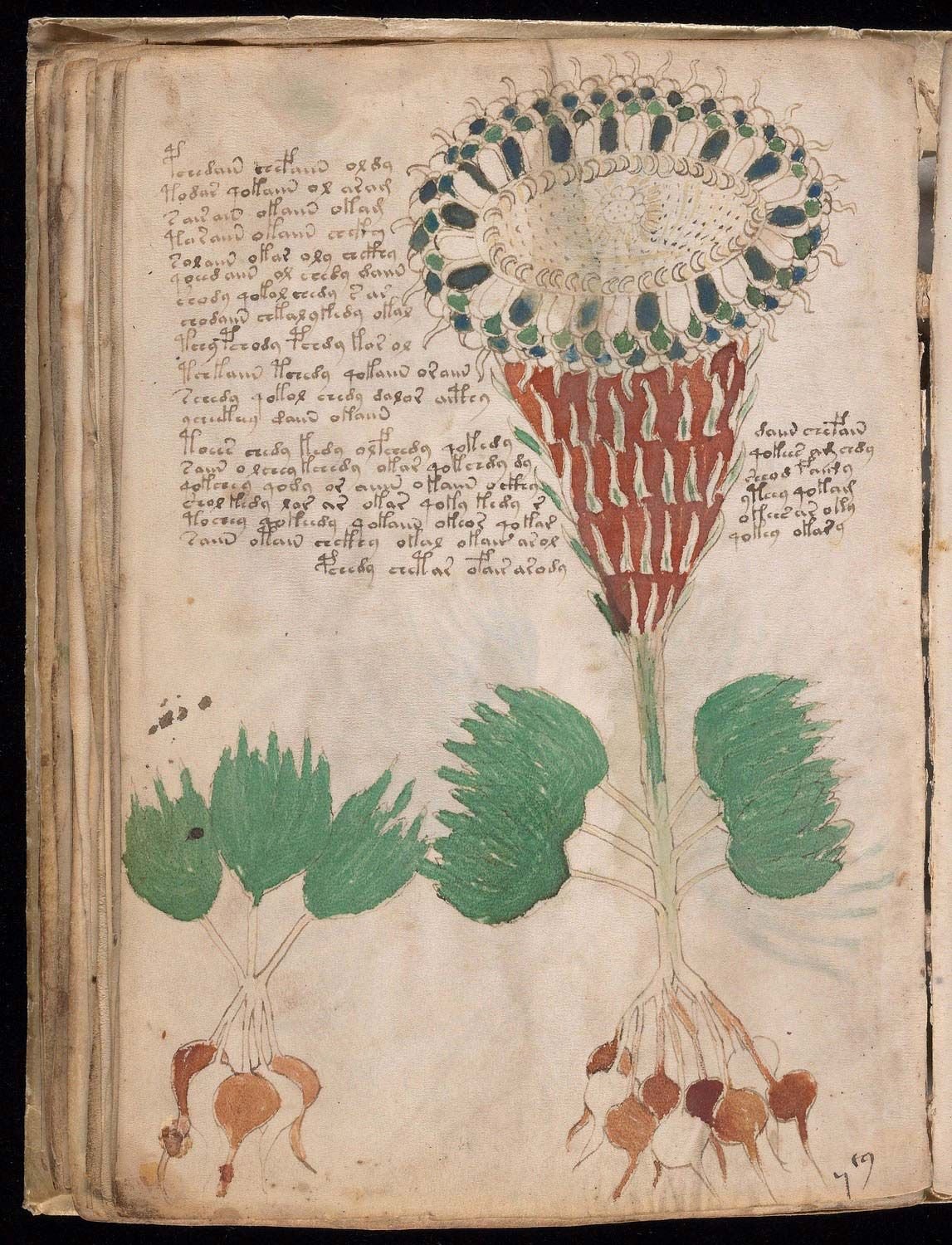
Its pages appear almost alive with mystery. Strange plants unlike any known species fill the margins. Constellation-like diagrams cover entire folios. Circular astronomical illustrations surround unfamiliar symbols. Human figures emerge from elaborate pools connected by intricate pipes and channels. Every page suggests meaning, yet nothing can be read.
The manuscript owes its modern name to the rare-book dealer Wilfrid Voynich, who purchased it in 1912. However, scientific testing has shown that the manuscript itself is much older.
Radiocarbon dating performed on its parchment indicates that it was created during the early fifteenth century, approximately between 1404 and 1438. This dating places the manuscript firmly within medieval Europe, ruling out many later theories about forgery.
At first glance, the writing resembles a genuine language. Individual words repeat in recognizable patterns. Certain symbols appear together frequently, while others rarely occur. Lines and paragraphs follow consistent formatting. Statistical analysis reveals characteristics remarkably similar to natural human languages.
This is one reason the manuscript has captivated linguists for more than a century.
If the text were simply random symbols, computers would detect obvious irregularities. Instead, analyses repeatedly show that its structure possesses levels of organization expected from meaningful communication.
Researchers have proposed hundreds of explanations.
Some believe it records a real language written in an unknown alphabet.
Others argue that it represents an elaborate cipher, where ordinary language has been encrypted.
Another possibility is that it preserves an extinct language with no surviving relatives.
A smaller number of scholars suggest it could be an elaborate medieval hoax designed to imitate meaningful writing without actually conveying information.
None of these ideas has achieved scholarly consensus.
Computational linguists have examined word frequency distributions using methods normally applied to modern languages. Cryptographers have tested countless decoding algorithms. Artificial intelligence systems have searched for hidden grammatical patterns. Yet every proposed translation eventually encounters serious problems.
The illustrations deepen the mystery.
The botanical section contains plants that cannot be confidently identified. Some appear to combine features from multiple species. Others may be stylized representations of real medicinal herbs, while still others may be entirely symbolic.
Astronomical diagrams include zodiac symbols familiar from medieval Europe, suggesting that at least some imagery reflects contemporary scientific traditions.
The biological section, filled with female figures immersed in flowing green liquid, has inspired countless interpretations ranging from medicine to alchemy.
Without understanding the text, however, none of these illustrations can be interpreted with confidence.
The Voynich Manuscript remains one of humanity’s greatest linguistic puzzles—not because there are no theories, but because none explains all the evidence.
Every page invites interpretation.
Every page resists certainty.
2. The Indus Valley Script
Long before ancient Greece reached its height, before Rome existed, and even before many Egyptian pyramids were completed, one of the world’s earliest urban civilizations flourished across the Indus River basin.
Known today as the Indus Valley Civilization, this remarkable society built carefully planned cities with sophisticated drainage systems, standardized brick construction, extensive trade networks, and impressive civic organization.
Major urban centers such as Harappa and Mohenjo-daro reveal extraordinary engineering for their time.
Yet despite decades of excavation, the civilization has never truly spoken to us.
Thousands of artifacts bear short inscriptions composed of distinctive symbols.
These inscriptions appear on seals, pottery, copper tablets, ivory objects, and other materials. More than four hundred different signs have been identified, although only a smaller subset appears frequently.
Unlike most ancient texts, however, the inscriptions are astonishingly brief.
Many contain only four or five symbols.
Very few exceed twenty.
This brevity creates one of the greatest obstacles to decipherment.
Successful decipherments usually rely on long texts that reveal grammar, sentence structure, repeated phrases, and contextual clues. The Indus inscriptions provide almost none of this information.
Researchers also lack a bilingual inscription comparable to the Rosetta Stone.
No ancient translation survives.
No known descendant writing system exists.
No historical record explains how the symbols were used.
Over the past century, scholars have proposed numerous interpretations.
Some argue that the script represents an early Dravidian language.
Others suggest connections to ancient Indo-Aryan languages.
A few researchers question whether the symbols represent writing at all, proposing instead that they functioned as religious or commercial symbols without encoding spoken language.
Computational analyses have shown that the order of symbols is neither completely random nor entirely fixed. Their statistical organization resembles known writing systems more closely than arbitrary decorative patterns.
Yet statistical similarity alone cannot reveal meaning.
The civilization itself remains equally mysterious.
Archaeologists have uncovered surprisingly little evidence of kings, large armies, or monumental palaces. The cities appear unusually standardized and well-organized, raising fascinating questions about political authority and social structure.
If the script could be deciphered, historians might finally understand how one of humanity’s earliest urban civilizations governed itself, worshipped, traded, and viewed the world.
Instead, thousands of inscriptions remain silent witnesses to a forgotten language.
3. Rongorongo of Rapa Nui
Far out in the southeastern Pacific Ocean lies the isolated island of Rapa Nui, famous for its enormous stone statues known as moai.
Yet another mystery rests not in stone but in wood.
Scattered among museum collections are a small number of carved wooden tablets bearing rows of unusual symbols.
This writing system is known as Rongorongo.
If Rongorongo truly represents writing—and most specialists believe it likely does—it would be one of the very few independently invented writing systems in human history.
The tablets contain hundreds of carefully carved symbols depicting humans, birds, fish, plants, tools, and geometric shapes.
Unlike alphabetic writing, each symbol resembles a miniature illustration.
One particularly intriguing feature is the direction in which the text was written.
Readers would begin at the bottom left of a tablet, read across a line, then rotate the tablet 180 degrees before continuing on the next line. This unusual system is known as reverse boustrophedon.
Unfortunately, nearly everything else remains uncertain.
European contact with Rapa Nui brought devastating disease, social disruption, and cultural transformation.
By the time scholars became interested in Rongorongo during the nineteenth century, few islanders remained who possessed traditional knowledge of the script.
No reliable reading tradition survived.
Only a limited number of tablets still exist today.
Some may have been destroyed during missionary activity or lost through decay.
The surviving examples provide too little material for straightforward decipherment.
Linguists have identified repeated sequences that may represent genealogies, ceremonial formulas, astronomical observations, or ritual chants.
However, no proposed interpretation has gained widespread acceptance.
Researchers continue using advanced imaging techniques to study carving styles, tool marks, and symbol variation.
Machine learning algorithms have recently begun identifying recurring structural patterns that human observers might overlook.
Even so, the meaning remains hidden.
The Rongorongo tablets preserve the possibility that an entire literary tradition once existed on one of the world’s most isolated inhabited islands.
Today, only fragments remain.
4. The Phaistos Disc
Sometimes a mystery fits in the palm of your hand.
Discovered in 1908 at the Minoan palace of Phaistos, the Phaistos Disc is a fired clay object roughly fifteen centimeters across.
At first glance, it appears almost modern.
Its surface contains spiral bands filled with carefully impressed symbols.
Unlike handwritten inscriptions, these signs were stamped into wet clay using individually carved seals.
Some historians have described this as one of humanity’s earliest examples of movable-type printing, although the exact production method remains debated.
The disc contains 241 individual symbols created from forty-five unique signs.
The images include human figures, birds, plants, shields, helmets, and various abstract forms.
Despite more than a century of study, nobody knows what the symbols mean.
One major challenge is uniqueness.
Only one confirmed Phaistos Disc exists.
Normally, decipherment depends upon comparing many examples of the same writing system.
Here, there is no comparable collection.
Researchers cannot determine whether the symbols represent syllables, words, religious icons, administrative records, poetry, or something else entirely.
Some scholars believe the language belongs to the Minoan civilization.
Others argue that it reflects an entirely different cultural tradition.
Because the disc was found in an archaeological context containing other Bronze Age artifacts, most experts accept its ancient origin.
Nevertheless, a few controversial claims have suggested modern forgery, although these arguments have generally failed to convince the majority of specialists.
The disc’s spiral arrangement has inspired many imaginative theories.
Some have proposed that it records a hymn.
Others suggest a military roster.
Still others envision a ritual calendar.
Each theory explains certain patterns while failing to account for others.
Until additional examples of the script are discovered—or another breakthrough occurs—the Phaistos Disc remains one of archaeology’s most beautiful unsolved riddles.
5. The Proto-Elamite Tablets
Long before the rise of the Persian Empire, southwestern Iran was home to one of the earliest complex societies in the ancient Near East.
Among its surviving artifacts are thousands of clay tablets bearing a script known today as Proto-Elamite.
Dating to approximately 3100–2900 BCE, these tablets are among the oldest known examples of writing.
Unlike the Indus inscriptions, Proto-Elamite texts are often quite lengthy.
This might seem to make decipherment easier.
Surprisingly, it has not.
Many tablets appear to record economic information involving livestock, grain, labor, and administration.
Numbers and accounting symbols can often be recognized because they resemble those used in neighboring Mesopotamian systems.
The difficulty lies in understanding the accompanying signs representing names, institutions, commodities, or grammatical relationships.
The language underlying Proto-Elamite remains uncertain.
It may represent an early ancestor of later Elamite.
It may record a different language entirely.
Scholars cannot yet determine this with confidence.
One reason for the difficulty is that the script was used for only a relatively brief historical period before disappearing.
Unlike Mesopotamian cuneiform, which evolved over thousands of years, Proto-Elamite left relatively few descendants.
Modern researchers are applying digital technology to the problem.
High-resolution three-dimensional scans allow scholars worldwide to examine tablets in unprecedented detail.
Damaged signs can be reconstructed virtually.
Databases compare symbol usage across thousands of inscriptions.
Artificial intelligence assists in identifying recurring combinations and possible administrative formulas.
Progress has been steady but incomplete.
Researchers now understand much more about the script’s structure than they did several decades ago.
Its actual language, however, remains undeciphered.
The tablets continue to preserve records of one of humanity’s earliest bureaucratic societies—records that can be counted, cataloged, and photographed, yet not fully understood.
Why Some Ancient Texts Resist Decipherment
When people first encounter these mysteries, the obvious question is often simple:
Why can’t scientists just decode them?
The answer lies in the nature of language itself.
Successful decipherment usually requires several crucial ingredients.
The first is abundant material. Long texts reveal grammar, vocabulary, and recurring expressions. Short inscriptions provide far fewer clues.
The second is context. If archaeologists know where a text was found, what objects surround it, and how it was used, interpretation becomes easier.
The third is comparison. A bilingual inscription or a known descendant language can transform an impossible puzzle into a solvable one. The Rosetta Stone succeeded precisely because it presented the same text in multiple scripts.
Many undeciphered texts possess none of these advantages.
Some survive only as isolated artifacts.
Others belong to languages with no living relatives.
Still others preserve writing systems entirely unlike anything known today.
Time has removed the very clues researchers need.
Modern Science and the Search for Ancient Voices
The effort to decipher ancient texts has changed dramatically in recent decades.
Linguists now collaborate with archaeologists, statisticians, computer scientists, mathematicians, and specialists in artificial intelligence.
Machine learning systems can identify hidden structural regularities across thousands of symbols.
Three-dimensional scanning captures damaged inscriptions with microscopic precision.
Multispectral imaging reveals faded ink invisible to the naked eye.
Digital databases allow scholars around the world to compare inscriptions instantly.
Even ancient DNA studies sometimes provide indirect clues by reconstructing migration patterns that may correspond to language families.
Yet technology has not eliminated uncertainty.
Computers can identify patterns.
Only evidence can confirm meaning.
A statistical similarity does not prove translation.
Scientific caution remains essential.
The Difference Between Mystery and Myth
Undeciphered texts often attract sensational claims.
Some people argue they contain knowledge of lost civilizations, extraterrestrial visitors, supernatural powers, or forgotten technologies far beyond their time.
There is no credible scientific evidence supporting such ideas.
The real mystery is already extraordinary.
These texts represent genuine human attempts to communicate across centuries.
They were written by real people living real lives within ancient societies.
Their meanings have been lost not because they were magical, but because history is fragile.
Languages disappear.
Libraries burn.
Empires collapse.
Knowledge survives only when it is continuously passed from one generation to the next.
The Hope of Future Discovery
History has repeatedly shown that impossible puzzles can eventually be solved.
Egyptian hieroglyphs remained unreadable for nearly fifteen centuries.
Maya writing baffled scholars for generations.
Both were ultimately deciphered through persistence, new evidence, and advances in scholarship.
The same could happen again.
A newly excavated archive might provide the missing bilingual inscription.
Another manuscript could preserve a forgotten grammar.
Additional tablets might reveal longer texts.
Future advances in computational linguistics may uncover patterns invisible today.
Every archaeological excavation carries that possibility.
Somewhere beneath desert sands, buried cities, or forgotten ruins may lie the missing key that transforms meaningless symbols into living language.
Listening to Silent Civilizations
Perhaps the greatest tragedy of undeciphered texts is not that we cannot read them.
It is that we know someone once could.
A scribe carefully carved the symbols of Rongorongo into wood.
An artisan impressed the signs of the Phaistos Disc into clay.
A merchant sealed goods with Indus symbols.
An administrator recorded transactions on Proto-Elamite tablets.
A medieval scholar filled page after page of the Voynich Manuscript with elegant writing.
To their creators, these texts were not mysteries.
They were ordinary communication.
Instructions.
Knowledge.
Poetry.
Religion.
Science.
Commerce.
Memory.
Today, they remain among humanity’s last unread libraries—beautiful, tangible, and profoundly silent. They remind us that history is never complete, that language is one of civilization’s greatest achievements, and that even in an age of satellites, supercomputers, and artificial intelligence, there are still voices from the ancient world patiently waiting to be heard once again.