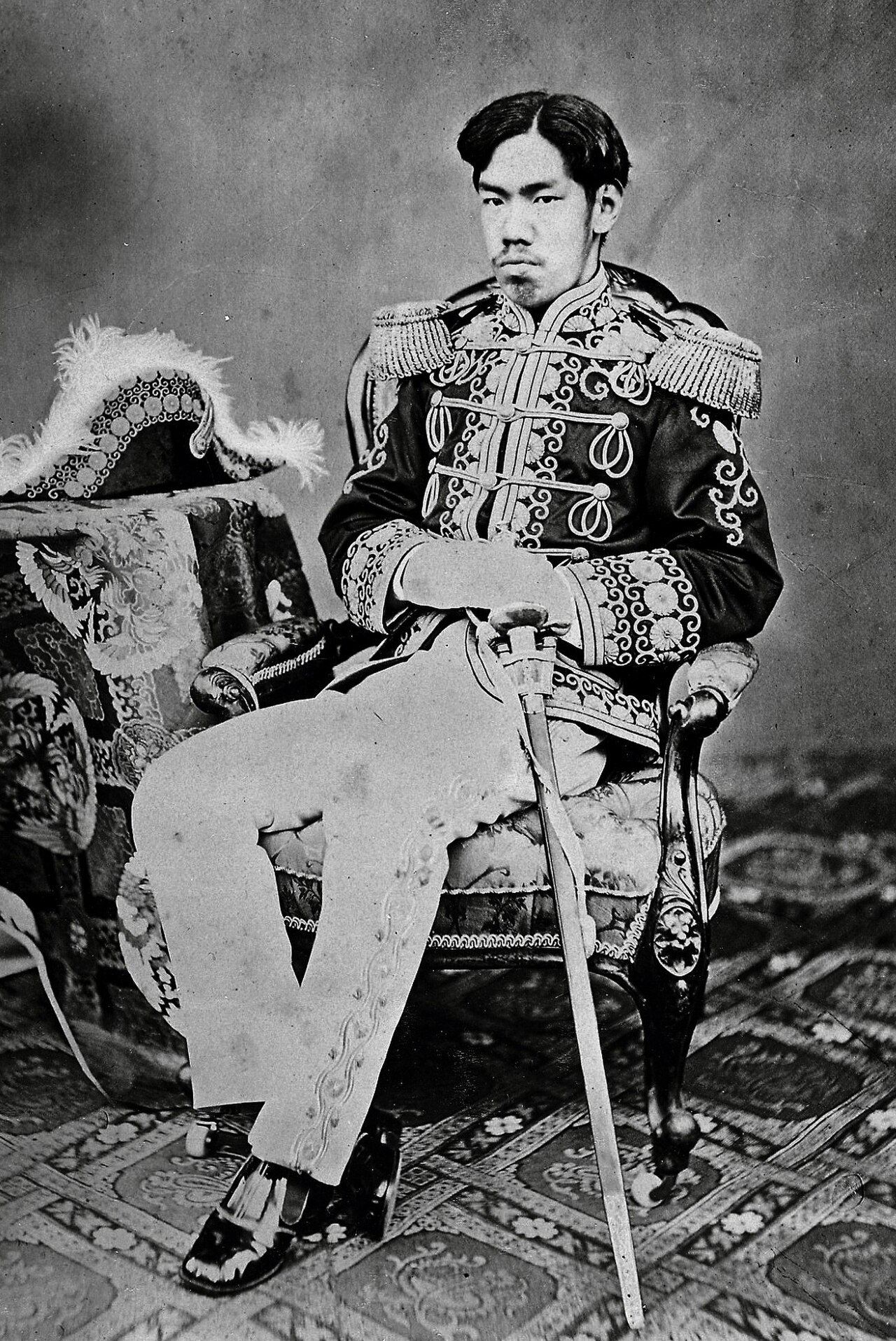
Emperor Meiji (born November 3, 1852, in Kyoto, Japan—died July 30, 1912, in Tokyo, Japan), whose personal name was Mutsuhito, was the 122nd emperor of Japan. He ruled from 1867 until his death in 1912, a period known as the Meiji era. During his reign, Japan changed from a largely traditional, feudal society into a modern industrial and military power. His reign included the end of the Tokugawa shogunate, the restoration of imperial government, the adoption of a new constitution, and major changes to Japan’s economy, education, military, and political system.
Birth and Family Background
Mutsuhito was born on November 3, 1852, in Kyoto, then Japan’s imperial capital. He was the son of Emperor Kōmei and one of the emperor’s consorts, Nakayama Yoshiko. He was born into the imperial family during a period when Japan was governed largely by the Tokugawa shogunate rather than by the emperor.
For centuries, Japanese emperors had held a position of religious and symbolic importance, but they generally exercised little direct political power. The Tokugawa shoguns, military rulers who governed from Edo, controlled the country’s administration and military affairs. The emperor and his court remained in Kyoto, where their influence was limited.
Mutsuhito grew up within the imperial court, surrounded by traditional ceremonies, customs, and expectations. His early life was shaped by the political tensions of the late Tokugawa period, when foreign pressure and growing domestic dissatisfaction were challenging the existing government.
Japan had maintained strict limits on foreign contact for much of the Tokugawa era. However, the arrival of American Commodore Matthew Perry’s naval expedition in 1853 and the agreements that followed forced Japan to open its ports to foreign trade and relations. These developments contributed to growing disagreements over how the country should respond to foreign influence.
Becoming Emperor
Mutsuhito became emperor on January 30, 1867, following the death of his father, Emperor Kōmei. He was still a teenager when he inherited the throne.
At the time, Japan was experiencing serious political conflict. Some powerful regional leaders wanted to end the Tokugawa shogunate and restore political authority to the imperial court. Others supported the existing government or disagreed over how much change the country needed.
In November 1867, Tokugawa Yoshinobu, the fifteenth and final Tokugawa shogun, formally returned his governing authority to the emperor. However, the transfer did not immediately settle the political struggle. Supporters of the imperial court and forces loyal to the shogunate continued to compete for control.
In January 1868, imperial forces declared the restoration of imperial rule. Fighting soon broke out in what became known as the Boshin War, a civil conflict between supporters of the new imperial government and those who remained loyal to the shogunate.
The conflict ended in 1869 with the victory of the imperial forces. The Tokugawa political system was dismantled, and the new government began reorganizing Japan under the emperor’s authority.
Although Mutsuhito became the central figure of the restored government, experienced officials and leaders from powerful former domains carried out much of the political and administrative work. The emperor’s role gradually became more prominent as the new system developed.
The Beginning of the Meiji Era
In 1868, the new government adopted the name Meiji for the emperor’s reign. The name is commonly translated as “enlightened rule.” This marked the beginning of the Meiji era, which lasted until 1912.
One of the government’s first major steps was to establish a new political center. In 1868, Mutsuhito moved from Kyoto to Edo, which was renamed Tokyo, meaning “Eastern Capital.” The imperial court moved with him, and Tokyo became the center of Japan’s new government.
The relocation was more than a change of residence. It represented the transfer of political authority away from the old Tokugawa center and helped establish Tokyo as the capital of modern Japan.
In 1868, the government also issued the Charter Oath, a statement outlining broad principles for the country’s future direction. It called for public discussion in government, greater unity, and the pursuit of knowledge from around the world.
The new leaders believed Japan needed to strengthen itself to avoid becoming dominated by Western powers. They therefore began studying foreign governments, industries, military systems, and educational institutions.
Family and Personal Life
Emperor Meiji married Ichijō Masako, who later became known as Empress Shōken, in 1869. She was his principal wife and played an important public role during his reign.
The emperor and empress did not have children together. Mutsuhito had several children with court consorts, including Yanagihara Naruko and Sono Sachiko. Five of his children survived infancy, although several died relatively young.
His surviving children included Crown Prince Yoshihito, who later became Emperor Taishō. Yoshihito was born in 1879 and was raised with the expectation that he would eventually succeed his father.
Emperor Meiji lived through a period in which Japanese court life was changing. Traditional customs remained important, but Western clothing, technology, diplomatic practices, and public ceremonies increasingly became part of imperial life.
He gradually adopted Western-style clothing for official occasions and appeared publicly in ways that reflected the changing position of the monarchy. His public image became closely connected with the modern Japanese state.
Modernizing Japan
One of the defining features of Emperor Meiji’s reign was the rapid modernization of Japan. The new government introduced major reforms designed to strengthen national unity and build a modern economy.
In 1871, the government abolished the old domain system and replaced it with prefectures administered by the central government. This ended the political independence of the regional domains that had governed Japan under the shogunate.
The reform reduced the power of traditional regional rulers and established a more centralized national administration. Many former domain leaders were compensated or given new positions, helping the government manage the transition.
The government also ended the formal privileges of the samurai class. The samurai had traditionally served as Japan’s warrior and administrative elite. As the country developed a modern national army, their hereditary military position became less important.
In 1876, the government prohibited most former samurai from carrying swords in public. This change symbolized the end of an important part of Japan’s traditional social structure.
Economic modernization was another priority. The government encouraged factories, mining, shipbuilding, transportation, and modern banking. It also built railways, expanded telegraph services, and introduced new industrial technologies.
The first railway in Japan opened in 1872, connecting Tokyo and Yokohama. Rail transportation gradually expanded, making it easier to move people and goods across the country.
The government initially established and operated many modern industries before transferring some of them to private business owners. These policies helped create the conditions for the growth of major Japanese industrial companies.
Education and Social Changes
Education became a central part of Japan’s modernization. In 1872, the government introduced a nationwide education system intended to make schooling more widely available.
The new system expanded elementary education and encouraged the development of secondary schools and higher education institutions. The government wanted Japanese citizens to acquire the knowledge and skills needed to work in a modern economy and serve the country.
Foreign teachers and specialists were invited to Japan, while Japanese students were sent abroad to study science, engineering, medicine, law, and other subjects.
In 1886, the government reorganized the school system through new educational regulations. Education increasingly became connected with national loyalty, discipline, and respect for the emperor.
The government also introduced changes in law and administration. Western legal systems were studied as Japan worked to establish a modern judicial structure and gain recognition as an equal partner in international relations.
These reforms did not make Japanese society completely Western. Instead, the government combined selected foreign ideas and institutions with Japanese traditions and national values.
The emperor remained central to this approach. The government presented him as the symbolic head of the nation and an important source of national unity.
Political Reforms and the Meiji Constitution
Japan’s modernization included major changes to its political system. During the early years of the Meiji era, government authority was concentrated among a relatively small group of influential leaders who advised and served the emperor.
Over time, pressure grew for a more formal political system. Some Japanese reformers wanted a constitution and an elected assembly that would give citizens a greater role in national affairs.
In 1881, the government announced that a national assembly would be established. Leaders studied European constitutional systems, particularly the German and Prussian models, when preparing the new political framework.
The Meiji Constitution was promulgated on February 11, 1889, and came into effect in 1890. It established a constitutional monarchy in which the emperor held extensive formal authority.
The constitution created an imperial parliament known as the Imperial Diet. It consisted of two houses: the House of Peers and the House of Representatives. The lower house was elected, although voting rights were initially limited to a small portion of the male population.
The new system introduced parliamentary government, but it did not establish full democratic control. The emperor retained important powers, including authority over the military and the appointment of government officials.
In 1890, the Imperial Diet held its first session. That same year, the government issued the Imperial Rescript on Education, which emphasized moral duties, respect for family, loyalty to the state, and devotion to the emperor.
Mutsuhito’s position as constitutional monarch became an important part of Japan’s political identity. Although government leaders made many day-to-day decisions, their authority was formally exercised in the emperor’s name.
Japan’s Military Development
Modernizing the armed forces was another major priority during the Meiji era. Japanese leaders believed a strong military was necessary to defend the country and protect its independence.
In 1873, the government introduced a national military conscription system. This required eligible men to serve in the armed forces, replacing the traditional system in which military service was mainly associated with the samurai class.
The army was reorganized using Western models, particularly those of Germany and France. The navy developed with substantial British influence. Japan purchased modern ships, trained officers, and established military schools.
These reforms gradually created a modern national military capable of operating beyond Japan’s traditional military structure.
The new armed forces were also closely connected to the emperor. The constitution formally identified the emperor as the supreme commander of the army and navy.
Military expansion became increasingly important as Japan sought greater influence in East Asia. This development brought the country into conflict with neighboring powers and changed its position in regional politics.
The First Sino-Japanese War
One of the most important military events of Emperor Meiji’s reign was the First Sino-Japanese War, fought between Japan and China from 1894 to 1895.
The conflict developed largely from competing interests in Korea, which had traditionally been influenced by China. Both Japan and China sought greater influence over the Korean government and its political direction.
Japan’s modern military forces proved highly effective during the war. Japanese troops and naval forces won a series of important victories against the Qing dynasty’s military.
The war ended with the Treaty of Shimonoseki in April 1895. China recognized Korea’s independence and ceded Taiwan and the Penghu Islands to Japan. China also agreed to pay an indemnity.
Japan’s victory demonstrated the strength of its newly modernized military. However, the result also created tension with Russia, Germany, and France, which pressured Japan to return the Liaodong Peninsula to China. This intervention became known as the Triple Intervention.
Japan eventually returned the peninsula but remained dissatisfied with the actions of the European powers.
The Russo-Japanese War
Tensions between Japan and Russia increased during the late 19th and early 20th centuries. Both countries wanted greater influence in Korea and Manchuria, a region in northeastern China.
Japan viewed Russian expansion in East Asia as a threat to its security and regional ambitions. Diplomatic negotiations failed to resolve their disagreements.
In February 1904, Japan attacked Russian forces at Port Arthur, beginning the Russo-Japanese War. The conflict involved major land and naval battles.
Japanese forces achieved important victories, including the defeat of Russian naval forces at the Battle of Tsushima in May 1905. Japan’s success surprised many observers because Russia was considered a major European power.
The war ended with the Treaty of Portsmouth in September 1905, following negotiations mediated by U.S. President Theodore Roosevelt.
Japan gained important rights and influence in Korea and southern Manchuria. Korea subsequently came under increasing Japanese control and was formally annexed by Japan in 1910.
The war marked a major turning point in Japan’s international position. However, the military victories also increased the government’s focus on expansion and strengthened the influence of military leaders in national affairs.
Later Years and Final Period of His Reign
By the early 20th century, Japan had developed a modern government, a growing industrial economy, a nationwide education system, and powerful armed forces. The country had also become increasingly involved in international diplomacy and regional conflicts.
Emperor Meiji continued to serve as the central figure of the political system. His public role included important ceremonies, state functions, and military-related duties.
In 1910, Japan formally annexed Korea, ending its status as an independent state. The annexation followed years of growing Japanese political and military control over the peninsula.
During the final years of his reign, Japan continued to develop its industries, transportation networks, government institutions, and military capabilities. However, rapid modernization also brought social tensions and new political challenges.
Empress Shōken remained an important figure in imperial public life. She supported charitable activities and became associated with efforts to improve social welfare, particularly through organizations connected with the Red Cross.
Emperor Meiji’s health declined in 1912. He died on July 30, 1912, in Tokyo at the age of 59. His death marked the end of the Meiji era.
His son, Yoshihito, succeeded him as emperor and took the reign name Taishō. The new emperor’s accession began the Taishō era, while the period of Emperor Meiji’s rule became known as one of the most significant stages in Japan’s modern history.