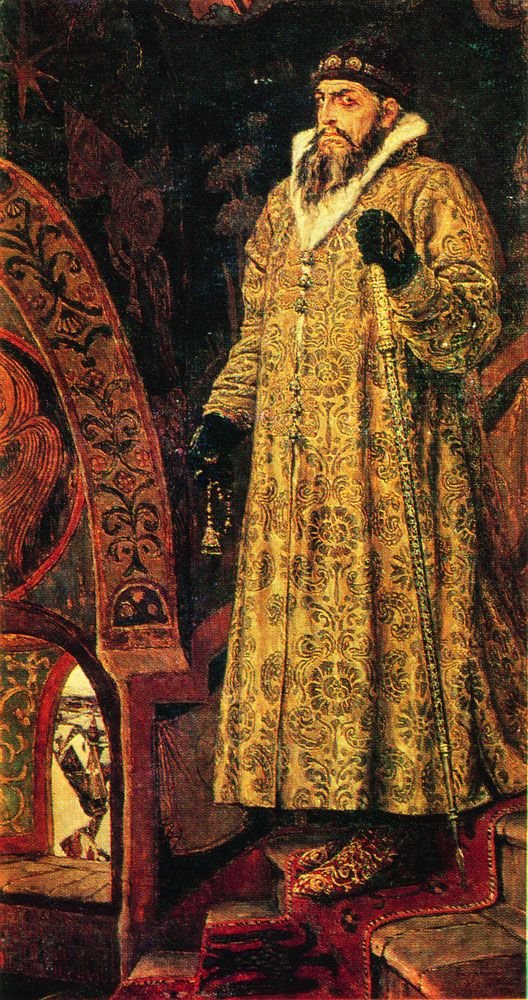
Ivan IV Vasilyevich (born August 25, 1530, Kolomenskoye, near Moscow, Grand Duchy of Moscow—died March 18, 1584, Moscow, Tsardom of Russia), better known as Ivan the Terrible, was the first ruler of Russia to be officially crowned tsar. He ruled from 1533 until his death, first as grand prince of Moscow and later as tsar. During his reign, he expanded Russian territory, strengthened the authority of the central government, introduced major administrative and military changes, and established a more powerful Russian state. However, his rule also became known for executions, political repression, violence against suspected enemies, and the destruction caused by his secret police force.
Early Life and Family Background
Ivan IV was born on August 25, 1530, to Grand Prince Vasily III of Moscow and his second wife, Elena Glinskaya. His birth took place during a period when the rulers of Moscow were gradually bringing more Russian territories under their control.
Ivan was the couple’s first surviving son and the expected heir to the throne. His father already had an older son, Yuri, from an earlier marriage, but Yuri was considered unsuitable to rule because of his disabilities.
Ivan’s early childhood was shaped by political uncertainty. When he was only three years old, his father died in December 1533. Ivan inherited the title of grand prince of Moscow, but he was far too young to govern independently.
His mother, Elena, became regent and took responsibility for managing the government on his behalf. She worked to maintain royal authority and protect her son’s position against powerful noble families.
However, her regency did not last long. Elena died in 1538, when Ivan was only seven years old. Her sudden death left the young ruler without his strongest political protector.
After her death, powerful noble families, particularly the Shuisky and Belsky clans, competed for control of the government. These nobles belonged to the boyar class, the highest-ranking members of the Russian aristocracy.
Childhood Under the Boyars
Ivan’s childhood was marked by political conflict, insecurity, and neglect. Although he was technically the ruler, powerful boyars controlled much of the government and often treated him as an unimportant child.
The competing noble families struggled to gain influence over the young grand prince. Government positions, wealth, and political authority became prizes in their rivalries.
Ivan later described experiences of humiliation and mistreatment during this period. He reportedly witnessed executions, arrests, and violent struggles among members of the aristocracy. These experiences contributed to his growing suspicion of the boyars.
He also received an education appropriate for a member of the ruling family. He studied religious texts, Russian history, and literature. He became familiar with the Orthodox Christian tradition and developed an interest in religious and political writing.
Ivan was intelligent, well read, and capable of expressing complex political and religious ideas. However, his difficult childhood also encouraged a deep distrust of people around him.
By the time he reached his teenage years, he was determined to establish his authority and prevent powerful nobles from controlling him as they had controlled the government during his childhood.
Coronation as the First Tsar of Russia
On January 16, 1547, Ivan was crowned tsar in a formal ceremony at the Cathedral of the Dormition in the Moscow Kremlin. He was 16 years old.
The title of tsar came from the Latin word Caesar and was associated with imperial authority. Although earlier Russian rulers had sometimes used the title informally, Ivan was the first ruler of Moscow to receive an official coronation as tsar.
The ceremony strengthened his claim to supreme authority and connected his rule with the traditions of the Byzantine Empire and Orthodox Christianity.
In the same year, Ivan married Anastasia Romanovna, a member of the influential Romanov family. Their marriage helped establish important political connections and gave the young tsar a trusted companion.
Ivan’s coronation marked the beginning of a new stage in Russian government. Rather than allowing the boyars to dominate political decisions, he sought to build a stronger central administration under his personal authority.
Early Reforms and Government Changes
During the first years of his personal rule, Ivan worked with a group of advisers who helped him introduce important reforms. One of the best-known members of this circle was the priest Sylvester. Another influential adviser was Alexei Adashev.
Their cooperation helped Ivan strengthen the government and improve the administration of the growing Russian state.
In 1549, Ivan convened an assembly known as the Zemsky Sobor. It brought together representatives of different social groups, including nobles, clergy, and other important members of society. These assemblies allowed the tsar to consult influential groups on matters affecting the country.
Ivan also supported changes to the legal system. The Law Code of 1550 revised earlier laws and strengthened the authority of the central government. It established clearer rules for courts, official responsibilities, and the administration of justice.
Military reforms were another important part of his early government. Ivan expanded the role of professional soldiers and created a more organized military force. In 1550, he established the streltsy, a corps of armed infantrymen who served the tsar and helped protect the state.
He also reorganized local administration and attempted to reduce corruption among government officials. These measures helped create a more centralized system of government.
Although the reforms did not eliminate the influence of the aristocracy, they increased the tsar’s control over important parts of the state.
Expansion of Russian Territory
One of Ivan’s most important achievements during his early reign was the expansion of Russian territory eastward and southward.
In 1552, his army captured Kazan, the capital of the Khanate of Kazan, a state that had developed from the former Mongol Empire. The conquest ended a long period of conflict between Moscow and Kazan and brought important territories along the Volga River under Russian control.
The victory was celebrated throughout the country. Ivan ordered the construction of a magnificent church in Moscow to commemorate the conquest. This building became known as Saint Basil’s Cathedral.
In 1556, Russian forces captured Astrakhan, another important khanate located near the mouth of the Volga River. This gave Russia control over much of the Volga’s course and opened new opportunities for trade and movement toward the Caspian Sea.
These conquests expanded Russian influence among the peoples of the Volga region and strengthened the country’s position in eastern Europe.
They also helped establish the foundations for further Russian expansion into Siberia, although that process developed over many years and involved other rulers, explorers, and military leaders.
Marriage, Family, and Personal Life
Ivan’s first marriage to Anastasia Romanovna was an important part of his personal and political life. Their relationship appears to have been close, and Anastasia was one of the few people Ivan trusted during the early years of his reign.
They had several children, including two sons who survived infancy: Ivan Ivanovich and Feodor Ivanovich.
Anastasia’s death in 1560 deeply affected the tsar. Ivan became increasingly suspicious that she had been poisoned by members of the aristocracy, although there is no conclusive evidence establishing that she was murdered.
Her death marked a turning point in his behavior. His relationship with his advisers deteriorated, and he became more hostile toward people he believed were plotting against him.
Ivan married several more times after Anastasia’s death. His later marriages were generally less stable, and his personal life became increasingly troubled.
His relationship with his eldest surviving son, Ivan Ivanovich, also became particularly important to the history of his reign because of the violent confrontation that eventually led to the prince’s death.
The Livonian War
In 1558, Ivan began a major military campaign against Livonia, a region along the eastern coast of the Baltic Sea that included parts of present-day Estonia and Latvia.
His main objective was to gain access to the Baltic Sea and establish stronger trade connections with western Europe. Control of the region would also increase Russia’s influence in northern and eastern Europe.
The conflict became known as the Livonian War. Russia initially achieved several military successes, but neighboring powers soon became involved.
Poland-Lithuania, Sweden, and Denmark all had interests in the region. Their involvement turned the conflict into a prolonged struggle involving several states.
Although Russian forces captured important territories during the early stages, the war gradually became increasingly difficult and expensive.
Russia faced military setbacks, economic problems, and growing pressure from its enemies. The conflict continued for more than two decades and ended in 1583 without Ivan achieving his main objective.
The war weakened the Russian economy and placed additional pressure on the population. It also contributed to Ivan’s growing frustration with military commanders and members of the aristocracy.
The Oprichnina and the Reign of Terror
One of the darkest periods of Ivan’s reign began in 1565, when he introduced a political system known as the oprichnina.
Ivan had become increasingly suspicious of the boyars and believed that powerful nobles were conspiring against him. He also faced military difficulties and political opposition.
In late 1564, he unexpectedly left Moscow with members of his household and moved to the royal residence at Alexandrov. From there, he announced that he was considering giving up the throne because of the disloyalty of the nobility and other officials.
The announcement created a political crisis. Moscow’s population and leading officials feared that the country would lose its ruler and descend into disorder.
Ivan eventually agreed to return, but only after receiving permission to punish suspected enemies and establish a separate territory under his direct control.
This arrangement became known as the oprichnina. Ivan divided the country into two administrative areas. One remained under the traditional government, while the other was placed under his personal authority.
He created a special force of loyal supporters known as the oprichniki. They were responsible for carrying out the tsar’s orders, identifying suspected enemies, confiscating property, and enforcing his authority.
The oprichniki became widely feared because of their violent methods. They arrested, tortured, and executed people accused of disloyalty, often without reliable evidence.
Many members of the aristocracy lost their property, and entire communities suffered from the violence.
The oprichnina also damaged the economy. Landowners were displaced, agricultural production declined in some areas, and many people fled regions affected by persecution.
In 1570, Ivan ordered a devastating attack on Novgorod, one of Russia’s most important cities. He suspected that its residents were planning to transfer their loyalty to Lithuania.
His forces killed large numbers of people, destroyed property, and looted the city. The exact number of victims is uncertain, but the attack caused widespread suffering and seriously damaged Novgorod.
The oprichnina eventually ended in 1572. Its administrative structure was formally abolished, although Ivan continued to exercise severe personal control over the government.
The Tatar Invasion of Moscow
Despite his efforts to strengthen the Russian state, Ivan faced serious military threats during his reign.
In 1571, Devlet Giray, the Crimean Tatar khan, launched an invasion of Russia and advanced toward Moscow.
Russian defenses failed to stop the invasion. Devlet Giray’s forces burned much of Moscow, causing enormous destruction and loss of life.
The following year, the Crimean Tatars launched another major attack. This time, Russian forces defeated them at the Battle of Molodi in 1572.
The victory prevented another major invasion and protected Moscow from a similar disaster.
These events exposed weaknesses in Ivan’s military system and demonstrated that his harsh domestic policies had not made Russia invulnerable to external threats.
Religious Beliefs and Relationship With the Church
Ivan was a deeply religious ruler who believed that his authority came from God. He viewed himself as a defender of Orthodox Christianity and considered the tsar’s position sacred.
His religious beliefs influenced his political decisions and his understanding of kingship. He often used religious arguments to justify his actions and demanded loyalty from both government officials and religious leaders.
Ivan also supported the construction of churches and monasteries. Saint Basil’s Cathedral, built to commemorate the conquest of Kazan, became one of the most recognizable buildings associated with his reign.
However, his relationship with church leaders was not always peaceful. He expected religious authorities to support his rule and sometimes clashed with those who criticized his decisions.
His letters and writings reveal a ruler who combined strong religious convictions with a belief in the absolute authority of the tsar.
Later Reign and Growing Instability
During the final years of his reign, Ivan faced the consequences of prolonged warfare, political repression, and economic difficulties.
The Livonian War continued to drain resources, while attacks by neighboring powers threatened Russian territory.
The country also experienced serious population losses in some regions because of warfare, famine, disease, and forced movement.
Ivan’s government struggled to manage these problems. His earlier administrative reforms had strengthened central authority, but the violence of the oprichnina had weakened many traditional institutions and damaged the country’s economic stability.
His personal behavior also became increasingly unpredictable. He remained suspicious of those around him and continued to punish people he considered disloyal.
Although Russia had expanded considerably during his reign, the country faced serious challenges by the time he entered his final years.
Death of His Son Ivan
One of the most tragic events of Ivan’s personal life occurred in 1581.
According to a widely accepted historical account, Ivan became involved in a violent argument with his eldest surviving son, Ivan Ivanovich. During the confrontation, the tsar struck his son with a staff or similar object, seriously injuring him.
The young prince died several days later.
The precise circumstances remain uncertain, and historical accounts differ in some details. However, the death of Ivan Ivanovich is generally associated with a confrontation involving his father.
The incident devastated the tsar. His son had been an important potential successor, and his death created a serious problem for the future of the ruling dynasty.
Ivan’s remaining adult son, Feodor, was not considered an equally strong or capable political figure. The loss of the elder prince therefore raised concerns about the stability of the succession.
Final Years and Death
During the last years of his life, Ivan continued to rule Russia while facing military, economic, and political difficulties.
The Livonian War finally ended in 1583. Russia failed to secure the Baltic territories it had sought, and the long conflict had placed a heavy burden on the country.
Ivan also faced uncertainty about the future of his dynasty. His eldest surviving son, Ivan Ivanovich, was dead, leaving Feodor as the main adult heir.
Ivan IV died on March 18, 1584, in Moscow, at the age of 53. He died while playing chess, according to traditional accounts.
His death ended a reign that had lasted more than five decades, making him one of the longest-reigning rulers in Russian history.
He was succeeded by his son Feodor I, who became tsar after his father’s death. Feodor’s reign was marked by the growing influence of powerful advisers, particularly Boris Godunov.
Ivan was buried in the Cathedral of the Archangel in the Moscow Kremlin, the traditional burial place of many Russian rulers.