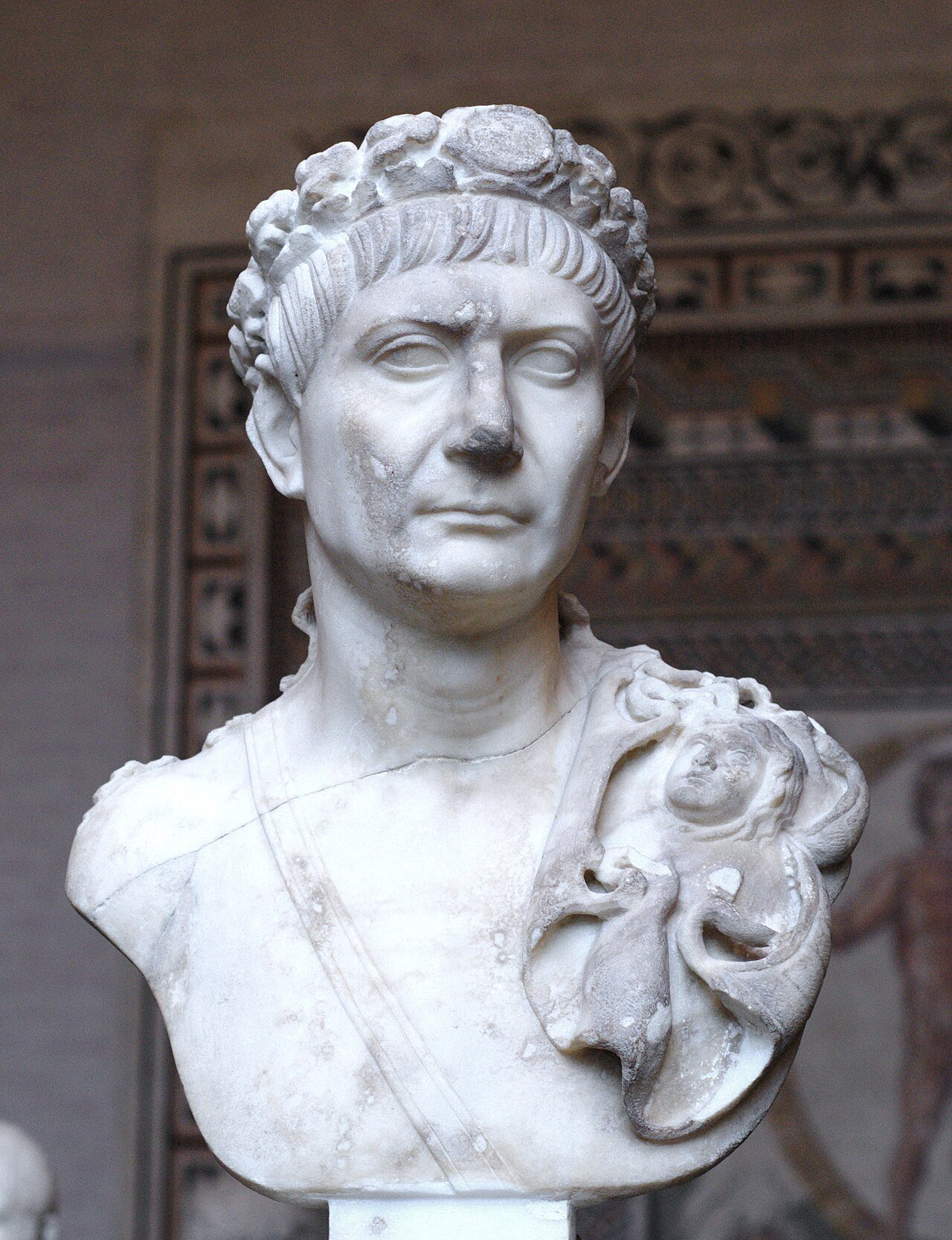
Trajan (born September 18, 53 CE, in Italica, in the Roman province of Hispania Baetica, near modern-day Seville, Spain—died around August 8, 117 CE, in Selinus, in the Roman province of Cilicia, now part of Turkey) was a Roman emperor who ruled from 98 to 117 CE. His full name was Marcus Ulpius Traianus. He is remembered for expanding the Roman Empire to its greatest territorial extent, strengthening its government, supporting public construction, and leading successful military campaigns. Ancient Roman writers praised his leadership, and later generations often regarded him as one of Rome’s most capable emperors.
Early Life and Family Background
Trajan was born into a Roman family with roots in Italica, a settlement in Hispania founded by Roman settlers. His family belonged to the provincial Roman elite, a group of wealthy and influential people who held important positions in local government and society. His father, also named Marcus Ulpius Traianus, was a successful military officer and administrator who later became a Roman governor.
During Trajan’s childhood, the Roman Empire was ruled by Emperor Claudius and later by Nero. Although Trajan was born outside Italy, his family had strong connections to Roman political and military life. His father’s career gave him opportunities to become familiar with the army and the responsibilities of imperial government.
Little reliable information survives about Trajan’s childhood, education, or private family life. However, his later military career suggests that he received the education and training expected of a young man from an important Roman family. He learned the skills needed for public service and gradually entered the military and political world.
Military Career and Rise to Power
Trajan began his military career at a young age, serving as a military officer under his father. He gained experience in several Roman provinces and developed a reputation as a capable and disciplined commander.
During the reign of Emperor Domitian, Trajan continued to rise through the Roman military and political system. He served as a military tribune, a position that involved working with Roman legions and assisting senior officers. He later held important administrative and military responsibilities.
In the late 80s CE, Trajan became a praetor, a senior Roman magistrate. He subsequently served in Spain and Germany, where he gained further experience managing troops and provincial affairs.
His career advanced significantly in 89 CE, when he supported Domitian during a rebellion led by Lucius Antonius Saturninus, the governor of Upper Germany. Trajan’s loyalty during this crisis helped establish his position as a trusted military leader.
By 91 CE, he had become consul, one of the highest offices in the Roman Republic’s traditional political system, which continued to exist under the emperors. He later received command responsibilities in Germania Superior, an important military region along the Rhine frontier.
Trajan’s military ability, political connections, and growing reputation made him an important figure in the empire. His experience in several provinces also gave him an understanding of the challenges facing Roman soldiers, administrators, and local communities.
Adoption by Emperor Nerva
In 96 CE, Emperor Domitian was assassinated following growing opposition within the imperial government. The Senate subsequently recognized Nerva, an older and experienced politician, as emperor.
Nerva faced serious difficulties early in his reign. He lacked strong support among the army, and tensions developed between the military and the government. Some soldiers remained dissatisfied with the treatment of senior officers involved in Domitian’s administration.
To strengthen his position and secure the future of the empire, Nerva adopted Trajan in 97 CE. The adoption was a major political decision because it established Trajan as his recognized successor.
Trajan was particularly suitable for the position because of his military reputation and influence among the legions. His adoption helped restore confidence within the army and gave Nerva’s government greater stability.
At the time, Trajan was serving in Germany. After receiving news of his adoption, he remained in his military position rather than immediately traveling to Rome. This allowed him to maintain his relationship with the troops while preparing to assume imperial responsibilities.
Nerva died in January 98 CE. Trajan succeeded him without a major struggle for power, becoming emperor of Rome at approximately 45 years of age.
Becoming Emperor of Rome
After becoming emperor, Trajan took time to establish his authority and strengthen his relationship with the Senate and the army. He did not immediately rush to Rome. Instead, he continued overseeing military affairs in the provinces before eventually entering the capital.
His approach helped distinguish his rule from that of some earlier emperors. He presented himself as a leader who respected traditional Roman institutions and valued cooperation with the Senate.
Trajan maintained a relatively approachable public image. He was willing to meet senators, listen to advice, and participate in public activities. He also avoided the excessive displays of personal authority associated with some previous rulers.
Although the emperor held enormous political and military power, Trajan understood the importance of maintaining support among influential Roman families, provincial administrators, and soldiers.
He appointed capable officials and relied on experienced administrators to manage the empire. His government continued the established Roman system of provincial administration while addressing practical problems involving taxation, public order, and military security.
Marriage and Personal Life
Trajan was married to Pompeia Plotina, commonly known as Plotina. She became empress when he took the throne and was an influential figure in Roman court life.
Ancient accounts generally describe their marriage as stable, although surviving information about their private relationship is limited. Plotina was known for her interest in philosophy and her support for certain cultural and charitable activities.
Trajan and Plotina had no known children. This absence later became important when questions arose about the succession to the throne.
Trajan also maintained close relationships with members of his extended family and political circle. His cousin Hadrian, who would eventually succeed him, became an increasingly important figure during his reign.
Despite his position, Trajan’s private life is not well documented. Most surviving accounts focus on his military campaigns, political decisions, public buildings, and administration rather than his personal habits or daily activities.
The First Dacian War
One of the most important military challenges during Trajan’s reign involved Dacia, a kingdom located north of the Danube River, in an area that largely corresponds to modern Romania.
Dacia was ruled by King Decebalus, who had previously fought against Roman forces during Domitian’s reign. Although a peace agreement had been reached, tensions continued between Rome and the Dacian kingdom.
Trajan considered Dacia a serious security concern because of its military strength and its position near the Roman frontier. The kingdom also possessed valuable natural resources, including gold and silver.
In 101 CE, Trajan launched a major military campaign against Dacia. Roman forces crossed the Danube and advanced into Dacian territory. The campaign involved difficult terrain, fortified positions, and determined resistance from Decebalus’s army.
The Romans gradually gained the advantage through their superior military organization and engineering skills. After a series of battles, Decebalus agreed to peace in 102 CE.
The settlement required Dacia to accept Roman conditions, including restrictions on its military and political independence. However, Decebalus remained in power, and the underlying conflict was not fully resolved.
The Second Dacian War
Peace between Rome and Dacia did not last. Decebalus gradually rebuilt his military strength and strengthened his position despite the earlier agreement.
Trajan viewed these developments as a threat to Roman security. In 105 CE, he began a second campaign against Dacia.
This time, the Roman army advanced with the intention of bringing the kingdom under direct Roman control. One of the most important engineering achievements of the campaign was the permanent bridge constructed across the Danube under the direction of the architect and engineer Apollodorus of Damascus.
The bridge made it easier for Roman troops and supplies to cross the river. It was a major military construction project and demonstrated the Romans’ ability to use engineering to support their campaigns.
Roman forces advanced toward the Dacian capital, Sarmizegetusa. After intense fighting, the city fell in 106 CE. Decebalus escaped but was eventually surrounded by Roman troops. Rather than being captured, he took his own life.
Following the Roman victory, Dacia became a Roman province. Roman settlers, soldiers, merchants, and administrators moved into the region, and its natural resources became an important part of the imperial economy.
The conquest was celebrated in Rome through public ceremonies and monuments. Trajan’s victories also became the subject of Trajan’s Column, a detailed stone monument that depicts scenes from the Dacian campaigns.
Public Construction and Government Projects
While Trajan is often remembered for his military victories, he also devoted considerable attention to improving Rome and its provinces.
His government supported the construction of roads, bridges, aqueducts, ports, public buildings, and other infrastructure. These projects helped improve transportation, trade, water supply, and communication across the empire.
In Rome, one of his most important projects was Trajan’s Forum, a large public complex designed by Apollodorus of Damascus. The complex included open spaces, administrative buildings, libraries, and a monumental column.
Trajan’s Market, another major construction project associated with his reign, contained multiple levels of shops and offices built into the slope of the Quirinal Hill. It provided space for commercial and administrative activities.
Trajan also expanded the port facilities at Ostia, the main harbor serving Rome. These improvements helped the city receive food and other supplies more efficiently.
His government repaired roads and supported public works in various provinces. These projects helped connect distant parts of the empire and made it easier for officials, merchants, and military units to travel.
Trajan’s construction program was not limited to Rome. He supported infrastructure and urban development throughout the empire, including improvements in Spain, North Africa, and the eastern provinces.
Social and Economic Policies
Trajan’s administration also addressed economic and social needs within the empire.
One important initiative was the alimenta program, which provided financial assistance to children in parts of Italy. The program supported families and helped maintain the population of Roman communities.
The system involved funds connected to agricultural land and loans, with the resulting income used to support eligible children. Although the full operation of the program is not completely understood, it formed part of Trajan’s broader efforts to provide public assistance.
He also supported economic development through infrastructure improvements. Better roads, bridges, ports, and waterways made it easier to move goods and connect markets.
Trajan maintained the Roman monetary system and used imperial resources to finance military operations and public construction. His victories brought valuable resources into the empire, particularly through the conquest of Dacia.
However, military expansion and large building programs required substantial financial resources. Trajan’s government relied on taxation, imperial income, and wealth acquired through conquest to support its activities.
His administration generally worked through established Roman institutions rather than attempting to replace the existing system.
Relations with the Senate and Provincial Government
Trajan maintained a working relationship with the Roman Senate throughout most of his reign. Although the emperor held supreme authority, the Senate continued to play an important role in government, administration, and public life.
Trajan presented himself as a ruler who respected senatorial traditions. He consulted senators, recognized their status, and avoided some of the conflicts that had damaged relations between the Senate and earlier emperors.
His provincial administration also received attention. Governors were responsible for maintaining order, collecting taxes, managing public finances, and overseeing local government.
Trajan expected officials to carry out their responsibilities properly and took an interest in administrative questions from different parts of the empire.
One surviving example of his approach comes from correspondence with Pliny the Younger, who served as governor of Bithynia and Pontus in Asia Minor. Their letters discuss matters such as financial administration, public buildings, local government, and the treatment of Christians.
These letters provide valuable information about how the imperial government handled practical problems in the provinces.
Trajan and the Roman Treatment of Christians
During Trajan’s reign, Christianity was still a relatively small religious movement within the Roman Empire, although Christian communities had begun to spread across several provinces.
The Roman authorities sometimes viewed Christians with suspicion because they refused to participate in traditional religious ceremonies honoring Roman gods and the emperor.
Around 112 CE, Pliny the Younger wrote to Trajan asking how he should deal with people accused of being Christians in his province.
Trajan’s response established an important policy. He instructed Pliny not to search actively for Christians or accept anonymous accusations. However, people who were formally accused and proven to be Christians could be punished if they refused to abandon their faith and perform the required religious acts.
Those who denied being Christians and demonstrated their rejection of the religion through traditional Roman worship were to be released.
Trajan’s instructions did not create a comprehensive empire-wide policy of religious persecution. Instead, they provided guidance for handling accusations within the existing Roman legal system.
The correspondence remains one of the most important surviving sources for understanding the relationship between the early Christian communities and the Roman government.
The Parthian Campaigns
In the later years of his reign, Trajan turned his attention toward the eastern frontier, where the Roman Empire shared a long and often unstable border with the Parthian Empire.
The Parthians controlled territories in the region of modern Iran and Iraq. Rome and Parthia had competed for influence over Armenia and neighboring territories for generations.
In 113 CE, Trajan began preparations for a major eastern campaign. His main objective was to strengthen Roman influence in the region and resolve disputes involving Armenia and Parthian authority.
Roman forces entered Armenia in 114 CE, and Trajan brought the kingdom under Roman control. Armenia was reorganized as a Roman province.
He then advanced into Mesopotamia, capturing important territories and cities. In 116 CE, Roman forces entered the Parthian capital of Ctesiphon, located near modern Baghdad.
Trajan also reached the Persian Gulf, marking the farthest eastern advance of a Roman emperor’s military campaign.
He declared the creation of additional Roman territories in Mesopotamia and other eastern regions. For a time, the empire reached its greatest territorial extent under his rule.
However, Roman control in the East proved difficult to maintain. Local resistance and rebellions developed in several areas, while the Parthian Empire continued to pose a military threat.
Trajan’s forces faced serious challenges in maintaining their new territories. The distance from Rome, the size of the region, and continuing unrest made permanent occupation difficult.
Rebellions and Military Difficulties in the East
During the eastern campaigns, rebellions broke out in several parts of the Roman Empire, including regions of Mesopotamia and the Jewish communities of the eastern Mediterranean and North Africa.
The Jewish revolt, which began around 115 CE and continued into 117 CE, affected areas including Cyrenaica, Egypt, and Cyprus. It caused extensive violence and required Roman military intervention.
Trajan’s forces were already stretched across a large territory. The need to suppress rebellions and defend newly conquered lands placed additional pressure on the Roman army.
The eastern campaign had achieved impressive military successes, but the empire could not easily maintain all the territories it had occupied.
Trajan began withdrawing from some areas and reconsidering the military position of Rome in the East. His health also began to decline, limiting his ability to direct events personally.
Final Illness and Death
In 117 CE, while returning from the eastern campaigns, Trajan became seriously ill. He was traveling through the eastern provinces when his condition worsened.
He reached Selinus in Cilicia, a city on the southern coast of what is now Turkey. He died there around August 8, 117 CE, at the age of approximately 63.
Trajan’s wife, Plotina, and members of his political circle were present during the final period of his life.
Before his death, Trajan had not publicly established a clear successor. His cousin Hadrian was an important military and political figure who had served in several positions during the reign.
Following Trajan’s death, Hadrian was proclaimed emperor. Trajan’s widow, Plotina, supported his succession, and the Roman Senate formally recognized him as the new ruler.
Trajan’s body was eventually brought back to Rome. He was granted the honor of burial beneath the Column of Trajan, the monument commemorating his Dacian victories. His ashes were placed in a golden urn within the base of the column.