When we gaze at the night sky, we imagine we are witnessing the entirety of the universe—the luminous galaxies, stars, and nebulae that decorate the darkness. Yet, in truth, what we see is merely a fraction of what exists. Beneath the glow of the visible cosmos lies a hidden realm that dominates the universe’s structure and fate. Around 95 percent of the universe is invisible to our eyes and undetectable by our instruments—composed of something we do not yet fully understand. We call these two mysterious entities dark matter and dark energy.
Their names, though poetic, reveal our ignorance as much as our curiosity. Dark matter is invisible matter that exerts gravity but emits no light. Dark energy is a far stranger phenomenon—an unseen force driving the accelerated expansion of the universe. Together, they form the cosmic scaffolding and the unseen wind that shapes everything we know.
We stand on a tiny island of ordinary matter—atoms, stars, planets, and ourselves—floating in a sea of darkness. To understand dark matter and dark energy is to confront the most profound mystery in modern science: why the universe exists as it does, and why we can see only the faintest glimmer of its true essence.
The Universe We Thought We Knew
For centuries, humanity believed that what we could see through our telescopes represented the whole universe. Stars, galaxies, and nebulae—these visible lights seemed to account for everything. Newton’s law of gravitation described how masses attract one another, and for a long time, that seemed enough.
But as technology improved, astronomers began to notice something strange. Galaxies were rotating too fast. Clusters of galaxies were moving in ways that defied Newton’s equations if only visible matter was considered. The luminous material—the stars, dust, and gas—did not provide enough gravitational pull to hold these structures together. Something unseen was exerting additional gravity, preventing galaxies from flying apart.
The universe, it seemed, was not just composed of the things we could see. Something else, something invisible yet immensely powerful, was out there shaping the cosmos. This realization marked the beginning of one of the greatest scientific detective stories ever told—the search for the dark universe.
The Birth of the Idea
The first hints of dark matter appeared in the early 20th century. In the 1930s, Swiss astronomer Fritz Zwicky studied the Coma Cluster—a vast congregation of galaxies millions of light-years away. Using the motions of the galaxies within the cluster, he calculated its total mass. To his astonishment, he found that the visible matter accounted for only a small fraction of the required mass. The galaxies were moving too fast; they should have dispersed long ago if only their visible mass were binding them.
Zwicky concluded that there must be some “dunkle Materie,” or dark matter, providing the missing gravitational glue. His idea was revolutionary—and ignored for decades. At the time, the tools to confirm his hypothesis did not yet exist. But his insight planted a seed that would grow into one of the defining puzzles of modern astrophysics.
Decades later, in the 1970s, astronomer Vera Rubin and her collaborator Kent Ford provided decisive evidence. By measuring the rotation curves of spiral galaxies—how fast stars move at different distances from the galactic center—they found that the outer stars were orbiting far too quickly. According to Newtonian mechanics, orbital speed should decrease with distance, as in the Solar System where planets farther from the Sun move slower. But in Rubin’s observations, the velocities remained nearly constant even at great distances.
The conclusion was inescapable: galaxies are embedded in massive, invisible halos of matter. This unseen substance does not emit light, yet it exerts a gravitational influence strong enough to govern the motion of billions of stars. The age of dark matter had begun.
The Nature of the Invisible
What is dark matter? Despite decades of investigation, the answer remains elusive. We know what it is not—it is not made of ordinary atoms, not composed of protons, neutrons, and electrons. Ordinary, or “baryonic,” matter interacts with light through electromagnetic forces; dark matter does not. It neither absorbs nor emits light, making it completely transparent and detectable only through its gravitational effects.
Astrophysicists have proposed several possible candidates for dark matter. One class includes WIMPs, or Weakly Interacting Massive Particles—hypothetical particles that interact through gravity and the weak nuclear force but not electromagnetism. Another possibility is axions, extremely light particles predicted by certain extensions of the Standard Model of particle physics.
There are also more exotic theories. Some propose that dark matter might consist of sterile neutrinos—a heavier form of the elusive neutrinos already known to exist—or that it could arise from modifications to gravity itself, suggesting our understanding of gravitational law may be incomplete.
Whatever it is, dark matter appears to outnumber ordinary matter by more than five to one. Without it, galaxies could not form, stars would not cluster, and the universe would look vastly different. It is the hidden scaffolding on which the luminous cosmos is built—the invisible skeleton of creation.
Mapping the Dark Cosmos
If dark matter cannot be seen directly, how can we study it? Astronomers have learned to trace its presence through its gravitational influence on light and matter. One of the most powerful tools is gravitational lensing, a phenomenon predicted by Einstein’s general theory of relativity.
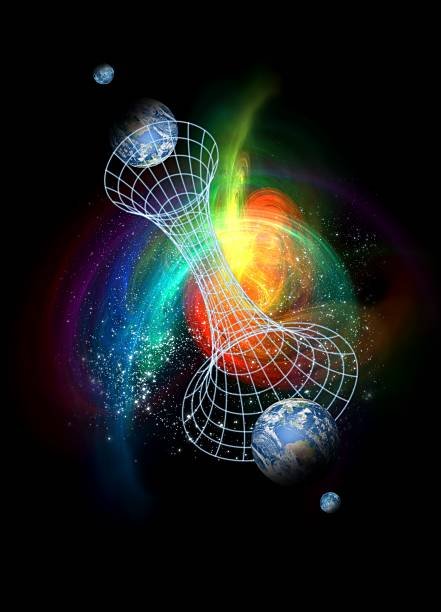
According to relativity, massive objects bend the fabric of space-time, causing light to curve as it passes near them. When light from a distant galaxy travels through a region filled with dark matter, its path is distorted, magnified, or even multiplied. By analyzing these distortions, scientists can map the invisible distribution of dark matter across the universe.
Observations from the Hubble Space Telescope and other surveys have produced breathtaking dark matter maps, revealing vast cosmic filaments stretching across billions of light-years. These filaments form a web-like structure connecting galaxies and clusters—what cosmologists call the cosmic web. Ordinary matter collects along these filaments, drawn into the gravitational wells created by dark matter.
Even the faint afterglow of the Big Bang—the cosmic microwave background (CMB)—contains fingerprints of dark matter. Tiny fluctuations in the CMB, measured by missions like WMAP and Planck, show how matter clumped together under gravity in the early universe. The patterns of these fluctuations match predictions that include dark matter, confirming its essential role in shaping cosmic evolution.
The Hidden Architect of the Universe
To appreciate the role of dark matter, one must imagine the universe as a grand architecture in progress. After the Big Bang, the universe was nearly uniform, with only minute ripples in density. As it expanded and cooled, gravity began to amplify these ripples, causing matter to cluster. But ordinary matter alone—interacting through radiation and pressure—was too restless to collapse efficiently.
Dark matter, unaffected by radiation, began clumping first, forming gravitational wells that acted as seeds for galaxy formation. Over billions of years, gas and dust fell into these invisible wells, igniting into stars and galaxies. Without dark matter’s steady pull, galaxies might never have formed at all.
Thus, while we see galaxies as the visible jewels of the cosmos, they are mere tracers of a much grander, invisible structure. Dark matter determines where galaxies form, how they cluster, and how they move. It sculpts the universe on the largest scales—an unseen artist shaping the masterpiece of creation.
The Search for Dark Matter
Despite its cosmic importance, dark matter continues to elude direct detection. For decades, scientists have designed increasingly sensitive experiments to capture the faint whispers of dark matter particles interacting with ordinary matter. Deep underground laboratories—buried beneath mountains or submerged in mines—house detectors shielded from cosmic radiation, waiting for the rare collision between a dark matter particle and an atomic nucleus.
Experiments like LUX-ZEPLIN in the United States, XENONnT in Italy, and PandaX in China use ultra-pure liquid xenon or argon as targets. When a dark matter particle collides with a nucleus, it produces tiny flashes of light and electrical signals that can be recorded. So far, these detectors have not found definitive evidence, but each null result helps narrow the possibilities, guiding us closer to the truth.
Meanwhile, particle accelerators like the Large Hadron Collider (LHC) search for dark matter’s fingerprints in high-energy collisions. If dark matter particles can be produced in these collisions, they would escape detection, carrying away missing energy—an invisible signature of their presence.
The search extends even to the cosmos. Space-based observatories look for gamma rays or cosmic rays that could result from dark matter annihilations or decays. Though the signals remain uncertain, the hunt continues relentlessly. To find dark matter is to uncover one of the deepest secrets of existence.
The Discovery of Dark Energy
While the mystery of dark matter captivated astronomers for much of the 20th century, an even greater enigma emerged near its end. In 1998, two independent teams studying distant Type Ia supernovae made a stunning discovery. They were measuring how the universe’s expansion rate had changed over time, expecting to find that gravity was slowing the expansion. Instead, they found the opposite—the expansion was accelerating.
Something unknown was pushing the universe apart, counteracting gravity on the largest scales. This mysterious force, invisible and omnipresent, came to be called dark energy. It accounts for nearly 70 percent of the total energy content of the universe, making it the dominant component of the cosmos.
Dark energy revealed that our universe is not only expanding, but doing so faster and faster with time. The galaxies are not merely drifting apart; they are being carried away by a cosmic acceleration whose nature defies comprehension. The discovery overturned our understanding of cosmology and earned the 2011 Nobel Prize in Physics for its discoverers.
The Energy of Empty Space
What is dark energy? Like dark matter, it is not directly observed, but inferred from its effects. The simplest explanation comes from Einstein’s own equations of general relativity. In 1917, to balance his equations and produce a static universe, Einstein introduced a term called the cosmological constant. When the expansion of the universe was later discovered, he abandoned it, calling it his “greatest blunder.” Yet decades later, the cosmological constant returned as a natural candidate for dark energy.
The cosmological constant represents the energy density of empty space itself—a property of the vacuum. According to quantum field theory, even the vacuum is not truly empty; it seethes with virtual particles and fields that constantly fluctuate. This vacuum energy could exert a repulsive pressure, driving the accelerated expansion of space.
However, there is a problem. When physicists attempt to calculate the expected vacuum energy from quantum theory, the result is staggering—about 120 orders of magnitude larger than what is observed. This discrepancy, the most dramatic in all of physics, is known as the cosmological constant problem. It highlights our profound lack of understanding about the nature of dark energy and the quantum vacuum.
Some alternative theories suggest that dark energy might not be constant but dynamic—a changing field called quintessence that evolves over time. Others propose that Einstein’s theory of gravity itself may need modification on cosmic scales. For now, dark energy remains a name for our ignorance, a symbol of the cosmic unknown that drives the universe’s destiny.
The Shape and Fate of the Universe
The balance between dark matter, dark energy, and ordinary matter determines the geometry and ultimate fate of the universe. Observations show that the universe is remarkably flat—its geometry consistent with Euclidean space. This balance is delicate; even a tiny deviation in the early universe could have produced a drastically different cosmos.
Dark energy dominates today, but in the past, when the universe was denser, dark matter played the leading role in structure formation. As the universe expands, matter becomes increasingly diluted while dark energy’s influence grows. Eventually, if dark energy remains constant, it will dictate the universe’s future.
In one possible scenario, the expansion continues forever, and galaxies drift farther apart until stars burn out and the cosmos fades into darkness—a “heat death.” In another, if dark energy grows stronger over time, it could tear apart galaxies, atoms, and even space-time itself in a catastrophic Big Rip.
Yet other models propose that dark energy may decay, allowing gravity to reassert itself and cause a “Big Crunch,” collapsing the universe back into a singularity. We do not yet know which destiny awaits, but every observation brings us a step closer to understanding the cosmic endgame.
Probing the Darkness
The quest to understand dark energy has become one of the most ambitious scientific enterprises of our age. Astronomers are mapping millions of galaxies, measuring their positions and distances to chart the history of cosmic expansion. Missions like the Dark Energy Survey (DES), the European Space Agency’s Euclid telescope, and NASA’s upcoming Nancy Grace Roman Space Telescope are designed to reveal how dark energy has influenced cosmic evolution.
By studying the distribution of galaxies, the patterns of cosmic microwave background radiation, and the bending of light across the universe, scientists hope to determine whether dark energy is truly constant or changing with time. These observations may not only solve the mystery of dark energy but also reshape our understanding of fundamental physics itself.
The pursuit of dark energy is not merely an astronomical endeavor—it is a philosophical one. It forces us to confront the nature of nothingness, to ask whether the vacuum itself is alive with hidden forces, and to consider whether our universe is but one among many in a vast multiverse shaped by different cosmic laws.
The Dark Universe and the Human Imagination
Dark matter and dark energy have transformed not only physics but our sense of place in the cosmos. They remind us that what we perceive is not the whole of reality. The stars, galaxies, and atoms that make up everything familiar are but a luminous frosting on an immense, invisible cake.
This revelation is both humbling and exhilarating. It tells us that we live in a universe far stranger and richer than we ever imagined. The visible cosmos—the realm of light—is only the beginning of a story that stretches into the unseen depths of space and time.
For the human mind, the existence of this dark universe is an invitation to wonder. It challenges our belief that seeing is understanding, that reality must reveal itself to our senses. It suggests that the universe hides its most profound truths behind veils of invisibility, waiting for us to uncover them through intellect and imagination.
The Unity of Darkness and Light
Though dark matter and dark energy are invisible, they are not separate from the cosmos we know. They are its foundation and breath, shaping every star and every moment. The galaxies that blaze in the night owe their existence to dark matter’s unseen hand; the universe’s accelerating expansion is powered by dark energy’s mysterious force.
Together, they weave a cosmic duality—a balance of attraction and repulsion, structure and expansion. Dark matter gathers, dark energy scatters; one builds, the other stretches. Without dark matter, there would be no galaxies; without dark energy, there would be no cosmic acceleration. The visible universe is the delicate equilibrium between these opposing forces.
In this sense, darkness is not the absence of light—it is the partner of creation. The unseen 95 percent of the universe is not emptiness but substance, not void but vitality. It is the hidden rhythm that governs the dance of galaxies and the destiny of time.
The Future of the Quest
In the coming decades, humanity’s search for the dark universe will intensify. New generations of telescopes, detectors, and experiments will probe deeper than ever before. The James Webb Space Telescope, Euclid, and the Vera Rubin Observatory will trace the cosmic web with unprecedented precision. Particle physicists will push the boundaries of detection, seeking the faint whispers of dark matter in the quietest corners of the Earth.
Perhaps we will discover a new particle that completes the Standard Model, or perhaps we will realize that gravity itself must be rewritten. Either way, the answers will revolutionize not only cosmology but our understanding of reality.
We stand, as always, at the edge of the unknown, our curiosity illuminated by the faint glow of knowledge and surrounded by the vast ocean of mystery. The dark universe calls to us—not as an abyss, but as an invitation.
The Poetry of the Invisible
Dark matter and dark energy reveal that the universe is larger, stranger, and more beautiful than we can imagine. They show that reality extends far beyond the limits of our perception—that even in the silence between galaxies, something vast and powerful is at work.
To explore the unseen 95 percent of everything is to participate in a cosmic act of imagination. It is to accept that the most important truths may not be visible but inferred, not illuminated but felt through their influence. It is to recognize that our universe, like life itself, is sustained by what we cannot see.
We live in a cosmos where darkness is not the enemy of light but its complement—where the unseen gives shape to the seen, and the mysterious gives meaning to the known. The stars shine because darkness allows them to; galaxies form because dark matter cradles them; the universe expands because dark energy breathes through it.
In the end, the dark universe is not a void but a revelation—a reminder that the greatest part of existence lies beyond our senses, waiting for us to listen, imagine, and discover. We are creatures of light, but our destiny, it seems, is written in the dark.