Every morning, before your feet touch the floor, something extraordinary happens.
You wake up.
Light enters your eyes. Sounds reach your ears. Memories begin to return. You remember your name, recognize your room, think about the day ahead, and perhaps wonder what you should have for breakfast. These moments feel so ordinary that we rarely stop to consider them.
Yet they are among the greatest mysteries in the universe.
How does a collection of billions of brain cells produce the rich inner world of thoughts, emotions, dreams, memories, and self-awareness? Why does seeing the color blue feel the way it does? Why is there something it is like to be you?
This mystery is called consciousness, and despite centuries of philosophical inquiry and decades of scientific research, no one fully understands how it began or why it exists.
Consciousness is the invisible thread that ties every moment of our lives together. Without it, there would be no joy, sorrow, curiosity, love, fear, imagination, or hope. Every scientific discovery ever made, every work of art ever created, every civilization ever built has ultimately depended on conscious minds asking questions and seeking answers.
Ironically, the greatest tool we possess for understanding the universe is itself one of the greatest mysteries within it.
The origin of consciousness is not simply a scientific puzzle. It is also a journey into what it means to be alive.
What Is Consciousness?
Before asking where consciousness came from, we must first understand what consciousness actually is.
At its simplest, consciousness is awareness.
It is the ability to experience the world and to experience yourself within that world.
When you feel warmth from sunlight, hear music, taste chocolate, remember your childhood, or imagine tomorrow, you are having conscious experiences.
Scientists often distinguish between being awake and being conscious.
A person under deep anesthesia may be alive but temporarily unconscious.
Someone dreaming experiences consciousness, although the experience differs from ordinary waking life.
Consciousness therefore involves far more than simply opening your eyes.
It includes perception, attention, memory, emotion, thought, and self-awareness.
Despite its familiarity, consciousness is surprisingly difficult to define.
Unlike a heartbeat or a bone, consciousness cannot be directly observed from the outside.
Researchers can study brain activity, but they cannot directly see another person’s subjective experiences.
This makes consciousness one of science’s most challenging subjects.
The Mystery We All Carry
Every human being lives inside a private universe.
No one else can directly experience your thoughts.
You can describe pain, happiness, or excitement, but another person can never feel those experiences exactly as you do.
This private inner world is sometimes called subjective experience.
It is the defining feature of consciousness.
Modern neuroscience can identify brain regions involved in seeing colors or recognizing faces.
But an enormous question remains.
Why do electrical signals inside the brain produce an experience at all?
Why does information processing feel like something?
Many scientists call this the “hard problem” of consciousness.
Understanding how the brain processes information is difficult.
Understanding why those processes produce experience may be even harder.
The Earliest Forms of Life
To understand consciousness, we must travel back billions of years.
Life on Earth began around 3.5 to 4 billion years ago.
The earliest organisms were incredibly simple.
They possessed no brains.
No nervous systems.
No eyes or ears.
These microscopic cells responded to chemicals, light, and temperature through basic biological mechanisms.
A bacterium moving toward nutrients behaves intelligently in a limited sense.
Yet few scientists believe bacteria possess consciousness similar to human awareness.
Instead, these early organisms demonstrate that life can respond to the environment without conscious experience.
This distinction is important.
Not every form of information processing requires consciousness.
Nature solved many survival problems long before conscious minds appeared.
The Evolution of Nervous Systems
As life became more complex, animals evolved specialized cells for communication.
These became neurons.
Neurons could rapidly transmit signals across the body.
Simple nerve networks helped organisms detect danger, locate food, and coordinate movement.
Eventually, clusters of neurons formed primitive brains.
These early nervous systems dramatically improved survival.
Instead of reacting only to immediate stimuli, animals could integrate information from multiple senses.
They could remember.
They could learn.
They could adapt.
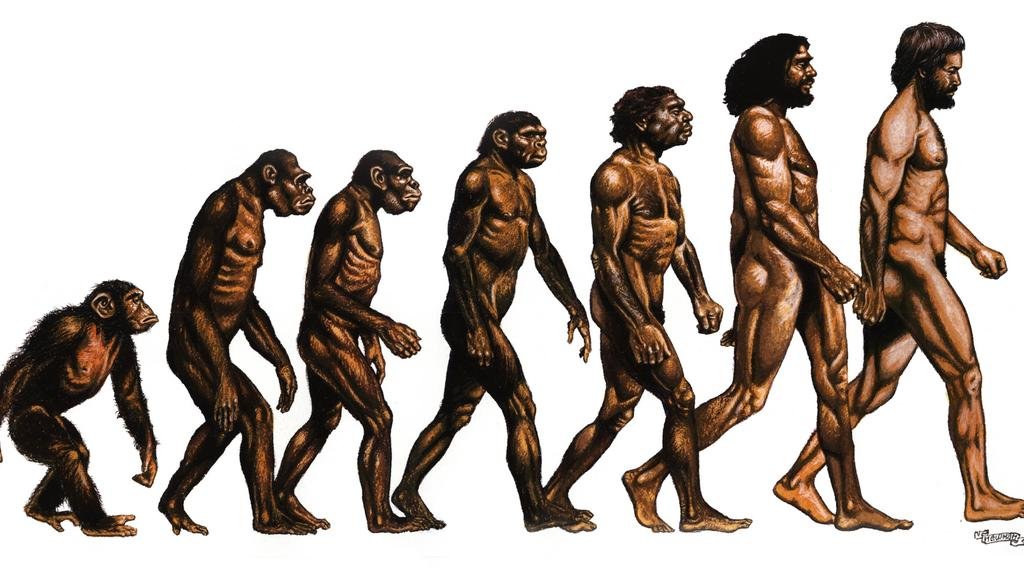
Many scientists believe consciousness gradually emerged during this long evolutionary process rather than appearing suddenly.
Why Would Consciousness Evolve?
Evolution does not create traits without reason.
Every biological feature carries costs.
Brains consume enormous amounts of energy.
In humans, the brain represents only about two percent of body weight but uses roughly twenty percent of the body’s energy.
If consciousness evolved, it likely provided important advantages.
One possibility is that conscious awareness helps animals make flexible decisions.
Rather than responding automatically, conscious creatures can compare alternatives.
They can imagine future outcomes.
They can learn from past experiences.
They can adapt to changing environments.
These abilities increase survival.
Natural selection would therefore favor organisms possessing increasingly sophisticated forms of awareness.
From Simple Awareness to Self-Awareness
Not all consciousness is equally complex.
Many scientists think consciousness exists along a spectrum.
Simple animals may possess basic sensory awareness.
More advanced animals may recognize relationships between events.
Still others may understand themselves as individuals.
Self-awareness represents one of consciousness’s most remarkable achievements.
It allows an organism to think about itself.
Humans recognize themselves in mirrors.
We think about our own thoughts.
We imagine ourselves years into the future.
We reflect upon our past.
This ability transforms consciousness from simple awareness into something profoundly richer.
The Human Brain
The human brain contains approximately eighty-six billion neurons.
Each neuron forms thousands of connections with other neurons.
Together they create an astonishingly complex communication network.
Every second, billions of electrical signals race through this network.
These signals allow us to perceive the world, move our bodies, solve problems, experience emotions, and create memories.
Remarkably, the brain accomplishes all this using only about twenty watts of power—roughly the energy consumed by a dim household light bulb.
No computer built today matches the brain’s efficiency.
Understanding how this extraordinary organ generates consciousness remains one of neuroscience’s greatest goals.
The Brain Is Always Active
Even during quiet moments, the brain never truly rests.
While you read these words, different brain regions process language, recognize letters, retrieve memories, predict upcoming sentences, and monitor your surroundings.
When you sleep, brain activity continues.
Dreams emerge.
Memories are strengthened.
Information is organized.
The brain is constantly constructing your conscious experience.
It is not merely recording reality.
It actively interprets, predicts, edits, and combines information into the seamless world you experience every day.
Perception Is a Construction
Many people assume the brain simply observes reality.
Modern neuroscience suggests something more surprising.
The brain builds reality.
Light enters the eyes as patterns of electromagnetic radiation.
The brain transforms those signals into colors.
Sound arrives as pressure waves.
The brain converts them into music and speech.
Even our perception of time depends upon brain activity.
Conscious experience is therefore an active creation.
The world we experience results from the brain’s ongoing interpretation of sensory information.
Dreams and Consciousness
Dreaming offers fascinating clues about consciousness.
While asleep, people experience vivid sights, sounds, emotions, and narratives.
Yet these experiences occur without direct input from the outside world.
Dreams demonstrate that consciousness does not require continuous interaction with reality.
The brain alone can generate remarkably rich experiences.
Scientists continue studying dreams to better understand how conscious experience emerges.
Although many questions remain, dreams reveal that consciousness is deeply connected to the brain’s internal activity.
The Hard Problem
Australian philosopher David Chalmers introduced the phrase “the hard problem of consciousness.”
The hard problem asks why physical processes inside the brain produce subjective experience.
Imagine building a robot capable of recognizing faces.
It processes information.
It identifies people.
It responds appropriately.
But does it actually experience seeing a face?
Or is it simply processing information without awareness?
The same question applies to humans.
Scientists increasingly understand how the brain processes information.
Yet explaining why those processes produce experience remains deeply challenging.
Some researchers believe solving the hard problem will require entirely new scientific ideas.
Others think continued neuroscience will eventually provide the answer.
Consciousness and Evolutionary History
Exactly when consciousness first appeared remains unknown.
Did fish possess conscious awareness?
What about insects?
Could octopuses experience the world consciously?
Scientists examine animal behavior, nervous system complexity, learning ability, and brain organization for clues.
Evidence suggests many animals possess at least some level of conscious experience.
Mammals display emotions, social relationships, and flexible problem-solving.
Birds demonstrate remarkable intelligence.
Octopuses solve puzzles despite possessing nervous systems unlike those of vertebrates.
These discoveries suggest consciousness—or something resembling it—may have evolved multiple times.
Animal Minds
Looking into an animal’s eyes naturally raises profound questions.
What is it experiencing?
Dogs appear to recognize emotions.
Elephants mourn deceased companions.
Crows remember individual human faces.
Chimpanzees use tools and cooperate.
Dolphins recognize themselves in mirrors.
Such behaviors suggest surprisingly rich mental lives.
Scientists remain cautious about interpreting animal experiences.
Yet growing evidence indicates consciousness is not uniquely human.
Instead, consciousness may exist in varying forms throughout much of the animal kingdom.
The Social Brain
Some researchers believe consciousness evolved partly because of social living.
Animals living in groups must recognize individuals.
They must predict others’ behavior.
They form alliances.
They compete.
They cooperate.
Understanding other minds becomes valuable.
Humans possess extraordinarily sophisticated social abilities.
We infer intentions.
We understand emotions.
We imagine what others think.
These capacities may have helped drive the evolution of increasingly complex consciousness.
Language Changes Everything
Language transformed human consciousness.
Words allow us to organize thoughts.
They preserve memories.
They enable abstract reasoning.
Through language, we discuss ideas that do not physically exist.
Justice.
Infinity.
Democracy.
Mathematics.
The future.
The past.
Language allows consciousness to reflect upon itself.
It enables culture, education, science, and civilization.
Although consciousness likely existed before language, language expanded its possibilities enormously.
Memory and Personal Identity
Imagine waking each morning with no memories.
Would you still be the same person?
Memory gives continuity to consciousness.
It connects yesterday with today.
It allows us to learn, form relationships, and develop identities.
Brain injuries affecting memory often transform conscious experience dramatically.
These cases reveal how closely consciousness depends upon memory.
Without memory, the sense of self becomes fragmented.
Attention Shapes Awareness
At every moment, the brain receives enormous amounts of information.
Yet we notice only a tiny fraction.
Attention acts like a spotlight.
It selects certain information while ignoring the rest.
When deeply absorbed in reading, you may fail to notice someone entering the room.
When searching for your keys, you might overlook other obvious objects.
Attention shapes conscious experience by determining what reaches awareness.
Without attention, consciousness would become overwhelmed.
Can Machines Become Conscious?
Artificial intelligence has revived one of philosophy’s oldest questions.
Could a machine ever become conscious?
Modern AI systems recognize speech, generate images, translate languages, and solve complex problems.
These achievements are remarkable.
Yet most scientists distinguish intelligence from consciousness.
An AI may process enormous amounts of information without possessing subjective experience.
Whether consciousness requires biological brains remains unknown.
Some researchers believe sufficiently advanced computers could eventually become conscious.
Others argue consciousness depends upon biological processes impossible to replicate digitally.
Currently, no evidence demonstrates that existing AI systems possess conscious awareness.
Integrated Information Theory
One influential scientific proposal is Integrated Information Theory.
This theory suggests consciousness depends upon how much information a system integrates into a unified whole.
According to this idea, consciousness increases as information becomes more interconnected.
Rather than emerging from one specific brain region, consciousness arises from patterns of communication throughout the brain.
The theory remains controversial.
Researchers continue testing its predictions using neuroscience experiments.
Global Workspace Theory
Another major theory is Global Workspace Theory.
According to this view, numerous unconscious brain processes occur simultaneously.
Only certain information enters a kind of mental workspace where it becomes available throughout the brain.
When information reaches this workspace, it becomes conscious.
The theory explains why we can perform many actions automatically while consciously focusing on only one task at a time.
Although incomplete, it has inspired many neuroscience experiments.
Is Consciousness an Illusion?
Some philosophers argue that consciousness, at least as commonly understood, may partly be an illusion.
They suggest the brain creates the impression of a unified self.
According to this perspective, the “self” may emerge from countless interacting brain processes rather than existing as a separate entity.
This idea remains controversial.
Regardless of philosophical interpretation, our conscious experiences remain undeniably real from our own perspectives.
The Mystery of Free Will
Consciousness naturally raises questions about free will.
Do we consciously choose our actions?
Or do unconscious brain processes make decisions before awareness arises?
Some neuroscience experiments suggest certain brain activity begins before people report making conscious decisions.
These findings sparked intense debate.
Many researchers caution against simplistic conclusions.
Decision-making likely involves both conscious and unconscious processes working together.
The relationship between consciousness and free will remains unresolved.
Near the Edge of Consciousness
Scientists study consciousness by examining situations in which it changes.
Sleep.
Dreaming.
Meditation.
Anesthesia.
Comas.
Brain injuries.
These conditions reveal important clues.
For example, anesthesia temporarily eliminates conscious experience while leaving many basic brain functions intact.
Studying such states helps researchers identify brain networks necessary for awareness.
Every discovery brings us slightly closer to understanding consciousness.
Consciousness Across Human History
Our ancestors likely experienced consciousness differently from modern humans.
Language evolved.
Culture expanded.
Technology transformed daily life.
Writing allowed thoughts to persist across generations.
Science reshaped understanding of reality.
Although human biology changed relatively little during recent history, the contents of consciousness evolved dramatically.
Today we imagine galaxies, quantum physics, artificial intelligence, and black holes.
Ancient humans imagined different worlds shaped by their environments and cultures.
Consciousness grows alongside knowledge.
The Cosmic Perspective
Some scientists wonder whether consciousness represents an inevitable outcome of increasing biological complexity.
If intelligent life exists elsewhere in the universe, might consciousness have evolved there as well?
No one knows.
The search for extraterrestrial life indirectly connects with consciousness.
Finding intelligent alien civilizations would profoundly reshape our understanding of the phenomenon.
It would demonstrate that consciousness is not unique to Earth.
Until then, humanity remains the only known species capable of asking where consciousness came from.
Why the Mystery Matters
Understanding consciousness could transform medicine.
It may improve treatment for coma patients.
It could deepen understanding of mental illness.
It may guide the development of safer artificial intelligence.
Perhaps most importantly, it helps us understand ourselves.
Every emotion.
Every dream.
Every scientific discovery.
Every act of kindness.
Every work of art.
Every question ever asked exists because consciousness exists.
Studying consciousness is therefore also studying humanity.
What Science Knows Today
Modern neuroscience has made extraordinary progress.
Scientists understand far more about neurons, brain networks, perception, attention, memory, and cognition than ever before.
Brain imaging reveals activity associated with conscious experience.
Researchers identify neural circuits supporting awareness.
Yet the central mystery remains.
Exactly how electrical activity inside billions of neurons becomes subjective experience is still unknown.
The origin of consciousness remains one of science’s greatest unsolved questions.
Conclusion
The origin of consciousness stands at the frontier of human knowledge, where neuroscience, psychology, biology, philosophy, and evolution converge. It is a mystery as profound as the origin of life itself because consciousness is the lens through which every other mystery is explored.
Evidence strongly suggests that consciousness emerged gradually through evolution rather than appearing suddenly. As nervous systems became more complex, organisms gained increasingly sophisticated abilities to perceive, learn, remember, and respond to their environments. In humans, this long evolutionary journey culminated in extraordinary capacities for language, imagination, self-reflection, and abstract thought. Yet despite remarkable advances in brain science, researchers still cannot fully explain why these physical processes give rise to subjective experience.
Perhaps future discoveries will reveal entirely new principles governing the relationship between brain activity and conscious awareness. New imaging technologies, artificial intelligence, computational neuroscience, and evolutionary biology may together illuminate questions that currently seem impossible to answer.
Until then, consciousness remains both familiar and mysterious. It is the silent companion present in every moment of our lives, the invisible stage upon which every memory, dream, emotion, and idea unfolds. We cannot step outside it to observe it directly, yet it shapes every experience we have ever known.
In seeking the origin of consciousness, humanity is ultimately searching for the origin of itself. Every answer we uncover brings us closer to understanding not only how the brain works, but what it truly means to experience the world, to know that we exist, and to wonder about our place in the vast universe.