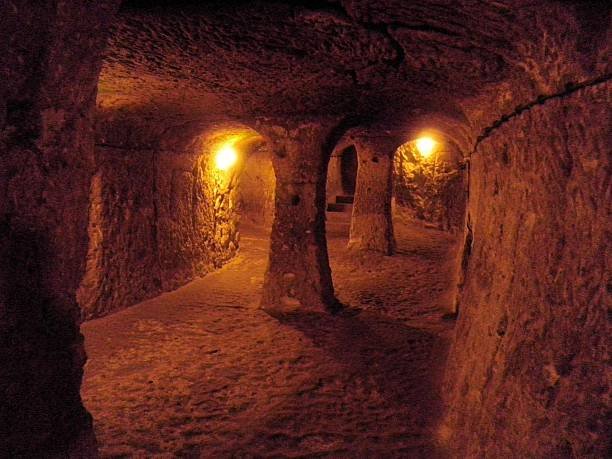
Beneath the rolling landscapes of central Turkey lies one of the most astonishing archaeological discoveries ever made. Hidden below the ground, carved deep into ancient volcanic rock, is a vast underground city capable of sheltering thousands of people. It contains living quarters, kitchens, storage rooms, wells, schools, chapels, workshops, ventilation shafts, and miles of tunnels. For centuries, nobody on the surface fully understood what existed below their feet.
This incredible place is known as Derinkuyu.
At first glance, Derinkuyu seems like something from a fantasy novel. A city buried deep underground, stretching through multiple levels beneath the Earth, sounds more like fiction than reality. Yet Derinkuyu is entirely real. It remains one of the most remarkable engineering achievements of the ancient world.
What makes Derinkuyu especially fascinating is not simply its size. Archaeologists know it existed and understand many aspects of its construction. The true mystery lies in why it was built on such a massive scale and how ancient people managed to create such a complex underground environment using the tools available to them.
For decades, the underground city has inspired wonder, debate, and speculation. Some explanations are supported by archaeology and historical evidence. Others belong more to the realm of imagination. But even after years of research, Derinkuyu continues to challenge our understanding of ancient societies and their capabilities.
The city stands as a reminder that history still contains extraordinary surprises, hidden in places where nobody expects to find them.
The Discovery That Changed Everything
The modern story of Derinkuyu began in 1963.
A resident of a small town in Turkey was renovating his home when he noticed something unusual. After knocking down a wall, he discovered a hidden passageway leading into darkness.
What seemed at first like a small cavity turned out to be the entrance to an enormous underground complex.
As researchers explored further, they realized they had uncovered something extraordinary. Tunnel after tunnel extended beneath the town. Chambers opened into larger rooms. Stairways descended deeper and deeper underground.
The scale of the discovery quickly became apparent.
This was not a simple cave system. It was a carefully designed city carved directly into the rock.
Archaeologists eventually revealed a network extending dozens of meters below the surface. Multiple levels connected through narrow corridors and staircases, creating a subterranean world unlike anything previously known.
The discovery stunned researchers and immediately raised difficult questions.
Who built this place?
When was it constructed?
Why did people choose to live underground?
And how could such an immense project have been completed in the ancient world?
The Landscape of Cappadocia
To understand Derinkuyu, it is important to understand the region where it exists.
The underground city lies within Cappadocia, a historic area of central Turkey famous for its unusual landscapes.
Millions of years ago, volcanic eruptions covered the region with thick layers of ash. Over time, the ash hardened into a soft volcanic rock called tuff.
Wind, rain, and erosion gradually sculpted the tuff into bizarre formations that today attract visitors from around the world. Towering rock pillars, cone-shaped hills, and dramatic valleys create an almost otherworldly appearance.
The softness of the rock played a crucial role in the creation of Derinkuyu.
Unlike harder stone, tuff can be carved relatively easily using simple tools. At the same time, it remains stable enough to support large chambers and tunnels.
This unique geological environment made large-scale underground construction possible.
Without Cappadocia’s volcanic history, Derinkuyu would never have existed.
A City Beneath the Earth
The scale of Derinkuyu is difficult to comprehend.
The city extends approximately 85 meters, or about 280 feet, below the surface. Archaeologists have identified multiple levels descending deep into the ground.
Thousands of people could have lived there simultaneously.
Some estimates suggest the city may have sheltered as many as 20,000 individuals along with their animals, food supplies, and essential resources.
The underground complex contains a remarkable variety of spaces.
There are living quarters where families could reside for extended periods.
There are kitchens and food preparation areas.
Storage rooms held grain, oil, and other necessities.
Animal stables provided shelter for livestock.
Religious spaces allowed worship and community gatherings.
Schools and meeting rooms suggest educational and social activities.
The city functioned as far more than a temporary refuge.
It possessed many features necessary for sustaining a large population underground.
The Engineering Marvel
One of the most impressive aspects of Derinkuyu is its engineering.
Ancient builders faced enormous challenges.
An underground city requires fresh air, water, waste management, lighting, security, and structural stability.
Without solutions to these problems, long-term habitation would have been impossible.
The people who built Derinkuyu addressed these challenges with remarkable ingenuity.
Perhaps the most impressive feature is the ventilation system.
Hundreds of ventilation shafts extend throughout the city, bringing fresh air into deeper levels. Some shafts reach the surface from great depths.
These shafts allowed air circulation across the underground network and helped maintain livable conditions.
Even today, visitors are often surprised by how fresh the air feels inside certain sections of the city.
The effectiveness of this ventilation system demonstrates a sophisticated understanding of underground architecture.
The Importance of Water
Any city requires a reliable water supply.
For an underground settlement, this need becomes even more critical.
Derinkuyu contained numerous wells that provided access to water.
Some wells connected directly to groundwater sources.
Others may have been designed to prevent enemies from poisoning water supplies during periods of conflict.
Water security appears to have been a major concern for the city’s builders.
The existence of internal wells meant inhabitants could survive underground for extended periods without relying on external access.
This feature strongly supports the idea that Derinkuyu served as a refuge during dangerous times.
Defending an Underground World
One of the most striking features of Derinkuyu is its defensive design.
Many entrances could be sealed using enormous circular stone doors.
These stone doors resemble giant wheels carved from rock.
Some weigh hundreds of kilograms.
When rolled into position, they blocked passageways and protected the city from intruders.
Small openings in the center allowed defenders to observe or communicate without exposing themselves.
The narrow tunnels further enhanced security.
Attackers would have struggled to advance through confined passageways while defenders held strategic positions.
The entire city appears designed with defense in mind.
This suggests that fear of invasion or attack played a significant role in its development.
Who Built Derinkuyu?
One of the biggest questions surrounding Derinkuyu concerns its origins.
Unfortunately, the answer remains uncertain.
Archaeological evidence suggests that parts of the underground city may date back thousands of years.
Many researchers believe the earliest sections were created during the first millennium BCE.
Some evidence points toward the Phrygians, an ancient people who lived in Anatolia after the collapse of the Bronze Age.
The Phrygians possessed advanced stoneworking skills and may have initiated the earliest excavations.
However, the city did not emerge fully formed.
Over centuries, successive generations expanded, modified, and improved the underground complex.
What visitors see today is likely the result of continuous development across many historical periods.
Derinkuyu was not built by a single civilization in a single moment.
It evolved gradually through time.
The Byzantine Connection
Although the earliest origins remain uncertain, historians know that Derinkuyu played an important role during the Byzantine period.
During this era, Christians living in the region faced periodic threats from invading forces.
The underground city provided a safe refuge during times of danger.
Historical evidence indicates that communities could retreat underground when necessary and remain hidden until threats passed.
The city’s chapels, religious rooms, and communal spaces support this interpretation.
For Byzantine inhabitants, Derinkuyu represented both protection and survival.
Its tunnels became a sanctuary during turbulent periods of history.
Life Underground
Imagining daily life in Derinkuyu requires entering a very different world.
The underground city was not a place of sunlight and open skies.
Life unfolded beneath layers of rock.
Families slept in carved chambers illuminated by oil lamps.
Meals were prepared in underground kitchens.
Children learned and played within enclosed spaces.
Animals occupied designated areas within the city.
Voices echoed through stone corridors.
Air moved gently through ventilation shafts.
Although conditions may seem unusual by modern standards, the city offered safety, stability, and protection.
For people facing invasion or violence, these benefits likely outweighed the discomforts of underground living.
The city represented security in an uncertain world.
The Network Beyond Derinkuyu
One of the most surprising discoveries about Derinkuyu is that it was not unique.
Researchers have identified numerous underground cities throughout Cappadocia.
Some are relatively small.
Others are astonishingly large.
Among the most famous is Kaymakli Underground City, another vast subterranean complex located nearby.
Evidence suggests that some underground settlements may have been connected through tunnels extending several kilometers.
This possibility transforms our understanding of the region.
Instead of a single underground city, Cappadocia may have contained an entire network of hidden communities.
The idea of interconnected underground populations raises fascinating questions about communication, defense, trade, and social organization.
Why Go Underground?
The most widely accepted explanation for Derinkuyu centers on security.
Throughout history, Anatolia occupied a strategic location between major civilizations and empires.
As a result, the region frequently experienced warfare, invasions, and political instability.
Underground cities offered protection.
When danger approached, communities could disappear beneath the surface.
Their entrances could be concealed or sealed.
Food, water, and shelter allowed them to survive for extended periods.
This explanation fits many features of Derinkuyu, including its defensive doors, internal wells, storage facilities, and ventilation systems.
However, some questions remain.
Why was such an enormous city necessary?
Why invest so much labor in creating such an extensive underground environment?
These questions continue to inspire debate.
The Mystery Scientists Can’t Fully Explain
The phrase “scientists can’t explain” often appears in discussions about Derinkuyu, but it can be misleading.
Researchers do not consider the city completely inexplicable.
Many aspects of its construction, function, and historical use are reasonably well understood.
The real mystery lies in the scale of the achievement.
The city is far larger and more sophisticated than many people expect from ancient societies.
Even knowing that the volcanic rock was relatively soft, the excavation of thousands of rooms and tunnels required extraordinary effort.
The planning involved was equally impressive.
Ventilation, water access, storage, defense, and structural stability all had to be carefully coordinated.
Scientists understand many individual components.
What remains astonishing is how effectively all those components came together.
Derinkuyu challenges assumptions about ancient engineering capabilities.
Ancient Technology and Human Ingenuity
Modern people sometimes underestimate ancient civilizations.
There is a tendency to assume that advanced achievements require modern technology.
Derinkuyu demonstrates why this assumption can be misleading.
Ancient builders possessed deep practical knowledge developed through generations of experience.
They understood local geology.
They knew how stone behaved under pressure.
They mastered excavation techniques suited to their environment.
Using relatively simple tools, they created structures capable of enduring for centuries.
Derinkuyu reminds us that technological sophistication does not always require machines or electricity.
Human ingenuity itself can achieve extraordinary results.
Myths and Extraordinary Claims
Because Derinkuyu seems so remarkable, it has attracted numerous speculative theories.
Some writers have claimed that extraterrestrials helped build the city.
Others have suggested connections to lost civilizations such as Atlantis.
Still others have proposed forgotten advanced technologies.
These ideas capture public imagination but lack supporting evidence.
Archaeology provides no indication that non-human builders were involved.
The city fits within known patterns of human adaptation, engineering, and historical development.
Its creators were almost certainly ancient people responding to practical challenges.
The true story is already extraordinary without requiring supernatural explanations.
Human achievement alone is enough to inspire wonder.
The Archaeological Investigation
Excavating and studying Derinkuyu remains a challenging task.
Not all sections of the city are accessible.
Some passages are blocked.
Others remain unexplored.
Archaeologists continue investigating the site’s development and chronology.
Each new discovery adds pieces to the puzzle.
Researchers examine tool marks, architectural features, artifacts, and historical records.
These investigations help reconstruct the city’s history and understand how different communities used the underground space across time.
The process is slow but rewarding.
Every chamber tells part of a larger story.
The Emotional Impact of Derinkuyu
Few archaeological sites evoke the same emotional response as Derinkuyu.
Standing underground, surrounded by stone corridors stretching into darkness, visitors often experience a mixture of awe and curiosity.
The city feels strangely alive.
One can imagine families gathering around lamps, workers carrying supplies through tunnels, children running through passageways, and communities seeking refuge during uncertain times.
The underground environment creates an intimate connection with the past.
Unlike ruins exposed to open skies, Derinkuyu preserves enclosed spaces that once sheltered real lives.
Its rooms feel personal.
Its corridors feel inhabited.
The city transforms ancient history into something tangible and human.
Derinkuyu and the Resilience of Humanity
Perhaps the greatest lesson of Derinkuyu concerns resilience.
Human history is filled with challenges.
People have faced wars, invasions, environmental changes, and uncertainty throughout the ages.
Again and again, communities have adapted in creative ways.
Derinkuyu represents one of the most dramatic examples of adaptation ever discovered.
Rather than abandoning their homeland during dangerous periods, people transformed the landscape itself.
They carved safety into the Earth.
They created an environment capable of sustaining life beneath the ground.
The city stands as a monument to determination, cooperation, and survival.
What Future Discoveries May Reveal
Despite decades of study, Derinkuyu still holds secrets.
New archaeological methods continue improving our understanding of ancient sites.
Advanced mapping technologies allow researchers to examine hidden spaces.
Ground-penetrating radar may reveal additional chambers.
Future excavations could uncover artifacts that clarify the city’s earliest origins.
There is even the possibility that undiscovered sections remain hidden beneath modern structures.
History has shown repeatedly that archaeological surprises often emerge where least expected.
Derinkuyu itself was rediscovered by accident.
The next major revelation may be waiting behind another forgotten wall.
The Legacy of the Underground City
Today, Derinkuyu stands among the world’s most remarkable archaeological sites.
It attracts visitors from across the globe who come to witness the underground wonder for themselves.
Yet its significance extends beyond tourism.
The city challenges assumptions about ancient societies.
It demonstrates the extraordinary lengths people will go to ensure survival.
It reveals how environmental conditions can shape human innovation.
Most importantly, it reminds us that history is often far more complex and fascinating than we imagine.
The people who built and expanded Derinkuyu were not mythical beings or possessors of lost super-technology. They were human beings confronting real challenges with creativity, intelligence, and determination.
Their achievement endured for centuries beneath the Earth.
Conclusion
Derinkuyu is one of the most astonishing places ever created by human hands. Hidden deep beneath the surface of Cappadocia, the underground city reveals a world of tunnels, chambers, wells, ventilation shafts, living quarters, and defensive structures carved into volcanic rock. It demonstrates a level of planning and engineering that continues to impress archaeologists and historians alike.
While scientists understand many aspects of Derinkuyu, questions remain about its earliest origins, its gradual development, and the full scale of the effort required to create it. These unanswered questions contribute to its enduring mystery. The city is not inexplicable, but it is extraordinary.
More than a historical curiosity, Derinkuyu is a testament to human resilience. It tells a story of communities adapting to danger, using ingenuity to create safety beneath the Earth itself. Every tunnel and chamber reflects the determination of people who refused to surrender to uncertainty.
Thousands of years after its creation, Derinkuyu continues to inspire wonder. Hidden in darkness for centuries, it now stands as one of the clearest reminders that the ancient world was capable of achievements far more remarkable than we once believed. Beneath the quiet landscape of central Turkey lies a city that still challenges our imagination, inviting us to look deeper into the past and reconsider what human beings can accomplish when necessity, creativity, and survival come together.