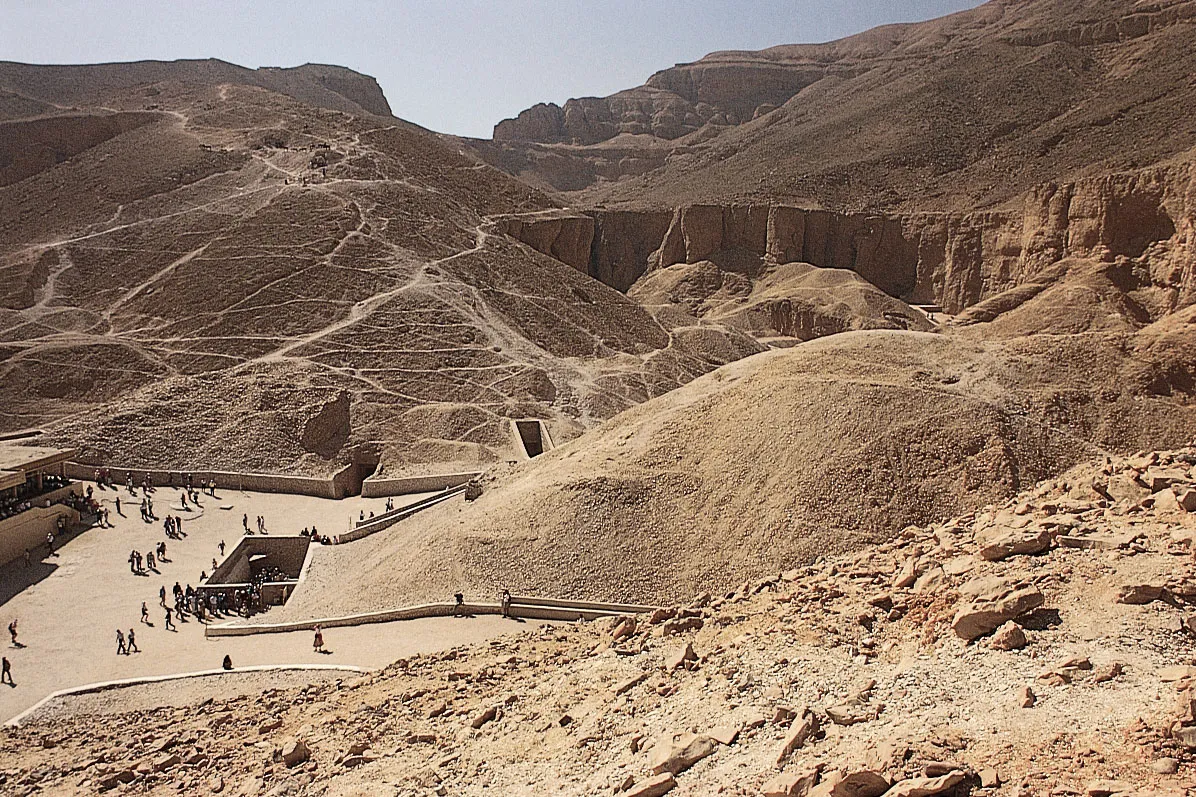
Beneath the scorching cliffs of southern Egypt lies a silent valley that has fascinated humanity for centuries. Hidden among barren hills on the west bank of the Nile, across from the ancient city of Thebes, stands one of the most extraordinary archaeological landscapes ever discovered. This is the Valley of the Kings, the royal burial ground of Egypt’s New Kingdom pharaohs.
At first glance, the valley appears almost lifeless. The rocky terrain seems incapable of supporting life, and the desert silence can feel overwhelming. Yet beneath these rugged limestone hills are dozens of tombs filled with stories of power, ambition, faith, betrayal, and death. Here, some of Egypt’s greatest rulers were laid to rest in elaborate underground chambers designed to ensure their eternal journey into the afterlife.
For more than three thousand years, the Valley of the Kings has guarded its secrets. Archaeologists have uncovered magnificent treasures, deciphered ancient inscriptions, and mapped hidden corridors. Yet despite generations of research, many mysteries remain unsolved.
Why was this remote valley chosen as a royal cemetery? How many undiscovered tombs still lie hidden beneath the desert floor? What happened to numerous missing pharaohs? Were secret chambers concealed behind tomb walls? Did ancient priests deliberately move royal mummies to protect them from grave robbers? And why does the valley continue to reveal surprising discoveries even today?
The Valley of the Kings is far more than an archaeological site. It is a puzzle spanning thousands of years, a place where every answer seems to create new questions.
The Birth of a Royal Necropolis
Before understanding the mysteries of the valley, it is important to understand its origins.
The Valley of the Kings became Egypt’s principal royal burial ground during the New Kingdom, roughly between the sixteenth and eleventh centuries BCE. During this period, Egypt reached the height of its political power and cultural influence.
Earlier pharaohs had built monumental pyramids as their tombs. The pyramids were intended to serve as eternal monuments visible across vast distances. While these structures symbolized royal power, they also advertised the location of immense treasures.
Over time, tomb robbery became a serious problem.
The rulers of the New Kingdom sought a different approach. Instead of constructing massive pyramids, they began carving tombs deep into the desert cliffs west of ancient Thebes, modern-day Luxor.
The chosen location offered natural isolation and protection. The steep valley was dominated by a pyramid-shaped mountain peak known as Al-Qurn. To ancient Egyptians, this natural formation may have symbolically replaced the artificial pyramids of earlier dynasties.
Thus began one of history’s greatest royal cemeteries.
Why This Valley?
One of the first mysteries concerns the location itself.
Why did the Egyptians choose this particular valley?
The official explanation seems straightforward. The valley’s remote position offered security. The surrounding cliffs created a natural barrier against intruders. The dry climate also helped preserve tombs and burial goods.
Yet some researchers believe additional factors influenced the decision.
Ancient Egyptian religion placed enormous importance on the western horizon. The sun set in the west each evening before beginning its journey through the underworld. Since death was associated with this nightly voyage, the western bank of the Nile held profound spiritual significance.
The valley may therefore have represented a symbolic gateway between the world of the living and the realm of the dead.
Even today, standing among the cliffs at sunset, it is easy to understand why ancient Egyptians viewed this landscape as sacred.
The Hidden Architecture of Eternity
The tombs of the Valley of the Kings were not simple graves.
They were carefully designed spiritual machines intended to guide a pharaoh through the afterlife.
Long corridors descended deep into the earth. Walls were covered with religious texts and elaborate paintings. Burial chambers contained magical imagery depicting gods, demons, celestial journeys, and cosmic transformations.
Each tomb followed a symbolic path.
As visitors moved deeper underground, they effectively followed the pharaoh’s journey through the underworld toward rebirth.
These tombs represent some of the most sophisticated funerary architecture ever created.
Yet despite extensive study, many aspects of their design remain poorly understood.
Researchers continue debating the precise meanings of certain symbols, chamber arrangements, and religious scenes.
The deeper scholars investigate these tombs, the more complex they appear.
The Mystery of Missing Tombs
One of the greatest unanswered questions concerns the number of tombs still hidden beneath the valley.
More than sixty royal tombs have been identified, but archaeologists strongly suspect additional tombs remain undiscovered.
The valley’s landscape has changed dramatically over thousands of years. Flash floods repeatedly deposited layers of rock, gravel, and sediment across the valley floor.
Entire entrances could easily become buried beneath debris.
The discovery of the tomb of Tutankhamun in 1922 dramatically demonstrated this possibility.
For centuries, people had searched the valley. Many experts believed little remained to be found. Yet the tomb of Tutankhamun had remained hidden beneath accumulated rubble and the remains of workers’ huts.
Its discovery transformed Egyptology.
If one royal tomb could remain concealed for more than three thousand years, could others still be waiting beneath the desert?
Many archaeologists believe the answer is yes.
The Extraordinary Discovery of Tutankhamun
No discussion of the valley’s mysteries is complete without the story of Tutankhamun.
Before the twentieth century, Tutankhamun was a relatively obscure pharaoh. He ruled briefly and left a limited historical footprint.
Everything changed when British archaeologist Howard Carter discovered his tomb.
Unlike most royal burials, which had been heavily looted, Tutankhamun’s tomb remained remarkably intact.
Inside, Carter found thousands of objects, including furniture, weapons, jewelry, chariots, statues, and the famous golden funerary mask.
The discovery captured global attention.
Yet even Tutankhamun’s tomb raised new mysteries.
Why was such an important burial hidden in a comparatively small tomb? Was the tomb originally intended for someone else? Why did the burial differ from many royal traditions?
More than a century later, researchers still debate aspects of Tutankhamun’s burial.
The Enigma of Tutankhamun’s Death
The death of Tutankhamun remains one of Egypt’s most famous mysteries.
The young king died around the age of nineteen.
Ancient records provide little information about the circumstances.
For decades, speculation flourished.
Some believed he had been murdered.
Others suggested an accident, disease, genetic disorders, or infection.
Modern scientific studies, including CT scans and DNA analysis, have provided valuable insights. Evidence suggests that health problems, combined with injury and illness, may have contributed to his death.
Yet no single explanation has achieved universal acceptance.
The young king’s sudden death continues to provoke debate among historians and medical researchers.
The Search for Hidden Chambers
One of the most exciting recent mysteries involves the possibility of hidden chambers within Tutankhamun’s tomb.
Some researchers proposed that subtle features visible on tomb walls might indicate sealed doorways.
The theory gained worldwide attention because it suggested an astonishing possibility.
Could another royal burial lie hidden behind the walls?
Some investigators even proposed that the tomb of the famous queen Nefertiti might be concealed nearby.
Ground-penetrating radar surveys produced conflicting results.
Some studies appeared to support the existence of hidden spaces, while others found no convincing evidence.
The debate remains unresolved.
Although no secret chamber has yet been confirmed, the controversy illustrates how the Valley of the Kings continues to generate excitement and uncertainty.
Where Is Nefertiti?
Few figures from ancient Egypt inspire more fascination than Nefertiti.
Known for her famous sculpted bust, Nefertiti was one of the most influential women of the ancient world.
Yet her final resting place remains unknown.
Some scholars believe she was buried elsewhere.
Others suspect her tomb may still lie undiscovered within the Valley of the Kings.
The mystery deepened because Nefertiti lived during a turbulent period marked by religious and political upheaval.
Historical records become fragmentary and confusing.
As a result, archaeologists still debate her fate.
The possibility that Nefertiti’s tomb remains hidden somewhere beneath the valley continues to inspire both researchers and the public.
The Lost Pharaohs
Not all pharaohs have been successfully located.
Several rulers known from historical records remain archaeologically elusive.
Their tombs have never been identified with certainty.
Some may have been destroyed by floods or ancient construction activities.
Others could remain buried beneath unexplored sections of the valley.
There is also the possibility that some tombs were intentionally concealed.
Ancient Egyptians sometimes reused burial sites, relocated remains, or modified tombs during periods of political instability.
Each missing pharaoh represents an unfinished chapter in Egyptian history.
The Problem of Tomb Robbers
One of the most surprising mysteries involves the widespread looting of royal tombs.
Despite enormous efforts to protect royal burials, most tombs were robbed in antiquity.
How did thieves repeatedly gain access?
Ancient records reveal that organized tomb robbery became a serious issue during periods of economic hardship.
Some thieves possessed detailed knowledge of tomb locations and layouts.
Evidence suggests that corrupt officials occasionally participated in the crimes.
The scale of the looting remains astonishing.
Many royal tombs were stripped of valuable objects only decades after burial.
Understanding how these robberies occurred continues to challenge historians.
The Secret Mummy Caches
During the nineteenth century, archaeologists made an extraordinary discovery.
Many royal mummies were not found in their original tombs.
Instead, they were discovered in hidden caches where ancient priests had secretly reburied them.
Among these were the mummies of some of Egypt’s greatest rulers.
Why were they moved?
The most widely accepted explanation is protection.
As tomb robbery intensified, priests attempted to save royal remains by relocating them to concealed locations.
Yet many details remain unclear.
Exactly when were these transfers conducted? How extensive was the operation? Were all royal mummies relocated, or only some?
The secret reburials reveal a dramatic chapter in the valley’s history.
The Mystery of Ancient Floods
Visitors often imagine the Valley of the Kings as a permanently dry environment.
In reality, the valley occasionally experiences powerful flash floods.
These floods have shaped the landscape for thousands of years.
Archaeological evidence shows that floodwaters repeatedly entered tombs, depositing mud, stones, and debris.
Some tombs suffered significant damage.
Others became buried and effectively hidden from view.
Researchers continue investigating the long-term impact of flooding on the valley.
The role of natural disasters may help explain why certain tombs disappeared while others survived.
The Curses of the Valley
Few topics attract as much public attention as the so-called curse of the pharaohs.
The legend gained popularity following the discovery of Tutankhamun’s tomb.
After several individuals connected to the excavation died, newspapers began linking their deaths to a supernatural curse.
Stories spread rapidly.
The public imagined ancient magical protections punishing those who disturbed royal burials.
In reality, scientific evidence does not support the existence of a curse.
Most deaths attributed to the curse can be explained by ordinary causes.
Nevertheless, the legend remains one of the valley’s most enduring mysteries in popular culture.
Its persistence demonstrates the powerful emotional impact of ancient tombs and forgotten kings.
The Mystery of Construction
Another fascinating question concerns how the tombs were built.
Ancient workers carved vast underground complexes using relatively simple tools.
They excavated corridors, chambers, stairways, and decorative surfaces with remarkable precision.
How were these projects organized?
How many workers participated?
How long did construction require?
Archaeologists have uncovered valuable evidence from nearby workers’ settlements, yet many details remain uncertain.
The logistical achievement represented by the valley’s tombs continues to impress modern researchers.
The Workers Behind the Kings
For many years, attention focused almost exclusively on pharaohs.
Today, archaeologists increasingly study the workers who built the tombs.
These craftsmen lived in a purpose-built settlement known as Deir el-Medina.
The site provides extraordinary insights into everyday life.
Records reveal disputes, friendships, family relationships, religious beliefs, and work routines.
Yet many mysteries remain.
How much creative freedom did artists possess? How were workers selected? What secrets did they carry regarding royal burials?
The lives of these skilled individuals remain an important area of research.
Unfinished Tombs and Sudden Deaths
Several tombs in the valley were never completed.
Their corridors end abruptly. Decorations remain unfinished. Construction appears to have stopped unexpectedly.
Why?
In some cases, the answer may be the death of a pharaoh.
Ancient Egyptian rulers often began preparing tombs years before their deaths. If a ruler died unexpectedly, workers might rush to complete essential sections while abandoning others.
Yet not every unfinished tomb can be easily explained.
Some appear connected to political upheaval, changing priorities, or unexplained interruptions.
Each unfinished tomb presents another historical puzzle.
Ancient Religious Mysteries
The walls of the Valley of the Kings contain some of the most complex religious imagery ever created.
Texts describe the sun god’s nightly journey through the underworld. Strange hybrid beings guard sacred pathways. Cosmic battles unfold in elaborate scenes.
Although Egyptologists have translated many inscriptions, interpretation remains challenging.
Ancient Egyptian religion evolved over centuries and often incorporated multiple layers of symbolism.
Some images likely held meanings understood only by priests and royal initiates.
As a result, certain religious concepts depicted in the tombs remain partially mysterious.
New Technologies and New Discoveries
The Valley of the Kings is no longer explored solely with shovels and brushes.
Modern technologies have transformed archaeological investigation.
Ground-penetrating radar can detect buried structures.
Laser scanning creates detailed digital maps.
DNA analysis reveals family relationships.
CT scanning allows researchers to examine mummies without unwrapping them.
Satellite imagery identifies subtle geological features.
These tools have generated remarkable discoveries while also raising new questions.
The valley remains an active field of investigation rather than a solved historical site.
Could More Royal Tombs Exist?
Perhaps the most exciting mystery of all concerns the future.
Many experts believe undiscovered tombs still exist.
The valley contains numerous unexplored zones. Geological studies indicate that buried features may remain hidden beneath sediment deposits.
Every generation has tended to assume the valley was nearly exhausted.
Yet discoveries repeatedly prove otherwise.
New chambers, artifacts, inscriptions, and burial sites continue to emerge.
The possibility of finding another royal tomb remains very real.
Such a discovery would instantly become one of the most significant archaeological events of the modern era.
The Valley’s Enduring Legacy
Part of what makes the Valley of the Kings so captivating is that it exists at the intersection of history and mystery.
Unlike purely legendary places, the valley is undeniably real.
Its tombs, inscriptions, mummies, and artifacts provide direct connections to one of humanity’s greatest civilizations.
Yet despite centuries of exploration, complete understanding remains elusive.
The valley constantly reminds researchers that the past is more complicated than it first appears.
Every solved mystery reveals another waiting beneath the surface.
Conclusion
The Valley of the Kings stands as one of the most extraordinary archaeological landscapes on Earth. Hidden within its desert cliffs are the stories of pharaohs, queens, priests, craftsmen, and entire generations who sought immortality through stone, art, and faith.
Modern archaeology has uncovered remarkable truths about the valley. We know who many of its rulers were, how their tombs were constructed, and what beliefs guided their preparations for the afterlife. Yet numerous mysteries remain unresolved. Hidden tombs may still await discovery. The final resting places of important historical figures remain unknown. Ancient religious symbolism continues to challenge interpretation. Questions surrounding royal deaths, secret burials, and lost treasures persist.
What makes the Valley of the Kings truly remarkable is not simply what has been found, but what remains hidden. More than three thousand years after the last pharaohs were buried there, the valley continues to surprise the world.
In its silent corridors and shadowed chambers, history still whispers unanswered questions. And somewhere beneath the desert floor, protected by time and stone, there may yet be discoveries capable of rewriting our understanding of ancient Egypt.