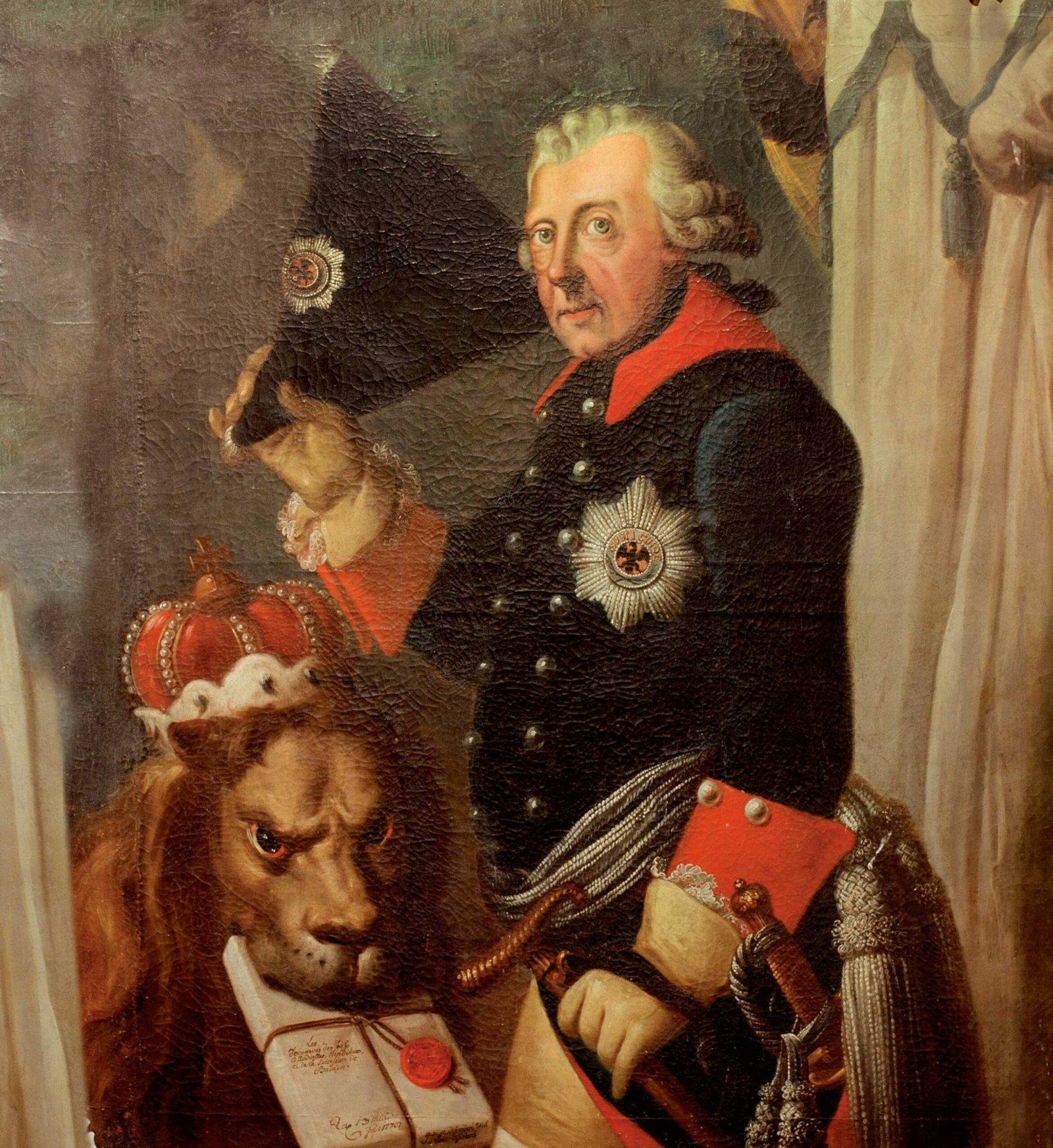
Frederick II (born January 24, 1712, Berlin, Kingdom of Prussia—died August 17, 1786, Potsdam, Kingdom of Prussia), commonly known as Frederick the Great, was King of Prussia from 1740 until his death. A member of the House of Hohenzollern, he was a military commander, political reformer, writer, musician, and patron of the arts. He expanded Prussian territory through a series of wars, strengthened its army, and established Prussia as one of the leading powers in Europe. His reign also brought changes to government, education, agriculture, and religious policy.
Early Life and Family Background
Frederick was born in Berlin on January 24, 1712, the eldest surviving son of King Frederick William I of Prussia and his wife, Sophia Dorothea of Hanover. His father was known for his strict personality, military discipline, and determination to build a powerful Prussian state. His mother came from the British royal family and was the daughter of King George I of Great Britain.
Frederick grew up in a royal household shaped by his father’s military values. Frederick William I believed that a strong army was essential to Prussia’s survival and success. He expected his son to develop the same interests and habits, including physical toughness, obedience, and strict discipline.
However, Frederick developed different interests. He enjoyed reading French literature, studying philosophy, writing poetry, and playing musical instruments. He was particularly attracted to French culture and the ideas of the European Enlightenment, a movement that encouraged reason, education, scientific inquiry, and criticism of traditional authority.
His interests frequently brought him into conflict with his father. Frederick William considered his son’s literary and artistic activities signs of weakness and believed that he was neglecting the responsibilities expected of a future king.
The relationship between father and son became increasingly difficult as Frederick grew older. His father regularly criticized him and sometimes treated him harshly. Frederick, in turn, resented the strict control placed over his personal life.
Conflict With His Father and Attempted Escape
By his teenage years, Frederick had become deeply unhappy with his father’s authority. He wanted greater personal freedom and hoped to escape the military lifestyle that dominated the royal household.
In 1730, when he was 18, Frederick attempted to flee Prussia with the help of his close friend Hans Hermann von Katte, a young army officer. Their plan was discovered before they could escape successfully.
Frederick William I regarded the attempt as an act of betrayal. He ordered Frederick’s arrest and had him imprisoned at Küstrin, a fortress town in eastern Prussia. Katte was sentenced to death and executed in November 1730. Frederick was forced to witness his friend’s execution.
The experience deeply affected him. Although he eventually received permission to leave prison, he had to accept his father’s authority and demonstrate that he was willing to fulfill his royal responsibilities.
During his time in Küstrin, Frederick received practical training in government and administration. He learned about financial management, agriculture, local administration, and military affairs. These experiences helped prepare him for the responsibilities he would later assume as king.
His relationship with his father gradually improved, although they never became especially close. In 1733, Frederick married Elisabeth Christine of Brunswick-Bevern, following his father’s wishes. The marriage produced no children, and the couple eventually lived largely separate lives.
Life at Rheinsberg
In 1736, Frederick moved to Rheinsberg Castle, north of Berlin, where he spent several years developing his intellectual and artistic interests.
Rheinsberg offered him greater independence than he had experienced during his childhood. He gathered writers, musicians, philosophers, and other educated visitors around him. He also corresponded with leading European thinkers, including the French philosopher Voltaire.
Frederick wrote poetry, composed music, played the flute, and studied political philosophy. French was his preferred language for literature and intellectual discussion. He admired French writers and believed that education and reason could improve government and society.
His relationship with Voltaire became especially important. The two men exchanged letters and discussed literature, philosophy, religion, and politics. Frederick admired Voltaire’s intelligence and writing, while Voltaire was interested in the young prince’s intellectual ambitions.
During these years, Frederick also continued preparing for military leadership. His artistic interests did not prevent him from studying the organization and practical demands of the Prussian army.
His father died on May 31, 1740. Frederick succeeded him as King Frederick II, beginning a reign that would transform Prussia’s position in Europe.
Becoming King of Prussia
Frederick inherited a state with an unusually well-organized administration, strong finances, and a large, disciplined army relative to its population. These advantages had been developed under his father, who had devoted much of his reign to strengthening the military and controlling government spending.
At the beginning of his own reign, Frederick introduced several changes. He relaxed some restrictions on public discussion, supported scientific institutions, and allowed greater freedom in certain areas of religious and intellectual life.
He also presented himself as a ruler who would govern through reason and public responsibility rather than personal privilege alone. He believed that a monarch should serve the state and protect its interests.
Despite his earlier dislike of military discipline, Frederick soon demonstrated that he was willing to use military power to expand his kingdom. His first major foreign policy decision came shortly after he became king.
The First Silesian War
In December 1740, Frederick invaded Silesia, a wealthy province belonging to the Habsburg monarchy under Maria Theresa, ruler of the Austrian hereditary lands.
Frederick based his claim partly on old Hohenzollern inheritance rights, although these claims did not provide a straightforward legal justification for taking the entire province. His decision was also driven by the desire to expand Prussian territory, strengthen its economy, and improve its strategic position.
The invasion began the First Silesian War, which became part of the larger War of the Austrian Succession.
Prussian forces achieved an important victory at the Battle of Mollwitz in April 1741. Although Frederick left the battlefield during the fighting, his army held its position and defeated the Austrian forces.
Prussia continued its military campaign, and the Treaty of Breslau in 1742 secured most of Silesia for Frederick. The acquisition gave Prussia a valuable industrial and agricultural region and significantly increased its resources.
However, the peace did not last. Frederick became concerned that Austria would attempt to recover the province and decided to fight again.
The Second Silesian War
In 1744, Frederick invaded Bohemia, hoping to strengthen Prussia’s position against Austria. This campaign began the Second Silesian War.
The invasion initially brought military gains, but supply difficulties and Austrian resistance forced Prussian forces to withdraw. Frederick then faced the challenge of defending Silesia against renewed Austrian attacks.
Prussian victories at Hohenfriedberg in 1745 and Soor later that year strengthened his position. His forces also defeated the Saxon army at Kesselsdorf.
The Treaty of Dresden, signed in December 1745, ended the conflict. Austria recognized Prussia’s possession of Silesia, and Frederick agreed to recognize Francis I, Maria Theresa’s husband, as Holy Roman Emperor.
The two Silesian Wars established Frederick’s reputation as a capable military commander and confirmed Prussia as an important European power. However, his success also created lasting hostility between Prussia and Austria.
Domestic Reforms and Government
While pursuing territorial expansion, Frederick also worked to improve the administration and economic strength of Prussia.
He believed that a successful monarch needed an efficient government, reliable revenue, productive agriculture, and a strong legal system. He took a direct interest in public administration and expected officials to carry out their duties carefully.
Frederick supported improvements to the legal system and encouraged more consistent judicial procedures. During his reign, Prussia developed further toward a more organized system of written laws, although the major Prussian legal code was completed and introduced after his death, in 1794.
He also supported the expansion of education. Elementary schooling received greater attention, and the government encouraged the establishment and improvement of schools. In 1763, he issued a General School Regulation that strengthened requirements for primary education in Prussia.
Religious policy was another area in which he allowed a degree of freedom. Frederick generally permitted different Christian groups, as well as Jewish communities, to practice their religions under various legal and social restrictions. He welcomed religious minorities when their skills and economic activities could benefit the state.
His approach reflected a practical understanding of government. He believed that religious differences should not prevent people from contributing to the kingdom’s prosperity.
Frederick also encouraged agricultural development. He supported the cultivation of previously unused land, the construction of canals, and the improvement of drainage systems. These projects helped increase agricultural production and encouraged settlement in less-developed areas.
He promoted the cultivation of potatoes as an additional food source, particularly because they could grow in conditions where some traditional crops struggled. His government encouraged farmers to adopt the crop, although its acceptance took time.
The Seven Years’ War
Frederick’s greatest military challenge began in 1756 with the outbreak of the Seven Years’ War. The conflict involved several major European powers, including Prussia, Austria, France, Russia, and Britain.
Austria wanted to recover Silesia, while France and Russia joined forces against Prussia. Frederick recognized that his kingdom faced the danger of being overwhelmed by a coalition of larger states.
Rather than waiting for his enemies to attack, he invaded Saxony in August 1756. This decision marked the beginning of the European phase of the Seven Years’ War.
Frederick initially achieved important victories. At the Battle of Rossbach in November 1757, his forces defeated a much larger French and Imperial army. The following month, he won another major victory against Austrian troops at Leuthen in Silesia.
These successes demonstrated his ability to use rapid movement, careful planning, and concentrated attacks to defeat larger armies.
However, the war became increasingly difficult. Prussia suffered heavy losses and faced attacks from several directions. Its limited population and resources made it difficult to replace soldiers and equipment.
In 1758, Frederick fought the Russians at the Battle of Zorndorf. Although the battle ended without a clear decisive result, both sides suffered severe casualties.
The following year brought one of the worst defeats of his military career. At the Battle of Kunersdorf in August 1759, Russian and Austrian forces inflicted a devastating defeat on the Prussian army. Frederick’s position became extremely dangerous, and he feared that his kingdom might collapse.
Prussia survived partly because its enemies failed to coordinate their efforts effectively and because military and political circumstances changed in its favor.
In 1760, Frederick continued fighting despite serious losses. He achieved a significant victory over Austrian forces at Torgau in November, but the kingdom remained exhausted.
The war continued for several more years. Frederick faced shortages of soldiers, financial difficulties, and the growing pressure of maintaining military operations on multiple fronts.
A major turning point came in 1762 when Empress Elizabeth of Russia died. Her successor, Peter III, admired Frederick and quickly ended Russia’s participation in the war. Russia’s withdrawal greatly reduced the pressure on Prussia.
Although Peter III was soon overthrown, the new Russian ruler, Catherine II, did not return to the war against Prussia.
Austria was also weakened by the prolonged conflict, and both sides eventually became willing to negotiate.
The Treaty of Hubertusburg, signed in February 1763, ended the war between Prussia and Austria and their allies. Frederick retained Silesia, preserving the territorial gains he had made more than two decades earlier.
The war had left Prussia financially and physically exhausted. Many communities had suffered destruction, agricultural production had declined in affected regions, and the army had lost large numbers of soldiers.
Rebuilding Prussia After the War
After the Seven Years’ War ended, Frederick focused on restoring the kingdom’s economy and population.
He supported the rebuilding of farms, villages, and towns damaged during the fighting. Government assistance was provided to farmers, and efforts were made to restore agricultural production.
Frederick encouraged immigration to areas that had lost population and supported the settlement of land that could be brought into cultivation. He also promoted manufacturing and trade to strengthen the kingdom’s financial position.
Roads, canals, and other transportation projects received attention because better connections helped farmers and merchants move goods more efficiently.
The king continued to support the expansion of agricultural production, including potato cultivation. He understood that a reliable food supply was essential to economic recovery and the stability of the population.
His administration also worked to maintain the financial reserves and military organization that had helped Prussia survive the war.
The First Partition of Poland
In 1772, Frederick participated in the First Partition of Poland alongside Russia and Austria.
The Polish-Lithuanian Commonwealth had experienced political instability and growing foreign interference. Its government was weakened by internal divisions and the influence of neighboring powers.
Frederick, Catherine II of Russia, and Maria Theresa of Austria agreed to divide portions of Polish territory among their states.
Prussia received Royal Prussia, although the city of Gdańsk remained outside its control. The acquisition connected previously separated Prussian territories and strengthened the kingdom’s position along the Baltic coast.
Frederick gained territory without fighting a major war. The partition also expanded his influence in the region and helped make Prussia more geographically connected.
The division of Poland was carried out without the consent of the Polish population and contributed to the weakening of the Commonwealth. It marked another important stage in the expansion of Prussian power during Frederick’s reign.
The War of the Bavarian Succession
Another European crisis developed in 1777 when Maximilian III Joseph, Elector of Bavaria, died without a direct heir.
Austria, under Emperor Joseph II, attempted to acquire parts of Bavaria through an agreement with the new Bavarian ruler. Frederick opposed the Austrian expansion because he feared that it would upset the balance of power in central Europe.
In 1778, Prussian forces entered Bohemia, beginning the War of the Bavarian Succession.
The conflict involved large military movements but relatively little direct fighting. Both sides experienced serious supply difficulties, and the war became known for the importance of food shortages and logistical problems rather than major battles.
The conflict ended with the Treaty of Teschen in 1779. Austria received a small portion of Bavarian territory but abandoned its broader plans to acquire the region.
Frederick had once again prevented Austria from making a major territorial expansion in central Europe.
Personal Interests and Cultural Life
Despite his demanding responsibilities as king, Frederick maintained strong interests in music, literature, architecture, and philosophy throughout his life.
He was an accomplished flute player and composed numerous musical works, including sonatas and concertos. He regularly performed with professional musicians and maintained a court orchestra.
His interest in music was closely connected to his personal identity. He often used music as a way to relax and continued practicing even during periods of intense political and military activity.
Frederick also wrote poetry, historical works, political essays, and philosophical discussions. He generally wrote in French rather than German because he preferred French literary traditions and considered French the language of European intellectual life.
His relationship with Voltaire continued for many years, although it became increasingly difficult. Voltaire spent time at Frederick’s court in Potsdam beginning in 1750. Their relationship eventually deteriorated because of personal disagreements, criticism, and disputes over money and reputation. Voltaire left Prussia in 1753.
Frederick also supported the construction and improvement of royal buildings. One of his most famous projects was Sanssouci Palace in Potsdam, completed in the 1740s. The palace served as his private residence and reflected his interests in art, music, philosophy, and architecture.
He preferred a relatively informal lifestyle at Sanssouci, where he spent much of his later life away from the ceremonies of the royal court.
Frederick’s Later Years
As Frederick grew older, he continued to direct government affairs and maintain close attention to military organization and foreign policy.
He remained deeply involved in administration, often reviewing reports and issuing instructions to government officials. He expected efficiency and personal responsibility from those who served the state.
His physical health gradually declined. Years of military campaigns, demanding work, and aging affected his strength, although he continued performing his royal duties for much of his later life.
Frederick never had children with his wife, Elisabeth Christine. Their relationship remained distant, and she generally lived separately from him.
His younger brother, Prince Henry of Prussia, was an important member of the royal family and a trusted military commander, but Frederick’s successor was his nephew, Frederick William II, the son of his brother Augustus William.
Frederick spent much of his final period at Sanssouci Palace. He continued reading, writing, and taking an interest in government matters until his health became too weak.
He died at Sanssouci on August 17, 1786, at the age of 74. He was buried in the palace grounds near his beloved dogs, in accordance with his wishes. Frederick William II succeeded him as King of Prussia.