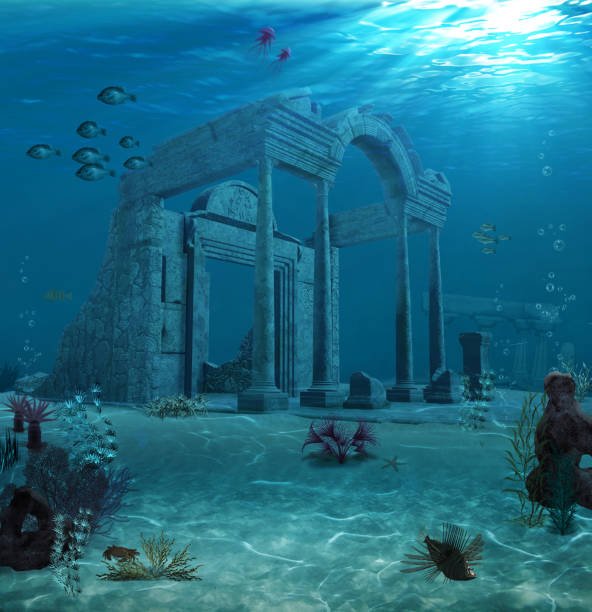
Atlantis has captivated the human imagination for more than two thousand years. Few stories from the ancient world have inspired as much fascination, debate, speculation, and mystery. Was Atlantis a real civilization that vanished beneath the waves? Was it an ancient memory of a catastrophic natural disaster? Or was it simply a philosophical tale created to teach a lesson about pride, power, and human ambition?
The mystery of Atlantis sits at the crossroads of history, archaeology, mythology, geology, and human imagination. It is a story that has inspired explorers, scientists, writers, filmmakers, and dreamers across generations. Despite centuries of investigation, no definitive proof of Atlantis has ever been found. Yet the legend refuses to disappear.
Part of the reason lies in the remarkable details associated with the story. Unlike many myths, Atlantis was described as a powerful island civilization with advanced engineering, magnificent architecture, vast wealth, and a dramatic destruction. The vividness of the account has encouraged countless people to wonder whether some kernel of truth lies hidden within the legend.
Today, modern archaeology and earth science provide new tools for examining the mystery. Researchers can map the ocean floor, study ancient climate records, analyze geological disasters, and investigate long-lost civilizations. While these discoveries have not solved the Atlantis puzzle, they have generated compelling theories that continue to fuel discussion.
The story of Atlantis is not merely about a lost city. It is also about humanity’s desire to understand its past, uncover forgotten worlds, and search for truths buried beneath layers of time.
The First Appearance of Atlantis
The story of Atlantis originates with the ancient Greek philosopher Plato, who lived during the fourth century BCE.
Atlantis appears in two of Plato’s dialogues, the Timaeus and the Critias. In these works, Plato describes an enormous island located beyond the Pillars of Hercules, which most scholars identify with the Strait of Gibraltar.
According to Plato, Atlantis was a wealthy and powerful civilization that existed thousands of years before his own time. The island possessed fertile land, abundant natural resources, impressive buildings, and sophisticated engineering projects. Its inhabitants constructed canals, harbors, temples, and defensive walls. The civilization flourished and became a major force in the ancient world.
However, Plato explained that the Atlanteans gradually became corrupted by greed and ambition. They attempted to conquer neighboring lands, including ancient Athens. In the story, Athens resisted the invasion and emerged victorious.
Soon afterward, Atlantis suffered a catastrophic fate. Plato wrote that powerful earthquakes and floods struck the island. In a single day and night of misfortune, Atlantis disappeared beneath the sea.
This dramatic ending became one of history’s most enduring mysteries.
Why Plato Created the Story
Understanding Atlantis begins with understanding Plato himself.
Plato was not a historian in the modern sense. He was a philosopher interested in politics, ethics, justice, and the ideal society. Many scholars believe Atlantis was primarily a literary device used to communicate philosophical ideas.
In Plato’s account, Atlantis represents a wealthy and powerful society that becomes morally corrupt. Athens, in contrast, represents virtue, discipline, and wisdom.
Viewed this way, Atlantis serves as a cautionary tale. The destruction of the island symbolizes the consequences of arrogance and moral decline.
Many historians argue that Plato never intended readers to treat Atlantis as a literal historical account. Instead, he may have created the story to illustrate political and ethical lessons.
Yet the situation is not entirely straightforward. Plato included surprisingly specific geographical and historical details. He described the dimensions of the island, the layout of its capital, its resources, its rulers, and even aspects of its military.
These details have led some researchers to wonder whether Plato based the story on older traditions, historical memories, or real events.
The Remarkable Description of Atlantis
One reason Atlantis remains so compelling is the extraordinary detail found in Plato’s account.
The capital city supposedly consisted of concentric rings of land and water connected by bridges and canals. Ships could travel directly from the sea into the heart of the city.
Magnificent temples adorned the landscape. One temple was dedicated to the sea god Poseidon. The city featured advanced engineering projects, including sophisticated water systems and large harbors.
The island possessed rich agricultural land capable of supporting a large population. Forests provided timber, while mountains contained valuable minerals.
Plato also described a mysterious metal called orichalcum, second in value only to gold. Although the exact identity of orichalcum remains uncertain, ancient Greeks associated it with great wealth.
The vividness of these descriptions gives Atlantis an air of realism that continues to intrigue readers today.
Ancient Memories and Historical Possibilities
One of the most interesting questions surrounding Atlantis is whether the story preserves memories of real events.
Human societies often pass stories from generation to generation. Over centuries, actual historical events can become transformed into myths and legends.
A flood may become a divine punishment.
A volcanic eruption may evolve into a tale of angry gods.
A destroyed city may become an entire lost civilization.
Some researchers suggest that Atlantis may represent a blend of historical memories that gradually changed over time.
If so, the challenge is identifying which real events might have inspired the legend.
The Minoan Civilization and Atlantis
Among all Atlantis theories, one of the most influential connects the legend to the ancient Minoan civilization.
The Minoans flourished on the island of Crete and surrounding regions during the Bronze Age. Their civilization was one of the most advanced in Europe at the time.
The Minoans built impressive palaces, developed extensive trade networks, and produced sophisticated art. Their maritime influence extended throughout the eastern Mediterranean.
For many years, archaeologists viewed the Minoans as a possible inspiration for Atlantis.
Several similarities are striking.
Like Atlantis, the Minoan civilization was wealthy, seafaring, and technologically advanced for its era. It possessed impressive architecture and exercised considerable regional influence.
Most importantly, the Minoans experienced a devastating natural disaster.
The Eruption of Thera
Around the second millennium BCE, one of the largest volcanic eruptions in human history occurred on the island of Thera, now known as Santorini.
The eruption was catastrophic.
Massive explosions shattered the island. Ash clouds spread across vast regions. Tsunamis likely swept through parts of the eastern Mediterranean.
The event dramatically altered the landscape and may have weakened Minoan society.
To modern researchers, the parallels are fascinating.
A powerful island civilization.
A sudden natural catastrophe.
Destruction associated with the sea.
An enduring cultural memory.
Although significant differences exist between Plato’s account and the Minoan world, many scholars consider the Thera eruption one of the strongest candidates for inspiring aspects of the Atlantis story.
The Lost City of Akrotiri
Excavations at the ancient settlement of Akrotiri have added another layer to the mystery.
Often compared to Pompeii, Akrotiri was buried beneath volcanic ash during the Thera eruption. The ash preserved buildings, artwork, and everyday objects with remarkable detail.
Archaeologists uncovered multi-story structures, sophisticated drainage systems, colorful frescoes, and evidence of a thriving society.
The discoveries demonstrated that Bronze Age civilizations could achieve levels of complexity that earlier generations had underestimated.
When visitors see the ruins of Akrotiri, it becomes easier to understand how stories of a lost advanced civilization might emerge and endure.
Yet Akrotiri itself does not perfectly match Plato’s Atlantis. It represents a real archaeological site rather than proof of the legendary island.
The Flood Hypothesis
Flood myths appear throughout human cultures.
Stories of great floods exist in Mesopotamian traditions, biblical narratives, Greek mythology, Indigenous oral histories, and many other cultural traditions.
Scientists know that dramatic flooding events occurred repeatedly during prehistory.
At the end of the last Ice Age, melting glaciers caused sea levels to rise significantly. Coastal regions that once supported human communities disappeared beneath advancing waters.
Some researchers propose that Atlantis may reflect collective memories of these ancient floods.
Communities witnessing the loss of coastal lands would naturally preserve stories about vanished territories.
Over centuries, these stories could evolve into legends about a lost island civilization swallowed by the sea.
This theory does not identify Atlantis as a specific location. Instead, it suggests the legend emerged from widespread experiences of environmental change.
Could Atlantis Be in the Atlantic Ocean?
Many people assume Atlantis must have existed somewhere in the Atlantic Ocean.
This idea comes directly from Plato’s statement that the island lay beyond the Pillars of Hercules.
Over the centuries, explorers and researchers have proposed numerous Atlantic locations.
Some suggested the Azores.
Others proposed submerged plateaus or underwater mountain ranges.
Still others imagined Atlantis occupying a vast landmass that later sank beneath the ocean.
Modern geology presents serious challenges to these ideas.
The Earth’s crust does not allow large continents to disappear suddenly beneath deep oceans in the manner described by Atlantis enthusiasts.
Oceanic crust behaves differently from continental crust, and geological evidence does not support the recent existence of a lost Atlantic continent matching Plato’s description.
As a result, most geologists reject the idea of a giant vanished continent in the Atlantic.
The Antarctica Theory
One of the more imaginative Atlantis theories links the lost civilization to Antarctica.
Supporters suggest Atlantis once existed in Antarctica before dramatic geological changes shifted the continent to its current location.
The theory gained attention during the twentieth century and was sometimes associated with the concept of crustal displacement.
Modern earth science does not support this scenario.
Antarctica has occupied polar regions for millions of years. Geological evidence demonstrates that the continent was already frozen long before human civilizations emerged.
Although the Antarctica theory remains popular in certain speculative circles, it lacks support from mainstream geology and archaeology.
Atlantis and the Caribbean
Another popular proposal places Atlantis somewhere in the Caribbean.
Interest in this idea intensified after unusual underwater formations were discovered near various islands.
Some observers interpreted submerged stone structures as evidence of ancient cities.
However, subsequent investigations generally found natural geological explanations or features that did not support claims of a lost advanced civilization.
Despite periodic excitement surrounding new discoveries, no convincing evidence has emerged connecting the Caribbean to Plato’s Atlantis.
The Bimini Road Mystery
Among the most famous underwater formations associated with Atlantis is the Bimini Road.
Discovered near the Bahamas, the structure consists of large stone blocks arranged in a linear pattern beneath shallow water.
At first glance, the formation appears surprisingly artificial. Some observers suggested it represented a road, harbor wall, or other human-made structure connected to Atlantis.
Geologists have studied the site extensively.
Most experts conclude that the stones are naturally formed limestone blocks shaped by geological processes and coastal erosion.
While the Bimini Road remains visually intriguing, it is generally not considered evidence of Atlantis by mainstream researchers.
Atlantis and Ancient Egypt
Plato claimed that the story of Atlantis reached Greece through Egyptian priests who preserved ancient records.
This detail has inspired extensive speculation.
Ancient Egypt possessed one of the world’s longest continuous civilizations. Egyptian priests maintained historical traditions and recorded important events.
Some Atlantis enthusiasts argue that Egyptian archives may once have contained information about a lost civilization.
However, no known Egyptian text clearly describes Atlantis as Plato portrayed it.
Despite intensive archaeological research in Egypt, definitive evidence supporting the existence of Atlantis has not emerged.
The connection remains an intriguing aspect of the legend rather than confirmed history.
Why Atlantis Continues to Fascinate
The enduring appeal of Atlantis goes beyond questions of historical accuracy.
Atlantis embodies several themes that resonate deeply with human psychology.
It represents the allure of hidden knowledge.
It suggests that forgotten civilizations may have achieved greatness beyond our expectations.
It combines wonder, tragedy, and mystery into a single narrative.
There is also something emotionally powerful about lost worlds.
Ancient ruins, abandoned cities, and vanished cultures remind us that even the most impressive human achievements can disappear.
Atlantis magnifies this idea on a grand scale.
The legend invites people to imagine an entire civilization erased by catastrophe, leaving only fragments of memory behind.
The Search for Atlantis in Modern Times
The modern search for Atlantis began in earnest during the nineteenth century.
Explorers, amateur researchers, historians, and archaeologists proposed countless locations.
Books, expeditions, documentaries, and research projects attempted to solve the mystery.
Technological advances expanded the search.
Sonar mapping revealed underwater landscapes in unprecedented detail.
Satellite imagery allowed researchers to identify ancient geological features.
Marine archaeology uncovered shipwrecks and submerged settlements.
Despite these advances, no discovery has provided definitive proof of Atlantis.
The search itself has become part of the legend.
Each new generation revisits the mystery using the latest scientific tools and perspectives.
What Archaeology Says Today
Most professional archaeologists approach Atlantis cautiously.
The consensus view is that no direct evidence currently supports the existence of Atlantis as a vast advanced civilization matching Plato’s description.
Archaeologists emphasize that extraordinary claims require extraordinary evidence.
A civilization capable of the scale described by Plato would likely leave substantial traces.
These traces might include inscriptions, artifacts, settlements, trade networks, or other archaeological signatures.
To date, such evidence has not been found.
This does not mean the story lacks historical roots.
Many scholars acknowledge that elements of Atlantis may have been inspired by real places, disasters, or cultures.
The challenge lies in separating historical possibilities from later embellishment.
Geological Lessons from Atlantis
Although Atlantis itself remains unproven, the search has produced valuable scientific insights.
Researchers studying possible Atlantis locations have learned more about earthquakes, tsunamis, volcanic eruptions, sea-level changes, and coastal evolution.
The legend highlights humanity’s vulnerability to natural disasters.
Entire communities can be transformed by geological events.
Volcanoes can reshape landscapes.
Earthquakes can destroy cities.
Tsunamis can alter coastlines in a matter of hours.
In this sense, Atlantis serves as a reminder that civilizations exist within dynamic and sometimes unpredictable natural systems.
Atlantis in Literature and Popular Culture
The influence of Atlantis extends far beyond academic debate.
Writers have used Atlantis as a setting for adventure stories, science fiction, fantasy novels, and philosophical works.
Filmmakers and television producers have reimagined the lost civilization in countless ways.
Some portray Atlantis as a technologically advanced society.
Others depict it as a mystical kingdom filled with ancient wisdom.
These interpretations often reveal more about contemporary hopes and fears than about the original legend itself.
Each generation creates its own version of Atlantis.
The story adapts, evolves, and survives.
Could Atlantis Ever Be Found?
The possibility cannot be completely dismissed.
History contains many examples of legendary places once considered fictional that later proved to have historical foundations.
Ancient cities mentioned in myths have sometimes been identified through archaeology.
Lost civilizations have emerged from beneath jungles, deserts, and volcanic ash.
Future discoveries may reveal new information about the origins of the Atlantis story.
Perhaps an undiscovered archaeological site will provide unexpected clues.
Perhaps new geological evidence will illuminate ancient disasters that inspired the legend.
Or perhaps Atlantis will remain forever suspended between history and myth.
The Most Compelling Modern Interpretation
Among the numerous theories, the connection between Atlantis and the Bronze Age Aegean world remains one of the most persuasive.
The combination of the Minoan civilization, the Thera eruption, tsunami destruction, and preserved memories of catastrophe offers a plausible framework for understanding how the legend may have developed.
This interpretation does not require a lost super-civilization or a vanished continent.
Instead, it views Atlantis as a story shaped by real historical events, transformed through centuries of retelling, and ultimately adapted by Plato for philosophical purposes.
Such an explanation aligns with both archaeological evidence and human storytelling traditions.
It acknowledges that myths often contain fragments of truth while recognizing that those truths become reshaped over time.
Conclusion
The mystery of Atlantis endures because it occupies a unique space between fact and imagination. It is a tale rooted in ancient literature, enriched by historical possibilities, and sustained by humanity’s fascination with the unknown.
More than two thousand years after Plato first described the lost island, Atlantis remains one of the world’s greatest unsolved puzzles. Modern science has challenged many traditional interpretations, ruling out some possibilities while strengthening others. Geological research, archaeology, and historical analysis suggest that real events—especially catastrophic natural disasters such as the eruption of Thera—may have contributed to the legend’s creation.
Yet no definitive answer exists.
Perhaps Atlantis was a philosophical allegory. Perhaps it was inspired by memories of Bronze Age civilizations. Perhaps it combined history, myth, and imagination into a story greater than any single source.
Whatever its true origin, Atlantis continues to inspire curiosity because it speaks to something timeless within human nature. It reminds us of lost worlds, forgotten histories, and the fragile nature of even the greatest civilizations. It encourages exploration, invites questioning, and keeps alive the possibility that beneath the surface of accepted history, there may still be mysteries waiting to be uncovered.
In that sense, Atlantis is more than a lost city. It is a symbol of humanity’s endless search for knowledge, a reminder that the past still holds secrets, and a testament to the enduring power of stories that refuse to sink beneath the waves of time.