On a clear night far from city lights, when the air is still and the sky feels endless, you can sometimes see it: a pale, glowing band stretched across the darkness like spilled silver. It looks soft, almost like a cloud. For thousands of years, humans stared at that mysterious streak and wondered what it was. Some imagined it was a river of spirits. Others believed it was a path carved by gods. Many cultures built stories around it, because it felt too vast and too strange to be ordinary.
But it is ordinary—at least in the universe’s terms.
That glowing band is our galaxy, the Milky Way, seen from the inside. It is not a cloud. It is a colossal city of stars, a swirling island of matter and light, holding hundreds of billions of suns, endless clouds of gas and dust, and worlds beyond counting. Somewhere inside it, on a small rocky planet orbiting an unremarkable star, life learned to look up and ask questions.
The Milky Way is not just a background decoration of the night sky. It is the structure that shaped the history of our solar system. It is the environment that provided the raw materials for Earth. It is the gravitational home that keeps our star in orbit and protects us from being flung into intergalactic darkness.
To understand the Milky Way is to understand where we are in the universe—not just geographically, but physically and historically. It is to realize that Earth is not floating alone. It belongs to something much larger, something ancient, and something still evolving.
This is the story of the Milky Way galaxy: what it is, how it formed, what it contains, and why it matters.
What Exactly Is the Milky Way?
The Milky Way is a galaxy, meaning a gravitationally bound system made up of stars, stellar remnants, gas, dust, and dark matter. Gravity holds all these components together in a vast structure that rotates slowly over time.
When we say “Milky Way,” we are referring to the entire galactic system that contains our solar system. It is not the same thing as the bright band in the sky, although that band is our visual perspective of the Milky Way’s disk.
From Earth, we are located inside the galaxy’s disk. When we look along the plane of that disk, we see dense star fields, clouds of dust, and distant glowing regions. That combined light appears as the Milky Way band.
From outside, if we could travel far beyond the galaxy and look back, we would see the Milky Way as a spiral galaxy—a flat disk with curved arms, a bright central bulge, and a surrounding halo of stars and dark matter.
The Milky Way is one of countless galaxies in the observable universe, but it is our galaxy, the one that shaped everything we know. Every star you see at night belongs to the Milky Way. The Andromeda galaxy is one of the few exceptions visible to the naked eye, appearing as a faint smudge in the sky.
Everything else—our sun, our planets, our bodies—exists within the Milky Way’s gravitational embrace.
How Big Is the Milky Way?
The Milky Way is enormous on a scale that is hard for the human mind to grasp. Its disk is roughly about 100,000 light-years across, meaning light traveling at its incredible speed would take around 100,000 years to cross it from one side to the other.
A light-year is not a measure of time, but distance. It is the distance light travels in one year: about 9.46 trillion kilometers. Even a single light-year is unimaginably large by everyday standards. The nearest star system to our Sun, Alpha Centauri, is more than four light-years away.
So when we say the Milky Way is about 100,000 light-years wide, we are describing a structure so vast that it contains distances beyond ordinary comprehension.
The thickness of the Milky Way’s disk is much smaller than its width. The disk is roughly about 1,000 light-years thick in its thin component, though it also contains a thicker disk component extending several thousand light-years above and below the plane.
The galaxy is not just the disk. Surrounding it is a halo of stars and globular clusters, and an even larger halo of dark matter. The dark matter halo likely extends far beyond the visible galaxy, possibly several hundred thousand light-years.
The Milky Way is not a simple flat pancake of stars. It is a layered structure with multiple components, each with its own history.
How Many Stars Are in the Milky Way?
The Milky Way contains an estimated hundreds of billions of stars. Exact numbers are difficult because we cannot easily count stars from within the galaxy, and dust obscures large regions of the disk.
Our galaxy contains stars of many types: small red dwarfs that burn slowly for trillions of years, bright blue giants that live fast and die young, Sun-like stars, and exotic remnants like white dwarfs, neutron stars, and black holes.
Most stars in the Milky Way are smaller and dimmer than the Sun. Red dwarfs are the most common type. They are faint but long-lived, meaning many of the galaxy’s stars may still be shining long after the Sun is gone.
The Milky Way’s star population is not evenly distributed. The central bulge is densely packed with stars. The spiral arms contain active star formation regions. The halo contains older, scattered stars and clusters.
If you could stand in the galaxy’s central region, the night sky would not be dark at all. It would be blazing with starlight, so crowded that the concept of individual stars would almost disappear into a luminous haze.
The Shape of the Milky Way: A Barred Spiral Galaxy
The Milky Way is classified as a barred spiral galaxy. This means it has a spiral structure, but with a central bar-shaped region of stars extending across its core.
Many spiral galaxies have these bars, and they play an important role in how matter moves within galaxies. The bar can channel gas inward toward the center, influencing star formation and feeding the central black hole.
The Milky Way has a central bulge—a dense, rounded region filled with stars. But rather than being perfectly spherical, the bulge appears to be elongated into a bar.
From the ends of this bar, spiral arms extend outward, curving around the galaxy like a cosmic pinwheel.
Spiral galaxies are not static sculptures. Their arms are not fixed structures like the arms of a solid object. Instead, they are more like density waves—regions where stars and gas become temporarily more concentrated, triggering star formation as gas clouds are compressed.
This means stars do not stay permanently in a single spiral arm. They orbit the galactic center and move in and out of arms over time.
The Milky Way is a dynamic, rotating system, constantly reshaping itself through gravity and motion.
The Milky Way’s Main Components
To truly understand the Milky Way, it helps to see it as a collection of major structural parts. Each component has different stars, different chemistry, and different history.
The Milky Way has a central region, a broad disk with spiral arms, and an outer halo. Each is distinct.
The galactic center is the most crowded and extreme environment. The disk is the region where most stars and gas are found, including the spiral arms where new stars are born. The halo is a faint, extended region containing older stars and globular clusters.
Beyond all visible matter lies the dark matter halo, which dominates the galaxy’s mass and gravitational influence.
These components form a layered structure, like an ancient city built over many eras.
The Galactic Center: The Heart of the Milky Way
The center of the Milky Way is located in the direction of the constellation Sagittarius. From Earth, it is difficult to see directly in visible light because dense clouds of dust block our view. But in infrared, radio, and X-ray wavelengths, astronomers can observe the galactic center in remarkable detail.
The central region is packed with stars, gas clouds, and energetic phenomena. It is a place of strong gravity and extreme environments.
At the very core of the Milky Way lies Sagittarius A*, a supermassive black hole with a mass of about four million times the mass of the Sun.
This black hole is not actively devouring huge amounts of matter at the moment, so it is relatively quiet compared to the blazing black holes in some other galaxies. But it is still powerful, and its gravity shapes the orbits of stars nearby.
Astronomers have tracked stars orbiting Sagittarius A* over many years. These stars move at incredible speeds, whipping around the invisible center in tight elliptical paths. Their motion provides strong evidence that a massive, compact object—a supermassive black hole—must be present.
The galactic center is not only fascinating because of the black hole. It is also a region of intense star formation, turbulent gas clouds, and strong magnetic fields. It contains massive star clusters and remnants of supernova explosions.
If the Milky Way were a living organism, the galactic center would be its beating heart—dense, energetic, and full of forces we barely understand.
Sagittarius A*: The Milky Way’s Central Black Hole
Black holes are among the strangest objects in physics. They are regions of spacetime where gravity is so strong that nothing, not even light, can escape once it crosses the event horizon.
Sagittarius A* is a supermassive black hole, meaning it is millions of solar masses. Supermassive black holes are found in the centers of most large galaxies. How they formed is still an active area of research, but their existence is strongly supported by observational evidence.
The black hole itself is invisible, but the region around it can glow as gas and dust spiral inward, heating up through friction and emitting radiation.
Sagittarius A* occasionally produces flares of radiation, likely caused by matter falling closer to the black hole. These flares are observed in infrared and X-ray wavelengths.
Despite its enormous mass, Sagittarius A* is relatively small in size compared to the galaxy. The Milky Way’s black hole is a tiny dot at the center of a structure tens of thousands of light-years wide.
Yet its influence is profound. It anchors the galaxy’s inner region and is a key part of the Milky Way’s history.
The Galactic Bulge: A Dense Sphere of Ancient Stars
Surrounding the central black hole is the galactic bulge, a dense concentration of stars extending thousands of light-years.
The bulge contains many older stars, and its stellar population differs from that of the disk. Many bulge stars have lower amounts of heavy elements compared to younger disk stars, suggesting they formed earlier in the galaxy’s history.
However, the bulge is not uniform. It contains a mixture of stellar populations and complex structures, including the bar.
The bulge is like an ancient downtown area of a city, crowded with old buildings and history layered upon history.
Studying the bulge helps astronomers understand how the Milky Way formed, because the bulge likely contains some of the oldest surviving stars in the galaxy.
The Galactic Disk: Where Most of the Action Happens
The disk is the Milky Way’s most recognizable feature. It is a flattened, rotating region containing most of the galaxy’s stars, gas, and dust.
The disk is divided into a thin disk and a thick disk.
The thin disk contains younger stars, open clusters, and most of the gas and dust. It is the region where star formation is most active. It includes the spiral arms, which are rich in molecular clouds and bright nebulae.
The thick disk contains older stars and extends farther above and below the plane. It has less gas and dust and is less active in star formation.
The disk is where our solar system resides. It is the region of the galaxy most familiar to us, though we can only see a small part of it directly.
The disk is also where much of the galaxy’s chemical evolution occurs. New stars form from gas clouds enriched by previous generations of stars. Over billions of years, this recycling process has increased the abundance of heavy elements, making rocky planets and life possible.
The Milky Way’s disk is not just a structure. It is a factory of stars and worlds.
Spiral Arms: The Milky Way’s Great Star-Birthing Highways
The spiral arms are the Milky Way’s most iconic feature, even though we cannot see them clearly from our position inside the disk.
Spiral arms are regions of higher density, containing more gas and dust. When interstellar gas clouds enter a spiral arm, they can be compressed, triggering gravitational collapse and star formation.
This is why spiral arms are often marked by bright, young stars. Massive blue stars are short-lived but extremely luminous, making arms stand out in other galaxies.
The Milky Way contains several major spiral arms, as well as smaller spurs and branches. Our solar system is located in a smaller structure called the Orion Arm or Orion Spur, situated between two larger arms.
Spiral arms are important not just visually, but biologically. They influence where and when new stars form. They also shape the distribution of supernova explosions, which spread heavy elements through space.
The spiral arms are like the Milky Way’s living veins, circulating matter and creating new stellar generations.
The Orion Arm: Our Local Neighborhood
The Sun is not near the center of the Milky Way. It is located about 25,000 to 28,000 light-years from the galactic center, roughly halfway between the center and the outer edge of the disk.
Our solar system lies in the Orion Arm, a minor spiral arm segment between two major arms. This region contains many well-known nearby stars and nebulae, including the Orion Nebula, a major star-forming region visible to the naked eye as a fuzzy patch in the constellation Orion.
Being located in this quieter region may have been beneficial for life. The galactic center is crowded and dangerous, with frequent supernovae and strong radiation. The outermost regions may lack enough heavy elements for rocky planets.
Our position is not at the center of the action, but it may be in a relatively stable zone—a place where the galaxy’s conditions are favorable for long-term planetary development.
In a cosmic sense, Earth is not in a glamorous address. But it may be in a safe one.
The Galactic Halo: The Milky Way’s Ancient Outer Shell
Beyond the disk lies the halo, a roughly spherical region extending far above and below the galactic plane.
The halo contains old stars, globular clusters, and very little gas and dust. Star formation is minimal in the halo because there is not enough dense gas.
Halo stars tend to be older and have fewer heavy elements, indicating they formed early in the galaxy’s history. Many halo stars may be remnants of smaller galaxies that merged with the Milky Way long ago.
The halo is important because it holds clues about the Milky Way’s formation. It is like an archaeological site, preserving evidence of ancient mergers and early star formation.
Globular clusters, which are dense collections of hundreds of thousands of stars, orbit in the halo. Many globular clusters are extremely old, some nearly as old as the universe itself.
The halo may look quiet compared to the disk, but it carries the Milky Way’s deep memory.
Globular Clusters: Ancient Star Cities
Globular clusters are among the most beautiful and mysterious structures in the galaxy.
They are tightly packed spherical clusters containing huge numbers of stars. Some globular clusters are more than 10 billion years old, meaning they formed early in cosmic history.
These clusters orbit the Milky Way in the halo. Their stars are mostly old and low in heavy elements. They are relics from the galaxy’s youth.
Globular clusters are important for understanding stellar evolution. Because all stars in a globular cluster formed around the same time, differences among them are mainly due to mass, allowing astronomers to test models of how stars age.
Globular clusters also challenge our understanding of star formation, because their density and chemical patterns suggest complex histories.
They are like fossilized cities of stars, surviving from an era when the Milky Way was still young and chaotic.
Interstellar Gas and Dust: The Galaxy’s Raw Material
The Milky Way is not just made of stars. Between the stars lies the interstellar medium, a mixture of gas and dust filling space.
This material may seem thin by Earth standards, but on a galactic scale it is massive. Interstellar gas is mostly hydrogen, with helium and trace amounts of heavier elements. Dust consists of tiny solid particles made of carbon compounds, silicates, and other materials.
The interstellar medium is essential because it is the birthplace of new stars.
When regions of gas become dense enough, gravity can pull them inward. As the cloud collapses, it heats up and forms a protostar. Eventually, nuclear fusion ignites, and a new star is born.
Dust plays a crucial role by blocking visible light and cooling clouds, allowing them to collapse more easily. Dust also creates the dark lanes we see in the Milky Way band, where starlight is obscured.
Gas and dust are also enriched by dying stars. When massive stars explode as supernovae, they scatter heavy elements into space. When Sun-like stars die, they release gas and dust through planetary nebulae.
This recycling process means the Milky Way is constantly renewing itself. It is not a static structure. It is a living system, converting gas into stars and stars back into gas.
Nebulae: The Birthplaces and Graveyards of Stars
Nebulae are some of the most stunning objects in the galaxy. They are clouds of gas and dust, glowing or dark depending on their environment.
Some nebulae are star-forming regions, where new stars are actively being born. The Orion Nebula is a famous example. In these regions, ultraviolet radiation from young stars causes gas to glow, producing bright colors.
Other nebulae are planetary nebulae, formed when Sun-like stars reach the end of their lives and shed their outer layers. These nebulae often have beautiful shapes and reveal the complex physics of stellar death.
There are also supernova remnants, expanding shells of gas created by massive stellar explosions. These remnants can trigger new star formation by compressing nearby gas clouds.
Nebulae represent both beginnings and endings. They remind us that the galaxy is a cycle, where death creates the conditions for new life.
The Milky Way is not simply a collection of stars. It is a cosmic ecosystem.
Star Formation in the Milky Way
Star formation is one of the most important processes shaping the Milky Way.
Stars form in cold molecular clouds, dense regions where hydrogen molecules exist. These clouds can be hundreds of light-years across and contain enough mass to form thousands of stars.
Within these clouds, turbulence, magnetic fields, and shock waves can create denser clumps. When a clump becomes massive enough, gravity takes over and the cloud collapses.
As collapse continues, the center becomes hotter and denser, forming a protostar. A rotating disk of material often forms around it, which can later become planets.
When the core temperature becomes high enough, hydrogen fusion begins. The star enters its main sequence phase, producing energy through nuclear fusion.
Star formation is not perfectly efficient. Many stars form in clusters, and their radiation and winds can blow away remaining gas, stopping further star formation.
The Milky Way continues to form stars today, though at a moderate rate compared to some other galaxies. Star formation is concentrated in the spiral arms, where gas density is higher.
Every star born in the Milky Way is a continuation of a process billions of years old—a process that created our Sun and eventually made Earth possible.
Stellar Evolution: The Life Cycles of Milky Way Stars
The Milky Way contains stars in every stage of life.
Stars are born, they burn fuel, and they die. Their life span depends mostly on their mass.
Low-mass stars, such as red dwarfs, burn fuel slowly and can live for trillions of years. Many red dwarfs in the Milky Way may outlive the current age of the universe.
Stars like the Sun live for about 10 billion years, spending most of their time fusing hydrogen into helium. When hydrogen in the core runs out, they expand into red giants, then shed their outer layers and leave behind a white dwarf.
Massive stars live fast and die young. They burn fuel quickly, fuse heavier and heavier elements, and eventually explode as supernovae, leaving behind neutron stars or black holes.
These deaths are not pointless endings. Supernovae create and spread heavy elements like iron, gold, and uranium. Without them, planets like Earth would not exist.
The Milky Way is filled with stellar remnants: white dwarfs quietly cooling, neutron stars spinning rapidly, and black holes hidden in darkness.
Each star is a story, and the galaxy is a library containing billions of them.
Supernovae: The Explosions That Shape the Galaxy
Supernovae are among the most powerful events in the Milky Way.
When a massive star reaches the end of its life, its core collapses, triggering a violent explosion. In a brief moment, a single star can outshine an entire galaxy.
Supernovae are essential for galactic evolution. They enrich the interstellar medium with heavy elements and generate shock waves that compress gas clouds, triggering new star formation.
Supernova remnants expand for thousands of years, creating glowing structures that can be observed in radio, optical, and X-ray wavelengths.
Supernovae also create neutron stars and black holes, some of the most extreme objects in the universe.
The Milky Way likely experiences supernova explosions every few decades on average, though many are obscured by dust and not easily visible from Earth.
In the long history of the galaxy, supernovae have played a crucial role in shaping its chemistry, structure, and capacity to host planets.
They are both destroyers and creators.
Black Holes in the Milky Way Beyond the Center
Sagittarius A* is the largest black hole in the Milky Way, but it is not the only one.
The galaxy likely contains millions of stellar-mass black holes, formed when massive stars collapse. These black holes are difficult to detect unless they interact with other objects.
Some black holes are part of binary systems, where they pull material from a companion star. As the material spirals inward, it heats up and emits X-rays, making the black hole detectable.
Other black holes may wander invisibly through space, leaving no obvious trace.
The Milky Way is not only filled with shining stars. It is also filled with hidden objects—dark remnants of stellar death.
These black holes influence the galaxy through gravity, and their mergers produce gravitational waves, ripples in spacetime that can be detected by observatories on Earth.
The Milky Way is both luminous and shadowed, a mixture of brilliance and invisible mass.
Neutron Stars and Pulsars: The Galaxy’s Extreme Beacons
Neutron stars are the collapsed cores of massive stars that exploded as supernovae. They are incredibly dense, containing more mass than the Sun packed into a sphere only about 20 kilometers wide.
Some neutron stars rotate rapidly and emit beams of radiation from their magnetic poles. If these beams sweep across Earth, we observe regular pulses, like a cosmic lighthouse. These objects are called pulsars.
Pulsars are among the most precise natural clocks known. Their timing can be incredibly stable, allowing scientists to test physics under extreme conditions.
Neutron stars also produce intense magnetic fields and can generate high-energy radiation.
In some cases, neutron stars merge, releasing enormous energy and creating heavy elements like gold and platinum. These mergers also produce gravitational waves.
The Milky Way is filled with these exotic remnants, scattered across the disk and halo, silently marking where massive stars once lived.
The Milky Way’s Rotation: A Galaxy in Motion
The Milky Way is rotating. Stars orbit the galactic center, moving under the influence of gravity.
Our solar system travels around the galactic center at a speed of roughly 220 kilometers per second. Even at that speed, it takes the Sun about 225 to 250 million years to complete one orbit. This is sometimes called a galactic year.
This means that since the Earth formed about 4.5 billion years ago, the Sun has orbited the galaxy’s center roughly 20 times.
The galaxy’s rotation is not like a solid wheel. Different parts rotate at different speeds. The inner regions orbit faster than the outer regions, though the rotation curve of the Milky Way is unusual.
In a simple system where most mass is concentrated in the center, outer stars should orbit more slowly. But observations show that stars far from the center orbit at surprisingly high speeds. This is one of the key pieces of evidence for dark matter.
The Milky Way’s rotation reveals that much of its mass is invisible.
Dark Matter: The Invisible Skeleton of the Milky Way
Dark matter is one of the greatest mysteries in modern astronomy.
It does not emit light, absorb light, or interact strongly with ordinary matter in ways we can easily detect. Yet its gravitational effects are unmistakable.
The Milky Way’s stars orbit too fast to be held together by the gravity of visible matter alone. Without additional mass, the galaxy would fly apart.
Dark matter provides the missing gravity.
The Milky Way is thought to be embedded in a vast halo of dark matter. This halo contains far more mass than all the stars and gas combined.
Dark matter shapes the galaxy’s formation and evolution. It acts like a gravitational scaffold, pulling gas inward and allowing galaxies to form in the early universe.
We still do not know what dark matter is made of. It could consist of unknown particles. It could involve new physics beyond the standard model of particle physics.
Whatever it is, dark matter dominates the Milky Way’s mass and holds the galaxy together.
Without dark matter, the Milky Way as we know it would not exist.
How the Milky Way Formed: A Galaxy Built Over Billions of Years
The Milky Way was not born as a finished spiral galaxy. It formed gradually through cosmic time.
In the early universe, matter began clumping under gravity. Dark matter halos formed first, pulling gas inward. The gas cooled and collapsed, forming the first stars.
The Milky Way likely began as smaller proto-galaxies that merged over time. In the early universe, galaxy formation was violent. Collisions and mergers were common.
As the Milky Way grew, it accumulated gas and stars from smaller galaxies. Some of these galaxies were completely absorbed, leaving behind streams of stars and globular clusters.
Over time, the Milky Way developed its disk structure, with gas settling into a rotating plane. Spiral arms formed as density waves. Star formation continued.
The Milky Way’s formation is still ongoing. It continues to merge with smaller satellite galaxies even today.
Our galaxy is not a static object frozen in time. It is the result of billions of years of cosmic evolution.
Galactic Cannibalism: The Milky Way’s Ongoing Mergers
The Milky Way is surrounded by smaller satellite galaxies, such as the Large Magellanic Cloud and the Small Magellanic Cloud, which are visible from the Southern Hemisphere.
There are also many dwarf galaxies orbiting the Milky Way, some of which are extremely faint and difficult to detect.
The Milky Way’s gravity slowly pulls these satellites inward. Over time, they can be torn apart by tidal forces, their stars stretched into long streams that wrap around the galaxy.
This process is sometimes called galactic cannibalism, but it is simply gravity at work.
Evidence suggests the Milky Way has absorbed many dwarf galaxies in the past, contributing stars to the halo and thick disk.
These mergers shape the Milky Way’s structure and add to its mass. They also introduce new gas that can fuel star formation.
The Milky Way is not alone in space. It is constantly interacting with its neighbors.
The Milky Way’s Satellite Galaxies: Small Companions in Orbit
The Milky Way’s satellite galaxies are important because they provide insight into dark matter, galaxy formation, and cosmic evolution.
Dwarf galaxies are often dominated by dark matter. Their stars are relatively few, but their gravitational behavior suggests large amounts of unseen mass.
Studying these satellites helps astronomers understand how galaxies form in dark matter halos.
The Large Magellanic Cloud is particularly significant. It is a relatively large satellite galaxy and contains active star formation regions like the Tarantula Nebula.
The Milky Way’s relationship with its satellites is dynamic. Some satellites may eventually merge into the Milky Way. Others may orbit for billions of years.
These small galaxies are not just minor details. They are part of the Milky Way’s extended ecosystem.
The Local Group: The Milky Way’s Galactic Neighborhood
The Milky Way is part of a collection of galaxies called the Local Group. This group contains more than 50 known galaxies, including Andromeda, the Triangulum galaxy, and numerous dwarf galaxies.
The Milky Way and Andromeda are the two largest galaxies in the Local Group. They dominate its gravitational structure.
The Local Group itself is part of an even larger cosmic structure, connected to galaxy clusters and filaments of matter spanning millions of light-years.
In the vastness of the universe, the Local Group is like a small neighborhood. But even this neighborhood contains unimaginable scale.
Understanding the Milky Way requires understanding its context. Galaxies do not exist in isolation. They form and evolve through interactions with their surroundings.
Andromeda and the Future Collision
The Andromeda galaxy is the Milky Way’s nearest large galactic neighbor, located about 2.5 million light-years away.
Andromeda is moving toward the Milky Way due to mutual gravitational attraction. Over billions of years, the two galaxies are expected to collide and merge.
This may sound catastrophic, but individual stars are so far apart that direct star collisions are unlikely. Instead, the galaxies will pass through each other, their gravitational forces reshaping their structures.
Gas clouds may collide, triggering bursts of star formation. The central black holes may eventually merge. The final result will likely be a larger elliptical galaxy, sometimes nicknamed “Milkomeda” in popular science.
This merger will take billions of years, long after humanity’s current era.
The future collision is a reminder that galaxies are not permanent shapes. They are evolving systems, shaped by gravity on cosmic time scales.
The Sun’s Journey Through the Milky Way
The Sun is not stationary. It orbits the galactic center, moving through the disk.
As it travels, it passes through different regions, including spiral arms. These passages may influence the solar system’s environment, potentially increasing exposure to supernova explosions or dense interstellar clouds.
The Sun’s orbit is not a perfect circle. It is slightly elliptical and also oscillates up and down through the galactic plane over millions of years.
This means the solar system is constantly moving through a changing galactic environment.
Our planet’s history has unfolded within this motion. Every dinosaur, every ancient ocean, every human civilization has existed while the Sun was silently circling the galaxy.
Earth is not just rotating and orbiting the Sun. It is traveling through the Milky Way at incredible speed, carried by a star that itself is part of a cosmic dance.
The Milky Way’s Age: How Old Is Our Galaxy?
The Milky Way is nearly as old as the universe itself. The universe is about 13.8 billion years old, and the Milky Way began forming not long after the first galaxies appeared.
Some of the oldest stars in the Milky Way are more than 13 billion years old, meaning they formed when the universe was still very young.
The Milky Way’s disk likely formed later, after the galaxy had accumulated enough gas and settled into a stable rotating structure.
The galaxy’s history is written in its stars. Older stars tend to have fewer heavy elements, because they formed before many generations of supernovae enriched the interstellar medium.
By studying star ages and chemical compositions, astronomers can reconstruct the timeline of the Milky Way’s formation.
The Milky Way is ancient. It has existed for billions of years before the Sun was born, and it will likely exist for billions of years after the Sun dies.
The Chemical Evolution of the Milky Way
The Milky Way’s earliest stars formed from almost pure hydrogen and helium, the elements produced in the Big Bang.
As these early stars lived and died, they created heavier elements through nuclear fusion and supernova explosions. This process is called nucleosynthesis.
Over time, the interstellar medium became enriched with elements like carbon, oxygen, nitrogen, silicon, iron, and many others.
This enrichment is crucial for planet formation. Rocky planets require heavy elements. Life as we know it requires carbon, oxygen, phosphorus, and many other elements.
The Sun formed about 4.6 billion years ago from gas already enriched by earlier generations of stars. That is why the solar system contains heavy elements and why Earth has a solid surface.
The Milky Way is not just a collection of stars. It is a chemical engine, gradually transforming the universe’s original simplicity into complexity.
Every atom in your body heavier than hydrogen and helium was forged in the heart of a star. The Milky Way is the factory where those atoms were made.
The Galactic Habitable Zone: Where Life Might Be Most Likely
The idea of a galactic habitable zone refers to regions of the Milky Way where conditions may be favorable for life.
Life needs stable conditions over long time scales. It also needs heavy elements for rocky planets. But it must avoid excessive radiation from supernovae and other energetic events.
The inner galaxy has more heavy elements, which could support more planet formation. But it is also more dangerous, with higher star density and more supernova activity.
The outer galaxy is quieter, but it may have fewer heavy elements, potentially limiting the formation of Earth-like planets.
Our solar system’s location, roughly halfway from the center, may be within a region that balances these factors.
This does not mean life cannot exist elsewhere. It simply suggests that certain regions may statistically be more favorable for complex life.
The Milky Way likely contains billions of planets. Many may be in habitable zones around their stars. Whether life exists on any of them remains unknown, but the galaxy provides countless opportunities.
If life is common, then the Milky Way may be filled with biological stories we cannot yet hear.
Exoplanets in the Milky Way: Worlds Beyond Counting
In recent decades, astronomers have discovered thousands of exoplanets—planets orbiting stars beyond the Sun.
These discoveries reveal that planets are common. Many stars have planetary systems. Some planets are rocky. Some are gas giants. Some orbit in their star’s habitable zone, where liquid water could exist.
This suggests the Milky Way may contain billions of planets, perhaps even billions of Earth-sized worlds.
The variety of planetary systems is astonishing. Some have planets orbiting extremely close to their stars. Some have giant planets in unusual orbits. Some have multiple planets packed tightly together.
These discoveries have changed our view of the galaxy. We no longer see the Milky Way as simply a collection of stars. We see it as a collection of potential solar systems, each with its own worlds.
The Milky Way may be less like a star city and more like a vast ocean of planetary possibilities.
How We Study the Milky Way From the Inside
Studying the Milky Way is challenging because we are inside it. We cannot easily take a photograph of our galaxy from the outside.
Instead, astronomers use multiple methods to map and understand the Milky Way.
They measure the distances to stars using parallax, a technique based on how a star’s position appears to shift as Earth orbits the Sun.
They study the motion of stars using Doppler shifts, measuring how their light changes due to movement toward or away from us.
They observe gas clouds using radio telescopes, which can detect emissions from hydrogen and other molecules. Radio waves can pass through dust, allowing astronomers to see regions hidden from optical telescopes.
They use infrared telescopes to see through dust and observe the galactic center.
They study globular clusters and halo stars to understand the galaxy’s ancient structure.
They also use large surveys that measure the positions, brightness, motion, and spectra of millions or billions of stars, allowing them to reconstruct the Milky Way’s structure in three dimensions.
Modern astronomy is turning the Milky Way into a mapped world. We are slowly learning the shape of our cosmic home, like explorers charting a continent from within.
The Milky Way in Different Wavelengths
The Milky Way looks different depending on what kind of light you observe.
In visible light, dust blocks much of the galactic plane, creating dark lanes. Star-forming regions appear as glowing nebulae.
In infrared, dust becomes more transparent, revealing stars hidden behind it. Infrared observations are essential for studying the galactic center.
In radio wavelengths, astronomers can map hydrogen gas across the galaxy, revealing the structure of spiral arms.
In X-rays, the Milky Way reveals high-energy phenomena such as supernova remnants, neutron stars, and matter falling into black holes.
In gamma rays, we observe the most extreme cosmic processes, including particle interactions and energetic jets.
Each wavelength reveals a different layer of reality. The Milky Way is not just what we see with our eyes. It is a multi-dimensional system full of invisible activity.
The galaxy is alive with radiation across the entire electromagnetic spectrum.
Cosmic Rays and High-Energy Activity in the Milky Way
The Milky Way is filled with high-energy particles called cosmic rays. These are mostly protons and atomic nuclei traveling at nearly the speed of light.
Cosmic rays are produced by energetic events such as supernova explosions and possibly activity near black holes.
When cosmic rays collide with Earth’s atmosphere, they produce showers of secondary particles. These particles can be detected on the ground.
The Milky Way is also a source of gamma rays, produced by cosmic ray interactions and other high-energy processes.
These phenomena remind us that the galaxy is not a calm, quiet place. It is filled with invisible storms of energy, constantly generated by stellar explosions and magnetic processes.
Even in the emptiness between stars, the Milky Way is active.
The Milky Way’s Magnetic Field
Galaxies have magnetic fields, and the Milky Way is no exception.
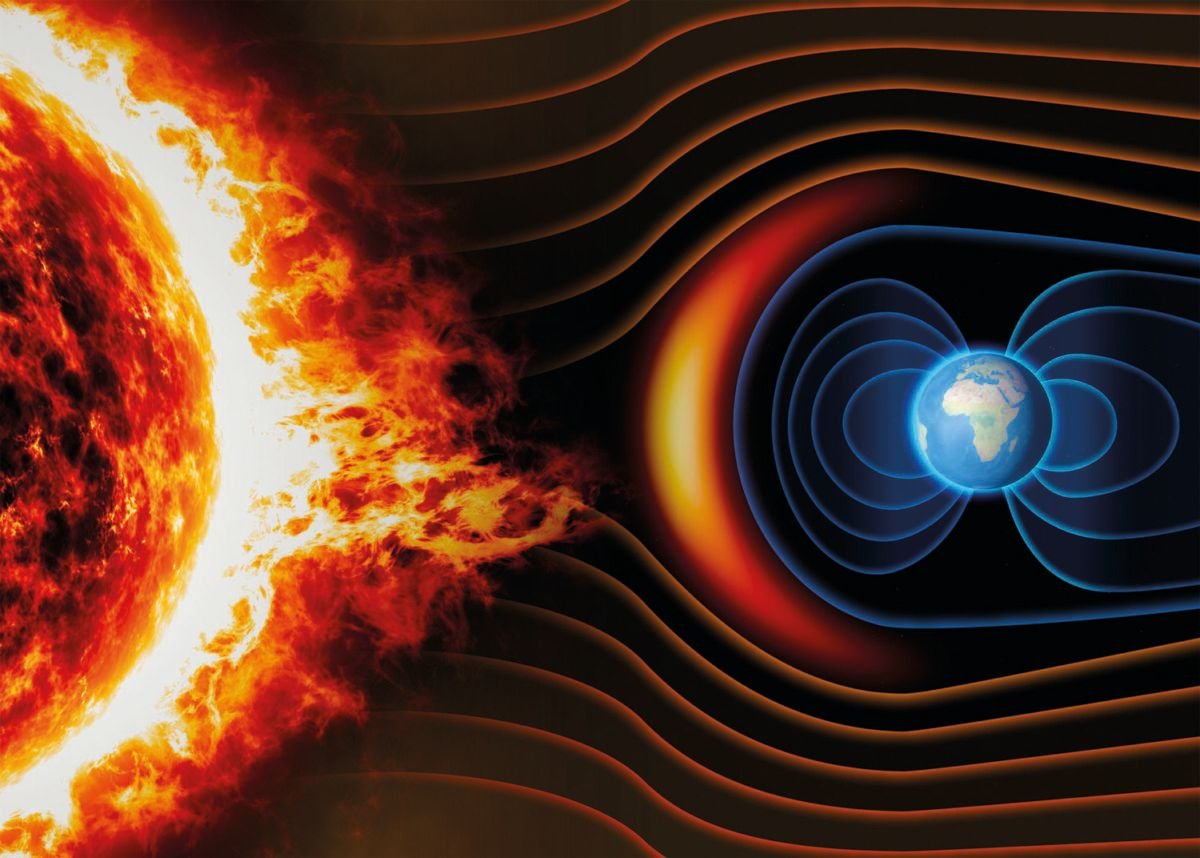
The Milky Way’s magnetic field is relatively weak compared to Earth’s, but on a galactic scale it plays an important role. It influences the movement of charged particles, shapes cosmic ray propagation, and affects the behavior of interstellar gas.
Magnetic fields can also influence star formation by resisting gravitational collapse in gas clouds.
The Milky Way’s magnetic field is complex, with large-scale structure and smaller turbulent regions.
Understanding galactic magnetic fields is difficult, but it is essential for a complete picture of how galaxies evolve.
The Milky Way is not just shaped by gravity. It is also shaped by electromagnetism, operating on vast scales.
The Milky Way’s Warped Disk
The Milky Way’s disk is not perfectly flat. It is warped, bending upward in some regions and downward in others.
This warp may be caused by gravitational interactions with satellite galaxies or by the influence of the dark matter halo.
Many spiral galaxies show warped disks, suggesting it is a common feature of galactic evolution.
The warp reminds us that the Milky Way is not a rigid object. It is flexible, shaped by interactions and gravitational tides.
Even our galaxy’s structure bears the marks of cosmic encounters.
The Fermi Bubbles: Giant Structures Above and Below the Center
Astronomers have discovered large bubble-like structures extending above and below the galactic center, visible in gamma rays and other wavelengths. These are often called the Fermi bubbles.
They may have been produced by past energetic activity in the galactic center, possibly from Sagittarius A* consuming matter or from intense star formation and supernovae.
These bubbles stretch tens of thousands of light-years and represent a dramatic event in the Milky Way’s recent history.
Their existence suggests the galactic center may have been more active in the past than it is today.
The Milky Way is not only shaped by slow rotation and gentle star formation. It has experienced bursts of violence and energy that leave scars across the galaxy.
The Milky Way’s Place in Cosmic Evolution
The Milky Way is not unique, but it is typical of large spiral galaxies.
Studying the Milky Way helps astronomers understand how galaxies form and evolve throughout the universe. Because we are inside it, we can observe its stars in great detail, including their ages, chemical compositions, and motions.
This makes the Milky Way a laboratory for understanding galaxy evolution.
The Milky Way also serves as a comparison point for other galaxies. By understanding our galaxy, we can better interpret observations of distant galaxies, which appear as small smudges of light even in powerful telescopes.
The Milky Way is both our home and our reference frame. It is the galaxy we know best, and through it we learn about all others.
Myths, Culture, and the Human Relationship With the Milky Way
Long before telescopes and astrophysics, the Milky Way shaped human imagination.
Different cultures gave it different meanings. Some saw it as a river, others as a road, others as a bridge between worlds. Many myths described it as the path of souls or the trace of divine events.
Even today, the Milky Way continues to inspire art, poetry, and philosophy. It represents mystery and belonging at the same time.
Modern science has not destroyed the Milky Way’s wonder. It has deepened it.
To know that the Milky Way is a spiral galaxy filled with hundreds of billions of stars does not make it less beautiful. It makes it more astonishing, because the truth is greater than the myth.
The Milky Way reminds us that humans are capable of understanding something vast, even while standing on a small planet.
It is a symbol of both our smallness and our intelligence.
The Milky Way and the Search for Extraterrestrial Life
The Milky Way is central to one of humanity’s biggest questions: Are we alone?
If planets are common, and if habitable environments exist, then it is possible that life exists elsewhere in the galaxy.
The Milky Way may contain microbial life, complex ecosystems, or even intelligent civilizations. We do not know.
Scientists search for life through multiple approaches. They study exoplanet atmospheres for chemical signatures. They search for radio signals that might indicate technology. They explore the possibility of life in our own solar system, such as on Mars or icy moons, which could suggest life is common.
The Milky Way is so large that even if intelligent life is rare, there could still be many civilizations spread across its stars.
But the vast distances make communication difficult. Even traveling at the speed of light, crossing the galaxy takes 100,000 years.
This leads to one of the deepest mysteries: the Fermi paradox. If intelligent life is possible and the galaxy is old, why do we not see clear evidence of it?
There may be many answers. Perhaps civilizations are rare. Perhaps they do not communicate. Perhaps they do not survive long. Perhaps we are not listening correctly.
The Milky Way is not just a physical structure. It is a stage where the drama of life may have played out many times.
We are still searching for the other voices, if they exist.
The Milky Way’s Ultimate Fate
The Milky Way will not remain the same forever.
In the distant future, it will merge with Andromeda. The resulting galaxy may become a large elliptical galaxy.
Star formation may eventually decline as gas is used up or heated, leaving a galaxy dominated by older stars and stellar remnants.
The Sun will also have its own fate. In about five billion years, it will expand into a red giant, altering or destroying the inner planets. Earth may become uninhabitable long before that.
But even as individual stars die, the galaxy will persist.
Over unimaginable time scales, galaxies may slowly evolve toward darkness as star formation ends and stars burn out.
Yet even then, the Milky Way’s matter will remain bound by gravity, drifting through space as a silent monument to cosmic history.
The Milky Way has existed for billions of years, and it will continue long after human civilization is gone.
It is an ancient structure, indifferent to our lives, yet somehow intimately connected to our existence.
Why the Milky Way Matters
It is easy to think of astronomy as distant and abstract. The Milky Way can seem like a topic for scientists and telescopes, not for everyday life.
But the Milky Way matters because it is our origin story.
The elements in your body were created in stars that lived and died inside the Milky Way. The Sun formed from galactic gas enriched by ancient supernovae. The Earth formed from the leftover material of star formation. Life emerged from chemistry made possible by heavy elements forged in stellar cores.
You are not separate from the galaxy. You are a part of it.
Understanding the Milky Way also changes perspective. It reminds us that our planet is one world among billions. It reminds us that borders, conflicts, and daily worries exist on a tiny speck of dust orbiting an average star in a spiral arm.
This is not meant to make human life feel meaningless. It can do the opposite. It can make life feel precious.
Because in a galaxy this vast, the fact that matter became conscious enough to understand itself is extraordinary.
The Milky Way is not just a galaxy. It is the environment that made us possible. It is our cosmic home, a swirling structure of light and gravity that has carried our solar system through space for billions of years.
When you look up at the Milky Way on a dark night, you are not just looking at stars. You are looking at history. You are looking at the birthplace of the atoms in your bones. You are looking at a vast rotating system that has been evolving since near the beginning of time.
And perhaps most of all, you are looking at a reminder that we live inside something far bigger than ourselves—something that still holds mysteries waiting to be discovered.